Iron Sights on Handguns: Sight Pictures, POA/POI, and Why Shooters Miss When They Switch Pistols
Iron sights are simple hardware. The misses happen because shooters don’t understand what their pistol is regulated to—and they keep using the wrong sight picture (hold) when they change firearms.
This scientific brief explains the three common sight pictures—center hold, combat hold, and 6 o’clock/target hold—and the mechanisms (vision science + human performance) that drive Point of Aim (POA) vs Point of Impact (POI) errors.
Abstract
Iron sights remain a foundational aiming system for handguns, yet a large share of “unexpected” misses are driven by a mismatch between sight picture (hold) and a pistol’s point-of-aim/point-of-impact (POA/POI) regulation. This article integrates findings from vision science (accommodation, depth-of-field, and alignment sensitivity), human performance research (postural balance, viewing time, and pressure effects), and applied marksmanship literature to explain center hold, combat hold, and 6 o’clock/target hold. Evidence indicates that focal behavior during pistol aiming commonly occurs near the front-sight region rather than at the distant target, while contextual visual factors can introduce systematic alignment bias. Under pressure and reduced viewing time, small inconsistencies are amplified into measurable performance decrements. The operational conclusion is direct: impacts move when the shooter’s visual reference changes, and firearm transitions routinely change that reference through sight geometry, regulation, and stability demands.
Keywords: handgun iron sights, sight picture, combat hold, 6 o’clock hold, point of aim, point of impact, accommodation, depth of field, marksmanship, pressure
Introduction
Iron sights are mechanically simple but perceptually demanding. A rear notch and a front post must be aligned consistently, then placed relative to a target. The most common failure point is not “not knowing what iron sights are,” but misunderstanding the relationship between the chosen sight picture and the pistol’s regulated POA/POI.
When shooters change handguns and begin missing, many blame trigger control, grip, or “the gun shoots left.” Those variables matter. But a frequent driver is more basic and more predictable: the shooter keeps the same perceived technique while the firearm’s required visual reference (sight picture + regulation) changes.
Visual Constraints in Iron-Sight Aiming
Accommodation and focal strategy
Human accommodation limits the ability to hold rear sight, front sight, and target in equal clarity simultaneously. Empirical measurement of focal distance during pistol sighting indicates focal behavior commonly occurs nearer the front-sight region than at the distant target (Ishigaki et al., 1995). The practical result is non-negotiable: iron-sight performance is built on stable front-sight referencing, not target sharpness.
Depth of field and “acceptable clarity”
Depth of field (DOF) varies across individuals and conditions and influences what appears “acceptably sharp” during aiming. Experimental work evaluating DOF in the accommodating eye demonstrates measurable ranges and variability, reinforcing that lighting and visual state can alter perceived alignment (López-Gil et al., 2014). When DOF is reduced (e.g., lower light), alignment precision often suffers because both sight edges and target cues become perceptually less stable.
Systematic alignment bias from visual context
Iron-sight aiming is an alignment task that can be influenced by contextual visual features. Controlled simulation research has shown systematic alignment errors can be affected by the proximity and placement of target marks relative to sight elements (Carkeet et al., 1996). In plain terms: two pistols with different sight geometries (notch width, post width, dot size, high-contrast outlines) can change what the shooter perceives as “centered,” even when the shooter believes alignment is identical.
Core Definitions: POA, POI, Sight Alignment, and Sight Picture
Point of Aim (POA) vs Point of Impact (POI)
POA is where the sights are referenced/placed on the target. POI is where rounds actually land (e.g., the center of a group). A pistol is effectively “regulated” when a specific sight picture at a specified distance with a specified ammunition profile yields a predictable impact location.
Sight alignment vs sight picture
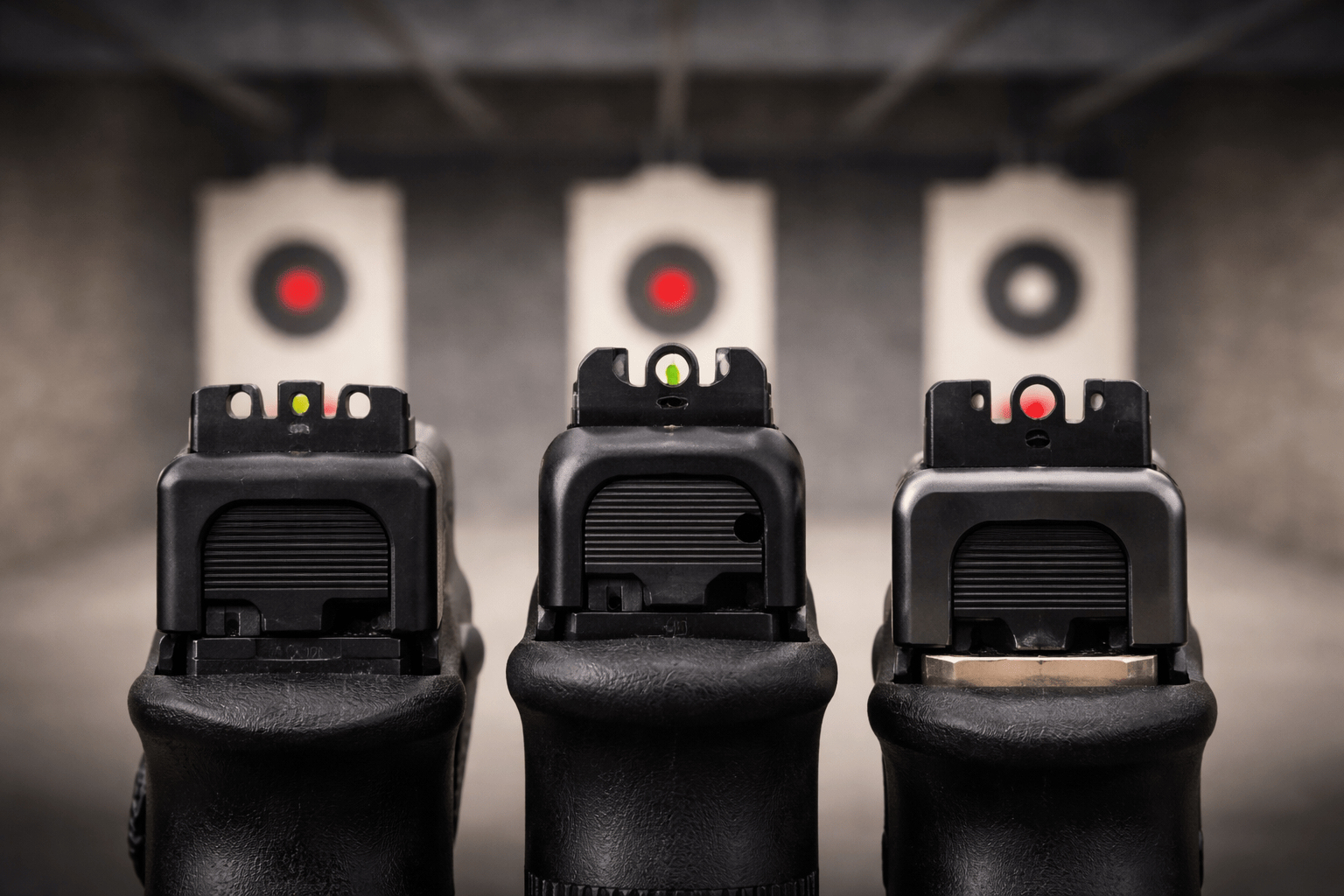
Sight alignment is the relationship between front and rear sights (equal height and equal light). Sight picture is where aligned sights are placed on the target. Correct alignment does not guarantee the intended POI if the sight picture is wrong for the pistol’s regulation.
The Three Common Sight Pictures (Holds) and Their Consequences
Note: Terminology varies across manufacturers and communities. These definitions are functional: they describe how the front sight is referenced to the target and how POA/POI behavior is typically observed.
Center hold
Definition: The front sight reference is placed at the intended strike point so POA and POI are expected to correspond when the pistol is regulated accordingly. This is intuitive and common for practical shooting where covering the intended impact point is acceptable.
Combat hold
Definition: A speed-oriented sight picture commonly placing the front sight (or front dot) over the intended impact zone to emphasize rapid indexing at realistic engagement distances. The defining attribute is acceptance of partial target occlusion for fast, repeatable confirmation. Whether impacts land exactly at the covered point depends on the pistol’s regulation and ammunition.
6 o’clock (target) hold
Definition: The front sight is held just below the aiming mark (a “lollipop”) to preserve full visibility of the bull. When regulated for this hold, POI should land in the bull while POA remains below it. If a shooter uses a center/combat hold on a pistol regulated for 6 o’clock aiming, impacts commonly shift—often vertically—because the visual reference has changed.
Why Shooters Miss When They Switch Handguns
This is where most shooters lie to themselves: “I’m doing the same thing.” No. You’re applying the same habits to a different visual system.
Regulation mismatch and sight geometry
Different pistols may be regulated for different sight pictures at different distances. Additionally, differences in sight height, notch width, post width, and contrast features can shift perceived centering and introduce consistent directional error (Carkeet et al., 1996).
Pressure and time limits amplify small errors
Marksmanship performance is negatively affected by pressure on average, although training that reflects threat context can mitigate some performance decrements (Cooper et al., 2022). Under real constraints, reduced time and increased arousal magnify small alignment and stability inconsistencies into misses.
Stability and viewing time constraints
Research comparing experienced and novice shooters indicates postural balance can be a major differentiator in pistol shooting accuracy, and optimal performance may occur within limited viewing time windows (Goonetilleke et al., 2009). Switching pistols can alter grip angle, recoil perception, and balance strategy enough to shift outcomes before the shooter even realizes it.
Practical Implications: What to Do (No Guessing)
- Validate your pistol’s POA/POI. Confirm which sight picture produces the intended POI with your carry/duty ammunition at relevant distances.
- Standardize focal priority. Evidence supports focal behavior nearer the front sight during pistol aiming (Ishigaki et al., 1995). Build consistency around that reality.
- Treat transitions as recalibration events. New pistol or new sights can shift perceived centering and systematic alignment bias (Carkeet et al., 1996).
- Pressure-proof the visual process. Pressure reliably degrades performance on average, but context-relevant training can offset some effects (Cooper et al., 2022).
Limitations
This article synthesizes peer-reviewed findings on visual and human performance mechanisms and applies them to handgun iron-sight use. However, POI is additionally influenced by ammunition characteristics, shooter biomechanics, and environmental conditions. These sources explain why errors happen and what amplifies them; each pistol must still be validated empirically for its specific POA/POI behavior.
Conclusion
Iron sights demand a stable visual reference. The shooter’s perceived “same technique” fails when the firearm’s regulation and sight geometry change the functional sight picture requirement. Vision science supports front-sight-centric focal behavior and demonstrates that contextual features can produce systematic alignment bias (Carkeet et al., 1996; Ishigaki et al., 1995; López-Gil et al., 2014). Human performance research supports the reality that pressure, reduced viewing time, and stability constraints amplify small inconsistencies into measurable misses (Cooper et al., 2022; Goonetilleke et al., 2009). The takeaway is direct: if you switch pistols and your hits move, your response should be recalibration and validation—not excuses.
References
- Carkeet, A., Brown, B., & Chan, P. (1996). Spatial interference with vertical pistol sight alignment. Ophthalmic and Physiological Optics, 16(2), 158–162. https://pubmed.ncbi.nlm.nih.gov/8762778/
- Cooper, D., Fuller, J., Wiggins, M. W., Wills, J. A., Main, L. C., & Doyle, T. (2022). Negative consequences of pressure on marksmanship may be offset by early training exposure to contextually relevant threat training: A systematic review and meta-analysis. Human Factors, 66(1), 294–311. https://pmc.ncbi.nlm.nih.gov/articles/PMC10756023/
- Goonetilleke, R. S., Hoffmann, E. R., & Lau, W. C. (2009). Pistol shooting accuracy as dependent on experience, eyes being opened and available viewing time. Applied Ergonomics, 40(3), 500–508. https://pubmed.ncbi.nlm.nih.gov/18992872/
- Ishigaki, H., Edagawa, H., & Miyao, M. (1995). On the focal distance of the eye during sighting in pistol shooting. Perceptual and Motor Skills, 81(1), 191–194. https://pubmed.ncbi.nlm.nih.gov/8532455/
- López-Gil, N., & colleagues. (2014). Depth-of-field of the accommodating eye. Optometry and Vision Science. https://pmc.ncbi.nlm.nih.gov/articles/PMC4461356/
- Simas, V., Schram, B., Canetti, E. F. D., Maupin, D., & Orr, R. (2022). Factors influencing marksmanship in police officers: A narrative review. International Journal of Environmental Research and Public Health, 19(21), 14236. https://pmc.ncbi.nlm.nih.gov/articles/PMC9655518/