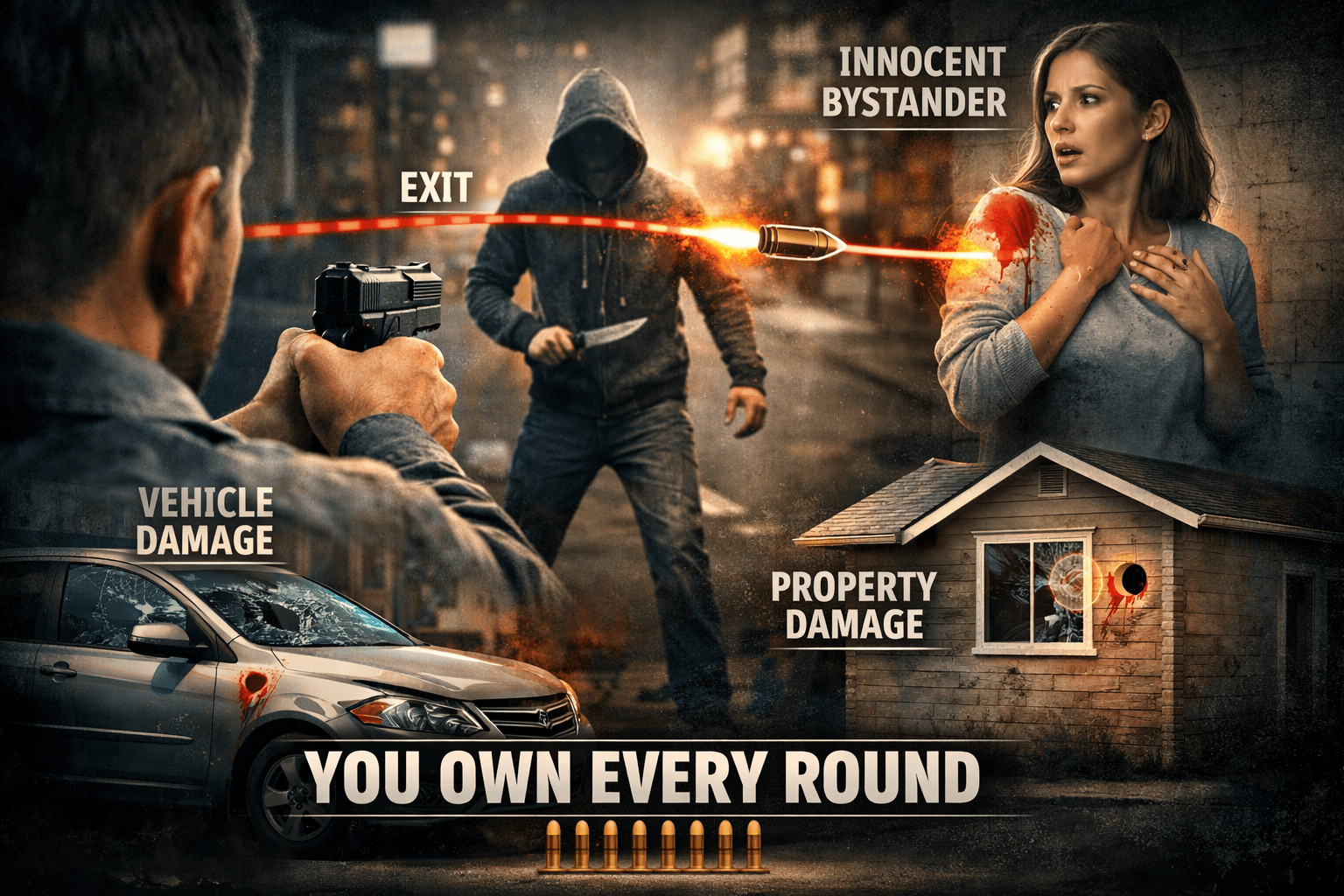
Florida Self-Defense Law + Forensic Science
You Own Every Round: Legal Liability for Misses, Over-Penetration, and Third-Party Harm in Florida Defensive Shootings
Self-defense may justify the decision to shoot. It does not erase the legal responsibility for where the projectile goes next. This paper-style brief explains criminal exposure, civil liability, and the ballistics behind through-and-through wounds and misses.
Key Takeaways (Florida)
- Self-defense is not a “bullet immunity” policy. If a round misses or exits and hits a bystander or property, the shooter can face criminal (recklessness/negligence) and civil (negligence/damages) consequences.
- Florida provides statutory immunity for justifiable force under Chapter 776, but immunity disputes often focus on whether the conduct was permitted and whether the shooter acted reasonably in context.
- Ballistics matters in court. Through-and-through wounds occur in forensic datasets and can create a second impact path that courts evaluate through foreseeability and reasonableness.
Abstract
Defensive shootings are assessed in two parallel systems: criminal law (state action) and civil law (private lawsuits).
Even when deadly force is legally justified, the shooter’s exposure often turns on whether they acted with reasonable care or with criminal negligence/recklessness
when a projectile misses or exits the intended target and injures an uninvolved person or damages property.
This brief summarizes Florida’s statutory framework and synthesizes available forensic/medical literature on projectile exit/retention, emphasizing that “exit-rate” claims are highly context-dependent.
1. The Principle: The Shooter Owns the Trigger Press
From a legal standpoint, the core issue is not philosophical—it is predictable doctrine: when you pull the trigger, you create a foreseeable risk to anyone and anything downrange.
A defender may be justified in firing at an assailant, yet still be held responsible if their conduct was negligent or reckless in relation to bystanders and property.
Courts have long treated bystander injury during defensive gunfire as a negligence question under the circumstances rather than an automatic “no liability” outcome.
2. Criminal Exposure vs. Civil Liability
2.1 Criminal exposure (State prosecution)
In many jurisdictions, the legal logic is straightforward: justification may excuse the intentional use of force against the attacker,
but it does not necessarily excuse reckless conduct that endangers others.
When a bystander is struck, prosecutors often evaluate whether the shooter’s actions were reasonable under stress or crossed into recklessness/negligence.
Where recklessness is proven, courts have recognized the viability of lesser charges (for example, involuntary manslaughter theories) even if murder is not supported.
2.2 Civil liability (private lawsuit)
Civil cases typically focus on negligence: duty of reasonable care, breach, causation, and damages.
A bystander injury or property strike tends to trigger questions a jury understands immediately:
Was the shot selection reasonable? Was there a safe backdrop? Were innocents clearly present? Was firing necessary at that instant?
3. Florida Framework: Chapter 776 and Immunity
Florida Statute § 776.032 provides immunity from criminal prosecution and civil action for the use or threatened use of force
when the force is permitted under Florida’s self-defense statutes (including, as applicable, §§ 776.012, 776.013, and 776.031).
This is a major procedural protection in Florida—but it is not a blank check for unsafe gunfire.
In contested cases involving third-party harm, litigation often centers on whether the specific conduct qualified as “permitted”
and whether the defender’s actions were reasonable rather than negligent or reckless.
4. Misses and Over-Penetration: Why the Second Impact Matters
4.1 Misses
A missed round is legally dangerous because it looks less like controlled defensive force and more like uncontrolled risk creation.
When the projectile strikes an uninvolved person, prosecutors and plaintiffs’ lawyers frequently frame the conduct as reckless or negligent:
firing without adequate regard for backdrop, angle, or the presence of noncombatants.
4.2 Through-and-through (exit wounds)
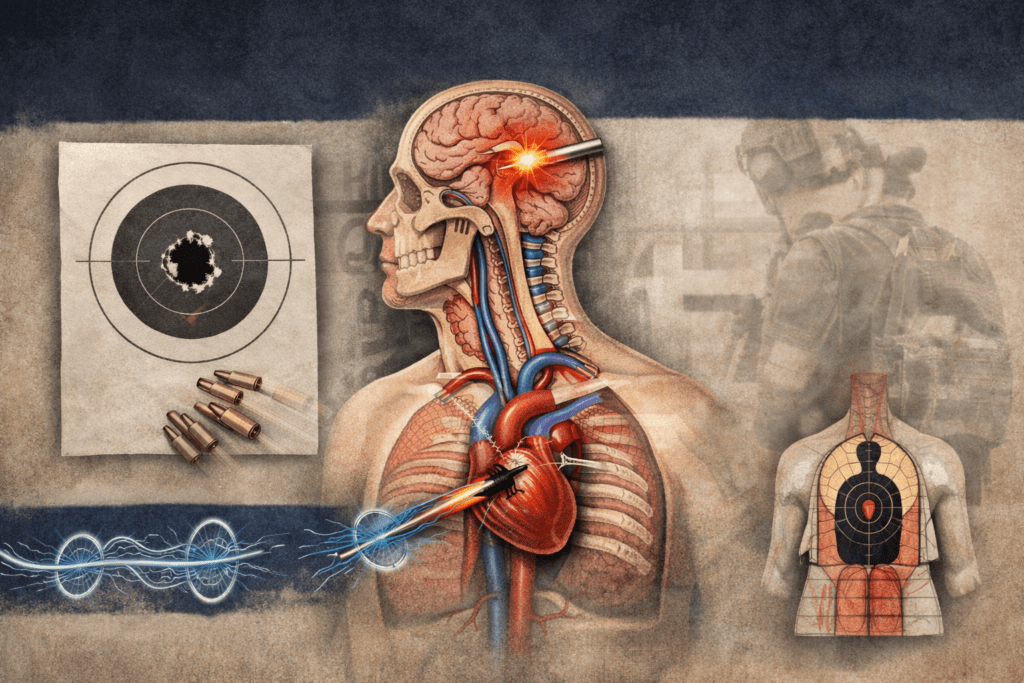
Through-and-through wounds are a documented outcome in forensic datasets.
Once a projectile exits, it can travel far enough to injure others or damage property, creating a second, independent harm pathway.
Medical ballistics literature notes that exit wounds are more likely with non-deforming projectiles, sufficient velocity/energy,
and tissue tracks that do not consume the projectile’s energy—especially when the path is relatively thin or avoids dense bone.
5. Scientific Evidence: How Often Do Bullets Exit?
There is no single universal percentage for “how often a defensive handgun round exits a body.” Exit likelihood varies by ammunition design,
impact velocity, angle of entry, anatomical track, intervening barriers, and whether bone is struck.
However, context-specific forensic studies provide bounded estimates that illustrate a key point:
exits are common in some datasets, while retained bullets/fragments are common in others.
5.1 Autopsy series (handgun fatalities)
In a retrospective review of handgun autopsies (2010–2020), the authors reported 151 entrance wounds,
with 98 complete wounds (entrance + exit) and 52 non-penetrating (retained), plus one graze wound.
In that dataset, the through-and-through rate by wound count is approximately 64.9% (98/151).
This is informative, but it is not a direct proxy for civilian defensive torso hits because fatality samples and wound distributions (including head wounds) can skew exit rates.
5.2 Fatal firearm deaths (another context)
A separate fatality study reported exit wounds present in 73.33% of victims (66/90). As with all fatality datasets,
weapon types, ammunition, and anatomical tracks can differ substantially from self-defense encounters.
5.3 Nonfatal injury samples: retained fragments are common
In a trauma registry study of gunshot admissions, most nonfatal patients had retained bullet fragments:
among nonfatal admissions, 75.5% had an RBF (retained bullet fragment). This reinforces the scientific reality:
retention and exit are both common outcomes, depending on variables that cannot be collapsed into one “universal” defensive-shooting percentage.
6. Liability Logic Courts Understand: Reasonableness Under Stress
When a third party is struck, courts and juries typically return to the same questions:
foreseeability and reasonableness.
A classic formulation in case law holds that a person acting in self-defense is not liable for accidental injury to a bystander
if the defender was not negligent—but whether the conduct was negligent is typically fact-driven.
Conclusion
Florida law recognizes justifiable force and provides meaningful immunity mechanisms.
But self-defense does not change physics: rounds miss, bullets exit, and collateral harm can occur.
The legal risk is shaped by whether the shooter acted with reasonable care versus negligence or recklessness.
Forensic and medical literature supports a disciplined conclusion:
you cannot assume the projectile will stop where you want it to stop,
and courts will evaluate what was foreseeable and what was reasonable based on the totality of the circumstances.
References
-
Florida Legislature. Fla. Stat. § 776.032 — Immunity from criminal prosecution and civil action for justifiable use or threatened use of force (2025).
Florida Statutes Online. Retrieved 2026-02-10.
https://www.leg.state.fl.us/Statutes/…/0776.032.html -
Florida Senate. Chapter 776, Florida Statutes (2025). Retrieved 2026-02-10.
https://www.flsenate.gov/Laws/Statutes/2025/Chapter776/All -
Cook v. Hunt, 69 P.2d 846 (Okla. 1936). Ordinarily one shooting at felon/assailant not liable for injury to bystander if not guilty of negligence.
Justia. Retrieved 2026-02-10.
https://law.justia.com/cases/…/23460.html -
Baum, G. R., & DiMaio, V. J. M. (2022). Gunshot wounds: Ballistics, pathology, and treatment. (Review).
https://pmc.ncbi.nlm.nih.gov/articles/PMC9462949/ -
Pipatchotitham, T., et al. (2022). The prevalence of exit gunshot wound shapes and the related factors. (Autopsy review of handgun deaths, 2010–2020).
Asian Medical Journal and Alternative Medicine.
https://asianmedjam.com/index.php/amjam/article/view/259 -
Jena, S., et al. (2023). Critical analysis of firearm wound characteristics in fatal firearm deaths (exit wounds reported in 66/90 cases).
European Journal of Medical and Health Sciences.
https://eu-opensci.org/index.php/ejmed/article/view/41871 -
Nee, N., et al. (2021). Retained bullet fragments after nonfatal gunshot wounds: Epidemiology and outcomes. PubMed.
https://pubmed.ncbi.nlm.nih.gov/33496545/
Disclaimer: Educational content only; not legal advice. For case-specific guidance, consult a Florida-licensed attorney.