the Real Legal Line, and the Consequences
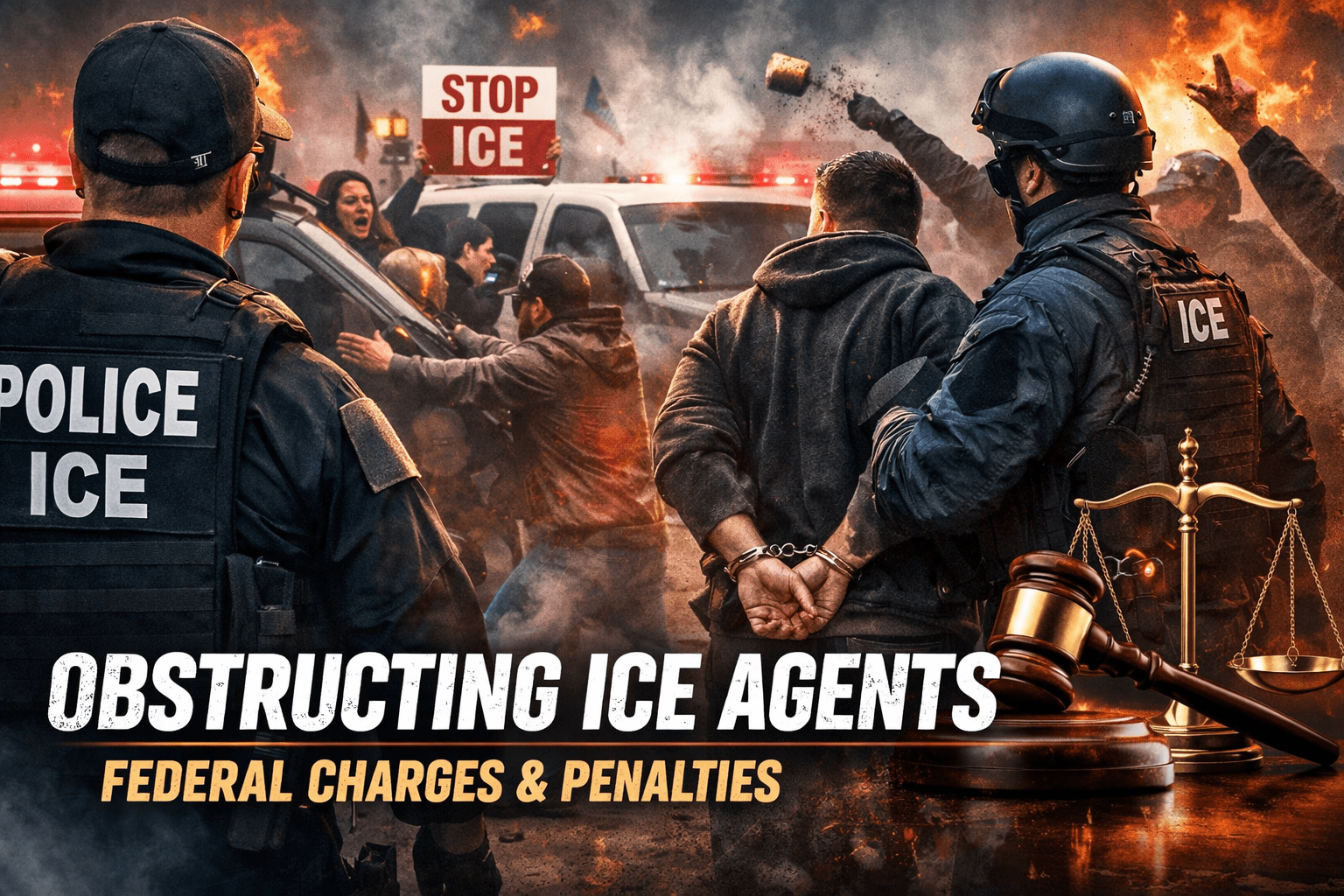
Peaceful protest is protected. Physically interfering with ICE (or any federal officer) performing an arrest, transport, search, or detention operation is not. When a crowd crosses from speech into force, intimidation, or physical obstruction, the case can escalate fast—from a misdemeanor to a felony carrying years (or decades) in federal prison.
This article breaks down the federal statutes most commonly used in protest/ICE-operation settings, what “blocking law enforcement” looks like in the eyes of federal prosecutors, and the fine + jail exposure that follows.
The legal reality: speech is protected—physical interference is prosecutable
You can film, chant, hold signs, criticize, and organize. What triggers criminal exposure is conduct: pushing, grabbing, surrounding vehicles, blocking exits, throwing objects, or using threats/menacing actions that create a reasonable fear of harm.
The federal government’s workhorse statute here is 18 U.S.C. § 111—assaulting, resisting, or impeding certain officers:
https://www.law.cornell.edu/uscode/text/18/111
The #1 charge in ICE-interference cases: 18 U.S.C. § 111
What the government must prove (in plain English)
Under 18 U.S.C. § 111, it is a crime to forcibly assault, resist, oppose, impede, intimidate, or interfere with a covered federal officer while they perform official duties:
https://www.law.cornell.edu/uscode/text/18/111
Two points matter in protest/ICE operations:
- “Forcibly” is the pivot. DOJ guidance emphasizes that force is essential, and a threat can qualify when it reasonably causes the officer to anticipate harm—especially when paired with aggressive movement or apparent ability to carry it out:
https://www.justice.gov/archives/jm/criminal-resource-manual-1565-forcible-act-required-18-usc-111-application-statute-threats - ICE personnel are federal employees. § 111 applies to officers designated in 18 U.S.C. § 1114, which broadly protects federal officers and employees while engaged in official duties:
https://uscode.house.gov/view.xhtml?edition=prelim&num=0&req=granuleid%3AUSC-prelim-title18-section1114
Penalty tiers (jail time that actually shows up in federal indictments)
Under § 111:
https://www.law.cornell.edu/uscode/text/18/111
- Simple assault: up to 1 year (misdemeanor)
- Physical contact or intent to commit another felony: up to 8 years (felony)
- Deadly/dangerous weapon or bodily injury: up to 20 years (felony)
Translation: In protest settings, the moment someone makes physical contact—shoving, grabbing, pulling an officer, yanking a door, striking a hand/arm, trying to “un-cuff” a detainee—this can jump to felony territory.
What “blocking ICE” looks like to federal prosecutors
These are common fact patterns that routinely get charged under § 111 (depending on force level and evidence):
- Surrounding an ICE vehicle so it cannot leave, then striking/rocking the vehicle or grabbing door handles while officers try to move.
- Forming a physical human barrier at a gate/driveway and refusing to disperse while officers are actively moving a detainee.
- Rushing an arrest team and forcing officers to redirect attention/resources to safety and crowd control.
- Throwing objects (even “small” items) that cause officers to flinch, retreat, or take cover.
- Threats paired with movement: stepping in aggressively, closing distance, and communicating violence in a way that creates a reasonable fear of immediate harm. DOJ specifically addresses threats as capable of meeting the “forcible” requirement depending on context:
https://www.justice.gov/archives/jm/criminal-resource-manual-1565-forcible-act-required-18-usc-111-application-statute-threats
“Civil disorder” exposure: 18 U.S.C. § 231(a)(3)
When protests turn into civil disorder and someone obstructs law enforcement during that disorder, prosecutors may add 18 U.S.C. § 231(a)(3) (obstructing law enforcement during civil disorder).
U.S. Code (House) reference:
https://uscode.house.gov/view.xhtml?edition=prelim&num=0&req=granuleid%3AUSC-prelim-title18-section231
A DOJ charging example showing § 231(a)(3) charged alongside § 111 in an operational setting:
https://www.justice.gov/usao-mn/pr/st-paul-woman-charged-assaulting-law-enforcement-officers-during-lake-street-narcotics
Bottom line: If the setting is volatile, chaotic, and violent or near-violent, § 231(a)(3) becomes a common “enhancer” charge.
Conspiracy: the multiplier that turns group activity into felony time
Two conspiracy statutes matter most:
18 U.S.C. § 372 — Conspiracy to impede or injure an officer
If two or more persons conspire to impede an officer by force, intimidation, or threat, § 372 carries up to 6 years:
https://www.law.cornell.edu/uscode/text/18/372
18 U.S.C. § 371 — Conspiracy to commit an offense or defraud the U.S.
§ 371 is frequently used when people coordinate to obstruct lawful government functions:
https://www.law.cornell.edu/uscode/text/18/371
DOJ manual on § 371 (impairing lawful functions):
https://www.justice.gov/archives/jm/criminal-resource-manual-923-18-usc-371-conspiracy-defraud-us
Protest/ICE example (what prosecutors argue): “We’re going to meet at X, track vehicles, and physically stop transport.” The government looks for group chats, coordinated roles, equipment intended for obstruction, and timing + movements consistent with a plan.
Harboring and “helping someone evade ICE”: 18 U.S.C. § 1071
If a person harbors or conceals someone knowing a federal warrant or process has been issued, to prevent discovery/arrest, that’s 18 U.S.C. § 1071:
https://www.law.cornell.edu/uscode/text/18/1071
Penalties:
- Up to 1 year (baseline)
- Up to 5 years if the warrant/process relates to a felony (or after conviction)
Destroying evidence or giving “tip-offs” about ICE activity: 18 U.S.C. § 2232 and related statutes
18 U.S.C. § 2232 — Preventing seizure / tip-offs
§ 2232 criminalizes destroying/removing property to prevent seizure and also includes giving advance notice of a search/seizure to prevent lawful seizure/securement. Penalty: up to 5 years:
https://www.law.cornell.edu/uscode/text/18/2232
18 U.S.C. § 1519 — Destroying/altering records in federal matters
If people delete, wipe, or falsify records to obstruct a federal matter, § 1519 can carry up to 20 years:
https://www.law.cornell.edu/uscode/text/18/1519
Witness tampering & intimidation: 18 U.S.C. § 1512
If someone uses intimidation, threats, or corrupt persuasion to prevent communication to federal law enforcement, § 1512 can trigger serious exposure—up to 20–30 years depending on conduct:
https://www.law.cornell.edu/uscode/text/18/1512
Fine exposure: “fined under this title” is not nothing (18 U.S.C. § 3571)
Many of these statutes say “fined under this title.” That typically points to 18 U.S.C. § 3571 fine limits:
https://www.law.cornell.edu/uscode/text/18/3571
General caps for individuals:
- Felony: up to $250,000
- Class A misdemeanor: up to $100,000
U.S. Code (House) consolidated fine provisions:
https://uscode.house.gov/view.xhtml?edition=prelim&path=%2Fprelim%40title18%2Fpart2%2Fchapter227%2FsubchapterC
Practical note: Federal sentencing also commonly includes supervised release, restitution (when applicable), and conditions that can permanently affect employment, firearms rights, travel, and licensing—even where prison time is not extreme.
Real-world charging examples (DOJ press releases)
These are not hypotheticals—DOJ regularly files § 111 and related counts involving immigration enforcement contexts:
- Federal indictment alleging assault on ICE deportation officers at an ICE facility in San Jose (charged under § 111):
https://www.justice.gov/usao-ndca/pr/nicaraguan-national-indicted-charges-assaulting-three-deportation-officers-ice - Mexican national charged with assault on federal officer and destruction of government property:
https://www.justice.gov/usao-sdca/pr/mexican-national-charged-assault-federal-officer-and-destruction-government-property - Obstruction during civil disorder charged alongside officer interference in an operational setting:
https://www.justice.gov/usao-mn/pr/st-paul-woman-charged-assaulting-law-enforcement-officers-during-lake-street-narcotics
The “line” protesters must understand: where lawful protest ends and federal felonies begin
Lawful (generally)
- Chanting, signs, speeches, filming from a lawful distance
- Peaceful assembly without physically obstructing officer movement
Unlawful exposure (common ICE-operation transgressions)
- Physical barriers that prevent officers from moving a detainee or operating a vehicle
- Surrounding vehicles with the intent to immobilize them
- Interfering with handcuffing/transport (touching officers or detainee during arrest/escort)
- Threats + advancing movement that creates a reasonable fear of immediate harm:
https://www.justice.gov/archives/jm/criminal-resource-manual-1565-forcible-act-required-18-usc-111-application-statute-threats - Organized, force-based obstruction planned in advance (conspiracy risk):
https://www.law.cornell.edu/uscode/text/18/372
If your conduct forces officers to stop the mission to manage you, you have crossed into the zone prosecutors describe as “impeding” or “interfering.”
FAQ
Can you be charged if you never touched an officer?
Yes—if prosecutors can prove forcible interference (including certain threats in context) under § 111:
https://www.law.cornell.edu/uscode/text/18/111
Is “just blocking a van” serious?
It can be. If officers are actively performing duties and the obstruction is force-based (physical barricade, mobbing the vehicle, grabbing doors), it can lead to felony exposure under § 111 and potentially additional charges depending on circumstances:
https://www.law.cornell.edu/uscode/text/18/111
What’s the biggest mistake people make in these situations?
Assuming protest protections cover physical interference. They do not. Speech is protected; force and obstruction of official duties are where federal cases get built:
https://www.law.cornell.edu/uscode/text/18/111
Statutes & official references
- 18 U.S.C. § 111 (Assaulting/resisting/impeding federal officers): https://www.law.cornell.edu/uscode/text/18/111
- 18 U.S.C. § 1114 (Protected federal officers/employees): https://uscode.house.gov/view.xhtml?edition=prelim&num=0&req=granuleid%3AUSC-prelim-title18-section1114
- DOJ CRM (Force/threats under § 111): https://www.justice.gov/archives/jm/criminal-resource-manual-1565-forcible-act-required-18-usc-111-application-statute-threats
- 18 U.S.C. § 231 (Civil disorders): https://uscode.house.gov/view.xhtml?edition=prelim&num=0&req=granuleid%3AUSC-prelim-title18-section231
- 18 U.S.C. § 2101 (Anti-Riot Act): https://www.law.cornell.edu/uscode/text/18/2101
- 18 U.S.C. § 372 (Conspiracy to impede/injure an officer): https://www.law.cornell.edu/uscode/text/18/372
- 18 U.S.C. § 371 (Conspiracy / defraud the U.S.): https://www.law.cornell.edu/uscode/text/18/371
- DOJ CRM on § 371: https://www.justice.gov/archives/jm/criminal-resource-manual-923-18-usc-371-conspiracy-defraud-us
- 18 U.S.C. § 1071 (Concealing person from arrest): https://www.law.cornell.edu/uscode/text/18/1071
- DOJ CRM on § 1071: https://www.justice.gov/archives/jm/criminal-resource-manual-1831-harboring-18-usc-1071-third-element-concealing
- 18 U.S.C. § 2232 (Preventing seizure / tip-offs): https://www.law.cornell.edu/uscode/text/18/2232
- 18 U.S.C. § 1519 (Destruction of records): https://www.law.cornell.edu/uscode/text/18/1519
- 18 U.S.C. § 1512 (Witness tampering): https://www.law.cornell.edu/uscode/text/18/1512
- 18 U.S.C. § 3571 (Federal fines): https://www.law.cornell.edu/uscode/text/18/3571
- U.S. Code (House) fine provisions: https://uscode.house.gov/view.xhtml?edition=prelim&path=%2Fprelim%40title18%2Fpart2%2Fchapter227%2FsubchapterC