Neurovisual and Photobiological Analysis of Light Utilization in Defensive Encounters
Abstract
Human performance in defensive encounters is critically dependent on visual perception, which is governed by complex neurophysiological and photobiological mechanisms. This manuscript examines the anatomy of the human visual system, the functional roles of rods, cones, and the photopigment rhodopsin, and the neurocognitive consequences of acute light exposure under stress. The physics of illumination—luminance, beam geometry, and contrast—is analyzed within a tactical framework, including the defensive application of handheld and weapon-mounted light. The operational concept of the “wall of light” is evaluated as a means of perceptual dominance, target discrimination, and threat management in both scotopic and photopic environments. Findings are synthesized into a training model for modern defensive doctrine.
1. Introduction
Vision dominates human sensory input, contributing the majority of information used for navigation, threat detection, and decision-making in dynamic environments (Goldstein, 2014). During defensive encounters, visual processing becomes the primary interface between the external environment and the central nervous system. Consequently, light is not merely an illumination tool but a neurophysiological control variable capable of influencing perception, cognition, and motor behavior.
2. Anatomy and Physiology of Human Vision
2.1 Optical Pathway and Retinal Architecture
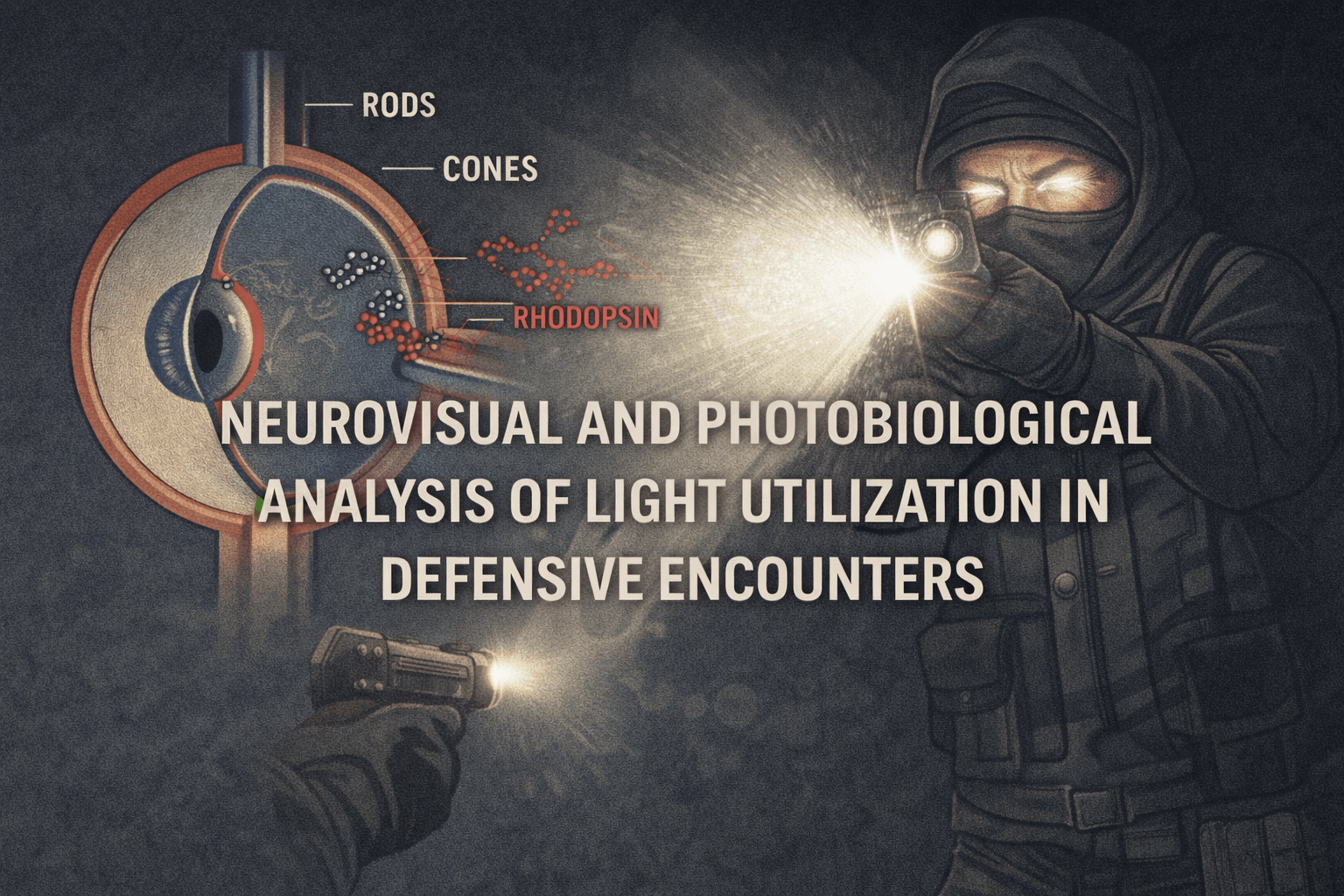
Photons enter the eye through the cornea, traverse the aqueous humor, pupil, and crystalline lens, and are focused on the retina, where phototransduction occurs. The retina contains approximately 120 million rods and 6–7 million cones, distributed non-uniformly across the retinal surface (Kolb, Fernandez, & Nelson, 2020).
-
Cones, concentrated in the fovea, mediate photopic (daylight) vision, color discrimination, and high spatial acuity.
-
Rods, prevalent in the peripheral retina, mediate scotopic (low-light) vision and motion detection.
2.2 Rhodopsin and Dark Adaptation
Rods contain the photopigment rhodopsin, which undergoes photochemical bleaching when exposed to light. Following intense illumination, rhodopsin regeneration requires approximately 20–40 minutes, during which scotopic sensitivity is markedly reduced (Lamb & Pugh, 2004). This delay in pigment regeneration produces functional night blindness and creates a pronounced vulnerability during low-light confrontations.
3. Photonic Influence on Neurological Function
Acute exposure to high-intensity light activates the pupillary light reflex, mediated by the optic nerve and midbrain pretectal nuclei, resulting in rapid pupillary constriction (Loewenfeld, 1999). Concomitantly, intense luminance induces retinal bleaching and disrupts cortical processing, degrading:
-
Visual acuity
-
Depth perception
-
Motion tracking
-
Vestibulo-ocular coordination
-
Cognitive processing speed
Under stress, these effects are magnified by sympathetic nervous system activation, further impairing perceptual-motor integration (LeDoux & Pine, 2016).
4. Tactical Application of Light in Defensive Encounters
4.1 Handheld vs. Weapon-Mounted Light Systems
Handheld lights permit independent illumination and non-lethal search functions but occupy one hand. Weapon-mounted lights allow one-handed firearm operation and align illumination with muzzle direction but require that anything illuminated be covered by the weapon. Each system presents distinct biomechanical and legal considerations for defensive use.
4.2 Strobe vs. Constant Illumination
While strobing light can induce disorientation, experimental data indicate that continuous high-intensity illumination provides superior target identification and cognitive dominance, whereas stroboscopic flicker may impair both subject and defender perception (Wilkins, Veitch, & Lehman, 2010).
5. Physics of the “Wall of Light”
The “wall of light” is produced by projecting a high-luminance, focused beam toward the adversary’s eyes, generating extreme contrast between illuminated target and darkened surroundings. This configuration:
-
Overloads rod-mediated scotopic vision
-
Silhouettes the subject
-
Preserves defender visual function through controlled beam management
The photometric dominance of the beam disrupts spatial orientation and reaction timing, providing opportunity for disengagement or tactical repositioning (Boyce, 2014).
6. Light as a Force Multiplier in Day and Night Conditions
Even in photopic environments, high-contrast focal illumination disrupts visual accommodation and saccadic eye movements, producing transient perceptual hesitation and degraded situational awareness (Wolfe et al., 2011). Thus, light remains an effective defensive tool in both low- and high-ambient illumination.
7. Conclusions
Light functions as a neurophysiological force multiplier in defensive encounters. Through its effects on retinal photochemistry, neural processing, and perceptual-motor coordination, controlled illumination alters the balance of situational control without reliance on lethal force. When integrated with modern training doctrine, defensive lighting becomes one of the most powerful non-lethal tools available for threat management and survival.
References
Boyce, P. R. (2014). Human factors in lighting (3rd ed.). CRC Press.
Goldstein, E. B. (2014). Sensation and perception (9th ed.). Cengage Learning.
Kolb, H., Fernandez, E., & Nelson, R. (2020). Webvision: The organization of the retina and visual system. University of Utah Health Sciences Center. https://webvision.med.utah.edu
Lamb, T. D., & Pugh, E. N. (2004). Dark adaptation and the retinoid cycle of vision. Progress in Retinal and Eye Research, 23(3), 307–380. https://doi.org/10.1016/j.preteyeres.2004.03.001
LeDoux, J. E., & Pine, D. S. (2016). Using neuroscience to help understand fear and anxiety. Nature Reviews Neuroscience, 17(7), 404–413. https://doi.org/10.1038/nrn.2016.72
Loewenfeld, I. E. (1999). The pupil: Anatomy, physiology, and clinical applications. Butterworth-Heinemann.
Wilkins, A. J., Veitch, J. A., & Lehman, B. (2010). LED lighting flicker and potential health concerns. IEEE Energy Conversion Congress and Exposition. https://doi.org/10.1109/ECCE.2010.5618050
Wolfe, J. M., Kluender, K. R., Levi, D. M., et al. (2011). Sensation and perception (3rd ed.). Sinauer Associates.