The Physiology of Adrenaline in Defensive Encounters
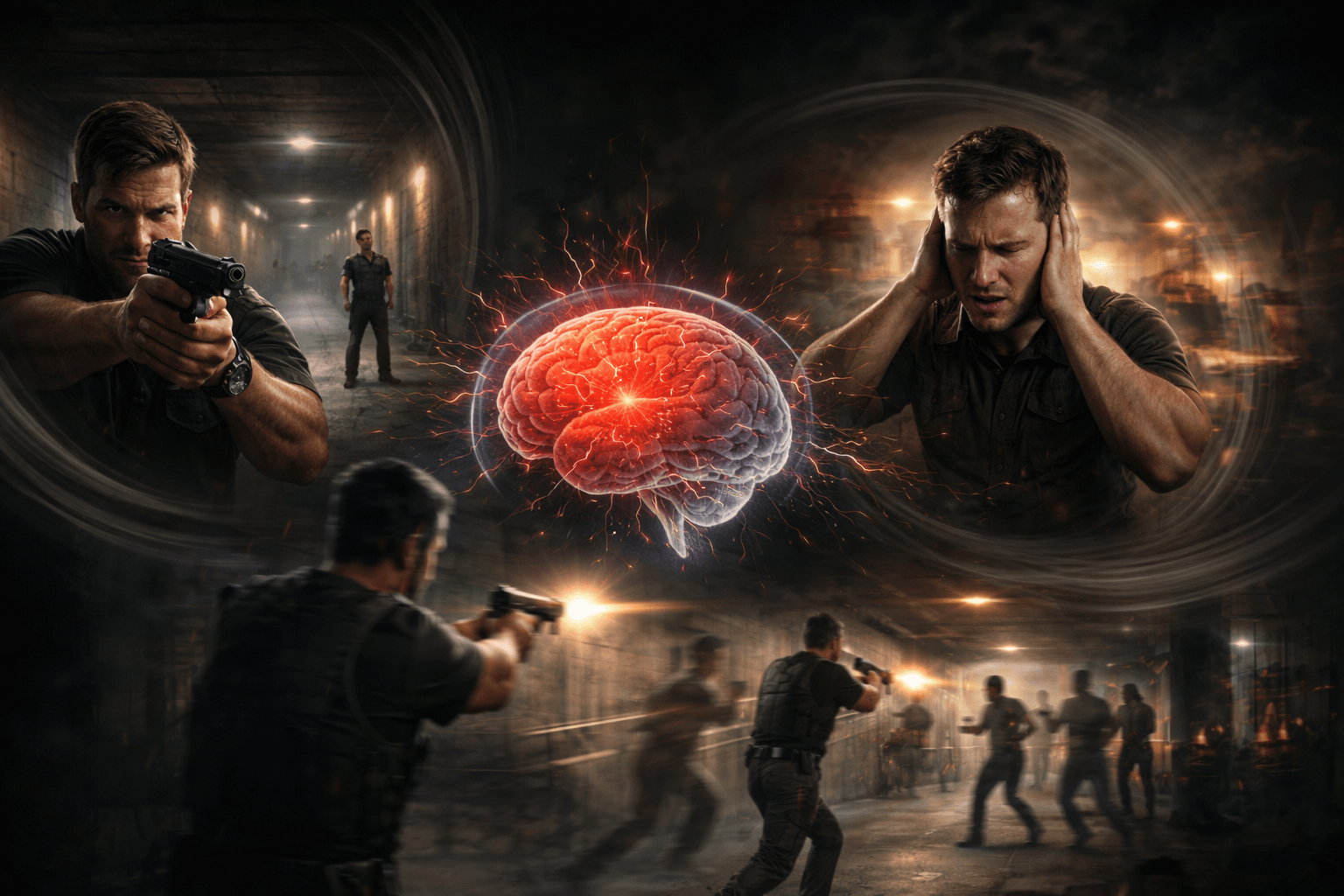
Tunnel vision, auditory exclusion, and time distortion—how the body alters perception during threat events,
why it degrades performance, and why Force-on-Force training is the corrective layer for
physiological stress gunfight realities.
see, what you hear, and how time feels, which directly impacts decision-making and accuracy.
This is the core of fight or flight shooting effects.
The Survival Switch: What “Fight-or-Flight” Really Does
In threat events, the brain rapidly shifts into a high-arousal state designed to improve survival. This shift reallocates attention and resources,
prioritizing speed, threat detection, and physical readiness. The tradeoff is that precision perception and fine motor control often degrade—especially
when the threat is close, fast, ambiguous, or moving.
Reviews of lethal-force events consistently describe multiple sensory distortions occurring during a single incident, often changing as the encounter unfolds.1
Adrenaline Tunnel Vision Shooting: Why Your Visual World Shrinks
What tunnel vision is (physiologically)
Tunnel vision is not the eyes failing—it is attention narrowing. Under adrenaline, the brain filters information aggressively
to focus on what it believes is the most immediate threat cue. In NIJ-published findings, officers reported “tunnel” vision in a substantial
portion of lethal-force events.1
Why tunnel vision is dangerous in defensive shooting
When attention narrows, you can miss critical information that determines legal, tactical, and ethical outcomes:
- hands moving to (or away from) a weapon
- additional threats entering from the flank
- innocents/bystanders near the line of fire
- cover, exits, and better angles
The marksmanship cost
Tunnel vision also degrades the “sighting loop.” Under stress, a shooter may lock onto the threat and stop confirming alignment, accept a lower
aiming standard than intended, and fire because urgency feels absolute—not because the shot is confirmed. That is the practical meaning of
adrenaline tunnel vision shooting.
Fight or Flight Shooting Effects: Auditory Exclusion and “Muted Reality”
What auditory exclusion is
Auditory exclusion is reduced perception of sound during extreme stress—gunfire may seem muffled or distant, or appear absent from memory.
NIJ findings report diminished sound as a commonly experienced distortion in lethal-force events.1
Why it matters tactically
Auditory exclusion can alter the way you process commands, movement cues, and timing. It can also distort recall afterward—an important issue because
investigators and the public often expect “perfect memory” from a system that is biologically optimized for survival, not recording.
Physiological Stress Gunfight: Time Distortion and “Everything Happened at Once”
Fast motion and slow motion
Many people report time behaving strangely during threat events—compressed (“it happened instantly”) or expanded (“slow motion”).
NIJ findings reflect both forms of time distortion occurring in lethal-force incidents.1
of a physiological stress gunfight.
When time feels compressed, shooters may fire too quickly for their visual standard, fail to reassess changes in threat behavior, and miss opportunities to disengage.
Memory and Perception: Why After-Action Recall Can Be Unreliable
Professional literature repeatedly notes that perceptual and memory distortions are common in shootings and high-threat incidents. Artwohl’s work highlights why
expecting perfectly accurate recall after a shooting is not realistic, given how stress affects perception and memory encoding.2
The FBI Law Enforcement Bulletin has also discussed how stress and other factors influence officer memory after shootings, including the investigative impact
of inconsistencies that may reflect variance rather than deception.3
For responsible civilians, the same physiology applies—even if the tactical and legal contexts differ.
The Performance Equation: Why Perception Drives Accuracy
Defensive performance is not only a trigger-control problem. It is a perception + decision + mechanics problem. When adrenaline narrows vision,
blunts hearing, and distorts time:
- threat cues may be processed late or incorrectly
- opportunities to disengage may be missed
- shots may be fired faster than confirmation allows
- angles and background risk may be mismanaged
This is why “more range time” alone often fails to fix real outcomes. Typical range environments are low ambiguity and low consequence—opposite of defensive reality.
The Corrective Layer: Why Force-on-Force Training Is the Answer
If the problem is perception under threat, training must include controlled threat stress—safely. Force-on-Force (FoF) training is the most direct
method for pressure-testing performance because it introduces live role players, ambiguity, deception, consequence-driven decision-making, movement, angles, and communication.
What FoF Trains That the Range Can’t
- seeing what matters under adrenaline
- managing time distortion and avoiding panic cadence
- communication under stress (commands, de-escalation, control)
- shoot/no-shoot decisions under uncertainty
- movement, angles, and background accountability
Why Scenario Training Matters
High-quality scenario and simulation training is frequently treated as a critical component for preparing people for real incidents when properly designed,
safety-controlled, and evaluated.4
In practical terms: FoF trains your nervous system to function while activated—making it one of the most reliable ways to improve decision-making and performance
under fight or flight shooting effects.
Why This Matters in Orlando, Tampa, Miami, and Beyond
In Florida, defensive incidents frequently involve vehicles (carjackings, road rage), crowded public areas (bystanders), low-light transitions (garages, parking lots),
and rapid proximity changes. Across Orlando, Tampa, Miami, Jacksonville, Daytona Beach, and Volusia County, the physiology does not change.
The body will still do what bodies do under threat.
and designed to pressure-test real decision-making.
Train for Fight-or-Flight Effects in Florida
If you carry a firearm, you must be able to see, decide, and act while your body is activated. Force-on-Force training pressure-tests perception and decision-making
under realistic stress—before the stakes are real.
Tip: Replace the link below with your FoF class registration page or event listing.