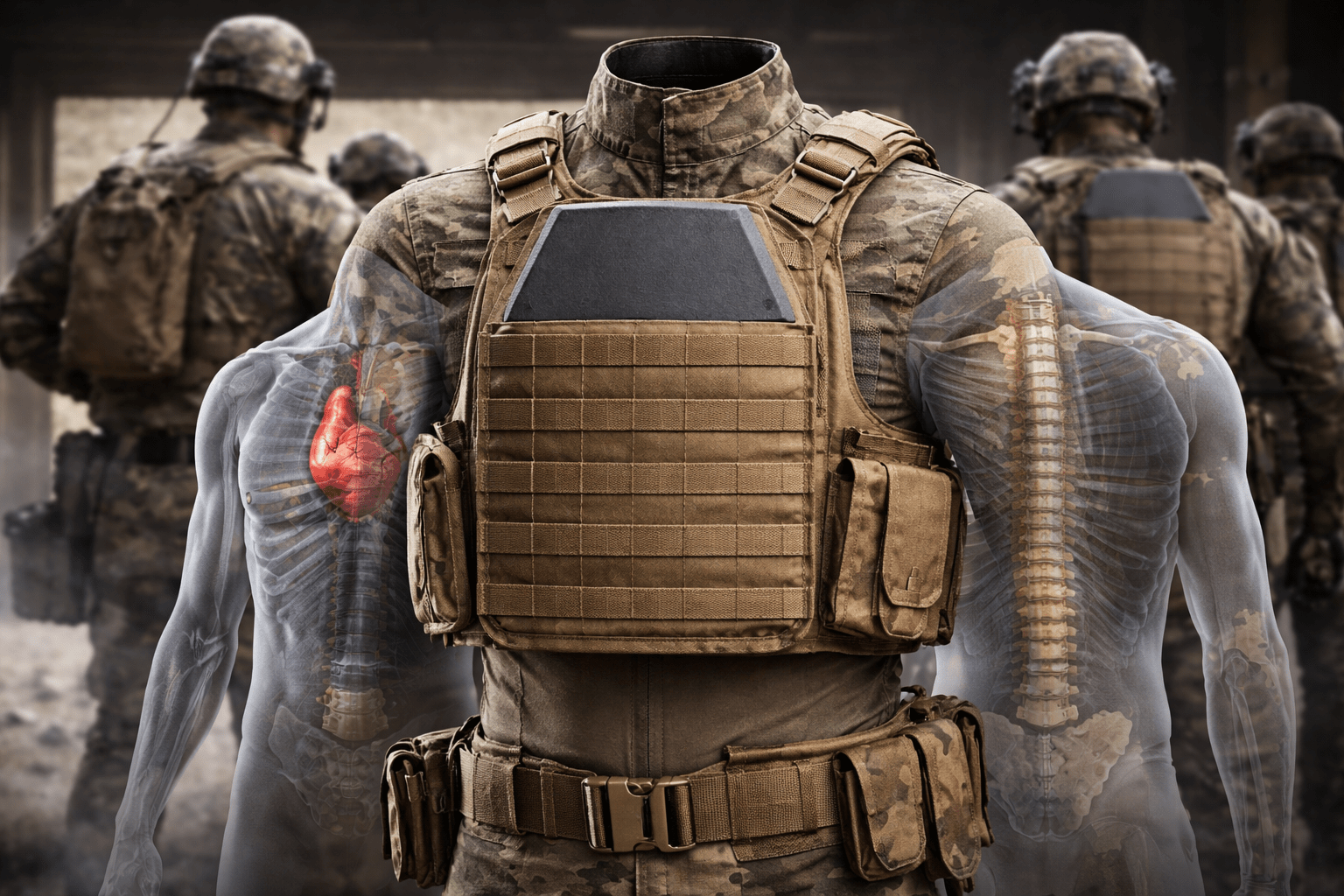
Body armor fit is not a comfort issue. It is a survival issue.
A plate carrier worn too low is not a minor adjustment problem. It is a protection failure. In law enforcement, military, and high-risk security work, body armor must protect the thoracic structures most associated with rapid incapacitation or death. At Valortec, we believe body armor placement should be taught with the same seriousness as firearms safety.
The Anatomy That Should Drive Armor Placement
The suprasternal (jugular) notch is your primary landmark. Behind the sternum lies the mediastinum—the central compartment containing the heart and major vessels. This is the priority “kill zone” that armor is designed to shield.
Key Anatomical Landmarks:
- Suprasternal/Jugular notch
- Manubrium and sternal body
- Upper thoracic spine and Scapular region
- Lateral thorax (directly under the arms)
Front Plate Placement: High and Centered
The top edge of the front plate should sit at or just below the suprasternal notch. Wearing it lower shifts protection away from the heart and great vessels to the less-critical abdominal area.
Back and Side Plate Standards
Back Plates: Should be centered over the upper thoracic spine, between the shoulder blades. It is not lumbar padding; it protects the upper posterior thorax.
Side Plates: Must sit directly under the arms over the lateral thorax. Misplacing them forward leaves the lungs exposed from the flank.
Behind-Armor Blunt Trauma (BABT)
Even when armor stops a round, the energy transfer (deformation) can cause severe injury. Research indicates that impact location significantly affects injury severity—hitting a compliant area like the rib cage results in different trauma than hitting the rigid sternum.
Valortec Fit Check List
- Front: Top edge at/below jugular notch.
- Back: High on upper back, centered on spine.
- Sides: Directly under the arms.
- Breathing: Full, deep breaths are possible without restriction.
- Access: Does not interfere with weapon draw or stock weld.
References & Professional Sources
- National Institute of Justice. (2018). Personal Armor and Fit Assessment
- National Institute of Justice. (2014). Selection and Application Guide to Ballistic-Resistant Body Armor
- Department of the Army. (2012). Improved Outer Tactical Vest Gen III Manual
- NIJ. (2025). Ballistic Resistance Standard 0101.07
- StatPearls. (2023). Anatomy, Thorax, Sternum
- StatPearls. (2023). Anatomy, Thorax, Mediastinum
- StatPearls. (2023). Anatomy, Thorax, Heart
- Journal of the Royal Army Medical Corps. (2001). Behind armour blunt trauma
- International Journal of Occupational Safety. (2006). Injury risk in BABT
- Journal of Biomechanical Engineering. (2024). Impact Location Dependence of BABT