

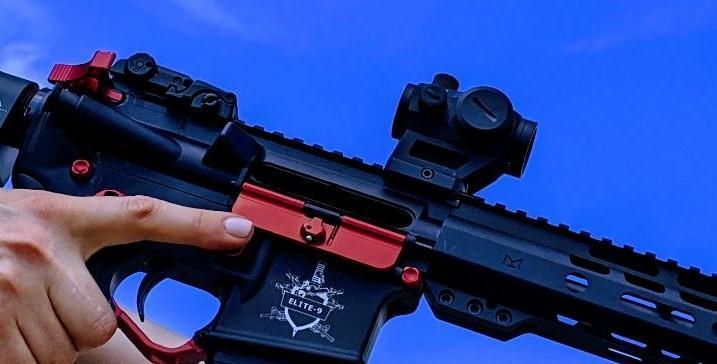
Why an AR-15 Red Dot Should Be Mounted at the Forward-Most End of the Upper Receiver
On a conventional AR-15 carbine, the proper mounting point for a non-magnified electronic sight is the forward-most practical position on the upper receiver, immediately before the handguard begins. Not centered unnecessarily. Not on the handguard. And never bridged across the receiver-handguard seam.
This is not a matter of style or internet habit. It is a matter of mechanics, structural repeatability, and optical efficiency. The upper receiver is the rifle’s primary optical reference surface because it is directly tied to the barrel extension, receiver bore, receiver face, and barrel nut assembly—the same junction that governs alignment, stiffness, and load transfer at the rear of the barrel system.
For a true 1x electronic sight, there is no traditional eye-relief limitation forcing the optic rearward. Once that restriction disappears, the strongest mounting logic becomes clear: place the optic as far forward on the upper receiver as possible while keeping the entire mount fully on the receiver rail. That location delivers the best balance of zero retention, structural consistency, and reduced visual obstruction.
Abstract
The technically defensible default position for a 1x electronic sight on the AR-15 is the front end of the upper receiver, just before the receiver transitions into the handguard. The reason is not cosmetic symmetry. It is the combination of platform geometry, receiver-end stiffness, boundary-condition control, and the optical flexibility of non-magnified aiming systems.
The barrel extension, upper receiver bore, receiver face, and barrel nut form the rifle’s primary alignment and stiffness junction. Army technical guidance treats this area as a critical assembly for barrel alignment and torque integrity. Patent literature describing AR-pattern barrel retention explains that axial and bending loads are transferred through this receiver-end interface. Manufacturer engineering commentary and optics guidance further support the same conclusion: the upper receiver is the correct reference structure for a primary aiming device, while the handguard is a secondary structure more vulnerable to flex, shift, heat influence, and independent movement.
Because a non-magnified red dot or holographic sight does not require traditional rearward eye-relief positioning, the correct answer is more specific than simply “mount it on the receiver.” The stronger conclusion is this: mount it at the forward-most portion of the upper receiver, stopping immediately before the handguard begins.
1. Core Thesis
The correct mounting position for a non-magnified electronic sight on a standard AR-15 is the forward-most practical point on the upper receiver rail, immediately aft of the receiver-handguard break, with the entire optic base supported by the receiver alone.
That is the best default position because it accomplishes four things at once:
- It anchors the optic to the rifle’s most stable optical reference surface.
- It keeps the sight off the more load-sensitive handguard.
- It avoids the instability created by bridging a structural seam.
- It takes full advantage of the optical freedom provided by a true 1x sight.
On a conventional two-piece upper and handguard system, that is the strongest general recommendation. The primary exception is a true monolithic upper, where the receiver and forward rail are one continuous structural unit.
2. The AR-15’s Real Structural Reference Is the Receiver-End Barrel Junction
The AR-15 does not rely on the aluminum upper receiver alone to contain firing pressure. The primary pressure-bearing lockup occurs in the steel bolt, steel barrel extension, and chamber system. However, that does not diminish the importance of the upper receiver. It is the structure that supports the barrel assembly through the receiver bore, receiver face, alignment pin interface, and barrel nut clamping system.
Army armorer guidance makes clear that the barrel-to-receiver relationship is a precision issue, not a casual assembly point. The alignment pin fit matters. Receiver slot integrity matters. Barrel-nut torque matters. Repeated torque cycles are prescribed to improve thread seating and alignment. Improper fit can create excessive windage and can require receiver replacement.
That is not the language of a non-critical part. It is the language of a structural reference node.
Patent literature describing AR-pattern barrel retention reinforces the same point in engineering terms. The barrel nut traps the barrel-extension flange against the receiver, maintains axial retention, and contributes to bending resistance. The barrel extension’s fit in the upper receiver bore also transfers load into the receiver body. That means the receiver-end barrel junction is the part of the rifle most directly responsible for keeping the barrel, bore axis, and top rail in a repeatable relationship.
If the optic is expected to hold zero and track with the barrel system, that is the structure it should reference.
3. Why the Handguard Is the Wrong Reference Structure
A separate AR-15 handguard is not the same structure as the upper receiver. Even a quality free-float handguard remains a secondary component attached forward of the barrel-retention junction.
This distinction matters because the handguard can respond differently to sling tension, support-hand pressure, barricade loading, bipod input, impact, and heat. It is not mechanically identical to the upper receiver, and it does not maintain the same direct relationship to the barrel extension and receiver face.
A monolithic-upper patent states this problem directly: when optics or sights are mounted to separate handguard structures, accuracy may be reduced because of misalignment relative to the upper receiver. That is a design-level admission that the seam between receiver and handguard is not trivial. The whole purpose of a monolithic rail is to eliminate the structural discontinuity that exists in a standard AR-15.
Optics manufacturers reach the same conclusion from the user end. Vortex explicitly advises mounting optics on the upper receiver and warns that placing a red dot farther forward on the handguard is a mistake unless the rifle uses a monolithic upper. Their stated reason is simple: handguards are more susceptible to shift from pressure, impact, and heat, and that can produce zero shift.
That is not internet folklore. It is a structural warning.
4. Why “Forward on the Receiver” Is Stronger Than “Somewhere on the Receiver”
It is correct to say a red dot belongs on the receiver. But that statement is incomplete.
The more precise and more technically sound recommendation is that the optic should sit at the front-most part of the upper receiver, just before the handguard line, while remaining fully supported by the receiver rail.
Why? Because a non-magnified electronic sight does not need to be positioned close to the eye the way a magnified optic does. Aimpoint describes its red-dot sights as operationally parallax-free and usable without perfect dot centering in the window. EOTECH states that its holographic sights offer unlimited eye relief and may be positioned anywhere on the firearm.
Once rearward eye-relief requirements disappear, there is no technical reason to waste the front of the receiver by leaving the optic centered or set back farther than necessary. The forward-most receiver position is where the optic still references the rifle’s most stable mounting surface while gaining the optical and ergonomic benefits of being farther from the shooter’s eye.
5. Optical Efficiency: Why a 1x Sight Belongs Forward
A non-magnified electronic sight is meant to be used in a target-focused, both-eyes-open shooting process. In that context, pushing the optic farther away from the eye reduces the apparent angular size of the housing in the shooter’s field of view.
In practical terms, the optic body feels smaller, less intrusive, and easier for the brain to ignore. The shooter’s attention remains on the target, not on the optic tube or window frame.
This is basic geometry. As eye-to-optic distance increases, the optic body occupies less visual angle. That does not make the reticle less useful, but it does make the sight housing less dominant in the shooter’s visual field. The result is a cleaner, faster-feeling presentation.
That is one of the major reasons a 1x optic should sit at the front edge of the receiver rather than somewhere farther back.
6. Barrel Dynamics and Boundary Conditions Support the Same Direction
Published small-arms barrel-dynamics research supports the larger structural logic. The work of Štiavnický and Lisý shows that barrel vibration influences muzzle position at bullet exit, and that barrel motion changes in response to accessory load, grip conditions, and the way the barrel is fixed at its rear boundary.
That matters because the optic should reference the most stable side of the system’s boundary conditions. On the AR-15, the rear fixed-end condition of the barrel begins at the barrel extension and upper receiver assembly. The handguard is not that boundary. It is a secondary structure attached forward of it.
Free-floating exists to minimize the influence of external forces on barrel behavior. The same principle supports keeping the primary sight on the receiver rather than on the handguard. If the design goal is to isolate the barrel from outside pressure, then the optic should also remain attached to the structure least likely to introduce additional alignment uncertainty.
7. Receiver Rigidity Still Matters, Which Makes Handguard Mounting Look Worse
The upper receiver is not infinitely rigid, and that actually strengthens the case for placing the optic at the front of the receiver rather than on the handguard.
BCM’s engineering discussion of the Mk2 upper notes that flat-top upper receivers introduced a rigidity penalty and identifies the ejection-port area as a structural weak point. Their solution was to improve rigidity and alignment retention under load, with claimed benefits to consistency and accuracy.
If rigidity matters even within the receiver, then mounting the primary sight on a separate handguard structure is even harder to justify. The answer is not to move the optic away from the receiver. The answer is to keep the optic on the best available structure, and within that structure to place it as far forward as practical before the handguard begins.
8. Why Bridging the Receiver-Handguard Seam Is Technically Worse
A bridged optic mount inherits the liabilities of both structures.
On a conventional AR-15, the upper receiver and handguard are not one continuous stiffness member. They are separate parts that can deflect differently under heat, pressure, loading, and incidental impact. If an optic mount spans both, the sight is forced to depend on two structures that may not remain in perfect alignment with one another.
That is unnecessary on a 1x optic because the receiver alone already provides sufficient rail space for proper forward placement. Bridging the seam therefore introduces extra risk with no compensating technical benefit.
The sound engineering rule is simple: do not let the primary optic span a structural seam when a single, stronger reference surface exists immediately behind it.
9. Practical Recommendation
For a standard AR-15 carbine with a separate free-float handguard, the default recommendation is straightforward:
Mount the red dot fully on the upper receiver, in the forward-most receiver slots that keep the entire mount behind the receiver-handguard break.
That location gives the optic the best available combination of:
- zero stability
- alignment repeatability
- mechanical integrity
- reduced visual clutter
- better use of a 1x sight’s optical freedom
It also tends to preserve cleaner charging-handle access and leaves room for rear backup sights or a future magnifier without compromising the basic mounting logic of the primary optic.
10. Exception
The principal exception is a true monolithic upper receiver. In that design, the forward rail is not a separate handguard structure in the usual sense, so the traditional receiver-versus-handguard distinction is substantially reduced.
Outside of that exception, the rule remains solid: mount the optic at the forward-most end of the upper receiver, immediately before the handguard begins.
Conclusion
The case for mounting a non-magnified electronic sight at the front end of the upper receiver is stronger than habit, aesthetics, or internet repetition.
The barrel-extension and upper-receiver junction is the rifle’s critical alignment and bending-load transfer node. The handguard is a separate structure that can shift relative to the receiver under force, heat, and impact. A 1x sight does not need rearward eye-relief placement. And pushing the optic forward reduces the apparent size of the housing while keeping the sight attached to the rifle’s most stable optical reference surface.
That is why the correct default mounting point is the furthest forward practical position on the upper receiver, immediately before the handguard.
On a conventional AR-15 carbine, that is the cleanest mechanical answer, the best optical answer, and the most defensible technical answer.
Frequently Asked Questions
Where exactly should a red dot be mounted on an AR-15?
The best default position is the forward-most practical point on the upper receiver, immediately before the handguard begins, with the entire optic mount fully supported by the receiver rail.
Should a red dot sit in the middle of the upper receiver?
Usually no. A true 1x electronic sight does not need traditional rearward eye-relief placement, so mounting it farther forward on the receiver is generally the better choice.
Should a red dot ever be mounted on the handguard?
Not as the default choice on a standard AR-15. The handguard is a separate structure and is more vulnerable to flex, load, and alignment changes than the upper receiver.
Should an optic bridge the receiver and handguard?
No. On a conventional AR-15, bridging the seam is mechanically unsound because the receiver and handguard are separate components that can move differently under load.
What is the main exception?
A true monolithic upper receiver is the main exception because the rail is one continuous structural unit rather than a separate receiver-and-handguard arrangement.
References
- TM 9-1005-319-23&P, M16A2/M4/M4A1 maintenance manual. Army technical guidance on barrel alignment, torque procedures, and receiver-end fit. View source
- US20160010938A1, Barrel extension. Patent discussion of barrel-extension flange retention, axial support, and bending-load transfer into the upper receiver. View source
- U.S. Patent 11,543,196, Monolithic upper receiver assembly. Discussion of misalignment risk associated with separate handguard structures and the design rationale for monolithic rail systems. View source
- Bravo Company Manufacturing, The MK2 Upper Receiver. Manufacturer engineering discussion of upper-receiver rigidity and deflection control. View source
- Vortex Optics, Making Sense of Magnified Optics on a Tactical Carbine Part 2. Manufacturer guidance recommending receiver mounting rather than handguard mounting on standard AR-pattern rifles. View source
- Aimpoint, Patrol Rifle Optic (PRO) technical page. Product guidance relevant to operationally parallax-free use and flexible sight placement. View source
- EOTECH, The Key Advantages of EOTECH’s Holographic Weapon Sights. Manufacturer guidance describing unlimited eye relief and flexible mounting location on the firearm. View source
- Štiavnický and Lisý, Influence of Barrel Vibration on the Barrel Muzzle Position at the Moment when Bullet Exits Barrel. Research on muzzle position, barrel vibration, and shot-path effects. View source
- Lisý and Štiavnický, Weapon Barrel and Its Additional Accessories. Research on accessory load, barrel vibration behavior, and point-of-impact implications. View source
Train Beyond Internet Myths
Rifle setup should be based on structural reality, not recycled myths. If your optic placement, mounting logic, and shooting process are built on guesswork, performance becomes guesswork too.


