Florida Lawmakers: Stop Hiding From the Firearms Training Problem
Florida lawmakers and policymakers need to stop pretending they do not see the problem.
The state’s firearms training and licensing standards contain serious gaps. Those gaps were identified in a January 10, 2024 letter sent on behalf of Valortec to the Florida Department of Agriculture and Consumer Services. The warning was clear: current Class G firearms proficiency standards and training regulation contain deficiencies that directly affect the safety and preparedness of licensees and the public.
This should have triggered immediate review.
It did not.
And that failure matters.
This is not a political issue. It is a public safety issue.
Too many officials talk about safety until the conversation becomes uncomfortable. Then they disappear behind process, silence, and political caution. But when government ignores weak standards in a high-liability field, it is not being neutral. It is choosing to leave the public exposed.
The Real Problem: Florida Is Protecting Minimums Instead of Protecting the Public
The core issue is simple. Florida’s current framework is too comfortable with minimum standards in a field where minimum standards can get innocent people hurt.
The uploaded letter states that Valortec identified “critical deficiencies” in Class G firearms proficiency standards and training regulation, and that these issues have direct implications for public safety and licensee preparedness.
That is not a small administrative complaint.
That is a warning that the state’s current system is not demanding enough in an area where the consequences of failure are immediate and irreversible.
A Weak Standard Creates a Weak Credential
If the testing model is soft, the credential loses value.
If the credential loses value, the public absorbs the risk.
That is the truth lawmakers need to face.
If the standard is weak, the credential is weak. If the credential is weak, the public carries the risk.
Florida’s Target-Spacings Problem Is a Real-World Safety Problem
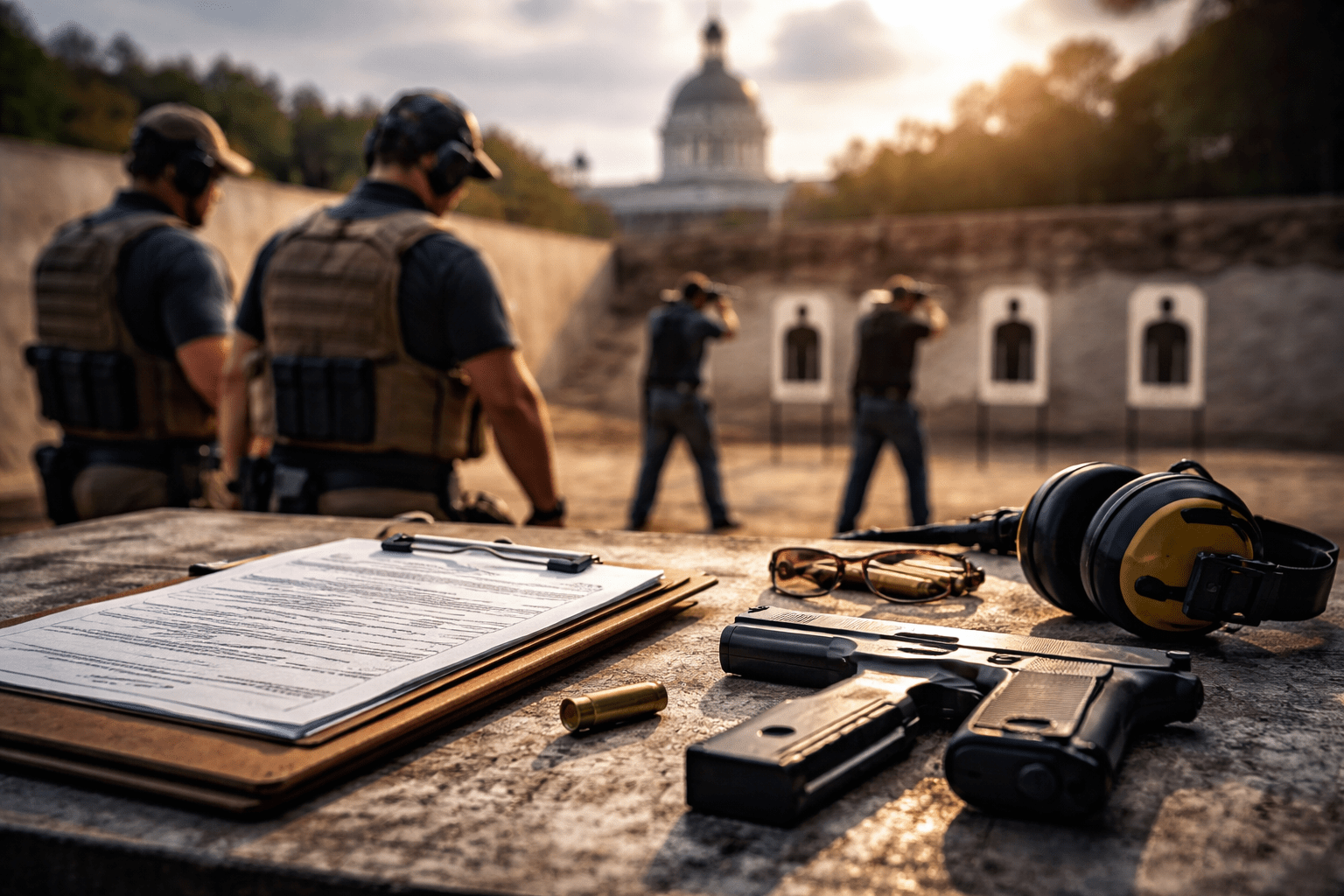
One of the most revealing failures identified in the letter is the lack of specific guidance regarding the distance between multiple targets in the Class G proficiency test. According to the document, this omission has resulted in inconsistent practices, including targets placed side by side on the same sheet of paper or only inches apart. The letter argues that this disregards the critical skill of target and threat acquisition in multiple-threat situations.
That is not a technicality.
That is a broken performance standard.
A firearms test that does not meaningfully evaluate transition between spatially separated threats is not measuring a real defensive skill. It is measuring compliance theater. It is producing the appearance of readiness without demanding the performance that readiness actually requires.
The Recommendation Lawmakers Should Not Ignore
The letter recommends that the Division of Licensing establish a minimum standard of at least three feet of separation between targets. The stated reasons are uniformity, better evaluation of threat transition, and improved preparedness for real-life situations involving dynamic and spatially dispersed threats.
That should not be controversial.
It should be common sense.
A firearms qualification should measure reality, not convenience.
The Passing Score Is Too Low for a High-Liability Field
The letter also challenges the current minimum passing score of 168 out of 240 points. It states that while this may establish baseline competency, it may not reflect the level of proficiency actually required in high-stakes, life-or-death situations. It further notes that research and practical experience show significant degradation in shooting accuracy under stress, and it recommends raising the passing score to 190 out of 240.
This is where policymakers need to stop hiding behind the phrase “minimum standards.”
Minimum standards are not automatically responsible standards.
In our Asset or Liability discussion of firearms and security training, we explain why compliance alone cannot establish the readiness the public deserves.
In a controlled, predictable qualification environment, people are shooting under conditions far removed from the chaos, fear, time compression, and physiological stress of real-life violent encounters. If the state already knows performance drops under stress, then refusing to raise the standard is not caution. It is avoidance.
A Low Bar Does Not Equal Safety
A low bar may make certification easier.
It does not make the public safer.
It does not make decision-making sharper.
It does not make misses less dangerous.
It does not reduce liability.
A low bar does not create safety. It creates paperwork.
Florida Has an Instructor Oversight Problem, and Everyone Knows It
The uploaded letter also confronts one of the most uncomfortable truths in the industry: Florida lacks comprehensive oversight for firearms instructors providing civilian training outside the Class G licensing context. It argues that many unlicensed individuals and organizations advertise and provide firearms training without proper credentials or compliance with state law, even though firearms instruction is identified as a high-risk, high-liability activity.
This should have set off alarms in Tallahassee.
Instead, the issue has been allowed to sit while weak instruction continues to circulate in the civilian training market.
The State Cannot Have It Both Ways
Florida cannot describe firearms instruction as high-risk and high-liability, then tolerate a marketplace where people teach defensive or tactical firearms skills without meaningful oversight.
That contradiction is indefensible.
The letter recommends that all civilian firearms training in Florida, except competitive or sport shooting, including self-defense and tactical courses, be conducted exclusively by licensed Class K instructors. It also calls for clear guidelines on approved certifications and stronger compliance with Florida statutes and administrative codes.
Lawmakers do not get to ignore that recommendation and still claim they are serious about public safety.
You cannot call something high-liability and then regulate it like it is harmless.
The Manual Should Have Been Updated Already
The letter does not merely criticize the system. It proposes reform. It urges enhanced instructor training, incorporation of stress inoculation and scenario-based training, regular curriculum review, and public education on the importance of seeking licensed instructors.
None of that is radical.
It is basic modernization.
And that is exactly why continued delay is so hard to defend. If the deficiencies are already known and the direction for reform is already on the table, then refusal to act stops looking like oversight and starts looking like institutional cowardice.
Update the Standards or Admit You Accept the Risk
That is the choice now.
If the standards are outdated, update them.
If the testing is weak, strengthen it.
If the oversight is loose, tighten it.
If the curriculum is stale, modernize it.
But stop pretending the problem is unclear.
If the manual is outdated, update it. If the standard is weak, raise it. If the oversight is loose, tighten it.
Public Safety Does Not End Where Political Discomfort Begins
The letter also raises the issue of language and command comprehension in Class D and G training. It argues that firearms training is too high-risk to tolerate communication failures, especially when effective interaction with law enforcement or first responders may become critical. It recommends English as the mandatory language of instruction and proficiency for those training categories, along with basic comprehension requirements.
Whatever one’s policy position on that recommendation, the underlying point is unmistakable: communication failures in armed, high-stakes situations create public-safety risks. The document says so directly.
This is where serious lawmakers separate themselves from political cowards. Serious lawmakers confront hard questions directly. Cowards avoid them because they fear backlash more than they fear preventable failure.
That is not leadership.
That is surrender.
Who Are Lawmakers Really Protecting?
At some point, Florida lawmakers need to answer a basic question:
Who are you protecting?
The public?
Or the comfort of a weak, inconsistent, and underregulated training environment that no one wants to confront honestly?
Because it cannot be both.
You cannot claim to care about accountability while refusing to address low thresholds, vague testing standards, inconsistent implementation, and weak instructor oversight. You cannot talk about responsibility while ignoring obvious gaps in a field that carries deadly consequences.
Public safety does not care about political discomfort. Liability does not care about campaign language.
The Final Line Florida Must Draw
This issue has been ignored for too long.
Not because the warning signs were absent.
Not because the deficiencies were unknown.
Not because reform ideas were unavailable.
It has been ignored because too many people in government would rather avoid confrontation than fix what is broken.
That needs to end now.
A Call to Action for Lawmakers
Florida legislators, regulators, and policymakers need to stop speaking in slogans and start acting in standards.
Review the Class G proficiency framework.
Define target-spacing requirements.
Raise the passing score to reflect real-world liability.
Tighten instructor oversight.
Restrict defensive civilian firearms instruction to appropriately licensed professionals.
Update the curriculum.
And do it publicly, clearly, and without apology.
If you know the standards are weak and still refuse to act, that is no longer caution.
That is complicity.
A Call to Action for Responsible Instructors
And for responsible instructors in Florida, this is the moment to speak plainly.
Stop protecting weak standards for the sake of industry comfort.
Stop pretending all credentials are equal when they are not.
Stop allowing public safety to be diluted by marketing, shortcuts, and watered-down instruction.
Demand higher standards.
Demand real oversight.
Demand a licensing and training system that reflects the seriousness of armed responsibility.
Because if professionals in this field stay silent, lawmakers will keep looking away.
And the public will keep paying the price.