Street Smart: Awareness, Pattern Recognition, and Real-World Decision-Making
Urban Survival Series — Part 4 of 5
Street smart is one of the most misunderstood survival skills in modern life.
Some people think it means acting hard.
Some think it means being suspicious of everyone.
Some think it means growing up around violence, talking rough, staring people down, or walking around like every sidewalk is a battlefield.
Wrong.
That is not street smart.
That is theater.
Real street smart is the disciplined ability to move through people, places, and situations with your eyes open, your mind working, your ego controlled, and your options protected.
It is the ability to observe what other people ignore.
It is the ability to read behavior before it becomes a problem.
It is the ability to recognize when a place, person, conversation, or pattern does not fit.
It is the ability to adapt without freezing.
It is the ability to protect your space, your information, your time, your family, your reputation, and your future.
The uploaded source article correctly defines street smart as pattern recognition under pressure, not paranoia or confrontation. That concept is the foundation for this expanded Valortec article and Part 4 of the Urban Survival Series.
Part 1 taught you to read the room.
Part 2 taught you to watch your six.
Part 3 exposed how attraction, attention, and trust can be weaponized through honey-trap manipulation.
Part 4 now ties it together:
Street smart is awareness plus judgment plus action.
Because awareness without decision-making is just watching the problem develop.
And in the real world, late decisions are expensive.
Street Smart Is Not Fear. It Is Functional Awareness.
Let’s set the tone correctly.
Street smart is not fear.
It is not panic.
It is not bias.
It is not pretending every stranger is a criminal.
It is not escalating every uncomfortable moment.
Street smart is functional awareness.
It is the ability to notice what matters, understand what it may mean, and make a better decision before your options collapse.
Mica Endsley’s foundational situational awareness model describes awareness as more than perception. Her model includes perceiving relevant elements, comprehending their meaning, and projecting what may happen next. In practical Valortec language: see it, understand it, anticipate it. (Sage Journals)
That is the difference between looking around and actually being aware.
Most people look.
Trained people process.
Most people notice only what is loud, close, obvious, or emotional.
Street smart people notice what is changing.
That is where the advantage lives.
The Opposite of Street Smart Is Oblivion
The opposite of street smart is not innocence.
It is oblivion.
Oblivion looks like this:
Walking through a parking lot with your face buried in your phone.
Letting strangers close distance without noticing.
Oversharing personal information with people who have not earned access.
Ignoring the feeling that something is wrong because you do not want to look rude.
Standing in a bad location because you did not think about exits.
Getting pulled into arguments that do not belong to you.
Staying in unstable places because your ego does not want to leave.
Waiting for certainty when the pattern is already wrong.
Telling yourself, “I’m probably overreacting,” while the situation continues to deteriorate.
That is not kindness.
That is not confidence.
That is not social maturity.
That is a failure to protect your options.
The Simons and Chabris inattentional blindness research showed that people can miss obvious events when their attention is focused elsewhere. That matters because distraction is not harmless in public spaces; distraction creates opportunity. (PubMed)
Your phone does not protect you.
Your title does not protect you.
Your firearm does not protect you if you never see the problem developing.
Your confidence does not protect you if it is built on denial.
Awareness buys time.
Time creates options.
Options prevent bad outcomes.
Street Smart Is Pattern Recognition Under Pressure
A pattern is stronger than a single signal.
One person looking at you may mean nothing.
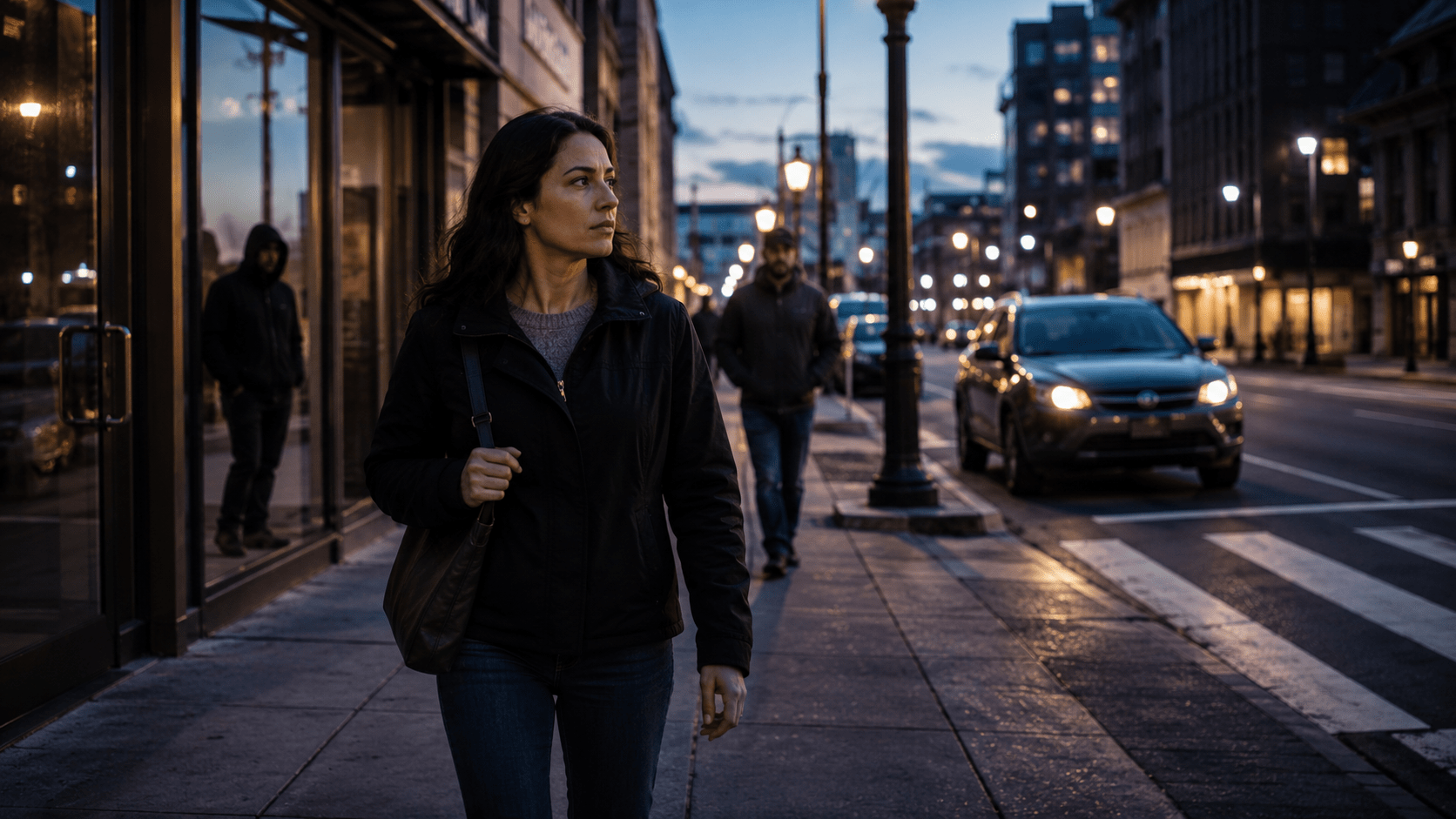
A person looking at you, matching your pace, adjusting direction when you do, and closing distance in an isolated area means something different.
One question about your job may be harmless.
A series of questions about your work schedule, access, travel, facility, coworkers, and credentials becomes a pattern.
One loud person may be an annoyance.
A loud person drawing attention while another person moves behind you may be a setup.
One vehicle passing slowly may be normal.
The same vehicle circling, stopping, watching, and reappearing changes the picture.
Street smart means you do not panic over one cue.
But you also do not ignore a pattern because you are afraid of being wrong.
That is the balance.
No paranoia.
No denial.
Just disciplined recognition.
The Six Pillars of Street Smart Survival
1. Observe Everything Without Acting Strange
Observation is the foundation.
You cannot respond to what you failed to notice.
But observation does not mean staring people down, acting hostile, or performing tactical theater in public.
Good observation is quiet.
It is mature.
It is constant.
It is professional.
You are reading:
The environment.
The exits.
The entrances.
The lighting.
The crowd.
The movement.
The timing.
The emotional climate.
The vehicles.
The blind spots.
The body language.
The person who appears out of place.
The person watching people instead of moving through the environment normally.
The group that spreads out when you move.
The person who changes direction when you change direction.
CISA’s “Power of Hello” framework uses the OHNO approach: Observe, Initiate a Hello, Navigate the Risk, and Obtain Help. That framework matters because it treats awareness as an early-intervention skill instead of a last-second emergency reaction. (CISA)
That is exactly the mindset urban survival requires.
Observe early.
Decide early.
Act early.
The person who observes early usually does not need to react violently later.
2. Read People by Behavior, Not Appearance
Street smart people do not judge danger by appearance alone.
That is amateur behavior.
A well-dressed person can be dangerous.
A rough-looking person can be harmless.
A quiet person may be more important than the loud person.
A friendly person may be manipulating access.
An angry person may be a distraction.
A polished person may be a fraud.
A nervous person may be afraid, not hostile.
A person who looks “normal” can still be watching, testing, probing, isolating, or positioning.
Read behavior.
Read context.
Read movement.
Read consistency.
Ask:
What are they doing?
Does their behavior match the environment?
Are they moving with a purpose?
Are they watching people instead of participating?
Are they closing distance without a reason?
Are they asking questions they do not need to ask?
Are they trying to isolate me from others?
Are they trying to rush my decision?
Are they refusing to respect a boundary?
Are they acting one way while positioning another way?
The street does not care how someone looks.
It cares what they do.
So should you.
3. Know the Context Before You Commit
Context changes everything.
A gas station at 2:00 p.m. is not the same as a gas station at 2:00 a.m.
A parking garage during business hours is not the same as a parking garage after closing.
A hotel lobby is not the same as a hotel hallway.
A restaurant during lunch is not the same as a restaurant bar at midnight.
A crowd leaving a concert is not the same as a crowd forming during a disturbance.
A person standing near an ATM has a different meaning than a person standing near a coffee shop.
Context tells you what behavior fits and what behavior does not.
The ASU Center for Problem-Oriented Policing describes street robberies as often more opportunistic and occurring in open, less predictable environments; it also notes that offenders still engage in decision-making processes. (Pop Center)
That is a critical lesson.
Crime is not magic.
Bad outcomes often depend on environment, timing, opportunity, target selection, access, and distraction.
Street smart people ask better questions:
Why is that person there?
Why is that vehicle parked that way?
Why is that person matching my pace?
Why did the room get quiet?
Why is someone asking questions about my work?
Why is this stranger trying to move me away from people?
Why does this conversation feel staged?
Why are my options shrinking?
The question “why?” turns observation into intelligence.
4. Think Ahead Before You Need To
Thinking ahead is not panic.
It is preparation.
It means you do not wait until the situation collapses before identifying options.
Where is the exit?
Where is the light?
Where is the crowd?
Where is help?
Where is my vehicle?
Where are my people?
Where is the bottleneck?
Where is the blind spot?
What would I do if this person keeps closing distance?
What would I do if the argument turns physical?
What would I do if the exit becomes blocked?
What would I do if someone follows after I change direction?
DHS active-shooter guidance tells people to be aware of their environment, note possible dangers, and identify the two nearest exits in facilities they visit. That principle applies broadly to urban survival: know where you are, know where you can go, and do not wait until every option disappears. (Department of Homeland Security)
This does not mean you live scared.
It means you live prepared.
The unprepared person waits for certainty.
The street smart person moves when the pattern turns wrong.
5. Stay Adaptable
Rigid people break.
Street smart people adapt.
If the route feels wrong, change it.
If the crowd changes, reposition.
If someone is matching your pace, create distance.
If the conversation becomes manipulative, end it.
If the room feels unstable, leave.
If the parking lot feels wrong, go back inside.
If the person ignores your boundary, escalate your boundary.
If your plan no longer fits the environment, change the plan.
Adaptability is not weakness.
It is survival intelligence.
Too many people stay in bad situations because they do not want to look rude, scared, dramatic, or paranoid.
That is ego.
Ego gets people trapped.
You do not owe a stranger your time.
You do not owe a bad environment your presence.
You do not owe an unstable person your attention.
You do not owe a manipulator an explanation.
You do not owe danger a debate.
Move early.
Reset.
Reposition.
Leave.
The best fight is the one your awareness prevented.
6. Protect More Than Your Body
Urban survival is bigger than physical safety.
You must protect:
Your space.
Your time.
Your information.
Your emotional energy.
Your family.
Your digital footprint.
Your reputation.
Your professional access.
Your financial security.
Your future.
Not everyone deserves access to you.
Not every conversation deserves honesty.
Not every question deserves an answer.
Not every invitation deserves acceptance.
Not every stranger deserves your trust.
Street smart means understanding that danger can show up as a physical threat, but also as manipulation, fraud, social engineering, coercion, reputation damage, professional compromise, or emotional control.
That is why Part 3 of this series addressed honey traps.
Modern survival is not just about what happens in an alley.
It is also about what happens in a direct message, a hotel bar, a fake opportunity, a private conversation, or a relationship that moves too fast.
Protect your boundaries.
Boundaries are not arrogance.
Boundaries are security.
Read the Environment: What to Check
Environment
The environment usually speaks before the incident does.
Ask:
Is the area isolated?
Is lighting poor?
Are exits blocked?
Is there a crowd forming?
Are people leaving quickly?
Is someone standing where they can observe movement?
Are vehicles positioned strangely?
Is there sudden silence?
Is there an argument building?
Is there a shift in energy?
Is there a bottleneck?
Is there a place where someone could approach unseen?
Street smart means you do not walk into spaces blind.
You pause mentally.
You collect information.
Then you move.
Body Language
Body language is not fortune-telling.
Do not pretend one cue gives you magical insight into someone’s mind.
A crossed arm may mean defensiveness.
It may also mean the person is cold.
A quiet person may be disengaged.
They may also be processing.
A stare may be hostile.
It may also be confusion.
The key is not one cue.
The key is clusters, context, baseline, and change.
Watch for:
Hands hidden.
Fists closing.
Repeated glancing.
Target fixation.
Blading the body.
Pacing.
Rapid approach.
Forced friendliness.
Group members spreading out.
Looking around before acting.
Watching your hands, pockets, bag, children, or vehicle.
Ignoring normal social distance.
Becoming angry when you create distance.
No single cue proves intent.
But a cluster deserves attention.
Tone and Energy
Every place has emotional temperature.
Calm.
Tense.
Drunk.
Excited.
Angry.
Defensive.
Suspicious.
Confused.
Agitated.
Fatigued.
A room can move from normal to unstable fast.
Raised voices, aggressive posture, intoxication, crowd movement, sudden silence, or emotional escalation can change the risk level.
Do not ignore energy.
Sometimes your nervous system detects a pattern before your conscious mind has fully explained it.
That does not mean your feeling is always correct.
It means your signal deserves review.
Ask: what did I notice?
Then look for observable facts.
Timing
Timing is a major clue.
Why now?
Why here?
Why did this person approach when I was alone?
Why did this stranger wait until my hands were full?
Why did this question come after they learned my job?
Why did the group move after I moved?
Why is this person still nearby after I changed direction?
Why did the environment shift when that person entered?
Bad timing may be accidental.
But street smart people do not automatically assume coincidence when a pattern is forming.
Patterns
Patterns reveal intent.
Someone walking behind you once may be nothing.
Someone matching every turn deserves attention.
Someone asking one question may be normal.
Someone building a profile of your routine is different.
Someone standing near an exit may be normal.
Someone watching every person entering and leaving is worth noticing.
A vehicle passing slowly once may be nothing.
A vehicle circling repeatedly changes the picture.
Street smart is pattern recognition.
Not panic.
Not prejudice.
Not fantasy.
Pattern recognition.
Red Flags
Red flags include:
Forced urgency.
Pressure to isolate.
Refusal to respect boundaries.
Unwanted closing distance.
Inconsistent stories.
Overinterest in your work, schedule, access, or personal life.
Attempts to distract you while someone else moves.
People who appear to coordinate without speaking.
Someone who becomes angry when you create distance.
A situation that keeps removing your options.
If something feels off, do not worship politeness.
Trust the signal enough to create space.
You can always apologize later for leaving.
You cannot always recover from staying too long.
Decide Early: The Street Smart Decision Model
The most dangerous decision is often no decision.
People freeze because they want more proof.
They do not want to overreact.
They do not want to embarrass themselves.
They do not want to misjudge.
They do not want to seem rude.
That hesitation can cost them.
You do not need courtroom-level evidence to cross the street.
You do not need certainty to leave a parking lot.
You do not need permission to end a conversation.
You do not need proof to protect your space.
You do not need to explain why you are uncomfortable.
Use this model.
Step 1: Notice
Pick up the cue.
A person is watching too closely.
A vehicle is circling.
A stranger is asking too much.
A group is spreading out.
The energy changed.
Someone is matching your pace.
Someone is standing where they have no clear reason to be.
Someone is trying to isolate you.
Someone is rushing you.
Someone is probing for information.
Notice means you do not dismiss the signal automatically.
You take the information seriously enough to evaluate it.
Step 2: Create Distance
Distance is time.
Time gives options.
Options create survival advantage.
Change lanes.
Cross the street.
Go back inside.
Move toward people.
Call someone.
Use lighted areas.
Get to staff or security.
Stop giving personal information.
Change your route.
North Carolina Department of Public Safety personal-safety guidance emphasizes staying alert, being conscious of who and what is around you, avoiding vulnerability signals, and trusting instincts if something does not feel right. (NC DPS)
That is not paranoia.
That is intelligent movement.
Step 3: Reset
A reset changes the conditions.
New route.
New angle.
New distance.
New lighting.
New witnesses.
New exit.
New decision point.
If the concern disappears after you reset, you avoided unnecessary risk.
If the concern follows you after you reset, you now have stronger information.
A person who follows after you change direction is telling you something.
A person who ignores your boundary is telling you something.
A person who keeps closing distance after you move away is telling you something.
Listen.
Step 4: Communicate
If the pattern escalates, communicate clearly.
Not emotionally.
Not dramatically.
Clearly.
“Stay close.”
“Move left.”
“Do not stop here.”
“Call security.”
“Two people behind us, closing distance.”
“Go back inside.”
“Exit is blocked.”
“Call 911.”
“Do not answer that.”
“Stop talking to him.”
DHS guidance on reporting suspicious activity says people should describe what they observed, including who or what they saw, when they saw it, where it occurred, and why it is suspicious. (Department of Homeland Security)
That same clarity matters in family safety, business safety, church safety, and personal safety.
Vague panic creates confusion.
Specific language creates action.
Step 5: Leave Early
This is where ego loses.
Street smart people leave early.
They do not wait until every exit is gone.
They do not wait until the argument becomes physical.
They do not wait until the stranger is inside arm’s reach.
They do not wait until the parking lot becomes empty.
They do not wait until the scammer has leverage.
They do not wait until their gut feeling becomes a police report.
Leaving early is not weakness.
It is discipline.
The goal is not to win a public confrontation.
The goal is to get home clean.
Manage Your Six
Your six is what is behind you.
The problem with most people is that their entire life is lived at 12 o’clock.
They face forward.
Think forward.
Walk forward.
Text forward.
Drive forward.
Talk forward.
And ignore everything behind them.
That is dangerous.
Managing your six means you understand what is behind you without constantly spinning around like an amateur.
Use:
Reflective surfaces.
Windows.
Vehicle glass.
Mirrors.
Shadows.
Natural pauses.
Route changes.
Body angle.
Seating position.
Peripheral vision.
Team positioning when with family or friends.
When entering a place, know what is behind you.
When walking, know whether someone is matching pace.
When seated, avoid giving the whole room your back if you have better options.
When standing in line, manage distance.
When approaching your car, check the area before opening the door.
When with family, account for who is behind you.
Your six is not paranoia.
Your six is geometry.
Ignore it, and someone else owns it.
Street Smart in Modern Environments
Parking Lots
Parking lots are high-risk because they combine vehicles, distractions, blind spots, movement, and transitional behavior.
People are loading bags, managing children, checking phones, searching for keys, and mentally shifting to the next task.
That is when awareness collapses.
Street smart parking-lot habits:
Put the phone away.
Scan before walking.
Have keys ready.
Avoid lingering with doors open.
Check around the vehicle before entering.
Do not allow unknown people to close distance unnoticed.
If something feels wrong, go back inside.
Do not let pride force you into an empty lot alone.
Your vehicle is not safety until you are safely inside and moving.
The danger often develops before the door closes.
Gas Stations
Gas stations are classic urban survival environments.
People are distracted by payment, pumps, children, receipts, doors, phones, and traffic.
The movement is predictable.
The hands are occupied.
The attention is divided.
Street smart gas-station habits:
Choose visibility over convenience.
Look around before exiting.
Do not get trapped between pump and vehicle.
Keep valuables out of sight.
Do not engage unnecessary conversations.
Watch people moving between pumps.
Watch vehicles that park but do not fuel.
Leave if the environment changes.
If the place feels wrong, leave.
Not because you are scared.
Because you are awake.
Restaurants
Restaurants can shift fast.
A peaceful meal can become a problem when alcohol, ego, crowding, arguments, or emotional instability enters the room.
Street smart restaurant habits:
Choose seating intelligently.
Know exits.
Watch crowd energy.
Do not ignore escalating arguments.
Keep your group together.
Avoid being boxed in.
Do not stare at conflicts.
Leave early if the room deteriorates.
You do not need to become part of someone else’s argument.
Pay later if necessary.
Protect your people first.
Public Events
Crowds change risk.
Movement changes risk.
Noise changes risk.
Excitement changes risk.
Panic changes everything.
Street smart public-event habits:
Know entry and exit points.
Identify bottlenecks.
Stay aware of crowd movement.
Pre-plan a meeting point.
Keep your group together.
Avoid being trapped near barriers.
Watch for sudden shifts in sound, movement, or behavior.
Leave before the crowd becomes a problem.
Ready.gov’s active-shooter preparedness material emphasizes knowing exits before running and using Run, Hide, Fight principles if violence occurs. (Ready.gov)
The broader lesson is simple:
Do not wait until crisis begins to learn the exits.
Hotels and Travel Spaces
Hotels create false comfort.
Lobbies feel public.
Hallways are not.
Elevators compress distance.
Parking garages create blind spots.
Travel creates fatigue.
Fatigue kills awareness.
Street smart travel habits:
Do not announce room numbers.
Do not discuss travel plans loudly.
Avoid isolated elevators when possible.
Look before entering hallways.
Watch who exits when you exit.
Do not open hotel doors casually.
Control luggage without burying your attention.
Use staff and public areas if something feels wrong.
Travel is where routine breaks.
That makes awareness even more important.
Online Spaces
Street smart is digital now.
A person can target you without ever standing near you.
They can learn your job, location, routine, family structure, professional network, frustrations, politics, spending habits, travel schedule, and emotional vulnerabilities through your own posts.
Digital street smart habits:
Do not overshare location.
Do not post travel in real time.
Do not reveal children’s routines.
Do not expose workplace details.
Do not advertise access.
Do not vent sensitive professional information.
Do not accept every connection request.
Do not move private conversations too fast.
Do not confuse attention with trust.
Your information is part of your security.
Stop giving it away for likes.
The Do’s and Don’ts of Street Smart Behavior
Do
Listen more than you talk.
Ask questions.
Stay curious.
Keep your circle solid.
Walk away from what does not serve you.
Use calm confidence.
Protect your information.
Control your distance.
Stay observant without acting confrontational.
Report suspicious activity when appropriate.
Move early.
Trust patterns.
Train your awareness.
Don’t
Overshare personal information.
Reveal your schedule to strangers.
Assume everyone is harmless.
Jump to conclusions without observing patterns.
Chase approval.
Stay where you are disrespected.
Repeat the same safety mistakes.
Let ego keep you in a bad place.
Confuse confidence with aggression.
Wait until every exit is gone.
The street does not reward denial.
It rewards awareness, distance, timing, adaptability, and decision-making.
Confidence Should Look Calm, Not Confrontational
A street smart person does not need to announce themselves.
They do not posture.
They do not stare people down.
They do not escalate every interaction.
They do not confuse fear with wisdom.
They do not confuse aggression with strength.
Calm confidence looks like this:
Head up.
Hands available.
Path clear.
Eyes working.
Distance managed.
Tone controlled.
Options open.
Exit identified.
Ego quiet.
That is the difference between professional awareness and amateur performance.
The goal is not to dominate the street.
The goal is to get home safe.
Every time.
The Valortec Street Smart Checklist
Use this before moving through public spaces:
Do I know where the exits are?
Do I know what is behind me?
Is anyone watching instead of moving normally?
Is anyone matching my pace?
Is anyone closing distance without reason?
Is the environment changing?
Is the crowd energy shifting?
Are my people accounted for?
Is my phone stealing my awareness?
Is my route predictable?
Is someone asking questions they do not need to ask?
Is someone pushing urgency, secrecy, or isolation?
Are my hands available?
Can I move if I need to?
Am I staying because of ego?
If the answers show risk, act early.
Do not negotiate with warning signs.
Part 4 of 5: The Urban Survival Series
This article should stand as the fourth installment in Valortec’s Urban Survival Series.
Part 1: Read the Room Before It Reads You — Social Intelligence and Urban Survival
Part 2: Watch Your Six — Situational Awareness, Rear Space, and Transitional Environments
Part 3: Honey Trap Awareness — When Attraction Becomes Access, Influence, and Control
Part 4: Street Smart — Awareness, Pattern Recognition, and Real-World Decision-Making
Part 5: From Awareness to Action — Building a Practical Urban Survival Training Plan
Part 4 matters because awareness must become decision-making.
It is not enough to notice.
It is not enough to feel that something is wrong.
It is not enough to “have good instincts.”
You need a decision model.
You need movement discipline.
You need boundaries.
You need communication.
You need the humility to leave early.
That is what street smart really means.
Final Word: Pattern Recognition Is Power
Street smart is not something you claim.
It is something you practice.
Every day.
Every parking lot.
Every public space.
Every conversation.
Every approach.
Every route.
Every decision.
See.
Think.
Position.
Move.
Win.
And let’s be clear: winning does not mean looking tough.
Winning means recognizing the problem early, protecting your options, making the right move, and getting home without becoming part of someone else’s plan.
Awareness is your advantage.
Adaptability is your survival tool.
Discipline is your shield.
Decision-making is your power.
Stay calm.
Stay sharp.
Stay ahead.
Because the street does not care what you meant to do.
It only exposes what you failed to notice.
Resources and References
Uploaded Source Draft — “Street Smart: Awareness, Pattern Recognition, and Real-World Decision-Making”
Original draft used as the foundation for this expanded Valortec Urban Survival Series article.
Mica Endsley — “Toward a Theory of Situation Awareness in Dynamic Systems”
Foundational situation-awareness model describing perception, comprehension, and projection in dynamic environments. (Sage Journals)
Simons and Chabris — “Gorillas in Our Midst” / Inattentional Blindness
Classic research demonstrating that focused attention can cause people to miss unexpected events in dynamic scenes. (PubMed)
CISA — Power of Hello
Practical OHNO framework: Observe, Initiate a Hello, Navigate the Risk, and Obtain Help. Useful for suspicious-behavior awareness and early intervention. (CISA)
ASU Center for Problem-Oriented Policing — Street Robbery
Explains street robbery as often opportunistic, occurring in open and less predictable environments, while still involving offender decision-making. (Pop Center)
DHS — Active Shooter Pocket Card
Public safety guidance advising people to be aware of their environment, note possible dangers, and identify the two nearest exits in facilities they visit. (Department of Homeland Security)
Ready.gov — Active Shooter Preparedness
Emergency preparedness guidance emphasizing knowing exits and the Run, Hide, Fight framework. (Ready.gov)
DHS — How to Report Suspicious Activity
Guidance on reporting suspicious activity with clear details about who or what was observed, when, where, and why it is suspicious. (Department of Homeland Security)
North Carolina Department of Public Safety — Personal Safety
Public safety guidance emphasizing alertness, confidence, awareness of surroundings, and trusting instincts when something does not feel right. (NC DPS)