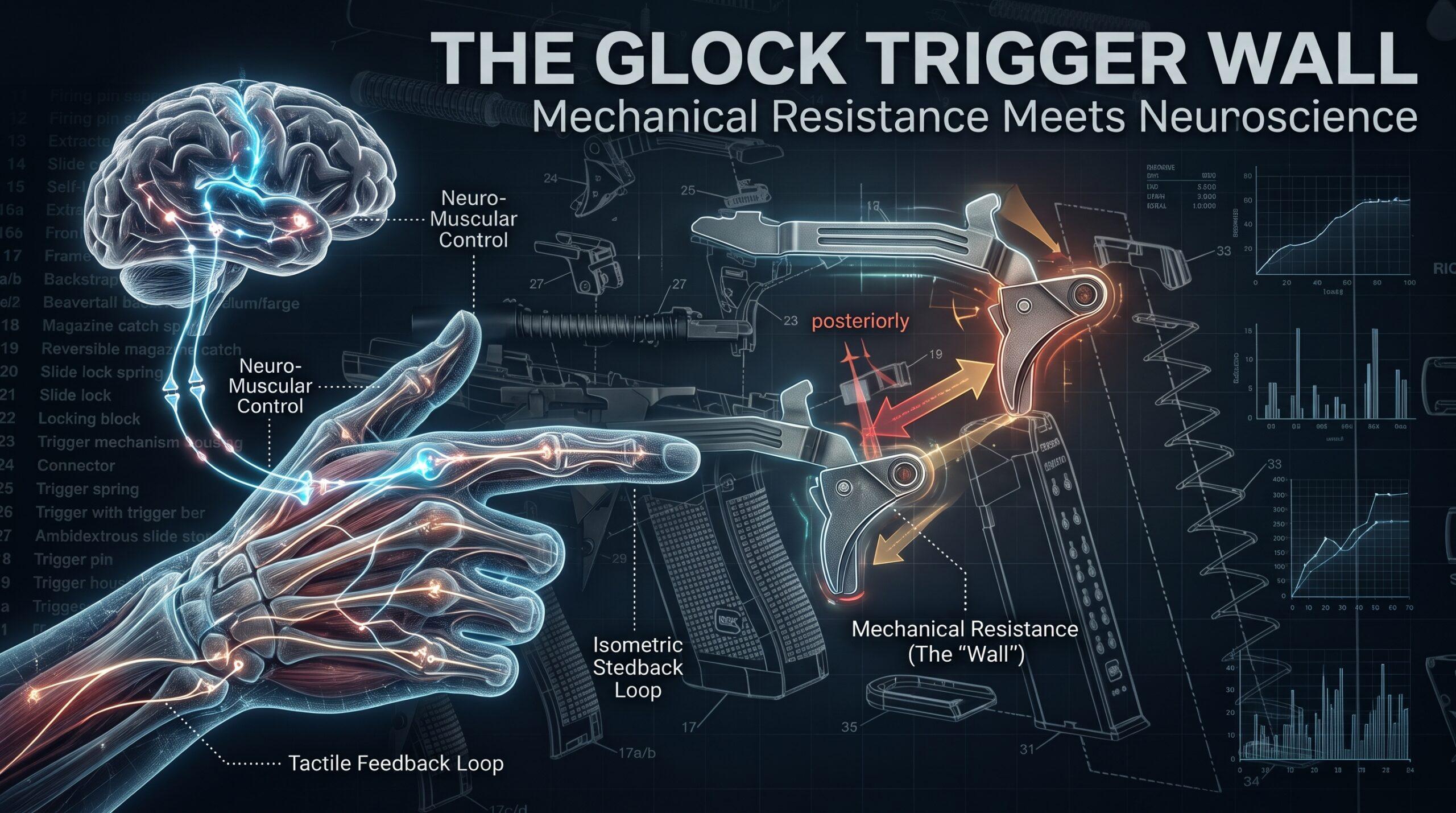
Mechanical resistance versus neurological interpretation: why a Glock trigger may feel like two “walls” and a “final wall” before the break.
What if the Glock trigger wall instructors have taught you to recognize isn’t actually a wall? What if a Glock trigger can produce several sensations that feel like mechanical stops, even though none of them represents an actual physical barrier to continued trigger movement?
For decades, firearms instructors have used the term trigger wall to describe the moment a shooter encounters increased resistance immediately before the trigger breaks.
It is a familiar expression in firearms education. Instructors teach take-up, the wall, the break, overtravel, and reset. These descriptions have become so deeply embedded in firearms training that many shooters assume the wall represents a particular mechanical stopping point inside the trigger system.
But that assumption deserves scientific examination.
A trigger wall is not necessarily a mechanical stop. It is often a perceptual interpretation of changing mechanical resistance.
And in a striker-fired pistol such as a Glock, the shooter may experience more than one of these perceptible resistance changes—what we will deliberately refer to throughout this discussion as “walls”—before the trigger mechanism releases the striker.
In some cases, a shooter may describe two preliminary “walls,” followed by a final, more pronounced resistance point immediately preceding the break.
For purposes of this discussion, the term “final wall” describes the pronounced resistance some shooters perceive immediately before striker release. It does not identify a physical obstruction or a separate mechanical component within the trigger system.
This terminology distinguishes the final perceived resistance threshold from the earlier changes in resistance.
Understanding the distinction requires examining two different systems working together: the firearm’s mechanical architecture and the human nervous system. This distinction also underlies Valortec’s science-based approach to neurological training and marksmanship.
The Glock Safe Action Trigger: Understanding the Mechanical Reality
The conventional Glock Safe Action system incorporates three independently operating passive mechanical safeties:
- Trigger safety.
- Firing pin safety.
- Drop safety.
According to Glock’s official technical documentation, these mechanisms disengage sequentially during a deliberate trigger press and automatically reengage when the shooter releases the trigger.
However, three mechanical safeties do not mean three trigger walls.
To understand why, we must differentiate between a physical obstruction and mechanical resistance.
The Trigger Safety: An Actual Mechanical Obstruction
The trigger safety is a small lever incorporated into the face of the trigger. When engaged, this lever physically prevents the trigger from traveling rearward unless the shooter depresses that lever along with the trigger.
This is a genuine mechanical obstruction.
Once the shooter depresses the trigger safety, the trigger can begin its normal rearward travel.
From this point forward, a properly functioning conventional Glock trigger does not ordinarily encounter an immovable mechanical stop before striker release. Instead, it encounters changing mechanical loads generated by components interacting throughout the firing mechanism.
This is where mechanical reality and human perception begin to diverge.
The Multiple “Walls” of a Glock Trigger
Once the shooter depresses the trigger safety, several mechanical interactions can produce changes in resistance. Some resistance changes may feel pronounced enough for the shooter to interpret them as distinct “walls.” Others may be almost imperceptible.
For purposes of understanding these sensory differences, we can examine a conceptual sequence consisting of:
- A first perceptible “wall,” associated with an early resistance change.
- A second perceptible “wall,” associated with additional changing mechanical loads.
- A final pronounced resistance region, which we call the “final wall,” immediately preceding the break.
These descriptions identify possible sensations, not three mechanically standardized stopping points found in every Glock.
The First Perceptible “Wall”: Initial Resistance Changes
During the initial rearward movement, the trigger bar moves through the firing mechanism while the partially tensioned striker spring undergoes additional compression.
At the same time, the trigger bar interacts with the spring-loaded firing pin safety plunger.
The firing pin safety mechanically blocks forward striker movement until the appropriate point in the trigger cycle. As the trigger bar lifts that safety, the interaction produces additional mechanical loading.
This may create a small but noticeable change in resistance.
For some shooters, the sensation is negligible. For others, it can resemble a preliminary “wall,” a slight bump, or a brief increase in pressure.
But there is no physical wall stopping the trigger at this point.
The shooter is detecting a variation in the force required to continue the trigger’s movement.
Furthermore, we cannot automatically attribute a tactile bump to the firing pin safety without examining or measuring the particular mechanism. Multiple interacting components contribute to the total resistance.
The Second Perceptible “Wall”: Changing Internal Mechanical Loads
As rearward movement continues, several forces influence the trigger’s resistance profile. These include striker spring loading, trigger bar movement, friction between contacting surfaces, and the changing mechanical advantage of the system.
The resulting force is not necessarily uniform.
It may increase gradually, change more abruptly, or vary in a way the shooter can distinguish from the previous portion of travel.
Depending on the particular trigger and the shooter’s sensitivity, the shooter may interpret another region of increased resistance as a second “wall.”
Again, this does not establish the existence of a second mechanical stopping point. It simply identifies another possible perceptual event.
A shooter who is particularly sensitive to small changes in force may distinguish separate resistance transitions, while another shooter experiences the same trigger movement as one continuous press.
The Final Resistance Point: The “Final Wall” Before the Break
As the trigger approaches striker release, the relationship between the trigger bar, connector, and striker-retention surfaces becomes particularly significant.
The connector influences trigger-bar movement until the mechanism releases the striker. This region commonly produces the most recognizable resistance increase associated with the conventional trigger wall.
Here, terminology becomes particularly interesting.
We call this terminal resistance the “final wall” because some shooters experience it as a comparatively firm threshold, despite the absence of a physical stop.
The expression “final wall” describes a subjective resistance threshold, not an engineering classification or a component specified by Glock.
Importantly, the sensation of reaching the “final wall” does not mean the trigger has encountered an immovable mechanical stop. What the shooter perceives is a substantial resistance threshold near the striker-release point.
When the trigger bar disengages from the striker lug, it releases the striker and the mechanism undergoes an abrupt change in loading. The shooter experiences that event as the break.
This distinction matters:
The “final wall” describes the pronounced resistance perceived immediately before the break; the break itself marks the mechanical release event.
Although the two experiences occur in close succession, they are not the same phenomenon.
So, How Many “Walls” Does a Glock Actually Have?
The answer depends on what we mean by a wall.
Mechanically, a properly functioning conventional Glock trigger, with its trigger safety disengaged, has no intended immovable trigger stop interrupting the normal pre-break travel.
Perceptually, a shooter may distinguish two preliminary resistance changes—two “walls”—before reaching the final pronounced resistance region that the shooter may perceive as the “final wall.”
In this conceptual interpretation, the sequence is:
First “wall” → Second “wall” → “final wall” → Break.
But that sequence is an illustration of possible sensory experiences, not a mechanically fixed sequence that every Glock must produce. Another shooter may perceive only one continuous increase in resistance followed by the break.
There is no scientifically defensible reason to declare that every Glock has exactly two preliminary “walls” and one “final wall.”
The correct statement is that multiple resistance transitions may exist in the trigger-force profile, and the human nervous system may interpret some of them as separate “walls,” while some shooters describe the terminal resistance as the “final wall.”
That is a fundamentally different proposition.
The Neuroscience of the Trigger Wall: What the Finger Actually Feels
The human finger is not a calibrated mechanical force gauge. It does not directly measure trigger resistance in pounds or newtons.
Instead, the nervous system continuously integrates sensory information from multiple sources, including:
- Cutaneous mechanoreceptors that detect pressure, skin deformation, and changing mechanical stimulation.
- Proprioceptive information associated with finger position, joint movement, and muscular activity.
- Motor commands and the internal estimation of muscular effort.
- Previous sensory experiences that influence how the shooter anticipates and interprets resistance.
Research published in IEEE Transactions on Haptics, titled Relative Contribution Ratios of Skin and Proprioceptive Sensations in Perception of Force Applied to Fingertip, demonstrated that perceived fingertip force involves both cutaneous and proprioceptive information, with their relative contributions varying under different experimental conditions.
Additional research published in Perception, Two Sensory Channels Mediate Perception of Fingertip Force, examined how humans discriminate different magnitudes of fingertip force.
These studies were not experiments on Glock triggers. They do, however, provide a scientific foundation for understanding why the perception of resistance is not a simple or perfectly objective measurement.
For a broader examination of the cognitive limits of firearms expertise, see Valortec’s article about the illusion of explanatory depth in firearms training.
Force Is Not the Same as the Perception of Force
In mechanical engineering, we can express the resistance encountered during trigger travel as a function of displacement:
F = F(x)
Where F represents the resisting force and x represents trigger displacement.
We express the rate at which resistance changes with displacement as dF/dx.
This relationship is important because a noticeable change in resistance may produce a stronger tactile impression than a similar amount of force applied more gradually.
A relatively small but abrupt increase in resistance may feel like a distinct “wall.” A larger increase distributed smoothly across a longer trigger movement may not produce the same sensation.
A shooter may perceive a distinct “final wall” immediately before striker release.
The nervous system is responding not only to the magnitude of force but also to changes in mechanical stimulation over time and movement.
That is why trigger-pull weight alone cannot explain the subjective experience of a trigger wall.
Two Shooters. One Glock. Different “Walls.”
Consider two shooters examining the same conventional Glock trigger under the same controlled conditions.
No one has modified the striker spring, connector, or firing pin safety. The trigger’s internal geometry also remains unchanged.
Yet the first shooter describes one noticeable wall immediately before the break.
The second shooter reports two preliminary resistance points, followed by a much more pronounced “final wall” before the striker releases.
Who is correct?
Potentially, both.
The physical mechanism may produce several measurable changes in resistance, but each shooter’s nervous system organizes those sensory signals differently.
One individual may experience the resistance profile as a continuous progression culminating in one pronounced wall. Another may interpret separate force transitions as two individual “walls,” followed by the “final wall.”
Neither subjective description, by itself, establishes the precise number or location of mechanical interactions within the firearm.
The mechanical system remains unchanged. The sensory interpretation differs.
This is not a uniquely firearms-related phenomenon. Similar principles arise in human interaction with automobile controls, industrial machinery, surgical instruments, and other mechanical interfaces where operators must interpret changes in tactile resistance.
The physical force exists independently of the individual. The conscious perception of that force emerges from the interaction between mechanical stimulation and neurological processing.
Why the Traditional Definition of a Trigger Wall Is Incomplete
Firearms instruction frequently divides the trigger press into distinct stages: take-up, wall, break, overtravel, reset.
This vocabulary is useful as a general description of the trigger experience. But it risks creating an inaccurate understanding when instructors present these subjective sensations as universal mechanical facts.
Consider the statement: “Every Glock has one wall, and once you reach that wall, the next movement releases the striker.”
As a simplified instructional description, that statement may communicate a recognizable sensation. As a comprehensive explanation of trigger mechanics, however, it is incomplete.
It assumes that the force profile produces one clearly identifiable threshold, that every shooter experiences that threshold consistently, and that the wall represents a specific mechanical stopping point.
Scientific evidence does not establish any of those assumptions as universal.
A Glock trigger can produce several changes in resistance before release.
Whether shooters experience those changes as discrete “walls” or perceive the “final wall” depends on the mechanism’s force profile and each individual’s sensory interpretation.
For comparison with other trigger architectures, see our analysis of single-stage and two-stage AR-15 triggers.
The Difference Between a Mechanical Event and a Sensory Event
This distinction should be central to scientifically informed firearms education.
| Mechanical reality | Neurological interpretation |
|---|---|
| The trigger safety can physically obstruct trigger travel. | The shooter perceives an initial obstruction. |
| As the trigger bar lifts the firing pin safety, it adds to the internal mechanical load. | The shooter may detect a first “wall” or bump. |
| Striker loading, friction, and interacting geometry influence resistance. | The shooter may perceive a second “wall.” |
| The connector and trigger bar guide the mechanism toward striker release. | The shooter may perceive a pronounced “final wall.” |
| The trigger bar releases the striker. | The shooter perceives the break and a change in resistance. |
The mechanical column describes physical interactions and events, while the neurological column describes possible subjective experiences. Both perspectives relate to the same trigger stroke, but they are not interchangeable.
Importantly, the table presents one possible interpretation of the trigger stroke—not a universally verified sequence of sensations.
A Critical Distinction: Resistance Is Not an Obstruction
A mechanical obstruction prevents movement until another action removes, displaces, or disengages it.
Mechanical resistance opposes movement, but sufficient applied force can generally overcome it within the mechanism’s intended operating range.
These are different engineering conditions.
The Glock trigger safety, when engaged, is an example of a physical obstruction to normal rearward trigger movement. By contrast, the force transitions encountered during normal trigger travel after disengaging that safety are primarily resistance phenomena.
The firing pin safety mechanically obstructs striker movement until disengaged, but it does not ordinarily act as an immovable trigger stop.
Similarly, the connector and trigger bar perform essential mechanical functions without creating a separate hard stop at every noticeable resistance transition.
Even the so-called “final wall” is not necessarily a physical barrier. It describes a subjective experience of pronounced resistance.
Consequently, describing every tactile change as a mechanical wall confuses the sensation experienced by the operator with the architecture of the mechanism.
A measurable increase in force does not necessarily represent a mechanical obstruction, and a perceived “wall,” including the “final wall,” does not establish the existence of a physical stopping point.
What This Means for Firearms Education
The implications extend beyond terminology. If instructors ground firearms education in biomechanics, mechanical engineering, motor learning, and neuroscience, they must distinguish objective mechanical events from subjective sensory experiences.
This does not mean eliminating the terms trigger wall or final wall. It means teaching what those terms actually represent.
A “wall” is a useful descriptive metaphor for a perceptible increase in resistance. The “final wall” specifically denotes the pronounced resistance experienced immediately before the break.
Instructors should not present these expressions as universal mechanical features that all shooters will detect at precisely the same moment.
Nor should instructors automatically interpret an individual’s failure to identify a distinct preliminary “wall” or the “final wall” as a deficiency in tactile sensitivity, coordination, or competence.
A shooter may accurately perceive the trigger as a continuous progression of resistance rather than a sequence of separate tactile barriers.
Likewise, someone who reports two preliminary “walls” followed by a “final wall” is not necessarily imagining those sensations. The shooter may be detecting genuine mechanical force variations and interpreting those changes as distinct sensory events.
The responsible scientific position is to recognize both the measurable mechanical forces and the variability of human perception. This principle informs the curriculum of the Valortec Knowledge Academy.
The Need for Objective Measurement
A more rigorous understanding requires instrumented evaluation.
A trigger-force-versus-displacement measurement can help identify actual changes in resistance across the trigger stroke. Researchers can compare those measurements with shooter reports of perceptible preliminary “walls” and the “final wall.”
That approach would help distinguish:
- Measurable changes in force.
- Changes sufficiently pronounced to be perceptible.
- Subjective differences between individuals.
- Actual mechanical release events.
However, a measured resistance peak does not automatically reveal which internal component caused it. Establishing that relationship requires an appropriate mechanical analysis.
The essential principle is simple: measure the mechanism, evaluate the perception, and do not assume they are identical.
Conclusion: The Wall Exists in the Experience, Not Necessarily as a Physical Barrier
The trigger wall is one of the most widely recognized concepts in firearms instruction. Yet the familiar term can obscure the mechanical and neurological complexity behind the sensation.
In a conventional Glock Safe Action trigger, once the shooter depresses the trigger safety, several interacting mechanical components generate changing resistance before the mechanism releases the striker.
Shooters may perceive some of those changes as distinct “walls.”
A shooter might identify a first “wall,” a second “wall,” and a pronounced “final wall” immediately preceding the break.
Another shooter might describe that final resistance simply as the trigger wall. Others may experience only a continuous increase in resistance without identifying any distinct preliminary “walls.”
These are descriptions of possible sensory experiences. They do not establish a fixed number of physical barriers within the mechanism.
The force is mechanical. Its sensation is neurological. The terms “wall” and “final wall” describe that interaction.
Understanding that distinction challenges oversimplified explanations and opens the door to more precise firearms education.
Because the objective of science-based instruction should never be to make the mechanical system conform to familiar terminology. It should be to ensure that our terminology accurately represents the mechanical system—and the human being interacting with it.
A shooter may perceive two preliminary “walls” followed by the “final wall” before the break. That does not mean the trigger contains three physical barriers.
That is the difference between mechanical resistance and neurological interpretation.
Technical and Scientific References
- GLOCK — Safe Action System. Official description of the operating principles and mechanical safeties.
- GLOCK — Owner Resources and Safety FAQs. Manufacturer explanations of the trigger, firing pin safety, and drop safety.
- Matsui, K., Okamoto, S., & Yamada, Y. (2014). Relative Contribution Ratios of Skin and Proprioceptive Sensations in Perception of Force Applied to Fingertip. IEEE Transactions on Haptics, 7(1), 78–85.
- Brothers, T., & Hollins, M. (2014). Two Sensory Channels Mediate Perception of Fingertip Force. Perception, 43(10), 1071–1082.
- Panarese, A., & Edin, B. B. (2011). Human Ability to Discriminate Direction of Three-Dimensional Force Stimuli Applied to the Finger Pad. Journal of Neurophysiology, 105(2), 541–547.