Civilian personal protection demands more than carrying a firearm. You may have invested in a quality holster, an expensive optic, ammunition and several firearms training courses.
Good. But none of that necessarily makes you a difficult target.
If you walk through parking lots staring at your phone, announce your whereabouts on social media, engage in arguments with strangers and open your front door without verifying who is standing outside, you have fundamentally misunderstood civilian personal protection.
Being armed and being security-conscious are two entirely different things.
The principles behind professional protective operations are not exclusive to government officials, diplomats, celebrities or corporate executives. Many of those same principles can be applied to the everyday lives of ordinary citizens.
You don’t need to become a professional bodyguard. You need to start taking responsibility for your own protection.
Civilian Personal Protection: Your Brain Is Your Primary Defensive Tool
Professional protection is fundamentally about prevention. A physical confrontation represents the point at which preventive measures have failed or circumstances have overwhelmed them.
Unfortunately, much of the civilian defensive firearms industry has conditioned people to associate personal protection almost exclusively with shooting.
What about recognizing danger? Understanding human behavior? Managing emotions? Evaluating your surroundings? Making decisions before circumstances deteriorate?
Your firearm cannot compensate for every failure of judgment that preceded a confrontation.
Civilian personal protection requires understanding five fundamental responsibilities:
- Awareness of your surroundings.
- Recognition of potentially dangerous behavior.
- Maintaining reasonable personal boundaries.
- Identifying opportunities to disengage.
- Making timely, responsible decisions.
None of these requires pulling a trigger. Read more about the principles of executive protection.
Road Rage: When Your Ego Becomes a Liability
On April 29, 2026, a road rage incident in Hillsborough County, Florida, escalated into a shooting. The Hillsborough County Sheriff’s Office subsequently announced the arrest of a suspect following an incident involving multiple roadways, including Interstate 4.
This happened in the same community where thousands of people commute to work, take their children to school and conduct their daily business.
Consider how frequently people become emotionally invested in traffic disputes involving complete strangers.
Someone cuts you off. Someone refuses to let you merge. Someone insults you or challenges your masculinity.
And suddenly, your ego demands a response.
Why?
What exactly are you defending? Your life or your pride?
Let the other driver go. Do not participate in the confrontation. If someone is threatening or following you, contact law enforcement and avoid leading that individual to your residence.
There is nothing cowardly about returning home alive. There is nothing courageous about manufacturing a confrontation that could have been avoided.
Criminals Don’t Always Look Like Criminals
In May 2025, North Port, Florida, experienced a targeted home invasion in which suspects allegedly impersonated Amazon delivery personnel. A woman and child were held hostage. Authorities subsequently announced multiple arrests, as FOX 13 Tampa Bay reported.
A familiar uniform. An everyday service. An apparently legitimate reason to be at someone’s front door.
This is where Hollywood’s portrayal of criminal threats becomes particularly problematic. People expect danger to look dangerous.
It doesn’t always work that way.
A uniform is not authentication. A friendly smile is not a security clearance. A convincing story is not proof of legitimacy.
Verify unexpected visitors, communicate through a locked door or doorbell camera, and independently confirm the identity of individuals requesting access to your residence.
You are not obligated to open your door simply because somebody knocks.
Being polite does not require surrendering your personal security.
Your Smartphone Can Be Both an Asset and a Liability
In March 2026, the Volusia Sheriff’s Office announced the arrest of a part-time prisoner transport deputy accused of stalking a former romantic partner using electronic tracking devices.
In August 2026, the Flagler County Sheriff’s Office reported another alleged stalking case involving a man who had met his victim through a dating application and subsequently tracked her movements.
These incidents illustrate a reality that many people underestimate: personal security now extends well beyond physical surroundings.
Your digital footprint, location-sharing permissions, social media activity and connected devices deserve attention.
Yet people routinely publish:
- Their real-time whereabouts.
- Upcoming vacation dates.
- Their children’s schools and activities.
- Their daily routines.
- Photographs revealing private residential information.
In February 2025, Reuters reported on an FBI operation addressing burglaries targeting professional athletes’ residences.
You don’t have to be wealthy or famous to benefit from the security lessons behind those investigations.
Consider what information you make publicly available and whether strangers genuinely need access to it.
Privacy is not paranoia. It is a legitimate component of personal security.
Situational Awareness Is Not Paranoia
Situational awareness does not mean walking around believing everyone is a potential attacker.
It means remaining sufficiently connected to your environment to recognize when something deserves your attention.
When entering a restaurant, shopping center, hotel, gas station or parking facility, take a moment to understand your surroundings.
Where are the exits? Where can you obtain assistance? Is someone behaving aggressively? Are you so distracted that you wouldn’t notice an emerging problem?
There is no need to become obsessed with identifying threats everywhere. Nervousness, unusual clothing or unfamiliar behavior alone does not establish criminal intent.
Evaluate circumstances and observable behavior, not stereotypes.
The objective is not to live in fear. It is to avoid living in unnecessary ignorance. Read our article on situational awareness and everyday safety.
Stop Confusing Equipment With Preparedness
The civilian defensive industry has become increasingly obsessed with equipment.
The latest pistol. The largest weapon-mounted light. The newest optic. The most expensive holster. The next piece of tactical equipment that supposedly provides a decisive advantage.
Meanwhile, how many of those same individuals can confidently answer the following questions?
| Security capability | Personal accountability |
|---|---|
| Situational awareness | Can I recognize an emerging problem? |
| Emotional control | Can I disengage when insulted or provoked? |
| Emergency preparedness | Can my family respond effectively during an emergency? |
| Medical readiness | Can I recognize and respond to life-threatening bleeding? |
| Legal knowledge | Do I understand the legal limitations of defensive force? |
| Digital security | Am I unnecessarily exposing personal information? |
| Physical capability | Can I move to safety when necessary? |
If your entire personal protection strategy revolves around your firearm, your strategy is incomplete.
You cannot purchase judgment, discipline or competence through an online shopping cart.
Your Family Is Part of the Equation
What happens when you are accompanied by your spouse, children or elderly parents?
Does your family know what to do during an emergency? Do your children know how to contact emergency services? Does your household have an emergency communication plan?
What happens when you become injured or incapacitated?
Personal protection is not simply about your individual ability to defend yourself. It also involves the safety of those who depend on you.
A responsible protector considers these circumstances before an emergency occurs.
Train for Reality, Not Fantasy
The overwhelming majority of your daily life will take place outside a shooting range.
Your environment will include distracted drivers, emotionally unstable individuals, crowded public spaces, unfamiliar locations, medical emergencies and people whose intentions may be difficult to determine.
That is reality.
Your education should extend beyond firearms and include conflict avoidance, emergency medical response, personal security, legal accountability and decision-making under pressure.
Firearms proficiency is valuable. Knowing when a firearm is unnecessary is equally valuable.
Seek professional education from individuals with verifiable qualifications, relevant experience and an understanding of the responsibilities associated with civilian personal protection. Learn more about the hidden risk of overconfidence.
Final Thoughts: Become an Asset, Not a Liability
No amount of preparation guarantees that you will never become a victim. Criminal responsibility always belongs to the criminal.
Nevertheless, there are meaningful steps you can take to reduce unnecessary exposure and improve your ability to respond responsibly.
You do not need to live like a covert operative, dress like a military contractor or treat every trip to the grocery store as a tactical operation.
You need awareness, discipline, humility, sound judgment and realistic education.
Your responsibility is not to win arguments, demonstrate your masculinity or prove how dangerous you can be.
Your responsibility is to get yourself and your loved ones home safely.
That is what civilian personal protection is about.
Be difficult to deceive. Be difficult to provoke. Be difficult to surprise.
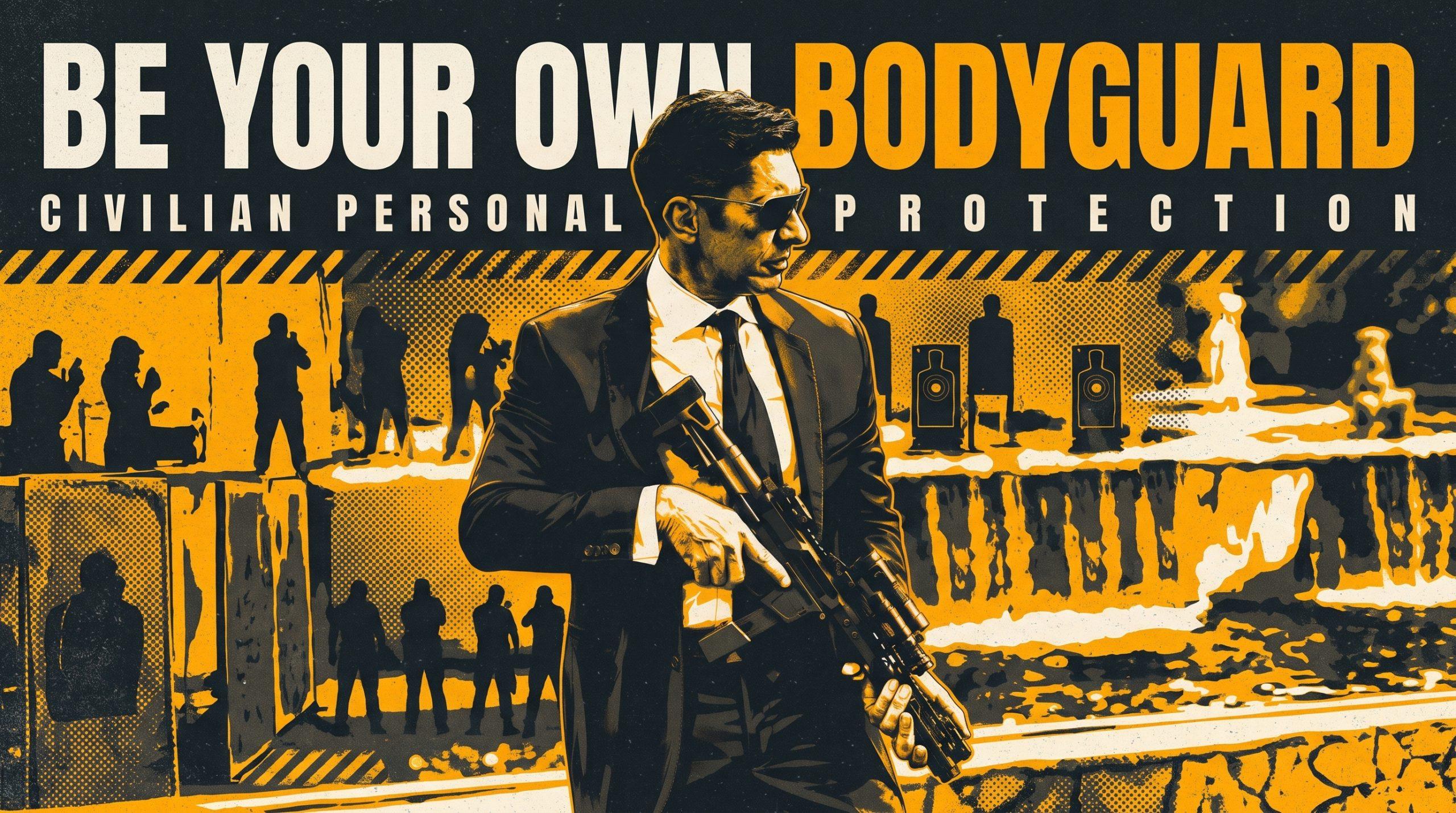
Be your own bodyguard.
You are either an asset or a liability. The world needs more assets.