C-Clamp vs Vertical Foregrip vs Forward Index Grip: Which Carbine Grip Wins?
For years, the firearms world has argued about the “best” way to hold the front of a carbine.
Wrap your hand around a vertical foregrip.
Stretch your arm forward and clamp the handguard.
Thumb over the top.
Elbow out.
Elbow down.
Pull harder.
Drive the gun.
And, naturally, everybody has an instructor, competition shooter, military unit, YouTube channel, or Instagram reel proving that their version is the correct one.
There is just one problem:
Physics doesn’t watch YouTube. And your muscles don’t care what looks tactical.
When we examine carbine grip technique, rifle biomechanics, muscle activation, leverage, physiological tremor, muzzle stability, and support-hand position, a very different picture begins to emerge.
The best support-hand technique may not be the traditional vertical foregrip.
It may not even be the aggressive C-clamp that has dominated modern carbine culture.
The strongest scientific argument points toward something between the two:
The Forward Index Grip.
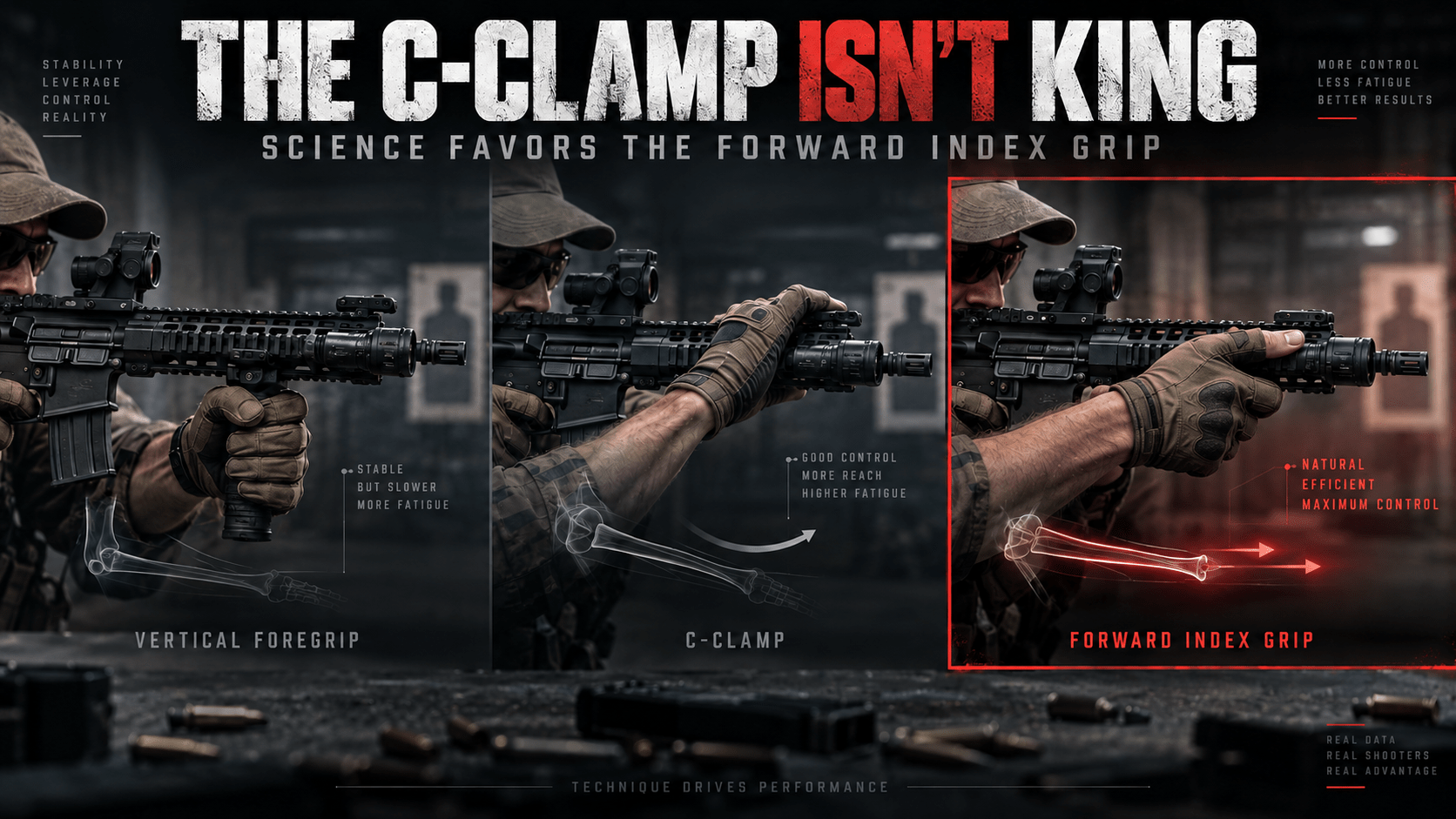
For purposes of this article, the Forward Index Grip means placing the support hand relatively far forward on the handguard, maintaining a mechanically efficient arm and wrist position, and allowing the thumb to point generally toward the target as a natural directional index.
Not maximum reach.
Not a death grip.
Not an exaggerated elbow position.
Just leverage, alignment, and enough muscular tension to control the rifle without fighting your own nervous system.
And that distinction matters.
C-Clamp vs Vertical Foregrip vs Forward Index Grip: The Three Carbine Grip Methods
Let’s simplify the debate.
We are comparing three common rifle support-hand concepts:
- the traditional vertical foregrip,
- the aggressive C-clamp,
- and the Forward Index Grip.
Vertical Foregrip: Comfortable, Repeatable, but Potentially Limited by Leverage
The support hand wraps around a handle mounted underneath the handguard.
It is comfortable.
It gives the shooter a positive reference point.
It can place the wrist in a relatively neutral position.
And depending on its location, it can reduce some muscular demands associated with reaching farther forward.
Its usefulness is real—not imaginary.
But comfort is not the same thing as mechanical advantage.
If that vertical foregrip is positioned too far rearward, you shorten the distance between the support hand and the front of the rifle.
And that costs you leverage.
C-Clamp Grip: Excellent Rifle Control, but Often Overdone
Then came the C-clamp.
Move the support hand forward.
Wrap the hand around the handguard.
Thumb over the top.
Often extend the elbow outward.
Control the rifle aggressively.
Competition and tactical shooting communities helped popularize variations of this position because moving the support hand forward gives the shooter greater authority over muzzle movement and rifle transitions.
And that part makes sense.
The problem begins when forward hand placement becomes confused with maximum muscular tension.
There is nothing scientifically magical about squeezing the handguard as hard as possible.
There is nothing magical about forcing the elbow into a particular position.
And there is certainly nothing magical about reaching so far forward that the shoulder begins performing unnecessary work simply to maintain the grip.
The useful component of the C-clamp may not actually be the “clamp.”
It may simply be the forward support-hand position.
That changes the entire conversation.
Forward Index Grip: Forward Leverage Without Excessive Muscle Tension
The Forward Index Grip keeps the support hand forward enough to create useful leverage without forcing the shooter into unnecessary tension.
The thumb follows the direction of the rifle and can function as a proprioceptive reference.
The wrist remains reasonably comfortable.
The shoulder is not pushed beyond its efficient range.
The objective is not maximum force.
The objective is maximum useful rifle control for minimum unnecessary neuromuscular effort.
Why Forward Support-Hand Position Improves Carbine Control
The easiest way to understand this requires almost no advanced science.
Imagine opening a heavy door.
Would you push it two inches away from the hinge?
Of course not.
You push near the outside edge because the farther you are from the pivot, the more leverage you have.
A rifle follows the same fundamental mechanical principle.
Rifle Grip Leverage: Why Support-Hand Distance Matters
Torque depends on the amount of force applied and how far that force is applied from the rotational point.
Torque = Force × Lever Arm
Increase the useful lever arm and you can generate the same rotational control with less force.
That matters because your support hand is not merely holding the rifle up.
It contributes to controlling:
- muzzle elevation,
- lateral movement,
- rotational movement,
- directional transitions,
- recovery following movement,
- and the position of the rifle relative to the body.
A hand positioned farther forward generally has greater mechanical opportunity to influence those movements.
This is why the real advantage of modern forward carbine grips isn’t fashion.
It’s leverage.
Why “As Far Forward as Possible” Is Bad Rifle-Grip Advice
Here is where carbine doctrine frequently crashes into human anatomy.
If farther forward provides more leverage, shouldn’t you simply stretch your support hand to the end of the handguard?
No.
Because your rifle has a lever system—but so does your body.
Excessive Forward Reach Increases Shoulder and Arm Demand
As the support arm extends farther:
- shoulder demand changes,
- elbow position changes,
- scapular position changes,
- forearm pronation changes,
- muscle activation changes,
- and the weight of your own arm becomes harder for the shoulder to support.
A 2025 study published in Acta of Bioengineering and Biomechanics examined rifle handling length and support-hand distance using motion capture and musculoskeletal modeling.
Researchers found that changing rifle and support geometry altered body posture, joint forces, muscle activation, and aiming stability.
Most importantly, identified muscle-activation patterns accounted for approximately 83.8% to 98.2% of the variance in aiming stability within their analysis.
How you interface with the rifle materially changes what your muscles are doing.
And those muscular patterns are strongly connected to muzzle stability.
The answer therefore isn’t:
REACH FARTHER.
The answer is:
Place the Support Hand as Far Forward as You Can Remain Biomechanically Efficient
That is a completely different rule.
What Is the Forward Index Grip?
The Forward Index Grip combines forward hand placement with efficient skeletal alignment and controlled muscular tension.
The goal is not to copy a specific photograph.
The goal is to create an efficient mechanical relationship between the shooter and the rifle.
Forward Index Grip Hand Placement
Place the support hand forward enough to gain useful leverage.
Allow the wrist to remain reasonably comfortable.
Keep the elbow mechanically efficient instead of forcing an artificial position.
Avoid pushing the shoulder into extreme extension.
Maintain enough contact pressure to stabilize the rifle.
Allow the support thumb to lie generally parallel with the handguard and point toward the target.
Why the Support Thumb Works as a Proprioceptive Index
The thumb is not replacing the optic.
It is not literally aiming the rifle.
Instead, it may function as a proprioceptive index—a consistent relationship between the orientation of the hand, forearm, rifle, and intended direction.
Humans are remarkably capable of knowing where their limbs are positioned without constantly looking at them.
That ability is proprioception.
The Forward Index Grip takes advantage of that natural relationship without requiring the shooter to aggressively wrap and squeeze the entire handguard.
More importantly:
It preserves one of the biggest advantages of the C-clamp—the forward lever arm—without requiring excessive support-arm tension.
C-Clamp Grip Problems: When More Tension Creates Less Stability
There is nothing inherently wrong with putting the thumb over the handguard.
Some shooters perform extremely well with a C-clamp.
The problem is the way the technique is frequently interpreted.
More pressure. More extension. More tension. More control.
Except muscular tension doesn’t work that way indefinitely.
Grip Pressure Can Increase Rifle Stability—Up to a Point
Increasing grip pressure and muscular co-contraction can increase mechanical stiffness in the arm.
That sounds beneficial.
Initially, it can be.
Research into human upper-limb control demonstrates that muscular co-contraction can increase joint stiffness and resistance to external disturbance.
So some tension is necessary.
A completely relaxed collection of joints is not going to control a moving rifle particularly well.
But the relationship does not continue forever.
The human body isn’t a bench vise.
Muscles produce force through neural signals.
Those signals fluctuate.
Muscles fatigue.
Physiological tremor exists.
Excessive Muscle Tension Can Increase Tremor
Martin Lakie’s paper, The Influence of Muscle Tremor on Shooting Performance, demonstrated an inverse relationship between tremor magnitude and shooting performance.
Research into isometric force control has also identified an 8–12 Hz physiological tremor component associated with force production and neuromuscular control.
In plain English:
Trying harder does not automatically make the rifle steadier.
At some point, more muscular effort becomes more muscular noise.
That is where an aggressively over-tensioned C-clamp can become self-defeating.
Skeletal Alignment vs Muscle Tension in Rifle Shooting
Here’s another uncomfortable concept for the “GRIP IT HARDER” crowd:
Your muscles shouldn’t have to do everything.
A stable shooting structure uses the skeleton, joints, and muscular system together.
That principle has existed in rifle marksmanship for generations.
The U.S. Marine Corps’ MCRP 3-01A Rifle Marksmanship doctrine has long addressed relationships among body position, structural support, stability, and muscular effort.
Efficient Rifle Control Requires Appropriate Muscle Activation
You don’t want zero muscle activation.
You want appropriate activation.
The rifle needs enough muscular and structural stiffness to resist unwanted movement without forcing every joint into unnecessary tension.
Think about holding a heavy object.
You can hold it with your arm completely extended.
Or you can hold it from a mechanically efficient position.
Both work.
One costs considerably more muscular energy.
The same principle applies to carbine grip and support-hand placement.
Vertical Foregrip Advantages: When It Still Makes Sense
Before everybody throws their vertical foregrips into the trash, don’t.
The vertical foregrip has legitimate advantages.
A vertical handle can reduce awkward wrist positioning.
Research by McGorry and Lin, Power Grip Strength as a Function of Tool Handle Orientation and Location, demonstrated that both handle orientation and reach location influence human grip-force capability.
Although the study concerns general ergonomics rather than firearms specifically, the underlying hand and wrist mechanics remain relevant.
When a Vertical Foregrip May Be the Better Choice
A vertical foregrip may make sense when:
- the rifle has a short handguard,
- accessories occupy available rail space,
- the shooter has limited wrist mobility,
- prolonged holding creates excessive fatigue,
- rifle configuration prevents comfortable forward hand placement,
- or the shooter achieves measurably better repeatability using the vertical grip.
Vertical Foregrip as an Index Point Instead of a Full Grip
There is another distinction that matters.
Using a vertical foregrip as an index or hand stop is not the same thing as wrapping the entire hand around it like a broomstick.
A short vertical foregrip mounted farther forward can complement the Forward Index Grip.
The fingers or palm can index against the grip while the hand remains primarily associated with the handguard.
That preserves much of the forward leverage while creating a consistent tactile reference.
Barrel Harmonics and Rifle Grip: Does Support-Hand Position Affect Accuracy?
This is where the internet usually starts talking nonsense.
Yes, rifle barrels vibrate.
High-speed measurement, numerical simulation, and finite-element studies demonstrate that barrels experience measurable vibration following ignition and during projectile travel.
Štiavnický and Lisý’s study, Influence of Barrel Vibration on the Barrel Muzzle Position at the Moment when Bullet Exits Barrel, examined how barrel attachment and fixing conditions influence barrel vibration and muzzle position as the projectile exits.
Another study, Xu et al.’s Study on Barrel Vibration Characteristics of Typical Sniper Rifle, examined barrel vibration modes and muzzle displacement.
Your Support Hand Does Not Consciously Control Barrel Harmonics
Your nervous system isn’t watching the barrel oscillate and then correcting those vibrations before the bullet exits.
It cannot.
What the shooter can influence is the condition of the rifle-human system before ignition:
- hand pressure,
- shoulder pressure,
- body alignment,
- joint stiffness,
- handguard loading,
- rifle orientation,
- and pre-shot muzzle movement.
With a rigid free-floating handguard, grip selection is therefore much more about whole-rifle stability and shooter biomechanics than directly “controlling barrel harmonics.”
The barrel vibrates.
The rifle moves.
Those phenomena are related—but they are not identical.
Muzzle Stability and Rifle Accuracy: Why Support-Hand Technique Matters
A classic 1997 study by Yuan and Lee, Effects of Rifle Weight and Handling Length on Shooting Performance, examined experienced marksmen and found that changing rifle geometry altered upper-extremity posture, muscle activation, and aiming stability.
The researchers also reported correlations between aiming fluctuation and shot-group dispersion ranging from approximately 0.86 to 0.98.
In plain language:
A steadier muzzle tends to produce better shooting.
Body Sway and Aim-Point Movement Affect Rifle Stability
Ball, Best, and Wrigley examined the relationship in Body Sway, Aim Point Fluctuation and Performance in Rifle Shooters.
Their research demonstrated relationships between body sway and aim-point fluctuation while showing that the exact relationship varies among shooters.
Era and colleagues likewise found that skilled rifle shooters demonstrated superior postural stabilization during aiming in Postural Stability and Skilled Performance—A Study on Top-Level and Naive Rifle Shooters.
Translation:
Your hands aren’t controlling the rifle alone.
Your entire body is.
The grip has to work with that system—not against it.
Which Carbine Grip Is Best: Vertical Foregrip, C-Clamp or Forward Index Grip?
If we force the three techniques onto the podium, here’s where they land.
Third Place: Traditional Rearward Vertical Foregrip
Comfortable.
Repeatable.
Potentially excellent for particular rifle configurations.
But when the support hand sits significantly rearward, it sacrifices mechanical leverage over the front of the rifle.
Useful?
Absolutely.
Mechanically optimal for general dynamic carbine control?
Probably not.
Second Place: Aggressive C-Clamp Grip
Excellent forward leverage.
Strong rotational control.
Highly effective for many shooters.
But the technique becomes inefficient when shooters confuse control with maximum muscular tension or push the support hand beyond its biomechanically efficient working range.
The C-clamp got something very right:
Move the hand forward.
Then firearms culture did what firearms culture frequently does.
It exaggerated it.
First Place: Forward Index Grip
This is where the combined evidence points.
Not because a scientific paper officially named a “Forward Index Grip” and crowned it champion.
It didn’t.
There is currently no peer-reviewed study identified in this review that directly compares these exact three named techniques under identical live-fire conditions.
Instead, the conclusion comes from combining research involving:
- rifle support length,
- aiming stability,
- mechanical leverage,
- upper-extremity biomechanics,
- muscle activation,
- postural stability,
- physiological tremor,
- grip orientation,
- and muzzle movement.
The winning principle is surprisingly simple:
Place the support hand forward enough to gain useful leverage, but not so far that the body must create unnecessary muscular tension to maintain the position.
The thumb pointing forward is not magic.
The exact hand position is not magic.
And the technique isn’t supposed to look dramatic.
That’s the point.
Stop Teaching Rifle Grip Positions. Start Teaching Biomechanical Principles.
This may be one of the biggest problems with modern firearms instruction.
We love copying positions.
We see somebody successful holding a rifle a certain way and immediately conclude:
That’s the position.
Then everybody gets molded into it.
Tall shooter.
Short shooter.
Long arms.
Short arms.
Heavy rifle.
Light rifle.
Fourteen-inch rail.
Ten-inch rail.
Body armor.
No armor.
Doesn’t matter.
Everybody gets the same Instagram screenshot.
That isn’t biomechanics.
That’s imitation.
The Five Principles of an Efficient Carbine Support-Hand Grip
A shooting position should result from principles.
Those principles are:
Leverage. Stability. Repeatability. Skeletal efficiency. Appropriate muscular tension.
Your individual body determines exactly how those principles should look.
Science doesn’t tell every shooter to place the thumb at precisely the same M-LOK slot.
It tells us something much more useful:
Stop using more muscle than the rifle requires.
The Science of Rifle Control: More Leverage, Less Unnecessary Tension
The best grip isn’t the grip that makes you feel strongest.
It’s the grip that lets you generate the required rifle-control torque while spending the least unnecessary muscular effort.
That is efficiency.
A shooter applying enormous muscular force from a poor mechanical position can have less effective muzzle control than another shooter applying moderate force through a longer lever arm and better skeletal geometry.
The second shooter isn’t weaker.
The second shooter is using physics.
The Best Carbine Grip Maximizes Control While Minimizing Neuromuscular Effort
That is the essence of the Forward Index Grip:
More useful leverage. Less unnecessary muscular tension. Better integration between shooter and rifle.
And that should be the objective of every rifle position we teach.
Final Verdict: The Forward Index Grip Has the Strongest Scientific Argument
The vertical foregrip isn’t dead.
The C-clamp isn’t stupid.
And the Forward Index Grip isn’t a magical new technique that invalidates everything that came before it.
But the available science strongly suggests that the firearms industry has spent too much time arguing about what the support hand should look like and not enough time asking what the support hand is mechanically supposed to accomplish.
Once you ask the second question, the answer becomes considerably clearer.
The support hand needs to provide:
leverage without excessive reach, stability without unnecessary rigidity, tension without excessive tremor, and repeatability without wasted muscular effort.
That leads toward a forward support-hand position.
But not necessarily the hardest C-clamp.
Not necessarily the longest possible reach.
And not necessarily a fist wrapped around a vertical handle close to the receiver.
It leads toward something considerably less dramatic—and considerably more scientific:
Put the Hand Where the Physics Works and the Body Doesn’t Have to Fight It.
That’s the Forward Index Grip.
And right now, it has the strongest argument.
Scientific References on Rifle Grip, Muzzle Stability and Shooting Biomechanics
- Wang Y, Xu C, Wang Y, He L. Effects of Rifle Handling Length and Supporting Length on Aiming Performance and Biomechanics. Acta of Bioengineering and Biomechanics. 2025;27(1):33–45.
PubMed | DOI: 10.37190/ABB-02555-2024-02 - Yuan CK, Lee YH. Effects of Rifle Weight and Handling Length on Shooting Performance. Applied Ergonomics. 1997;28(2):121–127.
PubMed | DOI: 10.1016/S0003-6870(96)00043-9 - Ball KA, Best RJ, Wrigley TV. Body Sway, Aim Point Fluctuation and Performance in Rifle Shooters: Inter- and Intra-Individual Analysis. Journal of Sports Sciences. 2003;21(7):559–566.
PubMed | DOI: 10.1080/0264041031000101881 - Era P, Konttinen N, Mehto P, Saarela P, Lyytinen H. Postural Stability and Skilled Performance—A Study on Top-Level and Naive Rifle Shooters. Journal of Biomechanics. 1996;29(3):301–306.
DOI: 10.1016/0021-9290(95)00066-6 - Lakie M. The Influence of Muscle Tremor on Shooting Performance. Experimental Physiology. 2010;95(3):441–450.
PubMed | DOI: 10.1113/expphysiol.2009.047555 - McGorry RW, Lin JH. Power Grip Strength as a Function of Tool Handle Orientation and Location. Ergonomics. 2007;50(9):1392–1403.
PubMed | DOI: 10.1080/00140130701340115 - Štiavnický M, Lisý P. Influence of Barrel Vibration on the Barrel Muzzle Position at the Moment when Bullet Exits Barrel. Advances in Military Technology.
Read the study - Xu N, Guan X, Liu G, Xu C. Study on Barrel Vibration Characteristics of Typical Sniper Rifle. Vibroengineering Procedia. 2019;24:6–10.
DOI: 10.21595/vp.2018.20370 - U.S. Marine Corps. MCRP 3-01A: Rifle Marksmanship.
Official U.S. Marine Corps publication information
Scientific Disclosure
There is currently no peer-reviewed study identified in this review that directly compares a traditional vertical foregrip, an aggressive modern C-clamp, and the exact Forward Index Grip described in this article under identical live-fire conditions.
The conclusions presented here are based on the convergence of peer-reviewed research involving rifle support length, human-rifle geometry, muscle activation, aiming stability, physiological tremor, postural control, grip ergonomics, and barrel dynamics.
That distinction matters.
Science should inform firearms instruction—not be rewritten to validate whatever technique we already wanted to teach.