America’s Security Industry Has a Competence Problem
America has built an entire security industry around a dangerous fantasy:
Give someone a uniform, a radio, a plastic identification card, and perhaps a handgun—and somehow that person becomes capable of protecting human life.
He does not.
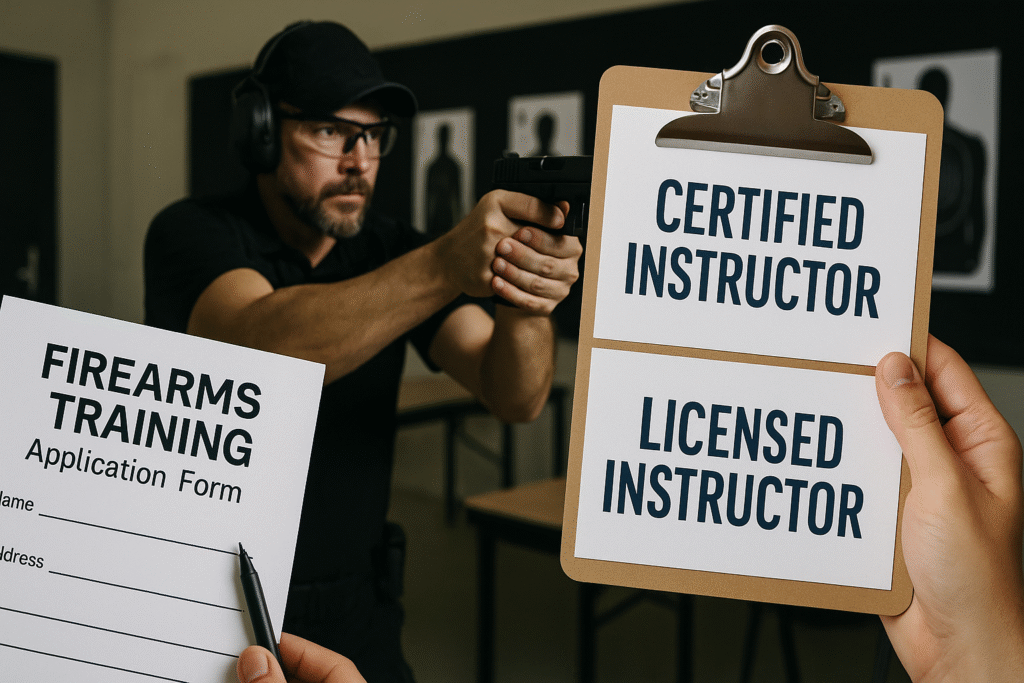
A license proves that the government gave someone permission to work. It does not prove that he can recognize an attack, make a decision under pressure, control his fear, move toward danger, protect another person, or prevail in a violent confrontation.
It certainly does not prove that he is a warrior.
Garret Machine, drawing from his experience in Israel’s Duvdevan Unit, protective operations for the Israeli Ministry of Defense, American law enforcement, and years of security instruction, teaches a concept that makes many people in the American security industry uncomfortable:
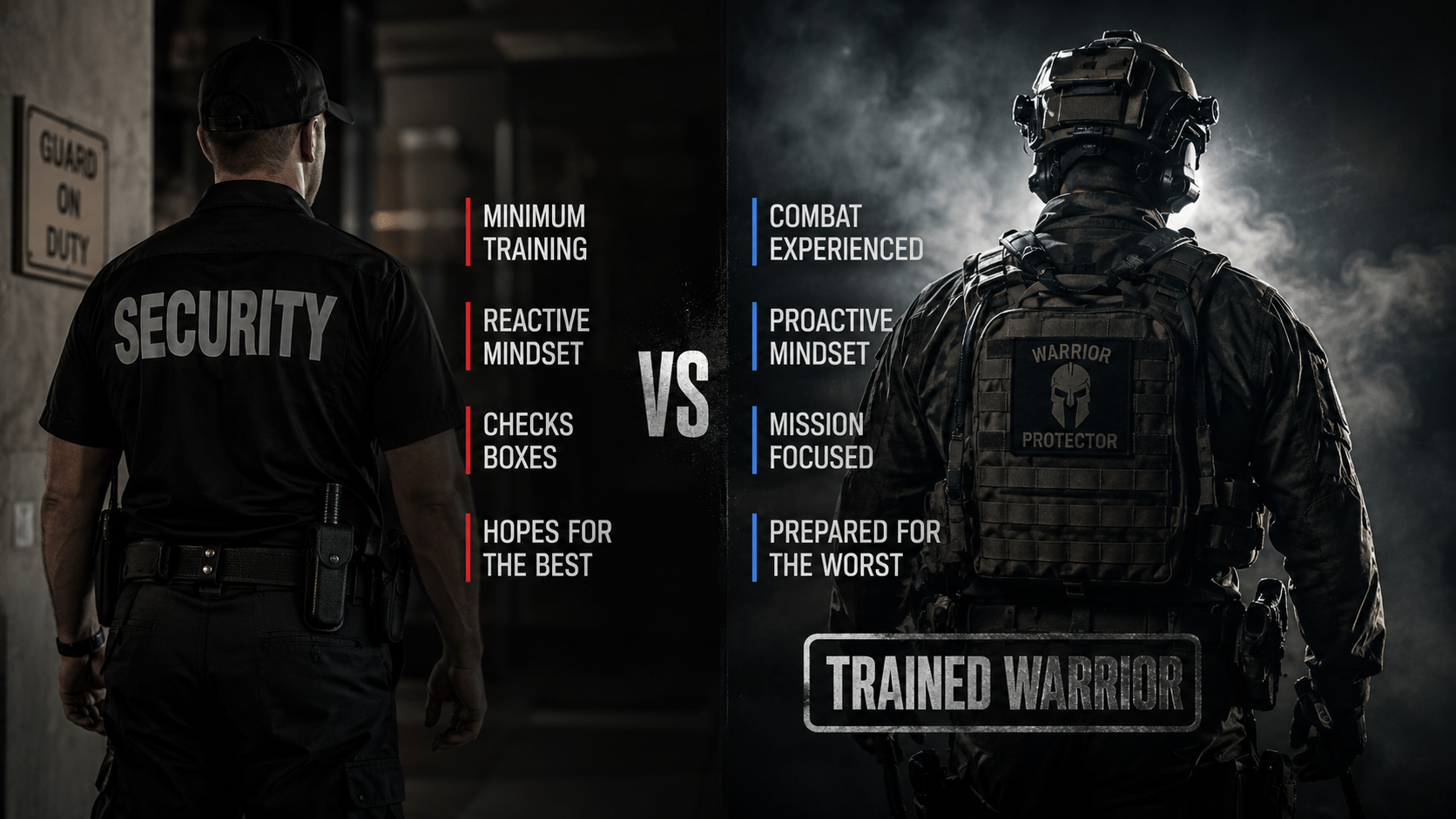
Israel trains fighters first and security professionals second.
America frequently does the opposite. We train guards first—sometimes barely—and hope they will magically become fighters when bullets start moving.
That is not a training system.
That is gambling with other people’s lives.
The Minimum Standard Has Become the Maximum Effort
In much of the American security industry, the minimum licensing requirement has quietly become the professional standard.
Complete a short course.
Pass a written test.
Fire a basic qualification.
Receive a card.
Congratulations. You are now standing between innocent people and a violent attacker.
That should disturb anyone with common sense.
A person can complete many armed-security courses without ever experiencing a realistic scenario, making a decision under stress, treating a traumatic injury, moving another person to safety, working as part of a response team, or facing an adversary who refuses to stand still.
The student fires at a stationary paper target in daylight, under predictable conditions, with the instructor announcing exactly what is about to happen.
The paper does not move.
The paper does not ambush anyone.
The paper does not scream.
The paper does not shoot back.
Yet we pretend that a passing score on that target establishes operational readiness.
It does not.
It establishes that the student met a minimum administrative requirement on one particular day. Nothing more.
A certificate is not courage. A qualification card is not judgment. A license is not competence.
And a uniform is definitely not a personality transplant.
Fighter First Does Not Mean Reckless First
The term warrior makes some people nervous because they immediately imagine aggression without control.
That is not the doctrine.
A professional warrior is not an angry person looking for permission to hurt someone. He is disciplined, observant, controlled, legally grounded, and capable of applying force only when force becomes necessary.
The warrior mindset is not about ego.
It is about responsibility.
It means accepting that there may come a moment when prevention fails, deterrence fails, verbal commands fail, and another human being begins intentionally attacking innocent people.
At that moment, somebody must act.
Not posture.
Not negotiate with himself.
Not wait for a committee meeting.
Act.
The purpose of serious security training is to prepare the professional to make that decision lawfully, rapidly, accurately, and without losing control of himself.
That capability cannot be installed during the attack.
It must already be there.
Israel Understands the Correct Order
The Israeli model begins with a combat foundation. Protective personnel are generally selected from people who have already developed discipline, tactical awareness, physical resilience, and experience functioning under genuine pressure.
Combat service does not automatically make someone qualified for protective work. It does, however, provide raw material that can be evaluated, selected, and refined.
First comes the ability to fight.
Then comes selection.
Then specialization.
Then continuous evaluation.
The individual learns the specific responsibilities of the assignment: protective formations, access control, surveillance detection, emergency medicine, tactical movement, advance work, route planning, threat identification, combat shooting, evacuation procedures, and coordinated response.
The American private-security model frequently reverses that sequence.
We place an inexperienced person at a door, give him a checklist, and tell him to call somebody more qualified when a serious problem appears.
That may be acceptable for reporting a broken window.
It is not a serious strategy for stopping an active killer.
Israel builds warriors and teaches them how to protect.
America often builds guards and hopes courage arrives with the uniform allowance.
Hope is not doctrine.
The Fight Is Usually Decided Before It Begins
On March 30, 1981, John Hinckley Jr. fired six rounds at President Ronald Reagan outside the Washington Hilton.
The protective detail did not have time to conduct a meeting. No one distributed an updated policy manual. Nobody asked for permission to perform the mission.
Agent Timothy McCarthy placed himself between the gunman and the president and was shot. Agent Jerry Parr forced Reagan into the limousine, recognized that the president’s medical condition was deteriorating, and redirected the vehicle to George Washington University Hospital.
Other agents and officers attacked the problem, controlled the gunman, and secured the scene.
The response was not created during those few seconds.
It had been created through selection, training, repetition, clearly defined responsibilities, and decisions made long before the first shot.
That is the point many training organizations still refuse to understand.
During a real attack, people rarely rise to the level of their imagination. They generally fall to the level of their preparation.
The incident will not wait for the responder to become brave.
It will reveal whether he prepared to act.
Equipment Cannot Repair a Defective Mindset
The American security market loves equipment because equipment is easy to sell.
New pistol.
New optic.
New holster.
New body armor.
New radio.
New tactical pants with enough pockets to invade a small country.
None of those products creates decisiveness.
Equipment supports capability. It does not manufacture it.
An individual may possess the finest firearm, the most expensive armor, and every tactical accessory advertised by a bearded man standing beside a rental helicopter. If he cannot recognize danger, manage fear, communicate, make decisions, and act under pressure, he is simply better equipped to fail.
History has repeatedly shown us what happens when armed personnel lack the doctrine, preparation, or willingness to move toward violence.
At Columbine High School in April 1999, officers initially followed the prevailing containment doctrine while victims remained inside with the attackers. That tragedy forced American law enforcement to reconsider how officers respond to active killers.
At Marjory Stoneman Douglas High School in Parkland in February 2018, an armed school resource officer remained outside while the attack continued inside the building.
A firearm was present.
A uniform was present.
A radio was present.
The required action was not.
This is the lesson people avoid because it is uncomfortable: possessing the tools of protection does not make someone a protector.
The uniform does not conceal the absence of mindset.
Eventually, it exposes it.
What Real Preparation Builds
Garret Machine’s warrior-first doctrine identifies several capabilities that cannot be replaced by a short licensing course.
Self-Knowledge Under Pressure
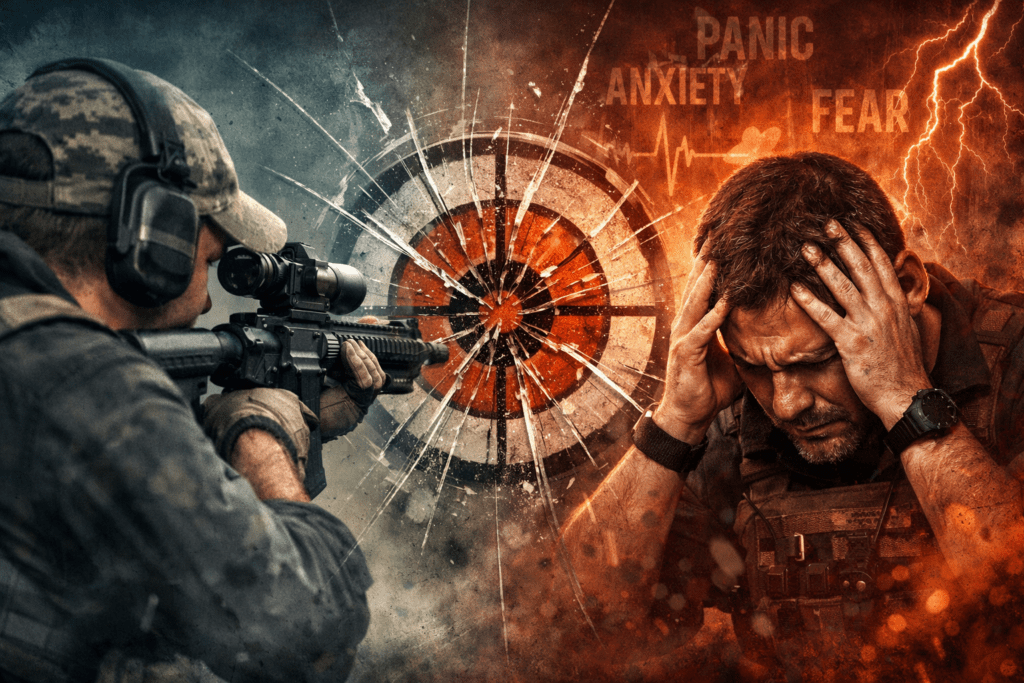
A professional must understand how he functions when frightened, exhausted, confused, and physically overwhelmed.
Will he move?
Will he communicate?
Will he make a decision?
Will he continue fighting after the original plan collapses?
A person who has never been tested does not know those answers. He may believe he knows. Confidence is inexpensive when nobody is shooting.
The first time a protector discovers his true response to extreme stress should not be during an attack on the people he was hired to protect.
Decisions Made Before the Emergency
Violent incidents develop faster than most people can process them.
There may be no time to invent a response.
Professionals establish emergency procedures in advance. They rehearse them until each team member understands his role, decision-making authority, communication responsibilities, evacuation route, medical function, and lawful use-of-force parameters.
This does not eliminate judgment. It creates a foundation from which judgment can operate.
The unprepared person sees chaos.
The trained professional sees a problem he has already studied.
The Ability to Think Like an Attacker
Security cannot be reduced to walking a perimeter and checking boxes on a clipboard.
A serious professional looks at the facility from the adversary’s perspective.
Where are the predictable routines?
Which entrance receives the least attention?
Where does the camera coverage fail?
Who has access without meaningful verification?
Where would an attacker stage?
Which employee can be manipulated?
What happens during shift changes, deliveries, fire alarms, power failures, or large public events?
A guard confirms that a door is locked.
A security professional asks how he would defeat it.
That difference is not paranoia. It is threat-informed planning.
Controlled Familiarity With Violence
Good people naturally resist hurting others. That is normally a positive human characteristic.
During a violent attack, however, hesitation may give the aggressor additional time to kill.
Professional preparation does not teach people to enjoy violence. It teaches them to recognize when lawful force has become unavoidable and to apply the necessary level of force decisively.
The goal remains prevention.
When prevention fails, the goal becomes stopping the threat.
Not punishing it.
Not satisfying anger.
Stopping it.
Anything less may abandon innocent people to someone who has no hesitation at all.
Certificates Do Not Fight
This is where the American training industry becomes offended.
We have confused education with attendance.
People collect certificates from weekend programs and immediately begin presenting themselves as subject-matter experts. They complete instructor courses designed so that almost everyone who pays will graduate. Then they return home and begin certifying the next generation of equally unprepared professionals.
It is a beautiful business model.
It is also professionally embarrassing.
A certificate confirms that someone completed a program. Its value depends entirely on the quality of the program, the standards enforced, the instructor’s competence, and the possibility of failure.
When everyone passes, the certificate does not identify excellence.
It identifies payment.
Serious professions use standards to remove people who cannot perform the job. Unserious professions lower the standards until failure becomes almost impossible.
Then they print a certificate and call the problem solved.
Human life deserves better.
Combat Experience Is Valuable—But It Is Not a Free Pass
Saying that combat and law-enforcement experience provide a valuable foundation does not mean every veteran or police officer is automatically qualified for protective work.
Some excellent soldiers make poor security professionals.
Some experienced officers lack patience, communication skills, emotional control, teaching ability, or protective judgment.
The Israeli model does not simply ask whether a candidate served.
It selects.
Experience establishes eligibility. It does not guarantee assignment.
The candidate must still demonstrate discipline, judgment, temperament, physical capability, professionalism, and the ability to operate within a coordinated system.
This is another lesson the American market frequently ignores.
We sometimes worship résumés without evaluating current performance.
A person may have done impressive things twenty years ago. The relevant question is whether he can perform the mission today.
Past experience matters.
Present competence matters more.
America Cannot Copy Israel—but It Can Stop Making Excuses
The United States cannot simply duplicate the Israeli military and security pipeline. Our military system, laws, culture, population, and private-security industry are different.
That does not excuse weak standards.
American security organizations can still build serious development programs.
They can select candidates rather than accepting everyone with a pulse and a payment method.
They can require physical readiness.
They can teach lawful use of force, de-escalation, emergency medicine, defensive tactics, threat recognition, communications, and realistic firearms skills.
They can conduct scenario-based and force-on-force training.
They can evaluate performance under time pressure, uncertainty, physical exertion, and opposing human behavior.
They can require recurring training instead of treating an annual qualification as proof of permanent competence.
They can establish meaningful failure standards.
Most importantly, organizations can stop pretending that minimum legal compliance is the same thing as operational readiness.
The law establishes the lowest acceptable threshold.
Professionals should be embarrassed to live there.
Build Protectors, Not Costumes
Security begins before the attack.
It begins with selection.
It continues through training, planning, observation, deterrence, discipline, and repetition.
The professional security officer does not merely occupy space. He studies the environment, recognizes changes, challenges irregularities, anticipates problems, protects routes, understands emergency procedures, and prepares for the moment when somebody attempts to harm the people under his protection.
When violence begins, he does not suddenly become someone else.
He becomes exactly what his training built.
That is why the warrior must come before the guard.
Not because every security officer needs military combat experience.
Not because aggression should replace judgment.
And not because the security profession needs more people pretending to be commandos.
The warrior-first principle means building disciplined people who possess the mindset, physical capability, judgment, and rehearsed skills necessary to act when action becomes unavoidable.
Anything less is theater.
A plastic card is not a shield.
A uniform is not courage.
A pistol is not competence.
Train the fighter.
Educate the professional.
Test the protector.
Then—and only then—place that person between innocent lives and the threat.
This article is based on the security principles, writings, and warrior-first teachings of Garret Machine, former Duvdevan operator, Israeli Ministry of Defense protective professional, law-enforcement officer, instructor, and author of Israeli Security Concepts.