

AR-15 Barrel Selection: The Professional Guide to 5.56 NATO
In a professional weapon system, the barrel is the single most critical component. It dictates accuracy, reliability, and terminal performance.
Choosing an AR-15 barrel is not about aesthetics; it is about matching mechanical specifications to operational requirements. For Law Enforcement, Military, and serious defensive shooters, “good enough” is a liability. At Valortec, we prioritize components that withstand high-cadence fire while maintaining repeatable accuracy.
1. Material Science: 4150 CMV vs. 416-R
Professional-grade barrels generally fall into two categories of steel. Your choice should depend on your firing schedule.
- 4150 CMV (Chrome Moly Vanadium): This is the Mil-Spec standard. It contains higher carbon and vanadium content for superior heat resistance. It is designed for hard use, rapid fire, and longevity in the field.
- 416-R Stainless Steel: Designed for match-grade accuracy. While highly accurate, it has a shorter lifespan under high-heat, high-cadence strings of fire compared to CMV.
2. Barrel Profiles: Weight vs. Heat Management
The profile (shape) of the barrel determines the rifle’s balance and how quickly it “strings” shots as it heats up.
- Pencil Profile: Lightweight and maneuverable. Ideal for long patrols or executive protection where the rifle is carried more than it is fired. However, it heats up quickly.
- Government/SOCOM Profile: The traditional choice. It adds mass under the handguards to handle heat better but can make the rifle feel “nose-heavy.”
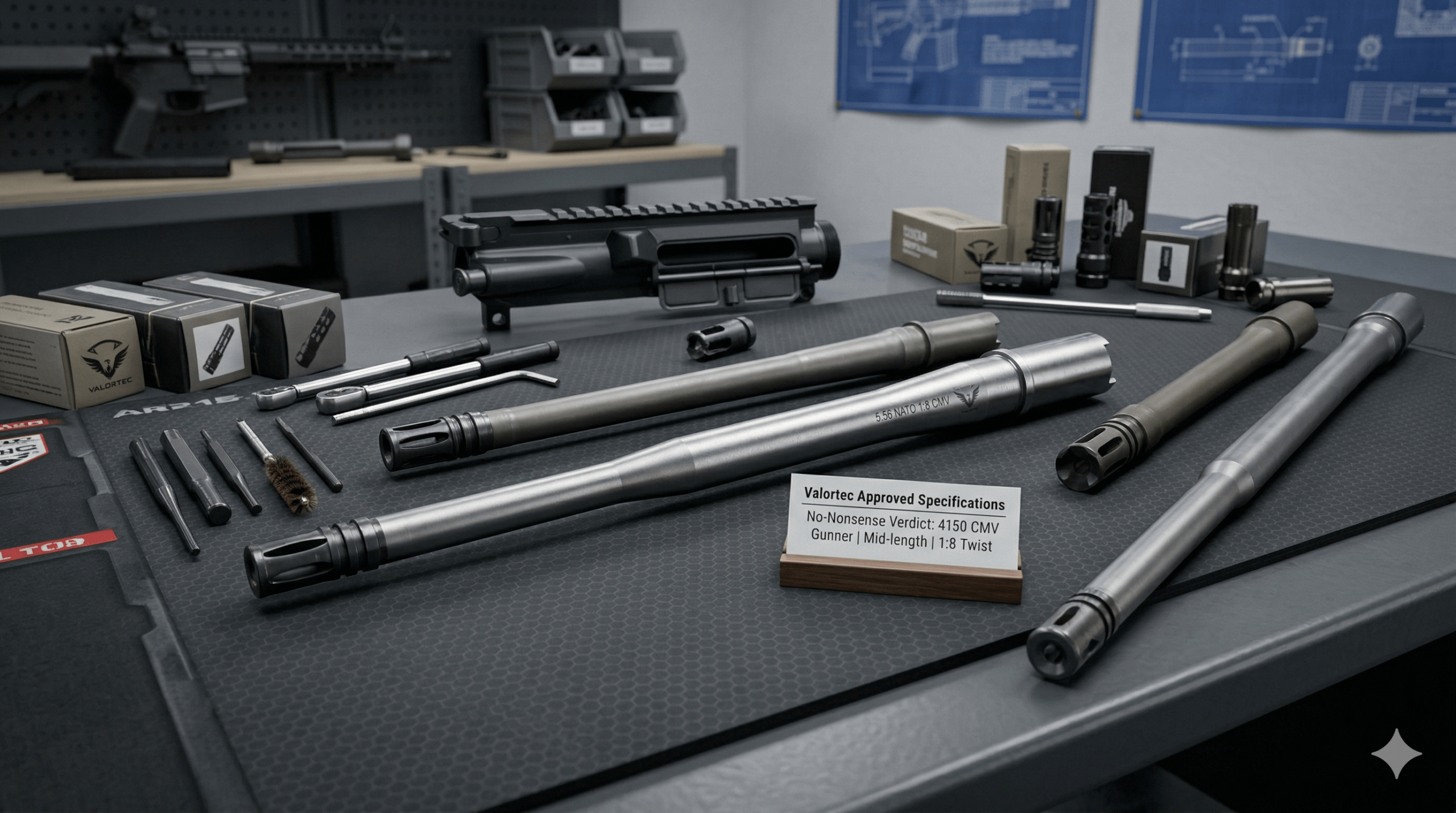
- Faxon Gunner Profile: A hybrid that moves the weight back toward the shooter. It features a Government-profile rear and a Pencil-profile front. This is the Valortec Recommended profile for general-purpose duty.
3. Gas System Length: The Key to Reliability
The gas system dictates the “dwell time”—how long pressurized gas acts on the bolt carrier group. Proper timing reduces wear and smooths out recoil.
| Barrel Length | Optimal Gas System | Reasoning |
|---|---|---|
| 10.3″ – 12.5″ | Carbine | Ensures enough pressure to cycle the action reliably. |
| 13.7″ – 16.0″ | Mid-Length | Reduced port pressure; smoother recoil; longer parts life. |
| 18.0″ – 20.0″ | Rifle | Maximum dwell time; lowest felt recoil; highest reliability. |
4. Twist Rate: Stabilizing Your Payload
The twist rate must match the grain weight of your duty ammunition.
- 1:7 Twist: Optimized for heavy 75gr to 77gr projectiles (like Mk262) and military tracers.
- 1:8 Twist: The most versatile. It stabilizes standard 55gr training ammo and heavy 77gr duty ammo with equal efficiency.
- 1:9 Twist: Legacy twist. Best for light 45gr to 55gr varmint loads; struggles with modern heavy duty rounds.
5. Quality Control Standards
A barrel is only as good as its inspection process. Never purchase a duty barrel that hasn’t undergone:
- Magnetic Particle Inspection (MPI): Detects hidden cracks or flaws in the steel.
- 11-Degree Target Crown: Ensures the gas exits behind the bullet uniformly for maximum accuracy.
- Stress Relieving: Prevents the barrel from “warping” or moving your point of impact as it gets hot.
Conclusion
For a no-nonsense professional build, select a **16″ Faxon Gunner Profile in 4150 CMV with a Mid-length gas system**. This configuration offers the best balance of weight, heat management, and mechanical reliability available on the market today.
Technical References
- Faxon Firearms. (2024). AR-15 Barrel Selection Build Guide
- Department of the Army. (2017). TC 3-22.9: Rifle and Carbine Training
- Small Arms Review. (2021). Gas System Lengths and Reliability Analysis
- National Institute of Justice (NIJ). (2025). Equipment and Technology Standards
- American Society for Metals (ASM). Properties of 4150 Chrome Moly Vanadium Steel


