Borrowed Badges, Empty Authority, and the Public-Safety Problem Nobody Wants to Touch
The USCCA “Instructor” Problem in Florida Firearms Training
Let’s say the quiet part out loud.
A logo is not a license.
A weekend certificate is not a profession.
A social media following is not legal authority.
And in Florida firearms training, the public needs to stop confusing marketing credentials with lawful, recognized instructor qualifications.
The firearms industry has a problem. Not a small one. Not a “difference of opinion” problem. Not a branding problem.
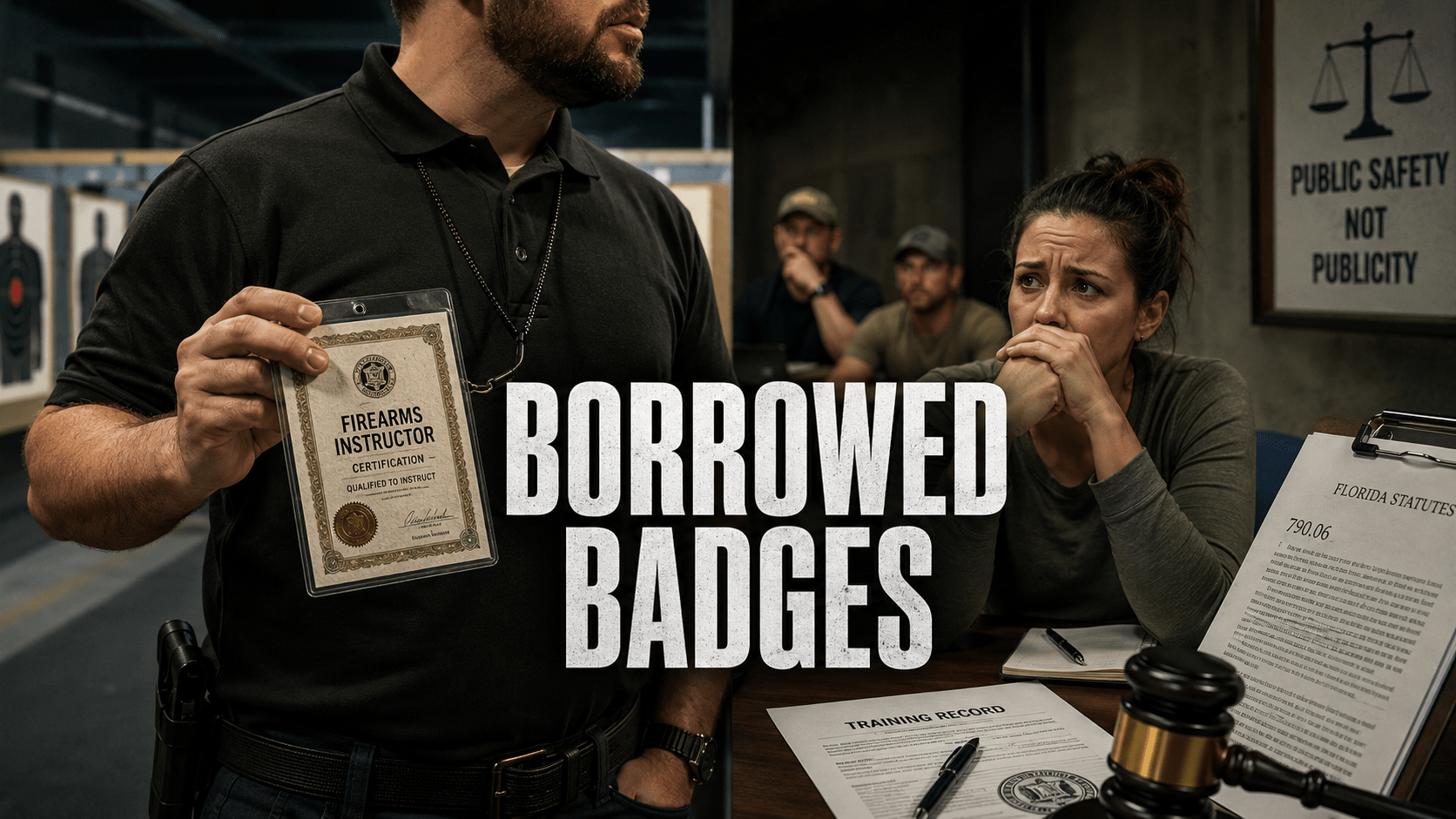
It has a public-safety problem dressed in a polo shirt, standing on a range, calling itself an instructor because a private membership organization sold it a badge, a binder, a toolkit, and the illusion of authority.
The subject is uncomfortable because it hits too close to the money. But uncomfortable does not mean untrue.
Across Florida and the rest of the country, too many people are being led to believe that a USCCA instructor credential carries the same legal weight as state-recognized firearms instructor qualifications. It does not. At least in Florida, the law is not vague about what it recognizes for concealed weapon or firearm license training. The Florida statute names the National Rifle Association. It names instructors certified through recognized state or law-enforcement pathways. It references the Criminal Justice Standards and Training Commission and the Department of Agriculture and Consumer Services.
It does not name the USCCA.
Not once.
Not in Section 790.06.
Not in Chapter 790.
That silence matters.
Florida Law Does Not Bow to a Marketing Logo
Florida Statute § 790.06 explains how an applicant demonstrates competence with a firearm for purposes of obtaining a concealed weapon or firearm license. The statute accepts several pathways, including hunter education, NRA firearms safety or training courses, law-enforcement firearms training, military service, organized competition, prior licensing, and courses conducted by state-certified or NRA-certified firearms instructors.
That is the fence the Florida Legislature built.
A USCCA instructor credential, by itself, is not listed inside that fence.
So when a class is advertised in Florida with “USCCA Certified Instructor” language, the public should ask the only question that matters:
What credential actually makes this course valid under Florida law?
Because if the real answer is, “The instructor also has an NRA credential,” then the USCCA logo is not the legal engine. It is the hood ornament.
That is the problem.
The student sees the branding and assumes authority. The instructor benefits from the assumption. The marketplace rewards the confusion. And the serious professionals who actually invested years into lawful, accountable, defensible instruction are forced to compete against weekend-certified personalities selling confidence they may not be qualified to teach.
That is not innovation.
That is credential laundering.
Permitless Carry Did Not Make Bad Training Safer
Florida’s permitless carry law changed the licensing requirement for carrying concealed under qualifying circumstances. It did not magically make bad instructors competent. It did not eliminate the concealed weapon license. It did not erase reciprocity concerns for people who still want or need a Florida license for travel, employment, or legal documentation.
And it absolutely did not make firearms instruction less serious.
In fact, it made serious instruction more important.
When the government reduces barriers to carry, responsibility does not disappear. It shifts. It lands harder on the citizen. It lands harder on the instructor. It lands harder on the training company that claims to prepare armed people for real decisions involving life, death, criminal liability, civil exposure, family safety, and public consequences.
That is why the instructor matters.
A bad golf coach ruins your swing.
A bad fitness coach may waste your money.
A bad firearms instructor can help build the habits, confidence, and legal ignorance that follow someone into a shooting, a courtroom, a prison sentence, or a funeral.
That is the difference.
The Insurance Funnel Wearing an Instructor Badge
The USCCA is widely known for membership benefits, education, and self-defense liability insurance-related membership offerings. Its own public materials describe Delta Defense, LLC as providing sales, marketing, operations, and administrative support services to the USCCA. Delta Defense identifies itself as a licensed insurance agency in all 50 states and the District of Columbia.
That matters because it reveals the business architecture.
Training may be part of the brand. Education may be part of the pitch. But the core commercial machine is membership, benefits, and insurance-related services.
So when private “instructor” programs create a large network of people carrying the brand into gun ranges and classrooms, the question becomes unavoidable:
Is this about professionalizing firearms instruction, or is this about building a distribution network?
Because there is a difference between an instructor development system and a sales ecosystem.
A real instructor development system is built around failure standards, supervision, correction, legal accountability, technical depth, teaching ability, diagnostic skill, and continuing evaluation.
A sales ecosystem is built around reach, conversion, branding, repeatability, and customer acquisition.
Those are not the same thing.
One protects students.
The other protects the funnel.
The Weekend Instructor Problem
The firearms industry loves shortcuts. It loves titles. It loves patches. It loves “nationally certified” language because it sounds impressive to beginners who do not know what questions to ask.
But a weekend cannot create a professional instructor.
A weekend can introduce material.
A weekend can review curriculum.
A weekend can evaluate basic familiarity.
A weekend can create a starting point.
But a weekend does not produce deep legal understanding. It does not produce diagnostic teaching ability. It does not produce maturity under pressure. It does not produce the professional judgment required to stand in front of armed citizens and tell them how to handle lethal force responsibly.
That kind of competence takes time.
It takes mentorship.
It takes repetition.
It takes correction.
It takes failing people who should not pass.
And that is where many certificate-mill systems collapse: they are not designed to fail people. They are designed to process people.
The student pays.
The candidate attends.
The certificate prints.
The badge appears online.
The Instagram bio changes.
The public gets another “instructor.”
That is not professional formation.
That is an assembly line.
Social Media Is Not a Qualification
The algorithm has made this worse.
A person can now build authority faster through content than through competence. A clean camera angle, a dramatic holster draw, a tactical beard, a few recycled talking points, and suddenly the public is looking at an “expert.”
But the algorithm does not check Florida Statutes.
It does not verify instructor credentials.
It does not evaluate whether the person understands use of force, safe gun handling, human performance, biomechanics, marksmanship diagnosis, student management, range safety, or legal liability.
The algorithm rewards attention.
Firearms training demands accountability.
Those two things are not the same.
A beginner does not know the difference between confidence and competence. That is why the beginner is vulnerable. That is why the instructor role must be taken seriously. That is why the industry’s addiction to personality-driven firearms education is dangerous.
A person with a large following can be wrong at scale.
And when firearms are involved, wrong at scale is not harmless.
This Is Not Anti-Gun. This Is Pro-Responsibility.
Some people will try to spin this conversation as an attack on the Second Amendment.
That is lazy.
Demanding competent instructors does not attack gun rights. It protects gun owners from fraud, false confidence, negligent training, and legally reckless advice.
The right to keep and bear arms is not strengthened by pretending every certificate is equal. It is not strengthened by allowing insurance-branded instructor credentials to be marketed as if they were state authority. It is not strengthened by lowering the instructor profession to the level of a weekend side hustle.
The Second Amendment deserves better than that.
Responsible gun owners deserve better than that.
Students deserve to know whether the person charging them money is legally recognized, technically competent, and professionally accountable — or whether they are simply standing behind borrowed authority and a brand logo.
The Real Liability Nobody Wants to Discuss
Here is where the conversation gets expensive.
When an instructor signs paperwork, issues a certificate, teaches a draw stroke, gives legal commentary, approves unsafe habits, or convinces a student that they are prepared when they are not, liability does not disappear.
It waits.
It waits for the negligent discharge.
It waits for the bad shooting.
It waits for the student who says, “My instructor told me…”
It waits for the plaintiff’s attorney.
It waits for the criminal prosecutor.
It waits for the deposition where someone asks:
“What qualified you to teach this person?”
“What legal authority did your certification carry in Florida?”
“How many supervised teaching hours did you complete?”
“What state agency licensed you as a firearms instructor?”
“What standard did you use to certify competence?”
“What did you teach about use of force?”
“Where are your records?”
“What did you observe in live fire?”
“What exactly did the student demonstrate before you issued the certificate?”
At that moment, the logo will not save you.
The weekend certificate will not save you.
The follower count will not save you.
The court will not care that your bio said “nationally certified.”
It will care about authority, competence, documentation, foreseeability, and whether your conduct created risk.
That is the brutal reality.
What Serious Students Should Ask Before Paying for Training
Before choosing a firearms instructor in Florida, students should ask direct questions:
What credentials do you hold that are recognized under Florida law?
Are you an NRA-certified firearms instructor, a state-certified instructor, or certified through a recognized law-enforcement training authority?
Are you licensed or authorized to conduct the specific type of training you advertise?
Do you teach live fire?
Do you maintain records showing that students safely handled and discharged a firearm in your physical presence?
Do you teach Florida use-of-force law within proper legal limits, or are you giving opinions you are not qualified to give?
What professional experience supports your ability to teach armed citizens?
What continuing education do you complete?
What is your student failure policy?
That last question matters.
If an instructor cannot explain how a student fails, that instructor is not running a standard. They are running a transaction.
What the Industry Should Do
The firearms training industry needs to stop hiding behind polite silence.
Ranges should stop promoting private marketing credentials as if they are state authority.
Gun shops should stop allowing certificate language that confuses students about what Florida law actually recognizes.
Students should demand proof, not branding.
Professional instructors should stop pretending this problem does not exist just because calling it out may offend people with big followings.
And Florida should seriously consider stronger instructor accountability for anyone charging money to certify firearm competence.
That does not mean restricting the right to own firearms.
That does not mean restricting lawful carry.
It means regulating the commercial act of taking money to certify another person’s firearm competence.
We regulate barbers.
We regulate contractors.
We regulate security officers.
We regulate people who cut hair, wire houses, and guard buildings.
But somehow, when a person charges money to teach citizens how to carry, handle, and potentially use deadly force, the industry wants to pretend a weekend certificate and a logo are enough.
That is insane.
The Bottom Line
The public deserves the truth.
A USCCA instructor credential may have marketing value. It may have educational value inside that organization’s ecosystem. It may be useful as supplemental training. But in Florida, the concealed weapon licensing statute does not name USCCA as an independent legal credentialing authority.
That is the line.
If the instructor’s Florida authority comes from NRA certification, state certification, law-enforcement instructor certification, or another recognized pathway, then say that clearly.
Do not hide behind a borrowed badge.
Do not let the student believe the brand is the legal qualification.
Do not sell confidence without competence.
Firearms training is not entertainment. It is not influencer content. It is not a side hustle for people who want a tactical identity and a commission stream.
It is a serious profession tied to public safety, legal survival, and human life.
And if that standard offends the weekend-certified crowd, good.
The truth usually bothers the people making money from confusion.
References and Further Reading
- Florida Statute § 790.06 — License to carry concealed weapon or concealed firearm
https://www.flsenate.gov/Laws/statutes/2025/790.06 - Florida Statutes Chapter 790 — Weapons and Firearms
https://www.flsenate.gov/Laws/Statutes/2025/Chapter790/All - Florida Statute § 790.01 — Carrying of concealed weapons or concealed firearms
https://www.leg.state.fl.us/statutes/index.cfm?App_mode=Display_Statute&URL=0700-0799/0790/Sections/0790.01.html - Florida Senate — House Bill 543, 2023
https://www.flsenate.gov/Session/Bill/2023/543 - Florida Department of Agriculture and Consumer Services — Concealed Weapon License eligibility
https://www.fdacs.gov/Consumer-Resources/Concealed-Weapon-License/Applying-for-a-Concealed-Weapon-License/Eligibility-Requirements - USCCA — About the USCCA FAQ
https://www.usconcealedcarry.com/about/faq/about-uscca/ - USCCA Membership page — self-defense liability insurance and Delta Defense relationship
https://www.usconcealedcarry.com/membership/ - Delta Defense, LLC — Official service provider for the USCCA
https://www.deltadefense.com/ - Florida Statute § 790.174 — Safe storage of firearms required
https://www.flsenate.gov/Laws/Statutes/2025/790.174 - Florida Statute § 790.15 — Discharging firearm in public or on residential property
https://www.flsenate.gov/Laws/Statutes/2025/790.15
Disclaimer: This article is opinion and commentary on a matter of public safety, firearms training standards, and Florida law. It is not legal advice. Readers should verify current law and consult a qualified attorney for legal questions.