Most Gun Owners Think They’re Ready. They’re Not.

Valortec Firearms Training & Concealed Carry Classes

You go to the range.
You load up.
You shoot.

And you leave feeling decent.

But here is what is really happening:

You stand still.

You take your time.

You aim… and still miss more than you should.

You buy gear because someone online said it was good.

You own a gun… but you struggle to control it well.

This is normal.

This is what almost everyone does.

You are not behind.
You are not broken.

You are just part of the 99%.

And the 99% are not ready.

Real threats do not stand still and wait for you.

They will not pause while you think.
They will not slow down so you can line up a perfect shot.
They will not give you time to reload after you missed every single round.

When your heart is pounding…

You will not magically get better.

You will perform at the level you have trained.

And right now…

Your practice is not building the skill you think it is.
Defensive Armed Response Training

The Complete Defensive Pistol Training Pathway

You do not need more random range time. You need a plan. DART is a step-by-step defensive pistol framework that turns average gun owners into capable, confident defenders.

Every Defensive Pistol Class. One Complete Path.

Every Defensive Pistol Class. One Complete Path.

Build Real Confidence with Measurable Skill Standards

Build Real Confidence with Measurable Skill Standards

DART uses clear benchmarks at every stage. You are not guessing if you are improving. You are not relying on feelings. You know your draw time. You know your accuracy. You know your speed. Confidence comes from proof. And you will have it.

Perform Under Stress with Solid Mechanics

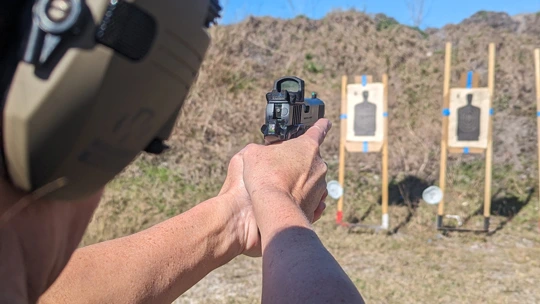
DART focuses on grip, trigger control, sight tracking, reloads, and malfunction clearing.

These are the hard skills that matter.

When your heart is pounding,
you do not think through steps.

You fall back on what you have trained.

DART builds those skills until they are automatic.

Pistol Defense Fundamentals

Stop Wasting Ammo with Structured Training Progression

Every class builds on the one before it.

You are not just “shooting.”
You are building skill, step by step.

Each drill has a purpose.
Each rep moves you forward.

Your range time finally counts.

Pistol Defense Fundamentals

Make Smart Gear Decisions with Expert Guidance

No more buying the wrong holster.
No more guessing on optics.
No more wasting money on trends.

You learn what works.
You learn why it works.
You choose gear based on performance, not hype.

Pistol Defense Fundamentals

Become Part of the 1%

Become Part of the 1%

Frequently Asked Questions

Who is this class designed for?

This class is designed for serious, responsible firearm owners who want realistic defensive training. It is ideal for concealed carriers and responsible citizens who understand basic firearm safety and want to train under stress. The membership is built for those committed to improving decision-making, composure, and performance in high-pressure encounters.

What topics are covered?

The program covers stress physiology, pre-assault indicators, use-of-force decision-making, concealment draw, close-quarters engagement, defensive movement, threat avoidance, and post-incident considerations. Training integrates live-fire fundamentals with scenario-based force-on-force exercises to develop both technical skill and psychological readiness under pressure.

Does it hurt?

Yes — it can. Non-lethal training rounds create a noticeable sting, especially on exposed skin. Protective clothing reduces discomfort, but the physical consequence is intentional. Experiencing manageable pain reinforces accountability, improves focus, and makes lessons memorable in a way static range training cannot replicate.

What skills improve?

Students improve stress management, reaction time, threat recognition, movement under pressure, communication, and use-of-force decision-making. Mechanical skills also sharpen, but the greatest growth occurs in judgment and performance under unpredictable conditions.

What are the scenarios?

Scenarios are based on common civilian violent encounters, including parking lot robberies, carjackings, convenience store hold-ups, ATM robberies, home invasions, active shooter environments, and multiple-attacker assaults. Each scenario is designed to replicate realistic distances, timing, and decision-making pressures civilians actually face.

What range are you located at?

Training is held at Firearms Training Club of America / Tall Palm Ranch, located at 1421 Fish Hatchery Rd., Lakeland, Florida. The facility supports live-fire and scenario-based training across multiple disciplines.

Do I need prior experience?

You do not need prior force-on-force experience, but you must be comfortable safely operating your firearm. Students should already know how to draw from concealment and manipulate their firearm safely. This is not a basic defensive pistol training — it builds on foundational skills and applies them under stress.

What protective gear is required?

For live-fire, students need their carry pistol, holster, magazines, belt, ammunition, eye and ear protection. For force-on-force scenarios, long sleeves, pants, groin protection, padded gloves, and protective face equipment are mandatory. Additional safety gear and non-lethal training firearms are provided.

Is it better than flat-range shooting?

It is not a replacement for range shooting — it builds on it. Static range practice develops mechanics. Force-on-force develops judgment, stress control, timing, and decision-making. Paper targets do not move, think, or react. Role players do. The combination produces more complete defensive capability.

What types of ammunition do you use?

Live-fire portions use standard factory ammunition appropriate for your pistol. Force-on-force scenarios utilize converted firearms that fire non-lethal training rounds. These marking rounds allow realistic engagement against live role players while maintaining a controlled and supervised training environment.

What happens in a session?

Sessions begin with structured live-fire drills to reinforce mechanics. Training then transitions into scenario-based force-on-force exercises using role players and non-lethal firearms. Students rotate between defender and aggressor roles, followed by debriefs that analyze decisions, movement, communication, and performance under stress.

What is your cancellation policy?

Because membership slots are limited, cancellations require advance notice. Members who provide sufficient notice may receive credit toward a future session. Late cancellations or no-shows may forfeit that session. Full policy details are provided during enrollment to ensure clarity and fairness.