The Firearms Instructor Industry Has a Standards Problem — and It Is Now a Public Safety Issue
A bad firearms instructor is not just a weak teacher.
A bad firearms instructor is a liability factory with a certificate, a marketing page, and access to people who may one day make a life-or-death decision with a gun in their hand.
That is the part too many people in the civilian firearms training industry do not want to say out loud.
Firearms training has exploded in popularity. That should be a good thing. Responsible citizens seeking education, safety, confidence, and lawful defensive capability is good for the country. But wherever demand grows, money follows. And wherever money follows, opportunists arrive.
Today, certain companies and organizations have turned firearms instructor certification into a business pipeline. Not a professional standard. Not a serious instructor-development process. Not a public-safety mission.
A pipeline.
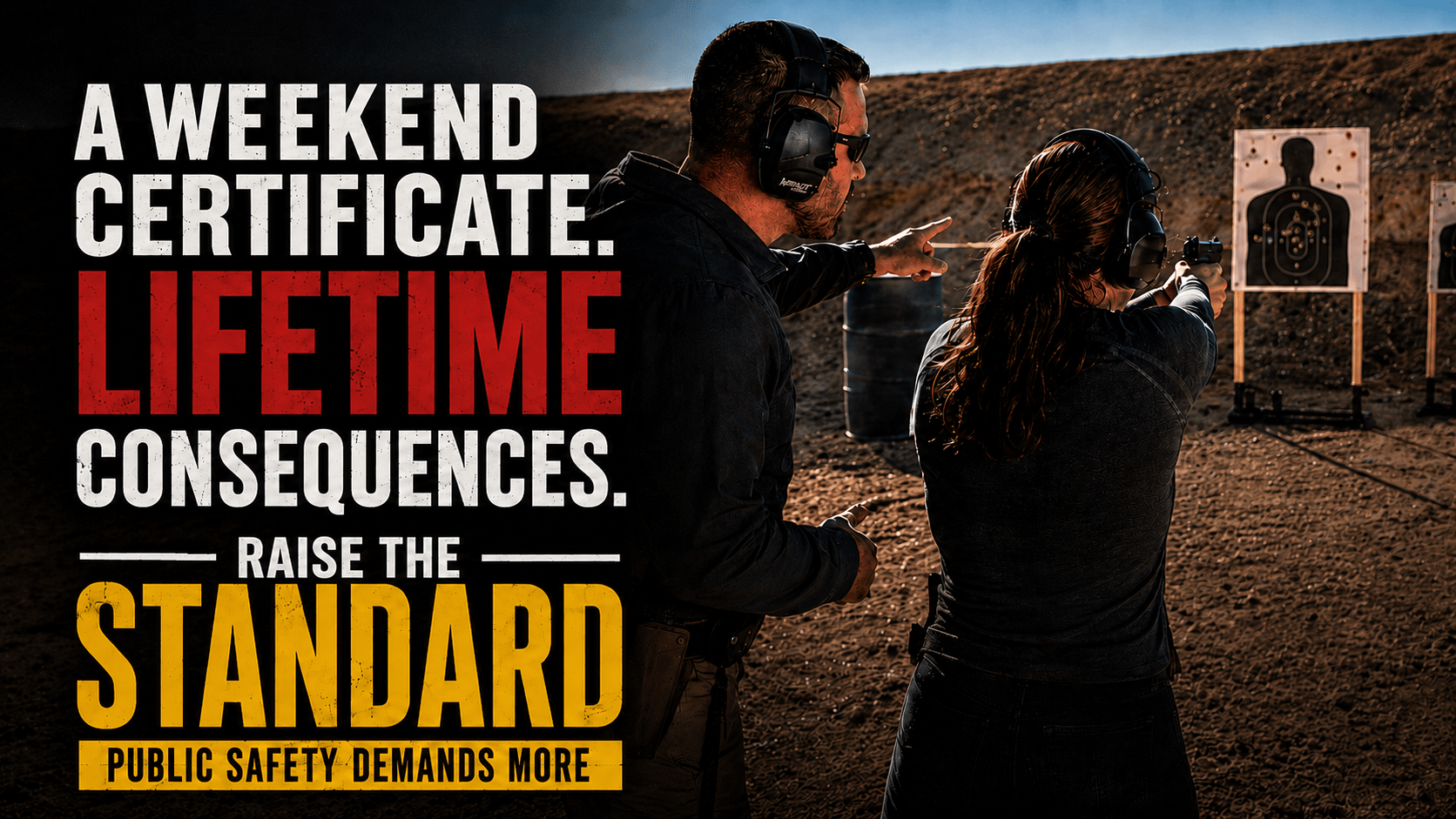
A weekend course. A certificate. A patch. A marketing badge. A social media announcement. And suddenly, a person who may have no serious professional background, no meaningful teaching experience, no legal depth, no diagnostic coaching ability, no understanding of biomechanics, no command presence, and no proven performance standard is now calling himself or herself a firearms instructor.
That is not instructor development.
That is credential manufacturing.
And in a high-liability profession, credential manufacturing is dangerous.
Florida Regulates Nails and Massage More Seriously Than Some Firearms Instructor Pathways
Let’s put this in perspective.
In Florida, a licensed massage therapist must complete a board-approved course of study of 500 or more clock hours, pass a board-approved examination, complete a ten-hour Florida Laws and Rules course, and complete background screening requirements.
A Florida nail specialist must complete 180 school hours through a Florida nail program before registration.
Read that again.
Massage: 500-plus hours.
Nails: 180 hours.
Firearms instructor certification in parts of the civilian market: sometimes a few days, a weak qualification, a certificate, and a sales funnel.
Very few people die because someone received a bad manicure. Very few people face prison because a massage therapist failed to explain imminence, proportionality, threat recognition, target accountability, or the legal consequences of deadly force.
But a firearms instructor can influence how a student carries a weapon, handles fear, interprets danger, draws under stress, presses a trigger, and explains the decision afterward to law enforcement, prosecutors, civil attorneys, and a jury.
That is not a hobby issue.
That is a public safety issue.
The Certificate Is Not the Standard
A certificate is paper.
Performance is the standard.
Judgment is the standard.
Legal understanding is the standard.
The ability to teach, diagnose, correct, demonstrate, document, and defend the training process is the standard.
The firearms industry has allowed too many people to confuse attendance with competence. Sitting through a course does not make someone an instructor. Passing a mediocre qualification does not make someone a professional. Wearing a branded shirt does not make someone qualified to teach a subject where one bad lesson can help create a wrongful shooting, a missed round, a dead bystander, or a destroyed family.
If the instructor qualification allows misses and still grants the credential, the standard is already compromised.
If the instructor candidate can miss the target, still pass, and then go teach citizens how to carry and use a firearm in public, the system has failed before the first student ever walks into the classroom.
A true firearms instructor should be able to demonstrate the material on demand.
No warm-up.
No excuses.
No “do as I say, not as I do.”
No hiding behind a certificate.
If you cannot demonstrate the skill, diagnose the failure, explain the science, articulate the law, and maintain 100 percent accountability for every round, you are not ready to teach civilians a high-liability subject.
You are not an instructor.
You are a risk with a logo.
The Legal Reality Is Too Serious for Weekend Credentials
Florida law treats deadly force as a grave matter. A person may be justified in using or threatening deadly force only when he or she reasonably believes it is necessary to prevent imminent death, great bodily harm, or the imminent commission of a forcible felony.
That means firearms training cannot be reduced to “grip it, rip it, and buy my membership.”
Students need to understand imminence. They need to understand proportionality. They need to understand avoidance, disengagement, target identification, backdrop, overpenetration, bystanders, articulation, and post-incident conduct.
They need to know when not to touch the gun.
They need to know when the gun makes the problem worse.
They need to know that every round fired belongs to them morally, legally, financially, and permanently.
That level of education does not come from instructor mills built around fear-based marketing, affiliate sales, insurance products, tactical theater, and social media applause.
It comes from real instructor development.
It comes from standards.
It comes from professional accountability.
Florida Already Knows How to Regulate Armed Training When It Wants To
This is not an impossible problem.
Florida already regulates armed security training under Chapter 493. A Class “G” statewide firearm license requires 28 hours of classroom and range training, and that training must be administered by a licensed Class “K” firearms instructor.
Florida also identifies that anyone providing classroom and range instruction to Class “G” applicants must hold a Class “K” license.
So the state already recognizes that armed work requires regulated instruction.
The problem is that the civilian firearms instructor market remains far too vulnerable to certificate mills, social media personalities, and private credential pipelines that may produce instructors without serious public accountability.
Florida law accepts several forms of firearm competency documentation for a concealed weapon or firearm license, including certain NRA courses, public or private firearms safety courses using certified instructors, and courses conducted by state-certified or NRA-certified firearms instructors. It also requires, for certain courses, that the instructor maintain records showing the student safely handled and discharged the firearm in the instructor’s physical presence with live fire.
That is a starting point.
It is not enough.
Recognition of a certificate is not the same as a serious, statewide instructor standard.
The Industry Has Confused Marketing With Mastery
Some of the loudest voices in firearms training are not the most competent.
They are the most visible.
They have followers. They have reels. They have patches. They have slogans. They have dramatic music. They have fear-based messaging. They have “limited-time” offers. They have cross-promoted products from parent companies, sister companies, sponsors, partners, and affiliate programs.
But followers do not stop bullets.
Engagement metrics do not equal judgment.
A viral video does not prove instructional competence.
A certificate from a weekend course does not prove that someone can safely teach a new gun owner, correct a dangerous habit, explain the legal threshold for deadly force, control a firing line, diagnose marksmanship failure, or prevent a student from developing habits that may later get someone killed.
The civilian market has tolerated too much theater.
Too many costumes.
Too much recycled YouTube doctrine.
Too many instructors teaching techniques they barely understand, cannot demonstrate under pressure, and cannot legally defend if one of their students applies the lesson in the real world.
That must change.
The Standard Should Be Brutal Because the Consequences Are Brutal
A firearms instructor should not be certified because he attended.
He should be certified because he can perform.
He should be certified because he can teach.
He should be certified because he can explain the legal, ethical, mechanical, neurological, and safety realities of firearms use.
He should be certified because he can demonstrate accuracy on demand.
A true instructor qualification should not reward mediocrity.
A true instructor qualification should not allow careless misses.
A true instructor qualification should not allow someone to miss the target and still walk away with authority to teach others how to carry guns around families, children, churches, schools, parking lots, stores, and public spaces.
The standard should be simple:
100 percent accountability.
Every round.
Every time.
Anything less is not instructor-level performance. It is a warning sign.
This Is Not Anti-Gun. This Is Pro-Responsibility.
Calling for higher instructor standards is not an attack on the Second Amendment.
It is the protection of it.
The right to keep and bear arms deserves better than weak instructors, low standards, and corporate certificate mills selling confidence they did not earn.
Responsible gun ownership requires responsible education.
Responsible education requires responsible instructors.
Responsible instructors require standards that are higher than marketing.
This is not about gatekeeping.
This is about public safety.
It is about protecting students from false confidence.
It is about protecting innocent people from poor training.
It is about protecting lawful gun owners from instructors who teach tactics without judgment, shooting without accountability, and confidence without competence.
A Serious Call to Action
Florida legislators, regulatory agencies, public safety officials, law enforcement leadership, insurance carriers, training academies, and responsible firearms organizations should take this issue seriously.
The civilian firearms instructor industry needs a real standard.
At minimum, states should consider:
Mandatory instructor licensing for civilian firearms instructors.
Required background checks.
Required professional education hours far beyond a weekend course.
Mandatory live-fire performance standards with no missed-round allowance for instructor certification.
Required legal education on use of force, negligent training, civil liability, and student documentation.
Required instructor recertification.
Required range safety and emergency medical training.
Required documentation of student performance and live-fire observation.
A complaint and disciplinary process for unsafe, fraudulent, or grossly incompetent instructors.
A clear separation between genuine instructor education and sales-driven certification pipelines.
The public deserves better.
Students deserve better.
Responsible gun owners deserve better.
And the Second Amendment deserves better than being represented by people who bought authority through a weekend certificate and a social media campaign.
A firearm is not a lifestyle accessory.
It is not a prop.
It is not a costume.
It is not a marketing funnel.
It is a tool capable of ending life, changing lives, destroying families, triggering criminal prosecution, creating civil liability, and altering the future of everyone involved in a single decision.
Anyone teaching that subject should be held to a standard that reflects the weight of that responsibility.
Until that happens, the industry will continue producing certificate-rich, competence-poor instructors — and the public will continue paying the price.
The time for polite silence is over.
Raise the standard.
Regulate the instructor pathway.
Protect the public.
Protect the responsible gun owner.
And stop pretending that a weekend certificate is enough to teach a life-and-death profession.