Florida Range Liability: When Gun Ranges Empower Unqualified Instructors
Educational analysis only. This article is not legal advice and does not create an attorney-client relationship.
There is a hard truth the firearms industry does not like to say out loud: some gun ranges are not just renting lanes. They are legitimizing incompetence.
When a range allows a “so-called instructor” to teach live-fire disciplines that person is not lawfully authorized, actually trained, or demonstrably competent to teach, the range is doing more than making a weak business decision. It is helping create a foreseeable zone of risk. In Florida, that can become the foundation for direct negligence, negligent selection, negligent retention, negligent supervision, apparent-agency-based vicarious liability, and, in the right case, negligent entrustment.
That exposure becomes even more dangerous when the range markets the instructor as credible, collects money under its own banner, issues certificates that imply competence, or tolerates “pass everyone” practices that turn false confidence into a product.
This is where the conversation has to get serious. The issue is not ego. It is not politics. It is not range gossip. It is public safety, civil liability, and the preventable risk created when a business places branding and profit ahead of competence.
Not Every Florida Firearms Course Is Governed by the Same Licensing Rule
The first legal point must be accurate. Not every firearms course in Florida falls under the same licensing structure. That distinction matters because the defense will try to blur it.
For regulated armed security training under Chapter 493, Florida law is direct. A Class “G” applicant must complete firearms training taught and administered by one or more Class “K” licensees. In other words, for Chapter 493-regulated armed security instruction, the state has already drawn the line. If a range lets someone provide that instruction without proper Class “K” authority, the range is not operating in a gray zone. It is stepping into regulatory and civil exposure tied to unlicensed or improperly licensed activity.
For many civilian firearms courses, the rule is different. Florida law does not require the same state licensing framework for every public-facing training course. Section 790.06 recognizes several ways a person may demonstrate competence with a firearm, including qualifying courses taught by certain certified instructors. It also requires the instructor who conducts or attests to certain qualifying training to maintain records showing the student safely handled and discharged the firearm in the instructor’s physical presence, including live fire.
That is why the strongest liability theory in many civilian-course cases is not simply that “no Florida state instructor license existed.” The stronger theory is that the range knew or should have known the instructor lacked competence for the specific discipline being taught, yet still allowed that person to teach under the range’s roof, to the public, with the range’s implied or express endorsement.
The civil issue is often larger than licensure alone. It is competence, representation, foreseeability, and institutional approval.
A Gun Range Is Not Automatically a Neutral Landlord
Florida negligence law does not require a plaintiff to find a perfect statute for every dangerous act. The broader question is whether the defendant created a foreseeable zone of risk.
That principle matters in the firearms-training context because a range is not hosting a harmless pastime. It is hosting live-fire activity involving lethal instruments, inexperienced students, fast-moving commands, and training decisions that can create both immediate harm on-site and downstream harm once a student leaves believing he or she is qualified.
The more a range does, the harder it becomes to hide behind the fiction that it is merely leasing space. Once the range advertises classes, promotes instructors, processes registrations, provides branding, issues certificates, supplies equipment, or markets itself as a place where the public can receive professional firearms training, it becomes substantially harder to claim it had no duty to verify who was teaching and whether that person was actually fit to teach.
That point is critical. A range that knowingly gives bad instruction a professional stage is not a passive bystander. It is part of the risk chain.
Negligent Selection, Retention, and Supervision
This is one of the most dangerous areas of exposure for ranges that tolerate unqualified instructors.
If management failed to verify discipline-specific credentials, ignored prior complaints, overlooked unsafe conduct, tolerated poor muzzle discipline, rubber-stamped unsupported legal instruction, or kept a problematic instructor because that person filled classes and generated revenue, those are not small management failures. They are the factual building blocks of negligent selection, negligent retention, and negligent supervision.
The legal theory becomes stronger when the range knew the difference between a person who can shoot and a person who can safely teach others to shoot, yet deliberately chose not to care. That distinction matters. Skill with a firearm is not the same thing as competence to instruct. Competence to instruct on one subject is not competence to instruct on all subjects. A person may be able to shoot a qualification course and still be wholly unfit to teach defensive pistol, movement, low-light, decision-making, or higher-risk reactive-fire disciplines.
When a range ignores that distinction, it is no longer simply making a staffing decision. It is betting public safety against convenience.
Vicarious Liability and Apparent Agency
Many ranges rely on the same defense: “The instructor was an independent contractor.” Sometimes that matters. Many times it does not save them.
That label is weakest when the range advertises the course, puts the instructor on its website, uses its own branding, collects payment, checks in students through staff, or issues house certificates. Once the range cloaks the instructor with the appearance of authority, it begins to build the very facts that support apparent-agency-based liability.
That is the real danger. Students do not parse corporate formalities. They see the range’s logo, the range’s calendar, the range’s registration system, the range’s staff, and the range’s endorsement. They reasonably believe the instructor has been vetted. If that belief is wrong, and the range created it, the range has helped build the case against itself.
That is how a “contractor defense” turns into a representation problem.
Negligent Entrustment: The Liability Gets Worse When Unsafe Students Are Still Passed Through
Negligent entrustment becomes especially serious in firearms training because the danger is immediate, obvious, and often documented in real time.
If a range or instructor supplies the firearm, ammunition, lane, or continued live-fire access to a student whose incompetence is obvious, repeated, or previously demonstrated, the exposure is no longer theoretical. The claim becomes that the business furnished dangerous instrumentalities to a person it knew or should have known lacked the training, judgment, or control to use them safely.
That includes the student who repeatedly violates muzzle discipline, cannot follow basic commands, demonstrates panic, freezes under simple instructions, mishandles loading or unloading, or requires repeated safety intervention and is still pushed through the class because nobody wants the friction of failing the student.
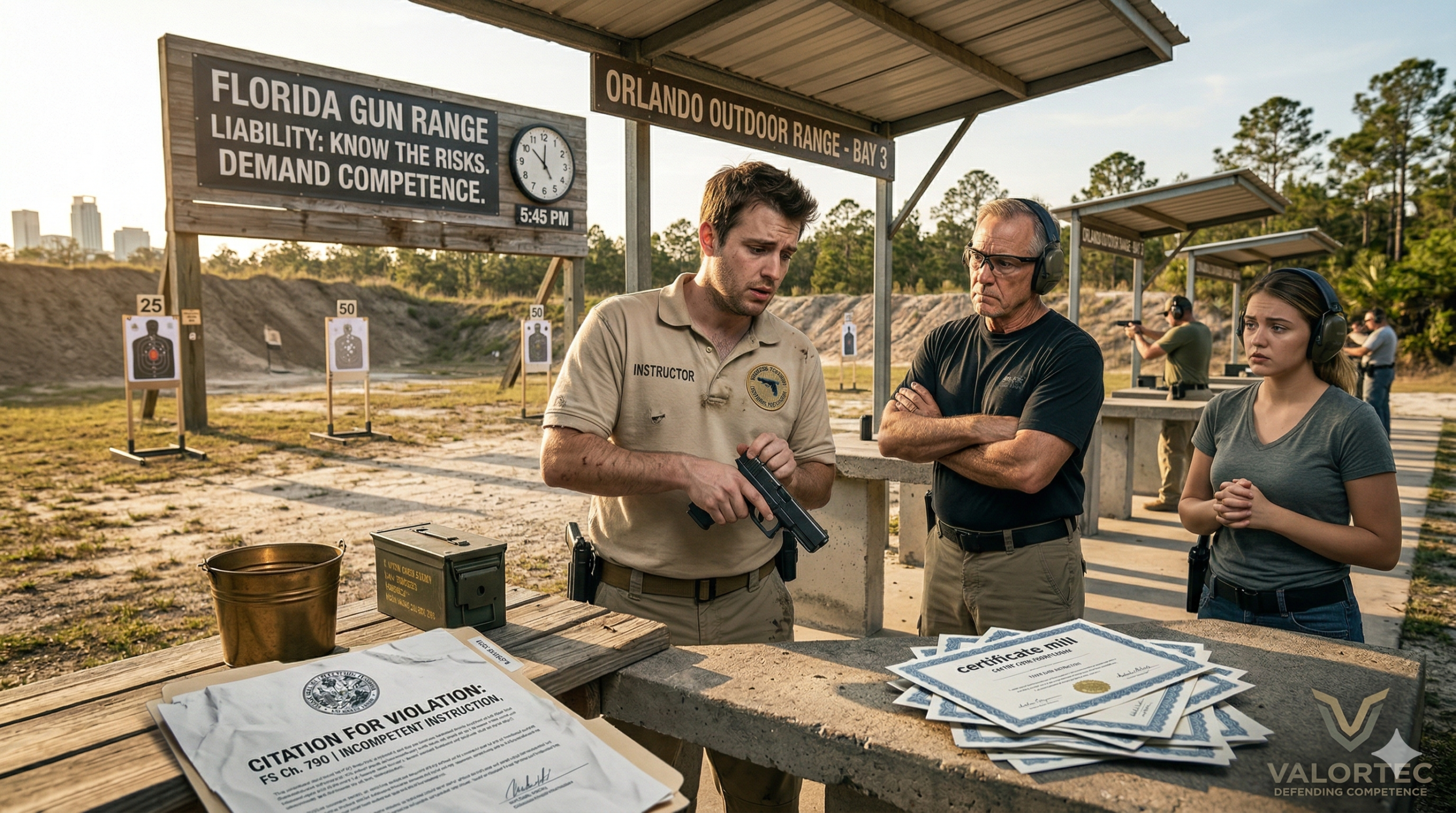
That is where the “certificate mill” culture becomes toxic. Once an unsafe student is nevertheless approved, passed, or certified, the problem is not merely failure to stop dangerous conduct. The problem is ratification. The range and instructor have transformed unsafe performance into a credential, and then sent that person back into the world with the false appearance of competence.
The False-Confidence Problem Is a Real Liability Problem
Bad training does more than waste time. It manufactures dangerous confidence.
That is what makes this issue so serious. Training is supposed to create confidence, habit, judgment, and performance under stress. When a range allows an incompetent instructor to hand out that confidence without the underlying skill, it is not simply offering weak instruction. It is producing a foreseeable hazard.
A student who hears, directly or indirectly, “you passed,” “you’re qualified,” or “you’re ready” may rely on that representation later in a real-world encounter. That reliance is not speculative. It is the entire point of the training product. If the confidence was false, and the range helped create it, the range has helped create the downstream risk as well.
Why the Usual Defenses Often Collapse
“The instructor was independent.”
That argument weakens quickly when the range marketed, branded, endorsed, scheduled, or operationally integrated the class.
“There is no specific Florida instructor license for every civilian course.”
That does not eliminate negligence. The case can still turn on competence, representation, supervision, and whether the range knowingly allowed instruction beyond the instructor’s actual ability.
“The student signed a waiver.”
Waivers do not erase evidence that the range knowingly used unqualified instructors, passed obviously unsafe students, or helped create a foreseeable risk to others.
“We are protected because we are a shooting range.”
Florida’s range-protection statute is not a blank check against ordinary negligence claims involving incompetent instruction and unsafe operational conduct.
Punitive-Damages Risk
When the facts show isolated sloppiness, the case may remain an ordinary negligence case. When the facts show management-level knowledge, indifference, or ratification, the exposure can become much more dangerous.
If management knowingly allowed unqualified instructors to teach advanced or regulated disciplines, ignored prior complaints, kept unsafe instructors on the line because they were profitable, or built a culture where students were not failed because failure hurts revenue, that begins to look less like ordinary negligence and more like conscious disregard for safety.
That is where punitive-damages exposure enters the conversation.
Valortec’s Position
At Valortec, we believe firearms instruction is a high-risk professional responsibility, not a costume, not a social-media performance, and not a shortcut business model.
A range that gives unqualified people a platform to teach beyond their competence is not elevating the industry. It is exposing students, staff, and the public to preventable harm. In a state like Florida, where the statutory and civil framework already recognizes the consequences of incompetence, negligence, false representation, and improper firearms instruction, that kind of conduct is not merely irresponsible. It is legally dangerous.
The firearms industry does not need more inflated certificates, fake authority, and range-floor mythology. It needs competence, accountability, and instructors who can actually defend every word they teach.
Conclusion
The real liability is not limited to the bad instructor standing on the line. The real liability is the institution that let that instructor stand there in the first place.
When a Florida gun range gives an unqualified instructor access to students, branding, live-fire space, and institutional legitimacy, it is not merely renting square footage. It is participating in the creation of risk. And when that instructor teaches beyond actual competence, beyond lawful authority, or beyond the discipline he or she is fit to teach, the range may face exposure for direct negligence, negligent supervision, negligent selection, negligent retention, apparent-agency-based liability, and negligent entrustment.
Once certificates are issued anyway, the damage grows. At that point, the range has not merely failed to protect the public. It has helped manufacture false confidence and send a foreseeable hazard beyond the berm.
References
- Florida Statutes, Chapter 493
- Florida Statutes § 493.6105
- Florida Statutes § 493.6113
- Florida Statutes § 493.6118
- Florida Statutes § 790.06
- Florida Statutes § 790.333
- Florida Statutes § 768.72
- Kitchen v. K-Mart Corp., 697 So. 2d 1200 (Fla. 1997)
- Insinga v. LaBella, 543 So. 2d 209 (Fla. 1989)
- Roessler v. Novak, 858 So. 2d 1158 (Fla. 2d DCA 2003)
- Almerico v. RLI Insurance Co., 716 So. 2d 774 (Fla. 1998)
- Ortega v. Burger King Corp., No. 3D23-0740 (Fla. 3d DCA June 19, 2024)
- Aspen American Insurance Co. v. Landstar Ranger, Inc., 65 F.4th 1261 (11th Cir. 2023)