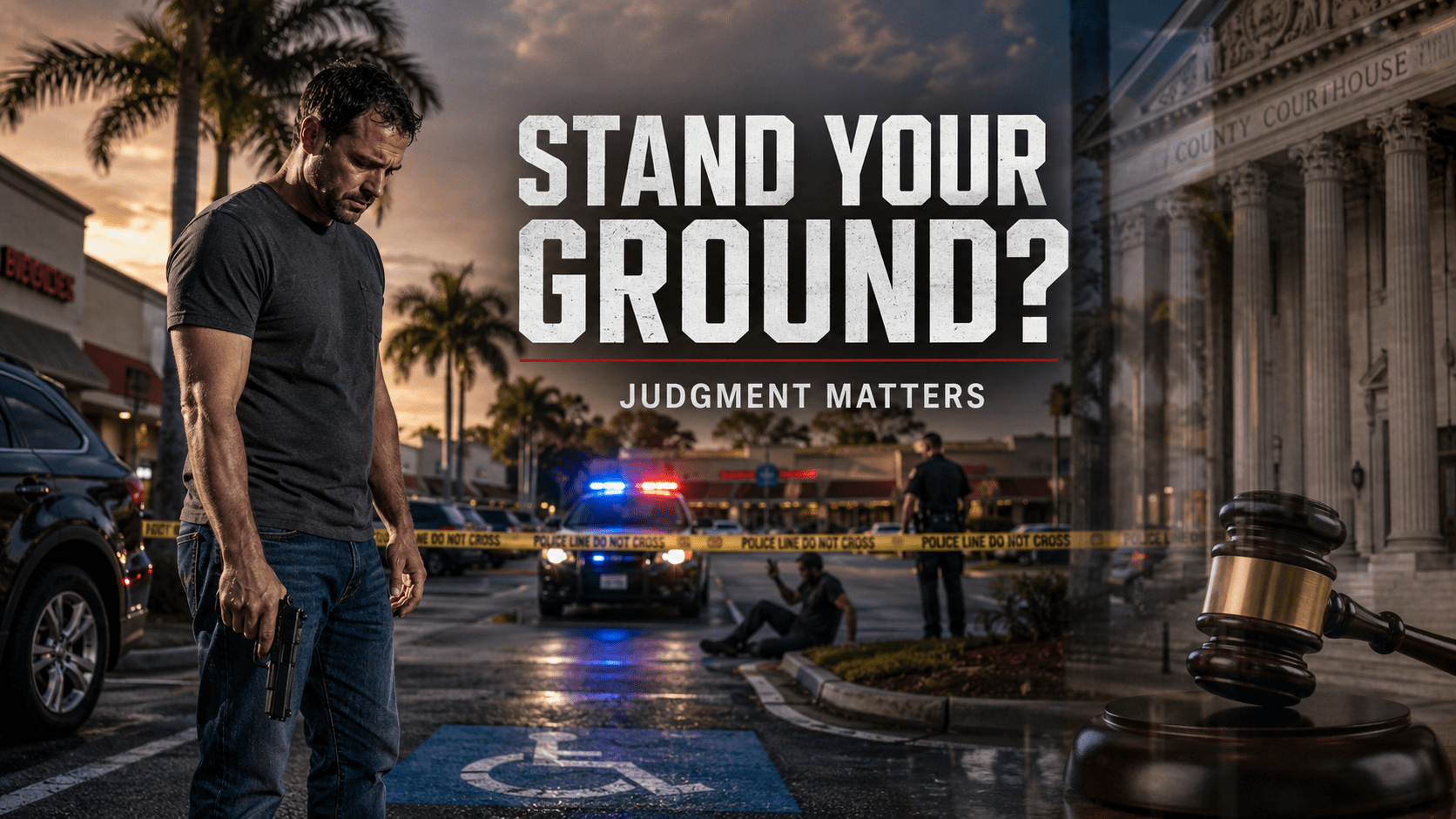
Florida’s Armed-Citizen Problem: Stand Your Ground Is Not a License to Be Stupid
High-profile shootings expose the dangerous gap between carrying a firearm and understanding Florida self-defense law.
Florida has made it easier for qualified citizens to carry concealed firearms. It has not made human judgment any smarter.
That gap matters.
It is where arguments become shootings, minor disputes become funerals, and armed citizens discover—usually while sitting in an interrogation room—that a political slogan is not a legal defense.
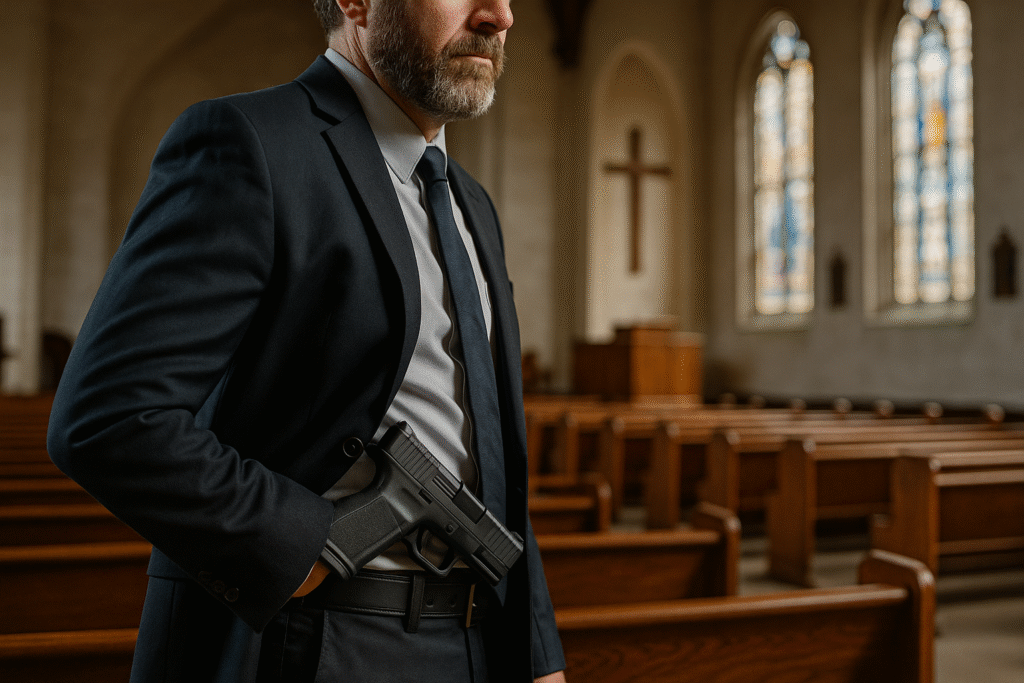
Florida law authorizes eligible individuals to carry concealed firearms with or without a state-issued license. The statutory requirements for unlicensed carry notably omit the licensing provision that requires applicants to demonstrate firearm competence. In plain language, Florida may authorize a person to carry a concealed firearm without requiring that person to prove that he understands how to operate it, when he may lawfully use it, or how to avoid creating a deadly confrontation. (Online Sunshine)
That should concern every responsible gun owner in this state.
The problem is not the right to carry. The problem is the illusion that possession equals preparedness.
It does not.
A holster is not a law degree. A concealed firearm is not a police badge. And “Stand Your Ground” is not the adult version of “Make my day.”
Three Words Most Armed Citizens Ignore
Florida’s deadly-force law revolves around three words:
Reasonable. Necessary. Imminent.
Under Florida Statute §776.012, deadly force may be justified when a person reasonably believes it is necessary to prevent imminent death, great bodily harm, or the imminent commission of a forcible felony. A person lawfully acting under that provision may have no duty to retreat when not engaged in criminal activity and when standing somewhere he has a right to be. (Online Sunshine)
The instructional material correctly emphasizes the same legal threshold: deadly force depends upon a reasonable belief that it is necessary to address an imminent deadly threat or forcible felony.
But here is the part that gets lost between social media clips and gun-counter mythology:
Having no legal duty to retreat does not mean retreating is weak, cowardly, or tactically foolish.
It means the law may not require it. That is all.
The statute does not say you must remain in a stupid argument. It does not require you to defend your honor. It does not deputize you to correct strangers, chase trespassers, win parking-space disputes, protect your lawn with a rifle, or punish someone who pushed you thirty seconds ago.
The training material says it plainly: the absence of a legal duty to retreat does not mean that leaving is the wrong decision, and avoidable situations should not be allowed to escalate.
A mature armed citizen understands that distinction.
An immature one becomes a case study.
Alec Baldwin: Firearm Safety Cannot Be Outsourced
The fatal shooting on the set of Rust raised an uncomfortable question that reaches far beyond Hollywood:
When a firearm is in your hand, whose responsibility is it?
Someone may have inspected it. Someone may have handed it to you. Someone may have announced that it was safe. None of those statements can stop a bullet once the trigger is pressed.
The criminal case against Alec Baldwin was ultimately dismissed with prejudice because the court found that prosecutors had withheld evidence—not because a jury determined that the firearm handling was responsible or that the shooting itself was harmless. (Reuters)
Florida law recognizes manslaughter through culpable negligence, although the standard requires more than ordinary carelessness. The conduct must rise to a gross or reckless disregard for human life or safety. (Online Sunshine) The case material similarly distinguishes ordinary negligence from the gross and flagrant conduct required for culpable negligence.
The larger lesson is not about actors.
It is about accountability.
Would you press a trigger merely because another person said the gun was unloaded? Would you point it toward someone because the environment was supposedly controlled? Would your answer change if there were cameras, contracts, instructors, armorers, or witnesses nearby?
It should not.
A firearm does not care who signed the safety checklist.
The bullet belongs to whoever launches it.
The Snow-Shovel Shooting: Pride Can Be Fatal
In February 2021, a long-running neighborhood dispute in Pennsylvania reportedly erupted during an argument over snow disposal. A husband and wife were shot and killed, and the shooter later died by suicide. Three people lost their lives over snow, insults, anger, and an inability to disengage. (KSL)
Read that again.
Three deaths.
Over snow.
This case should be shown to every person who believes carrying a firearm makes verbal confrontation safer.
It does not. A firearm raises the consequences of every emotional failure around it.
Could one of the people have walked inside? Could someone have stopped shouting? Could the police have handled the property dispute? Could pride have been swallowed for five minutes?
Probably.
But pride has buried many people who were technically correct about something completely irrelevant.
The lesson for Florida gun owners is brutal but simple: You cannot control whether another person is unstable, armed, intoxicated, enraged, suicidal, or willing to die over nonsense.
You can control whether you remain available for the argument.
Walking away does not mean the other person won. It means your family does not have to identify your body because you needed the final word.
If carrying a firearm makes you more willing to argue with strangers, you are not prepared to carry one.
You are merely armed.
Kyle Rittenhouse: A Legal Victory Is Not a Life Plan
Kyle Rittenhouse was acquitted of all criminal charges arising from the Kenosha shootings after the jury accepted his claim of self-defense. (The Associated Press)
That is the legal result.
But an acquittal should not be converted into a tactical training doctrine.
The Florida analysis would still ask the same questions it asks in every deadly-force case: Was the danger imminent? Was deadly force reasonably necessary? Was the person lawfully present? Did he provoke the confrontation? Did he attempt to withdraw? Had the threat stopped when each shot was fired?
Florida Statute §776.041 can restrict self-defense claims when a person is committing a forcible felony or initially provokes the use of force. An initial aggressor may have to exhaust reasonable means of escape or clearly withdraw before regaining the protection of self-defense law. (Online Sunshine)
That does not mean simply carrying a rifle makes someone the aggressor. It does mean that conduct before the shooting matters.
Words matter.
Movement matters.
Pursuit matters.
Withdrawal matters.
Video matters.
And each shot may be judged separately.
The case material highlights several enduring lessons from the Rittenhouse prosecution: expect your statements to be used, do not assume people will retreat merely because they see a firearm, expect video evidence, and expect the possibility of arrest and criminal charges.
There is also a larger question that many people avoid because politics has poisoned their ability to think:
Why voluntarily place yourself in the middle of predictable violence unless you have a clear legal duty, professional mission, disciplined plan, proper support, and the training to manage it?
Being acquitted years later does not return your privacy, money, reputation, sleep, relationships, or previous life.
Courtroom survival is better than prison.
It is not better than avoiding the disaster.
The McCloskeys: Your Property Is Not Worth a Human Life
Images of Mark and Patricia McCloskey standing outside their St. Louis home with firearms became instant political ammunition. Depending on the audience, they were portrayed as defenders of private property, reckless gun owners, political victims, or armed aggressors.
Florida law would be less interested in the political labels than in the precise facts.
Florida Statute §776.031 generally permits nondeadly force when reasonably necessary to prevent or terminate trespass or criminal interference with property. Deadly force is permitted only when reasonably believed necessary to prevent the imminent commission of a forcible felony. (Online Sunshine)
That means someone stepping onto private property does not automatically become a lawful target.
Trespassing is not a death sentence.
Your lawn is not worth a human life.
Your mailbox is not worth a human life.
Your decorative gate is not worth a human life.
And a firearm is not an expensive “No Trespassing” sign.
Florida’s home-protection presumption is powerful, but it is not unlimited. It generally applies when someone is unlawfully and forcefully entering—or has entered—a dwelling, residence, or occupied vehicle, or is attempting to remove someone from one of those protected places. (Online Sunshine)
A crowd crossing a property boundary or entering a private street does not automatically create the same legal presumption as a person violently breaking into an occupied home.
There may still be circumstances supporting self-defense if an imminent deadly threat exists. But that justification must come from the threat—not merely from property ownership.
The videos and photographs of the McCloskey incident showed the couple outside with firearms as demonstrators passed their property, while the parties disputed whether the crowd posed an immediate threat. (PolitiFact)
The Florida questions would be unavoidable:
Was anyone unlawfully and forcefully entering the residence?
Was there an objectively reasonable belief of imminent death or great bodily harm?
Was an imminent forcible felony occurring?
Where were the muzzles pointed?
Were fingers placed on triggers?
Were the firearms being used to stop an immediate lethal threat—or to intimidate people into obeying?
Those distinctions separate lawful defense from unlawful exhibition, aggravated assault, or worse.
Michael Drejka: Florida’s Warning in Eleven Seconds
The Michael Drejka case may be the clearest warning for Florida’s armed citizens.
Drejka confronted a woman about her vehicle being parked in a disabled parking space. Markeis McGlockton came out of the store and violently pushed Drejka to the ground. Drejka drew a handgun and shot McGlockton as evidence indicated McGlockton was backing away.
A jury rejected Drejka’s self-defense claim, convicted him of manslaughter, and he received a twenty-year sentence. Florida’s Second District Court of Appeal affirmed the conviction and sentence. (Justia Law)
The entire confrontation—from the physical attack to the shooting—occurred in approximately eleven seconds. Surveillance video and eyewitness testimony indicating that McGlockton was retreating became critical evidence. (Justia Law)
This is where the bumper-sticker interpretation of Stand Your Ground collapses.
Yes, Drejka was pushed violently.
Yes, being driven to the pavement can cause serious injury.
But self-defense is not a lifetime subscription activated by the first unlawful act.
The legal question is not simply whether McGlockton had attacked him.
The question is whether deadly force was reasonably necessary at the exact moment Drejka fired.
Had the threat continued?
Was McGlockton advancing?
Was he retreating?
Was the shot defensive—or retaliatory?
A prior attack does not create an unlimited window to shoot. When the imminent threat ends, the justification can end with it.
Drejka also reportedly made a statement after the shooting expressing the idea that McGlockton should not have pushed him and should have expected consequences. That type of language can allow prosecutors to argue that the shooting was punishment rather than protection. (Justia Law)
That is another lesson armed citizens ignore:
After a shooting, your social-media posts, previous threats, training statements, clothing, recorded conversations, body language, interviews, and spontaneous comments may become evidence.
The gun may remain silent after the final shot.
You probably will not.
Immunity Is Not an Invisible Shield
Some Florida gun owners talk about self-defense immunity as though a laminated statute card will cause responding officers to salute, apologize, and leave.
That is fantasy.
Florida Statute §776.032 provides immunity from criminal prosecution and civil action for justified uses of force. But law enforcement may still conduct a standard investigation and may arrest when probable cause exists to believe the force was unlawful. A defendant may also have to raise and litigate immunity during a pretrial hearing. (Online Sunshine)
The supplied case timeline illustrates exactly how lengthy the process can become: investigation, charging, arrest, bond proceedings, trial, conviction, sentencing, and appeal.
“Stand Your Ground” does not mean “No investigation.”
It does not mean “No arrest.”
It does not mean “No attorney fees.”
It does not mean “No civil litigation.”
It means that legally justified force may receive statutory protection after the evidence is examined.
The word justified comes first.
Florida Must Ask Harder Questions
Why does our state permit eligible people to carry concealed firearms without requiring proof that they have received meaningful firearms training?
Why do so many courses teach students how to obtain a certificate but not how to recognize an imminent threat?
Why are instructors discussing draw speed without discussing disengagement?
Why are students firing hundreds of rounds without conducting a single realistic use-of-force exercise?
Why do people memorize “no duty to retreat” but ignore “reasonably,” “necessary,” and “imminent”?
Why do armed citizens believe that defending their pride is the same as defending their lives?
And why does the firearms-training industry continue producing people who can hit a paper target but cannot identify when there is no lawful target at all?
That is not preparedness.
That is armed ignorance.
The Standard Must Be Higher
Carrying a firearm should make you more patient, not more confrontational.
More observant, not more arrogant.
More willing to leave, not more determined to win.
The responsible armed citizen does not look for opportunities to invoke Stand Your Ground. He recognizes that the best defensive shooting is the one he had the awareness, judgment, discipline, and humility to avoid.
The law establishes the minimum threshold for justification.
Professional training must go further.
It must develop firearm safety, judgment, emotional control, threat recognition, de-escalation, communication, movement, medical response, legal articulation, and the ability to perform under stress.
Because the real test is not whether you can draw and fire.
The real test is whether you can recognize the moment when you must fire—and every other moment when you must not.
At Valortec, we do not train people merely to carry guns or collect certificates. We train responsible citizens and professionals to understand that every round fired carries a legal, moral, and human consequence.
You own the firearm.
You own the decision.
And you will own every round.
This article is educational commentary and does not constitute legal advice. Florida use-of-force cases are fact-specific and should be evaluated by a qualified Florida attorney.