The “Instructor” Who Passes Stick-Hitters Isn’t a Trainer—They’re a Liability Generator
If your student can’t hit a USPSA torso and you still issue a certificate, you own what happens next.
Let’s call it what it is.
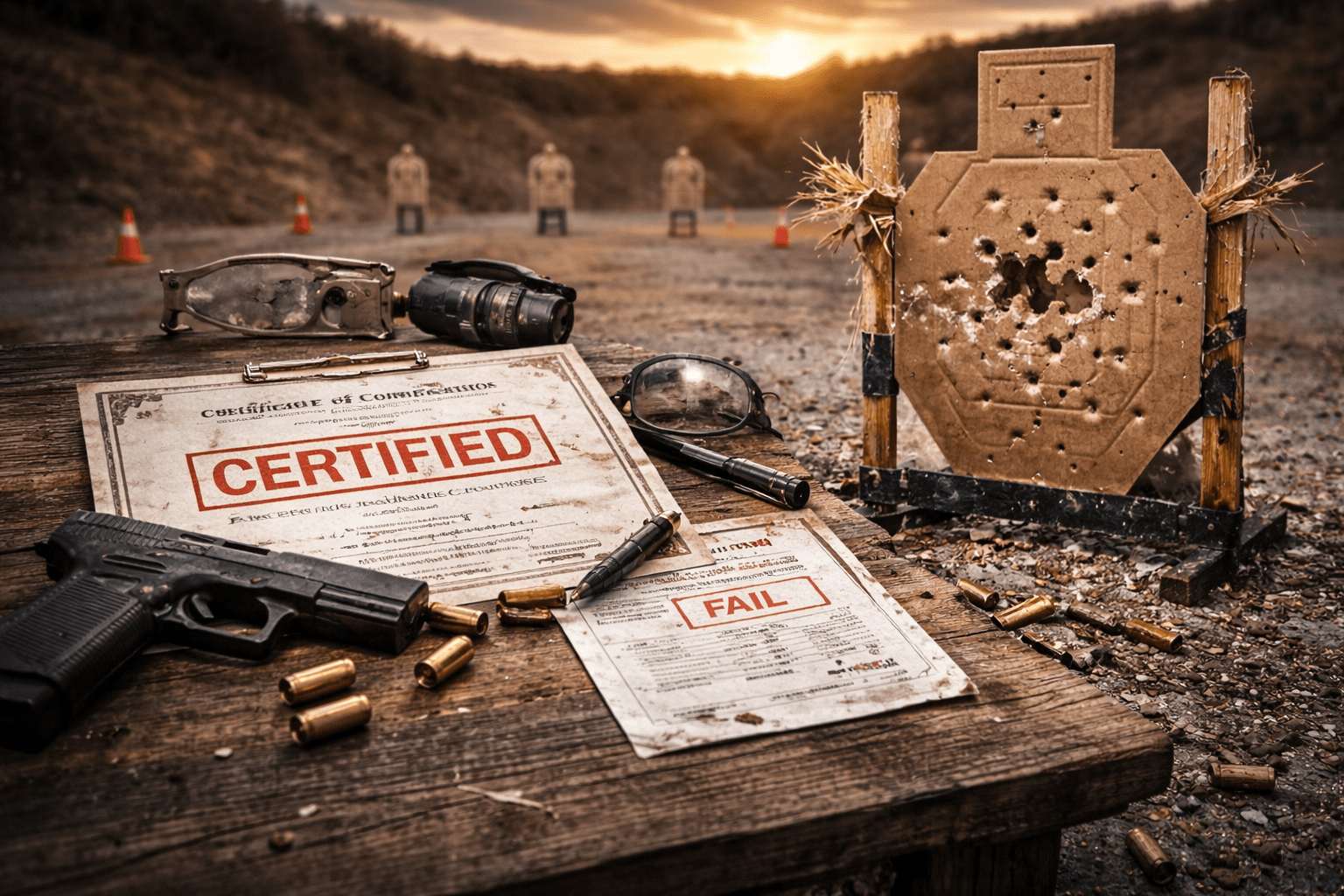
A student consistently missing a standard USPSA cardboard target—29.93” tall x 18.12” wide, center roughly 4 feet high—and instead hammering the 1” x 2” uprights or the ground-level base is not “learning.” That shooter is not “almost there.”
That shooter is dangerously unprepared.
And the so-called firearms instructor who watches that happen, shrugs, and still hands them a “certificate” is not an instructor. They’re a credential printer. A confidence dealer. A person selling the public a lie: “This person is proficient.”
That lie does not stay on the range.
It leaves with the student. It rides in the holster. It enters grocery stores, parking lots, churches, schools, apartment hallways, traffic stops, and domestic disputes.
And when the first real stress event happens—when adrenaline hits, when hands shake, when vision narrows, when time compresses—that “trained” shooter does exactly what they did on the range:
They miss the torso.
Only now the “sticks and base” are replaced by bystanders.
At that moment, the legal question becomes simple and brutal:
Who created this foreseeable risk—and certified it into public carry?
Answer: the instructor who passed them.
The Range Tells the Truth. The Sticks Prove Incompetence.
A USPSA torso is forgiving. The uprights are not. The base is not. If a shooter is striking thin wood supports or the ground structure instead of the cardboard, you are seeing fundamental failures that an honest instructor cannot ignore:
-
Trigger control that collapses under any speed
-
Visual discipline that never existed
-
Recoil management with no stable platform
-
Presentation that drifts off target
-
Flinch and anticipation left untreated
-
“Coaching” that is really just encouragement and noise
Here’s what that pattern means in plain English:
The shooter cannot keep rounds in a human-sized strike zone under controlled conditions.
So the instructor who passes them is certifying a fiction.
And fiction becomes negligence the moment it becomes foreseeable harm.
“So-Called Instructor” is Not an Insult. It’s a Legal Description of Conduct.
There are real instructors—professionals who run standards, diagnose errors, remediate deficiencies, and refuse to rubber-stamp people into danger.
Then there are the other ones.
The ones who:
-
Don’t measure performance
-
Don’t document failures
-
Don’t remediate fundamentals
-
Don’t stop unsafe progression
-
Don’t fail students who should fail
-
Don’t care where the rounds go—as long as the payment clears
-
Issue certificates like they’re raffle tickets
That isn’t instruction. That’s negligent enablement.
If your “course” allows a student to repeatedly miss a torso and still “graduate,” your program is not producing trained carriers. It is producing unknown-trajectory hazards.
And that is not just “bad pedagogy.” It’s actionable.
The Certificate is the Smoking Gun
A certificate is not a souvenir. It is a representation.
The moment you issue a certificate—explicitly or implicitly stating that the student achieved a level of competence—you’ve created three legal realities:
-
You created reliance.
The student believes they are capable because you told them they are. -
You created foreseeability.
You had live-fire evidence they were not capable, and you certified them anyway. -
You created a chain of causation.
When that student later misses in public, the plaintiff’s attorney will trace the line straight back to your range.
That’s the legal map: knowledge → certification → reliance → foreseeable harm.
This is exactly where instructors talk tough until a subpoena arrives.
Legal Responsibility: You Don’t Get to Wash Your Hands After You “Graduate” Them
1) Direct Civil Liability: Negligent Training / Negligent Instruction
If a student harms someone and the evidence shows the instructor:
-
observed repeated fundamental failures (stick/base strikes),
-
did not correct or remediate to a standard, and
-
still certified competence,
the instructor can be sued for negligent training. The allegation is predictable:
You breached your duty by failing to train to a basic, measurable standard, and your certification foreseeably increased the risk of harm to others.
In plain terms: you manufactured an unsafe shooter and pushed them into public carry with a stamp of approval.
2) Negligent Entrustment Principles: “You Knew—or Should Have Known”
Negligent entrustment principles (commonly associated with Restatement (Second) of Torts § 390) focus on enabling a person to use a dangerous instrumentality when you know—or should know—they are likely to create unreasonable risk.
On the range, “should have known” is not theory. It’s on camera. It’s on paper. It’s in the targets.
Repeated stick/base hits are a bright red warning flag. If you certify anyway, you are documenting your own knowledge of incompetence.
3) Vicarious Liability: Your Business, Your Agency, Your Brand Gets Named
If the “instructor” operates under an academy, security agency, training company, or employer, the lawsuit will expand to the entity:
-
negligent hiring / retention
-
negligent supervision
-
negligent training policies
-
failure to enforce standards
-
misrepresentation of qualifications
Because the plaintiff’s attorney isn’t hunting feelings. They’re hunting coverage.
And if your internal culture is “pass everybody,” you’ve built institutional negligence.
Criminal Exposure: When Negligence Turns Into Charges
Here’s the part instructors ignore because it scares them.
Criminal statutes do not require you to intend harm. They require you to create unreasonable risk with disregard for safety—especially when you occupy a position of responsibility.
Florida Example: Culpable Negligence (F.S. 784.05)
Florida criminalizes culpable negligence—exposing another person to injury through reckless disregard can be charged as a second-degree misdemeanor, with penalty caps up to 60 days jail and $500 fine (via Florida general penalty statute).
If your conduct contributes to injury or sets conditions that create substantial risk, you have a problem—not a training philosophy.
Florida Example: Manslaughter by Culpable Negligence (F.S. 782.07)
If negligence contributes to a death, Florida’s manslaughter statute includes killing by culpable negligence. Manslaughter is a second-degree felony, with penalty caps up to 15 years prison and $10,000 fine (via Florida general felony penalty and fine statutes).
No—this does not mean every bad instructor gets charged with manslaughter. It means the legal system has a framework to treat gross negligence seriously when harm occurs and causation can be shown.
And the “certificate + documented incompetence” combo makes causation arguments far easier.
“Waivers” Don’t Save You
Waivers don’t erase negligence. They don’t protect you from administrative action. And they do nothing for third-party victims.
If your defense is “they signed a waiver,” you’ve already admitted you know there’s risk. Now you’re arguing you should be allowed to monetize it anyway.
That’s not a defense. That’s Exhibit A.
The Public Safety Reality: You’re Creating Armed Guesswork
When an incompetent shooter carries a firearm in public with a false sense of proficiency, they become an involuntary threat multiplier:
-
They fire when they shouldn’t.
-
They shoot faster than they can control.
-
They miss the threat.
-
They hit unintended people and property.
-
They escalate situations they cannot manage.
And the instructor who certified them has done something unforgivable:
They converted incompetence into confidence.
Confidence is the accelerant. Incompetence is the spark. Public carry is the oxygen.
That combination is how tragedies happen.
The Standard That Should Be Non-Negotiable
This is the minimum standard of integrity:
If a student cannot consistently keep rounds on a torso-sized USPSA target under the distances and time pressures appropriate to the course, they do not pass.
Not “almost.” Not “good enough.” Not “here’s your certificate anyway.”
If your student is striking sticks and bases, your job is to:
-
stop the line,
-
diagnose,
-
remediate,
-
document,
-
retest,
-
and if they still fail—fail them.
Anything else is not instruction. It’s negligence wrapped in marketing.
Final Message to the “Certificate Mills”
If you are passing shooters who can’t hit a USPSA torso, you are not helping them. You are endangering the public.
You are issuing a piece of paper that tells a person, “You’re ready,” when the target tells the truth: they’re not.
And once you let that person walk into the public environment carrying a firearm under false confidence you manufactured, you have stepped into legal responsibility—because the harm is foreseeable, the incompetence is observable, and the certification is your signature on the risk.
Cardboard is the minimum.
If they can’t hit it, they don’t pass.
And if you pass them anyway, don’t act shocked when the legal system treats you like what you are: part of the problem.