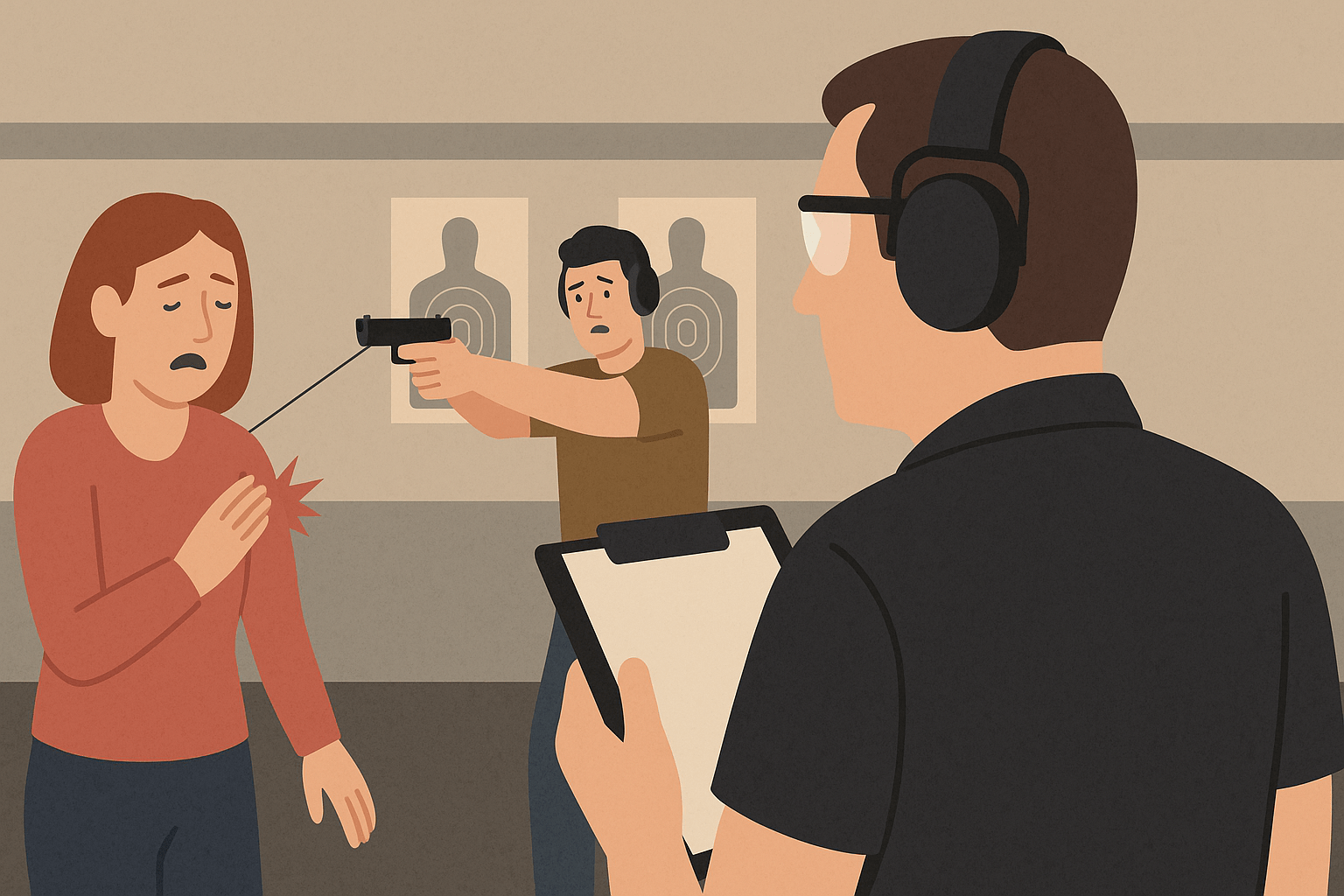
Instructor Liability When a Student Hits a Bystander
When a civilian claims self-defense but a round injures or kills an innocent third party, attorneys rarely stop at the shooter. They go upstream and ask:
- Who trained this person?
- What curriculum was used?
- Was the instructor licensed or just privately certified?
For firearms schools and academies offering firearms training in Florida and nationwide, these incidents create direct exposure under vicarious liability, negligent entrustment, and simple negligence theories. The question is whether you can prove a defensible standard of care—or whether your training records become plaintiff’s Exhibit A.
Vicarious Liability, Negligent Entrustment & the Certified-vs-Licensed Divide
Plaintiffs increasingly argue that instructors and training entities contributed to a bystander injury by:
- Certifying unsafe or unqualified students
- Ignoring backdrop / bystander considerations in training
- Failing to follow state-mandated curricula and documentation rules
Courts look hard at three things: duty, standard of care, and documentation. Being a licensed firearms instructor operating under a regulated curriculum is very different, legally, from being a weekend “certified” instructor with loose records.
A. What Courts and Agencies Have Actually Said (2010–2025)
Below are key decisions and enforcement actions that shape how judges and lawyers analyze firearms-training liability. Several are law-enforcement or range-operations cases, but the logic is routinely applied to civilian trainers and academies.
-
LaMusga v. Burke / Tactical Solutions Group (Ohio, 2017) – wrongful-death suit after armed private security shot a civilian; plaintiff also sued a separate training company for negligent training.
Holding: Appellate court affirmed summary judgment for the trainers; the record showed compliance with the state-mandated curriculum (OPOTC), which became the standard-of-care shield.
Source: Supreme Court of Ohio -
Kedra v. Schroeter (3d Cir. 2017) – death during a state police firearms class.
Takeaway: Allegations that the instructor violated multiple safety rules were enough for negligence claims to proceed. Written rules, checklists, and adherence are scrutinized.
Source: Justia Law -
Illinois AG v. various instructors (2010s–2020s) – criminal actions for falsifying concealed-carry training certificates.
Point: States will prosecute sham training and false certificates; those records also devastate civil defenses when a later shooting occurs.
Source: Illinois Attorney General -
Klotz v. Lumma (Ill. Cir. Ct., filed 2022) – class action alleging concealed-carry classes failed to meet state standards; the instructor pleaded guilty to issuing false certs.
Relevance: Plaintiffs attacked the validity of training itself; non-compliant courses became negligence evidence.
Source: K & G Law -
Henriksen v. City of Rialto (Cal. Ct. App. 1993) – negligent hiring/training case tied to firearms mishandling injuries.
Relevance: Courts examine whether entities trained and supervised armed personnel to a defensible standard; the same questions are now asked of private academies. -
Popow v. City of Margate (D.N.J. 1979) – seminal “failure-to-train” case.
Holding: Failing to train officers for foreseeable conditions (night, moving targets, urban backdrop) supported liability.
Civilian takeaway: Decision-making and backdrop modules are not optional; plaintiff’s lawyers analogize this to civilian trainers who never teach shot accountability.
Source: Office of Justice Programs -
Avenarius v. State of Iowa (Iowa Ct. App. 2024/25) – injury during a firearms-instructor school; negligence claims against the state-run academy.
Relevance: Courts are open to claims against instructor-training programs themselves, giving a roadmap for duty, waivers, and scope of risk.
Source: Nyemaster Goode, On Brief -
“Bullets & Burgers” / Uzi range litigation (AZ/NV, 2016–2021) – wrongful-death suits after a 9-year-old killed an instructor with a Mini-Uzi.
Relevance: Plaintiffs focused on program design (unfit shooter + inappropriate platform). Even when the shooter is a minor, range and instructor choices become the liability center of gravity.
Source: Reuters -
Commercial range negligence cases (2010s–2020s) – suits over negligent supervision, unsafe setups, and patron injuries.
Relevance: Courts emphasize supervision, waivers, and safety protocols—the same elements juries will examine if one of your students later harms a bystander.
Example: Lake & McHenry County Scanner -
Waiver & assumption-of-risk decisions (multiple states) – litigation over range waivers and liability forms.
Relevance: Well-drafted waivers may limit claims but never excuse gross negligence or statutory violations.
Source: Justia Law
Bottom line: Courts are far more receptive when trainers can show compliance with state-mandated curricula and robust documentation. Deviations, sham certificates, or unsafe program design give plaintiffs traction, especially when a bystander is injured.
B. How Plaintiffs Connect a Bystander Injury to the Instructor
-
Vicarious liability (respondeat superior). If an instructor acts on behalf of a company or academy, plaintiffs sue both. They argue the entity controlled curriculum, standards, and supervision. Courts then ask whether the conduct fell within the scope of duties and whether the program met the standard of care.
See the LaMusga record for how proving compliance with state rules blunted those claims. -
Negligent entrustment / negligent certification. Issuing a certificate to someone you knew—or should have known—was unsafe or unqualified is a classic plaintiff theory, especially if the state later rejects those certs or prosecutes the instructor.
Illinois AG prosecutions are the cautionary example. - Direct negligence (failure to train/supervise). Allegations that your course never covered decision-making, backdrop control, or “no-shoot” discipline mirror the inadequate-training logic in Popow. Plaintiffs argue it was foreseeable that misses or pass-throughs could strike bystanders.
C. Certified vs. Licensed Instructors: Legal Reality, Not Marketing Spin
Certified (Private Credential)
- Private organization (NRA, USCCA, etc.) attests that you completed its syllabus.
- Helps show baseline competence, but it does not create statutory authority.
- If your “certified” course departs from state requirements or lacks documentation, the certificate becomes hollow in court.
Licensed (State-Authorized)
- The state regulates you: mandated hours, lesson plans, rosters, record-keeping, audits.
- In litigation, proof of licensure and compliance (lesson plans, exams, qualification sheets) often defines the standard of care in your favor.
- Unlicensed or falsified training invites administrative and criminal action and strengthens negligence claims.
See Illinois AG concealed-carry cases.
In a bystander-injury lawsuit, plaintiffs almost always join the instructor and academy. A licensed instructor with full records can say, “We met or exceeded the state standard,” as in LaMusga. A merely certified instructor who cut corners is exposed.
D. Legal Consequences When a Student Hurts a Bystander
-
Civil damages (most common). Negligence, negligent entrustment, negligent supervision/training, and vicarious liability claims—often with punitive-damage allegations if training was reckless or certificates were falsified.
Klotz v. Lumma shows how defective courses become the center of a civil case. -
Administrative sanctions. Suspension or revocation of instructor status, fines, and mandated corrective action where the jurisdiction regulates instructors and curricula. These files are discoverable in civil suits.
Illinois AG CCL crackdowns are the warning. -
Criminal exposure (fact-specific, rarer). Fraud/forgery for certificates, or criminal negligence where the instructor’s conduct creates a substantial and unjustifiable risk—such as inherently unsafe drills or platforms.
NewsChannel 20 coverage highlights how these charges emerge. -
Insurance disputes. Carriers may deny coverage if the injury “arises out of an assault/battery” or falls under specific exclusions. Recent appellate authority shows how coverage turns on policy language and how the claim is framed.
Justia insurance-coverage cases are mandatory reading for training entities.
E. Actionable Risk Controls You Can Adopt (and Market)
-
Teach—and test—decision-making & backdrop control.
Bake target identification, backstop awareness, and “no-shoot” discipline into lesson plans and score sheets. This speaks directly to the inadequate-training theories derived from Popow. -
Follow state curricula to the letter—then exceed them.
Log hours, objectives, drills, and pass/fail criteria; keep rosters and written exams. A LaMusga-style paper trail is gold when defending your program. -
Gatekeep and remediate.
Don’t certify obviously marginal performers. Document remediation attempts and, when necessary, failures to qualify. This undercuts negligent-entrustment arguments.
See Klotz v. Lumma for what happens when standards are ignored. -
Design safe programs.
Avoid high-risk pairings (inexperienced shooters on heavy-recoiling or automatic platforms). Document instructor-to-student ratios, safety briefs, and platform selection. The Uzi / “Bullets & Burgers” litigation shows how setup choices become the core of the case. -
Tune licensure and insurance to your training risk.
Ensure your policy actually covers training-related injuries and third-party harms caused by alumni use-of-force. Expect carriers to litigate exclusions; work with counsel familiar with firearms-industry coverage.
Relevant coverage disputes are summarized on Justia. -
Prepare for subpoenas now.
Assume that if a former student shoots a bystander, lawyers will demand your rosters, lesson plans, safety policies, waivers, instructor credentials, and incident logs. Your compliance posture today shapes your settlement posture tomorrow.
F. Executive Takeaway for Instructors & Academies
- Licensed and compliant beats “certified and casual.” Courts are more receptive when you can prove adherence to state standards, as in LaMusga. The Illinois concealed-carry prosecutions show the flip side: falsified or deficient training becomes the plaintiff’s strongest exhibit.
- Documented shot-accountability training is your differentiator. Build, teach, and advertise a curriculum that emphasizes backdrop management, decision-making, and “no-shoot” discipline—and back it with records. That’s both risk management and SEO-ready positioning in a market that is becoming legally sophisticated.
If you are serious about firearms training in Florida and beyond, treat every class as if a future jury will read your lesson plan. Because if a student’s round ever hits a bystander, they probably will.