America Is Learning the Wrong Lesson From Poland’s School Firearms Policy
The United States is in danger of learning the wrong lesson from Poland.
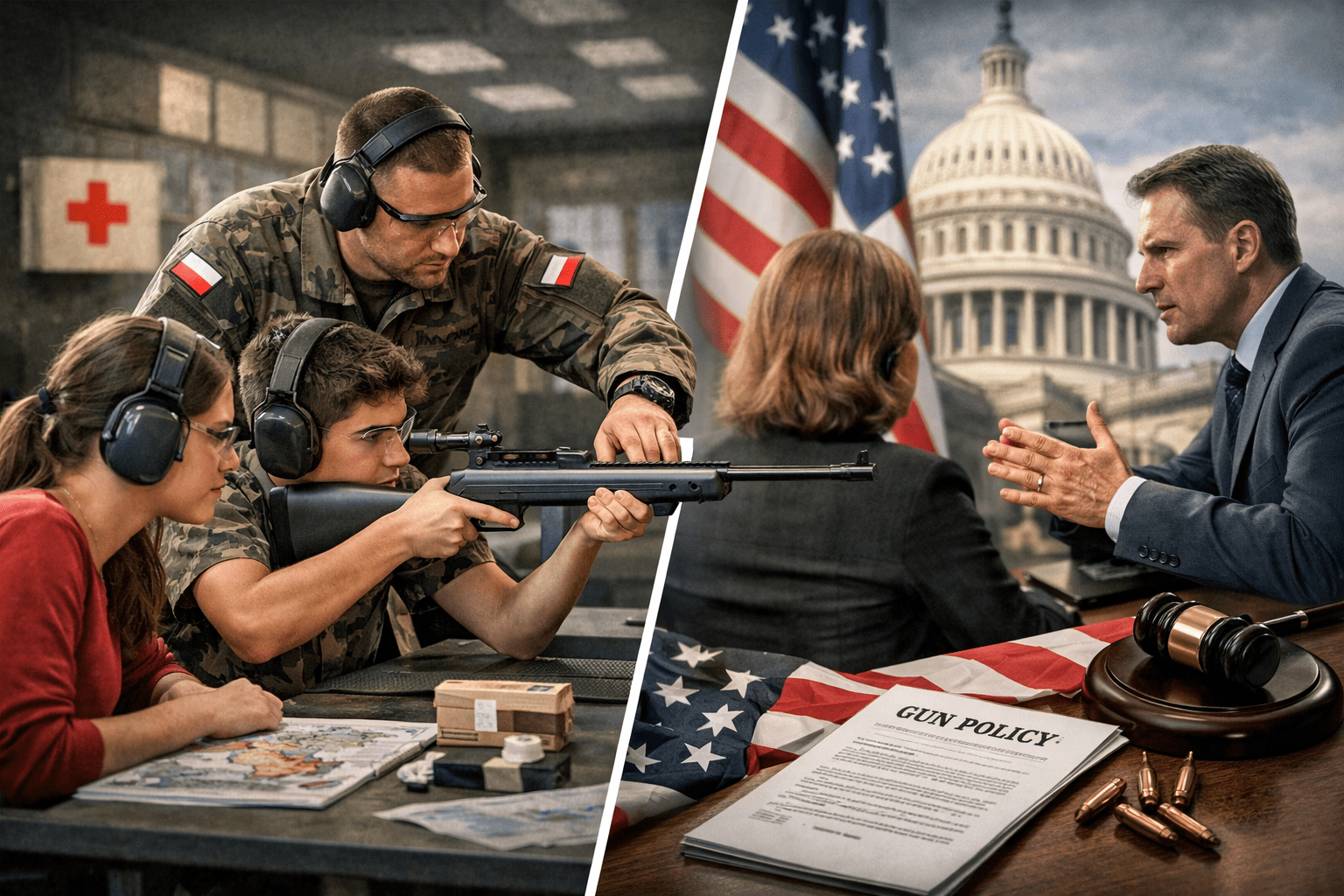
The headline version of the story is emotionally explosive: Poland added mandatory firearms-related training to its school safety curriculum. That is enough to trigger the usual American cycle of applause, panic, shallow takes, and political theater. But the serious lesson is not that Poland decided to “teach kids guns.” The serious lesson is that Poland embedded shooting-related skills inside a broader, state-backed Education for Safety framework that also includes first aid, emergency behavior, rescue skills, civil defense, cyber issues, and wartime readiness. In Poland’s official curriculum, the primary-school track focuses on safe handling principles, parts identification, shooting positions, sight alignment, breathing, and trigger control, while the secondary-school track goes further into weapon assembly and practical shooting using firearms, pneumatic weapons, ASG replicas, and virtual or laser ranges. Poland’s government also made clear that the shooting-skills portion was phased in over two school years and fully required from the 2024/2025 school year. (Gov.pl)
That distinction is everything.
Because if American policymakers and training leaders reduce Poland’s model to the cheap phrase “mandatory gun training for children,” they will misunderstand both the policy and the opportunity. Poland’s model is not compelling because it is provocative. It is compelling because it is structured.
Poland built a preparedness system, not a headline stunt
A serious reading of Poland’s curriculum shows that the firearms-related component does not sit alone. It sits alongside first-aid instruction, emergency response behavior, and wider state-security education. The secondary-school curriculum explicitly includes bleeding-control measures, pressure dressings, and behavior under violent-threat conditions, including the “run, hide, fight” framework. It also calls for practical implementation through schools working with local government, military units, and pro-defense organizations and using school resources or outside facilities such as virtual and laser ranges. (Zintegrowana Platforma Edukacyjna)
That matters for one simple reason: systems beat slogans.
Poland did not just make a cultural statement. It designed a progression. Students are introduced to safety and fundamentals first. Higher-complexity practical training comes later. The curriculum recognizes equipment constraints, allows simulation and low-risk training tools, and ties the subject to emergency competence rather than treating marksmanship as a stand-alone civic virtue. (Zintegrowana Platforma Edukacyjna)
That is exactly the part America should study.
The United States cannot copy Poland—and should not try
The American education system is not built for national curriculum transplantation. The U.S. Department of Education states plainly that education in the United States is primarily a state and local responsibility. States, communities, and institutions determine curricula, enrollment requirements, and graduation standards. That means there is no realistic path to a single nationwide firearms curriculum modeled after Poland’s approach. Any U.S. version would have to be built through states, districts, extracurricular frameworks, and tightly controlled local implementation. (U.S. Department of Education)
That is not a problem. That is reality.
The real American mistake would be trying to copy the optics of Poland’s policy without copying the architecture behind it. A country with decentralized school governance, sharp political division, and widely varying training standards cannot afford symbolic policy experiments. It needs disciplined, measurable, risk-controlled models.
The American environment demands a higher standard, not a louder argument
There is a hard fact U.S. leaders cannot ignore: according to the CDC, firearm injuries were the leading cause of death among children and teens ages 1–19 in 2022. The CDC also reports that firearm injuries were among the five leading causes of death for people ages 1–44 and that medically treated firearm injuries are often the result of assaults and unintentional injuries. (CDC)
That changes the burden of proof.
In the United States, any school-adjacent or youth-oriented firearms policy has to be judged first by whether it reduces risk, improves supervision, strengthens safety behavior, and increases emergency competence. It cannot be justified by ideology, nostalgia, or the fantasy that mere exposure produces maturity. It must be designed as a risk-management system.
That is why the real transferable lesson from Poland is not “normalize guns earlier.” It is “normalize disciplined preparedness earlier.”
What U.S. policymakers should learn from Poland
The first lesson is structural: firearms familiarity should never be isolated from the rest of public-safety education. Poland’s curriculum places shooting-related competencies inside a larger framework of first aid, rescue, crisis behavior, and national resilience. If U.S. policymakers want to build anything intelligent in this space, it should live inside emergency preparedness, public safety, or structured extracurricular development—not as a free-floating “gun class” detached from medical and safety education. (Zintegrowana Platforma Edukacyjna)
The second lesson is developmental: age-tiering is not optional. Poland’s primary-school curriculum centers on safe handling, basic parts, posture, sight picture, breathing, and trigger control. The secondary-school curriculum advances into assembly, disassembly, and practical shooting options. That progression reflects a basic truth many American debates ignore: younger students and older students should not be exposed to the same content in the same way. Safety concepts come first. Complex practical work comes later, under tighter control. (Zintegrowana Platforma Edukacyjna)
The third lesson is operational: simulation is not a concession to weakness. It is a serious training tool. Poland’s framework explicitly allows virtual and laser ranges, pneumatic systems, and ASG replicas. In a U.S. environment where liability, public concern, and infrastructure vary wildly, simulation-first design is not political compromise. It is professional common sense. (Gov.pl)
The fourth lesson is institutional: policy means nothing without written standards. If a state or district wants to touch this subject, then instructor qualification, storage rules, supervision ratios, medical coverage, approved equipment, lesson scope, and auditing requirements should all be defined before a single program begins. A vague mandate creates chaos. A structured mandate creates accountability.
What U.S. firearms trainers should learn from Poland
This is where the conversation gets uncomfortable, and it should.
Too much of the American training world still confuses personal familiarity with professional readiness. That may work in marketing. It does not work in schools, youth programs, or public-policy environments.
Poland’s model implies a different standard: instructors are not simply there to teach people how to shoot. They are there to operate inside a safety ecosystem. That means training must be nested inside emergency response, behavioral discipline, controlled progression, and institutional oversight. (Zintegrowana Platforma Edukacyjna)
The U.S. already has examples of what that professionalism looks like. Army JROTC’s official marksmanship guidance states that dummy and air rifles must be stored behind locked doors and that all weapons, including air rifles, require double-lock systems. The Civilian Marksmanship Program states that JROTC instructors must complete the JROTC Marksmanship Instructor Course before they can teach air rifle marksmanship to cadets, and that the course covers organizing a marksmanship program, safely conducting air-rifle live firing, and teaching basic marksmanship skills. (USARMYJROTC)
That is what a real standard looks like.
Not a strong personality.
Not a social media following.
Not “I’ve been around firearms my whole life.”
Not a loose collection of anecdotes dressed up as doctrine.
The same pattern appears in school-based archery. NASP’s Basic Archery Instructor certification was specifically developed so instructors can present lessons that are safe for students, instructors, bystanders, and the facility, and the training covers safe range setup, instruction, and equipment maintenance. (NASP Schools)
American firearms trainers should pay attention to that. The future of legitimate school-adjacent training in the U.S. will not belong to hobbyists with opinions. It will belong to organizations that can document standards, demonstrate instructor discipline, manage risk, and prove that their programs produce safer outcomes.
The smartest American adaptation would be narrower, safer, and more disciplined
The right U.S. takeaway from Poland is not a national mandate and not a public-relations stunt. It is a set of design principles.
Build from safety to complexity.
Use simulation and low-risk tools first.
Tie weapons familiarity to first aid, crisis response, and accountability.
Require instructor qualification that is specific, documented, and auditable.
Use school and district governance structures that already exist.
Measure safety performance, supervision, and emergency readiness—not just marksmanship scores.
Those principles fit the American environment far better than imported rhetoric ever will. They also align with the reality that U.S. education is decentralized and that any serious effort must survive scrutiny from administrators, parents, insurers, and the public. (U.S. Department of Education)
The bottom line
America does not need to imitate Poland’s optics. America needs to study Poland’s discipline.
Poland’s school policy is worth examining because it treats preparedness as a system: safety, medical readiness, structured progression, and controlled exposure under institutional rules. That is the lesson worth importing. The headline is not the model. The architecture is the model. (Gov.pl)
For U.S. policymakers and training leaders, the standard should be brutally simple:
If a youth or school-adjacent program makes students safer, more supervised, more medically prepared, and more accountable, it deserves consideration.
If it does not, it does not belong anywhere near a school.
Sources and links
Primary and official sources used for this article:
- Poland Ministry of Education: “Edukacja dla bezpieczeństwa – rozporządzenia podpisane”
- Poland official curriculum portal: “Edukacja dla bezpieczeństwa – szkoła podstawowa”
- Poland official curriculum portal: “Edukacja dla bezpieczeństwa – szkoła ponadpodstawowa”
- U.S. Department of Education: Federal Role in Education
- CDC: Fast Facts — Firearm Injury and Death
- U.S. Army JROTC: Marksmanship / Storage & Security Protocols
- Civilian Marksmanship Program: JROTC Marksmanship Instructor Course
- NASP: Basic Archery Instructor Certification