Light Controls the Fight Before the Fight Starts
Your eyes are not magic. They’re biology.
In low light, your vision shifts away from crisp detail and color and leans hard on motion detection and contrast. That’s where most people get sloppy—misidentify threats, miss hands, and make catastrophic decisions.
The real advantage: you’re not “illuminating.” You’re disrupting.
A high-intensity beam can force a visual reaction—pupil constriction and disruption of night vision—which reduces what the other person can process in that moment.
Seconds are leverage.
Why a Small Handheld Flashlight Beats “Phone Light” Every Time
A purse-friendly defensive light is about speed and control, not size.
Phone light fails because it:
- requires unlocking and navigating
- forces your head down (attention collapse)
- delivers weak output with poor beam control
- gives you no safe “on/off discipline” under stress
A real handheld light gives you:
- momentary activation (press = light, release = dark)
- one-hand control while you move, grab keys, hold a child, or open a door
- a beam designed for reach + spill (you see the environment and the subject)
- immediate “wall of light” capability when distance closes
What to Look for in a Purse / EDC Flashlight (Real Criteria, Not Marketing)
Ignore the internet obsession with “max lumens.” Output specs are often abused.
What matters in the real world:
1) Candela and beam shape (the “punch”)
- Candela drives useful intensity at distance and contributes to visual disruption.
- You want a usable hotspot with enough spill to navigate.
2) Momentary switch (mandatory)
If the light doesn’t give you instant momentary, it’s a liability. You need short bursts so you can move without backlighting yourself.
3) Size you will actually carry
If it’s too big, it lives in a drawer. A purse light must be compact, consistent to grip, and easy to index in the dark.
4) Clip + lockout
Purse carry is chaos. A clip helps staging. A lockout prevents accidental activation.
5) Simplicity under stress
In a real encounter, fine motor skill drops. Your light must run like a seatbelt: simple, repeatable, automatic.
How to Use a Handheld Flashlight in Self-Defense (Civilian-Realistic, Not Hollywood)
Here’s the sequence that matters: Detect → Identify → Disrupt → Disengage.
1) Detect: use light to kill surprises
Short bursts while moving. Don’t walk through darkness pretending it’s “fine.” Darkness is where unknown hands win.
2) Identify: hands, waistline, posture, intent
Your goal is not “find a face.” Your goal is to confirm what’s happening:
- Is there a weapon?
- Are they closing distance?
- Are they mirroring your movement?
3) Disrupt: the “wall of light” at the decision moment
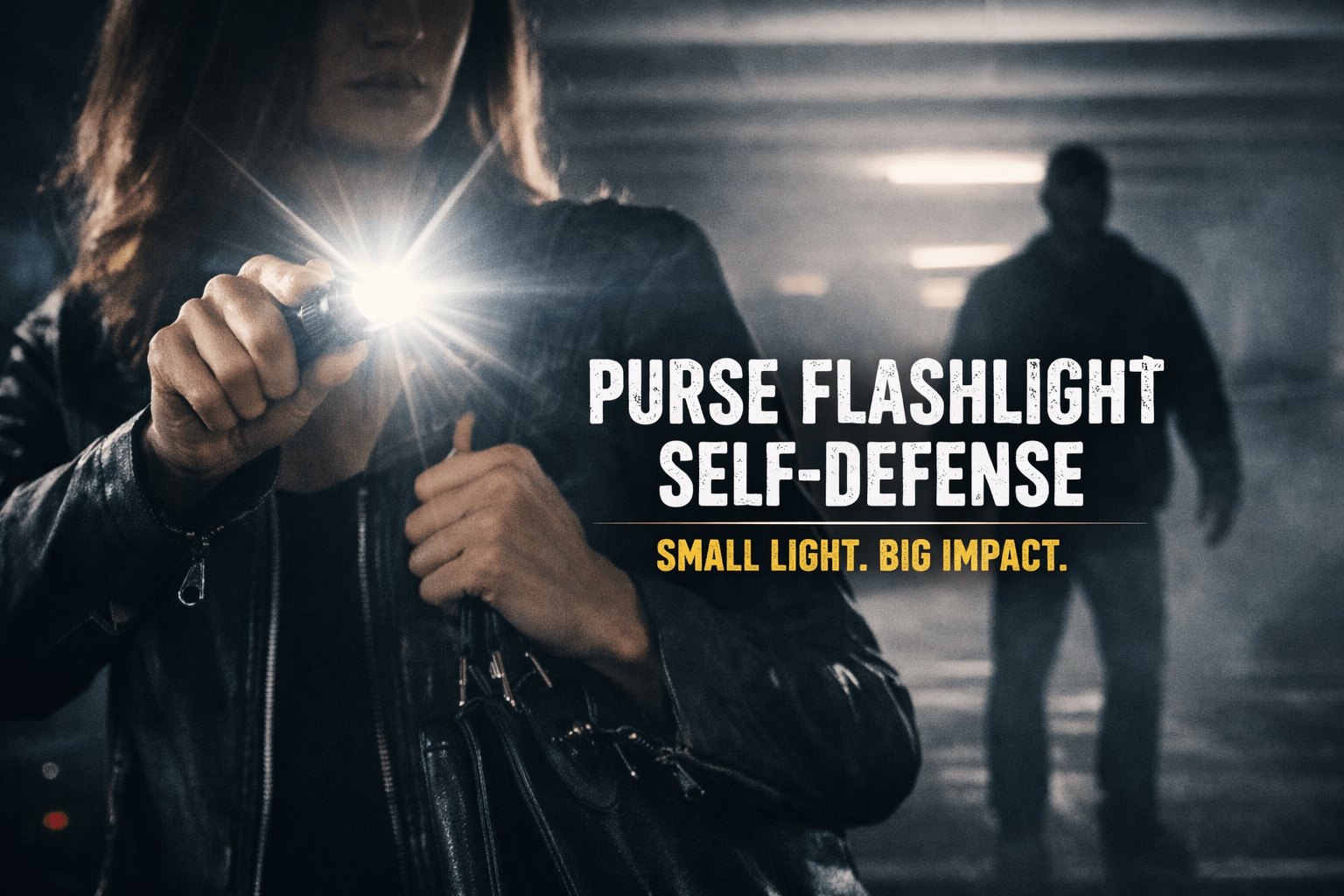
When someone is closing and you need space, a bright beam to the face is not “mean.” It’s a non-lethal dominance tool that can break approach momentum and create hesitation.
4) Disengage: move now
Light buys time. Movement uses it. Your objective is separation, barriers, exit, and calling for help—not “winning a duel.”
“Strobe” Is Not a Magic Button
Strobe gets sold like a superpower.
Reality: continuous high-intensity light often provides better identification and control. If you rely on strobe as your plan, your plan is a gadget.
The Legal Advantage: A Flashlight Can Be a Force Option Before Force
A handheld light is one of the few defensive tools that helps you:
- avoid misidentification
- create distance without touching anyone
- deter without escalating immediately
Self-defense outcomes don’t reward panic. They reward reasonableness, articulation, and proportionality.
A flashlight supports that because it helps you see, decide, and demonstrate control.
The Female Reality: Purse Carry Changes the Game—So Stage It
If your flashlight is buried under makeup, receipts, and keys, you don’t “have” a flashlight.
You have a future regret.
Practical staging:
- use an internal pocket or dedicated pouch
- keep the light oriented the same way every time
- practice finding it with eyes closed
- pair it with a simple routine: “hand on light when walking to car at night”
This isn’t paranoia. This is professionalism.
The Uncomfortable Truth: Tools Don’t Replace Training
Buying a flashlight is easy.
Using it under stress—without freezing, without blinding yourself off reflective surfaces, without making bad decisions—requires reps.
If you want real capability, train it.
Call to Action
If you live in Florida and you’re serious about personal protection, stop treating low-light as an afterthought.
Valortec runs structured low-visibility training that pressure-tests handheld light use, threat identification, decision-making, and real-world mechanics—because the dark is where skill gaps get people hurt.
Ready to train? Visit your Valortec course registration page and lock in your seat.
FAQ
Is a small handheld flashlight effective for self-defense?
Yes. A compact handheld flashlight improves threat identification, can disrupt an aggressor’s vision, and helps you create time and distance to escape—especially in common low-light environments like parking lots and garages.
What matters more: lumens or candela?
Both matter, but candela and beam shape drive useful intensity at distance. A defensive light should have a strong hotspot for reach with enough spill to navigate and assess the environment.
Should I use strobe mode for self-defense?
Don’t rely on strobe as a magic solution. Many defenders benefit more from continuous high-intensity light for identification and control. The priority is momentary use, movement, and disengagement.
How do I carry a flashlight in a purse so it’s accessible?
Stage it in the same pocket every time, oriented consistently, ideally with a clip or pouch. If it’s buried, it won’t be available when you need it.
Why is flashlight use important in low-light self-defense?
Low light increases misidentification risk and slows decision-making. A handheld light helps you confirm hands, intent, and threats while reducing the chance of tragic errors.