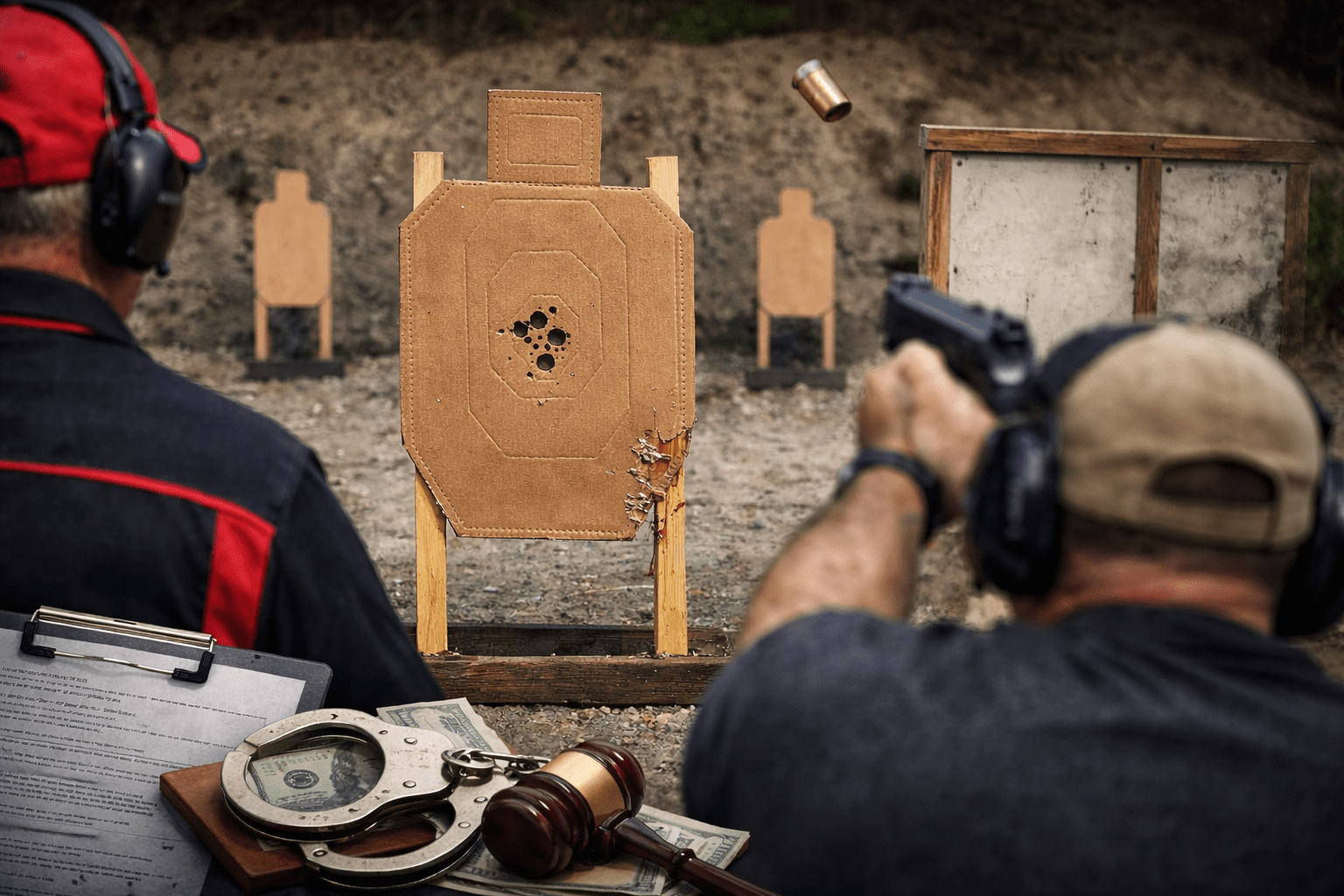
If Your Range Allows “Certificate Mills,” Your Facility Becomes the Crime Scene
Ranges and agencies that permit incompetent “instruction” aren’t neutral landlords. You’re enabling foreseeable harm—and inviting civil, administrative, and punitive exposure.
base on the ground, that is not “learning.” That is grossly inadequate marksmanship under controlled conditions.
If your facility allows an instructor to watch that happen and still issue a “certificate,” your range is not just hosting training.
You are hosting a liability factory.
And once that newly “certified” shooter carries a firearm into public with a false sense of proficiency, the risk is no longer hypothetical.
The harm becomes foreseeable, predictable, and legally actionable.
The Range’s Duty Isn’t Optional: You Control the Ground, You Control the Risk
Ranges and agencies love to hide behind a fantasy: “We just rent lanes.” Wrong.
If you are the owner, operator, manager, or controlling entity of the premises, you have duties to lawful visitors—and you can be sued when you
enable unsafe conditions and foreseeable harm.
Florida law expressly addresses actions against the owner / lessor / operator / manager of property and the
allocation of fault in premises-liability frameworks involving third-party acts.
When you knowingly allow negligent training practices on-site—especially practices that create predictable harm outside your facility—you step into:
- Premises liability and negligent supervision
- Negligent retention (you kept allowing the instructor after obvious warning signs)
- Vicarious exposure when the instructor operates under your agency brand
- Punitive damages risk if facts support gross negligence
“They Signed a Waiver” Is Not a Strategy—It’s a Future Exhibit
Waivers don’t erase negligence. They don’t protect third-party victims. And they don’t stop administrative action.
If your facility knowingly permits negligent conduct, you can still be pulled into litigation and discovery—and your waiver becomes part of the evidence trail.
Florida Attorney General Opinion (range liability & waivers context)
A waiver is not a force field. If you monetize risk you can plainly see, you own a piece of what follows.
The “Range Protection” Statutes Don’t Protect Unsafe Training
Some ranges hear “range protection” and assume immunity from everything. That assumption is reckless.
Florida’s range-related protections are often tied to specific issues (including nuisance/noise) and do not grant a blanket license to run sloppy,
dangerous programs or allow negligent instruction.
Florida Statutes § 823.16 (Sport shooting ranges)
Florida Statutes § 790.333 (Sport shooting & training range protection)
In certain contexts, legal guidance and policy discussions have also referenced continuing compliance with recognized safety standards when ranges seek protection.
If your operation tolerates “certificate mill” behavior, you are not operating like a protected facility—you’re operating like a foreseeable hazard.
Florida Attorney General Opinion (range protection / standards context)
The Core Issue: Your Facility Is Allowing Misrepresentation of Competence
A certificate issued to a shooter who can’t reliably hit a torso-sized target is not encouragement. It is a representation.
And when that representation is false, your facility is enabling a dangerous chain:
- Documented incompetence on your property
- Certificate issued anyway
- Student relies on it as proof of proficiency
- Student carries in public
- Predictable miss under stress
- Innocent people get hit
- Attorneys trace the chain back to the range that allowed it
This is foreseeability, in writing, with your address on it.
Civil Liability: The Range Gets Named Because You’re the Enabler With Assets
If a negligent instructor operates on your premises and your business profits from it—lane fees, class fees, memberships, retail sales—expect the lawsuit to include you.
Plaintiffs will allege:
- Negligent supervision: you permitted unsafe training practices in your facility
- Negligent retention: you continued allowing the instructor after obvious warning signs
- Failure to enforce safety and competency standards
- Misrepresentation / deceptive practices (depending on marketing and certificate language)
If the facts show you ignored obvious danger, plaintiffs will pursue punitive damages. Florida’s punitive damages statute hinges on
intentional misconduct or gross negligence proven by clear and convincing evidence.
Florida Statutes § 768.72 (Punitive damages standard)
If your staff sees repeated “stick hits,” hears complaints, watches rubber-stamp certificates, and you keep booking the same instructor—your facility is helping write the gross-negligence narrative.
The Urgency: This Isn’t a Training Debate. It’s a Public Safety Countdown.
A shooter who can’t hit a torso target under controlled conditions is exactly the shooter who will miss in a parking lot.
And once that happens, the legal machine will do what it always does:
- Sue the shooter
- Sue the instructor
- Sue the range
- Sue the sponsoring agency
- Sue anyone who marketed “qualification” and collected payment
This is not paranoia. This is how liability works when harm is foreseeable and preventable.
If you permitted the enabling conditions, you are a contributor.
What a Responsible Range Does Immediately
If you want to stay in business and stay out of court, implement an enforceable policy now.
Not a suggestion. A policy with teeth.
Non-negotiables for any instructor operating on your property
- Objective standards: documented accuracy requirements on torso-sized targets at specified distances
- Fail authority: instructors must fail students who cannot meet minimum hits
- No participation certificates: certificates must reflect measured performance, not attendance
- Incident documentation: repeated misses = remediation plan or dismissal
- Instructor vetting: verify credentials, insurance, methodology, and safety record
- RSO oversight: RSO can halt training if safety/standards are violated
- Marketing compliance: no “qualified for defense” claims unless standards justify it
The simplest line your staff needs to say
“If they can’t keep rounds on the torso, they don’t pass in this facility.”
Put that in writing. Train your staff to enforce it. The certificate mills will leave on their own.
Final Warning to Ranges and Agencies
If you allow incompetent instruction on your grounds—especially instruction that produces “certified” shooters who can’t hit a torso target—you are not a bystander.
You are a gatekeeper who opened the gate.
And once the predictable harm happens, don’t act shocked when your facility is treated like a responsible party—because you were.