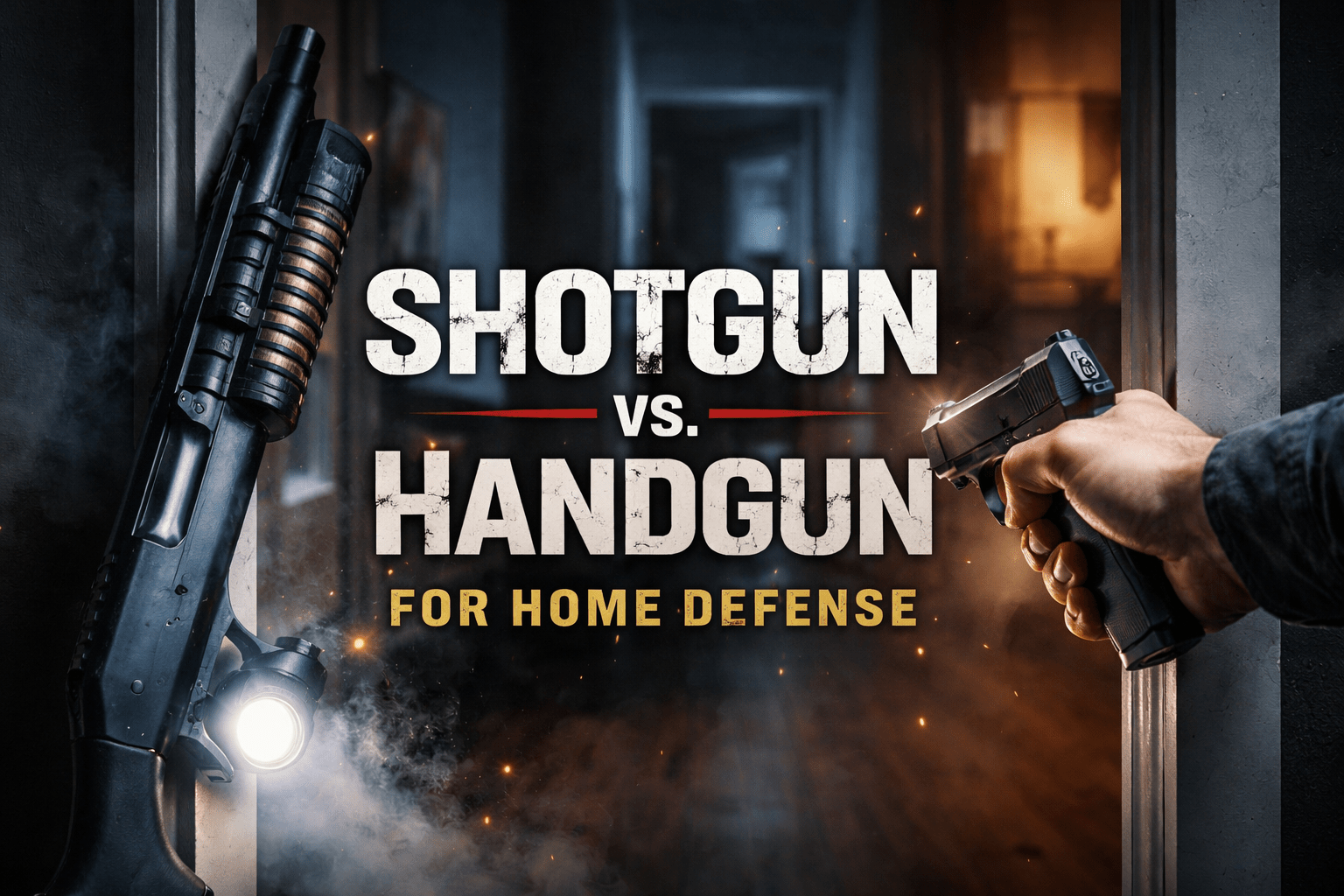
Shotgun vs. Handgun for Home Defense: A Scientific Analysis of Human Performance, Recoil, Noise, and Control
Abstract. For decades, the shotgun has been promoted as the default home-defense weapon for the ordinary citizen. That belief has been repeated so often that many people now treat it as settled truth. It is not. When home defense is evaluated through the lens of human performance under acute stress, the shotgun’s supposed simplicity begins to collapse. Scientific literature on stress physiology, perceptual narrowing, motor performance, and marksmanship shows that emergencies degrade perception, judgment, and skilled movement.[1] At the same time, manufacturer data and acoustic research show that the shotgun imposes substantial burdens in length, recoil, blast, and manual operation that many ordinary citizens are poorly prepared to manage.[2]
This paper argues that for the average civilian homeowner, the claim that the shotgun is automatically the superior home-defense platform is more folklore than science. The shotgun remains a formidable weapon in capable hands, but capable hands are the point. To run a shotgun efficiently under pressure requires more training, more strength, more repetition, and more technical discipline than many pseudo-instructors are willing to admit. The handgun is not magic and is not effortless, but in a confined residential emergency it often presents fewer physical and cognitive liabilities.[3]
Home defense is not decided by folklore, nostalgia, or Hollywood. It is decided by what the average person can actually control under chaos, fear, noise, and time pressure.
1. Introduction: The Problem With Tradition and Folklore
The home-defense debate is often contaminated by tradition, exaggeration, and cinematic fantasy. One of the most persistent myths is that the shotgun is naturally easier to use than a handgun and therefore is the obvious choice for the ordinary homeowner. That claim ignores the actual conditions of a home-defense event: darkness, sleep inertia, narrow hallways, furniture, family members, limited reaction time, psychological shock, auditory overload, and acute fear. In other words, the environment is not a square range and the user is not calm.[1]
A realistic comparison must ask a different question: Which platform gives an average citizen the highest probability of retaining control, making sound decisions, and delivering accountable performance while under acute stress inside a confined structure? When evaluated on that basis, many of the shotgun’s assumed advantages weaken substantially.[4]
2. Human Performance Under Stress Is the Real Battlefield
Research on acute stress and firearms performance shows that stress is not a minor inconvenience. It changes how people perceive, think, and move. Anderson and colleagues reviewed the physiological effects of acute stress and concluded that stress-related autonomic and musculoskeletal changes can degrade skilled motor performance.[1] Biggs and colleagues found that under direct-fire stress, participants experienced reduced situational awareness and perceptual shortcomings, and that stress-inoculation training reduced these errors.[4] Di Nota and Huhta likewise emphasized that armed performance is a complex motor learning problem, not a simple matter of owning equipment.[3]
This matters because the average citizen in a home-defense emergency is not functioning at a relaxed baseline. Heart rate rises. Breathing changes. Vision narrows. Attention becomes selective. Fine discrimination suffers. Any firearm that demands more body strength, more manual manipulation, more recoil management, and more spatial clearance becomes harder to run correctly at the exact moment when the user is least able to compensate.[1]
The emergency does not lower the standard. It raises the consequences of every weakness in equipment handling, movement, and decision-making.
3. Size and Maneuverability Indoors
The dimensional difference between a service-size handgun and a defensive shotgun is not trivial. Glock lists the full-size G17 Gen5 MOS at 7.95 inches overall length, 33.33 ounces loaded, and 17-round standard capacity.[5] Mossberg lists the 590 platform as a pump-action design available in 6-shot, 7-shot, and 9-shot variants; commonly cited 18.5-inch 7-shot 12-gauge models run about 38.625 inches overall with 6+1 capacity and roughly 6.3 pounds of weight.[6]
That difference is decisive in confined spaces. A handgun stays closer to the user’s centerline, requires less clearance to orient, and is easier to move around doorways, furniture, corners, and family members. A long gun can still be used indoors, but it demands more spatial management and creates a larger handling footprint. The more confined the structure, the more that extra length becomes a burden rather than a benefit. For the average homeowner, the idea that a near-39-inch pump shotgun is automatically the easiest emergency tool inside a house is not a serious ergonomic conclusion. It is nostalgia masquerading as doctrine.[5]
Key Dimensional Reality
A service-size handgun is dramatically shorter, lighter, and easier to keep inside the body’s working envelope than a full-length pump shotgun. In close quarters, that matters immediately.
4. Recoil: Physics Does Not Care About Folklore
Recoil is one of the clearest areas where shotgun mythology breaks down. SAAMI’s recoil formulae make clear that recoil is driven by the mass and velocity of the ejecta and propellant gases relative to firearm weight.[8] Federal’s 9mm 124-grain HST load is listed at 1150 fps.[9] Federal’s low-recoil 12-gauge 00 buck load is listed at 1140 fps, and Federal’s personal-defense FLITECONTROL 12-gauge 00 buck load is listed at 1145 fps.[10][11] The velocities are comparable, but the shotgun is launching a dramatically larger payload. Under SAAMI’s own recoil framework, that means materially greater recoil impulse.[8]
This is not merely a comfort complaint. Heavy recoil affects confidence, recovery time, sight disruption, body mechanics, and follow-up accountability. It also punishes weaker, smaller, aging, or infrequent shooters more severely. A platform that delivers more recoil while also requiring manual cycling in the pump-action format raises the physical demands at the exact moment when stress has already compromised coordination. For trained long-gun users, that burden may be manageable. For the average homeowner, it is often underestimated and too often denied by pseudo-instructors who mistake bravado for analysis.[1]
The shotgun is powerful, but power without control is not an advantage. It is a liability wearing the costume of confidence.
5. The Pump Shotgun Is Not “Simple”
One of the most damaging myths in the home-defense world is that the pump shotgun is simpler than a handgun. Mechanically, that is a weak claim. Glock’s own explanation of semi-automatic pistols states that a semi-automatic handgun fires a chambered round, extracts and ejects the casing, and then loads a new round into the chamber with each trigger pull while ammunition remains in the magazine.[7]
By contrast, Mossberg’s documentation and manuals make clear that the pump gun requires the user to move the forearm fully rearward and then fully forward to cycle the action.[12] That means every shot from a pump shotgun carries not just recoil management and target accountability, but also an added manual action cycle that must be completed correctly under stress. A missed stroke, incomplete stroke, or delayed cycle is not theory. It is a human-performance liability built into the platform.[12]
That does not make the pump shotgun ineffective. It makes it more dependent on training and repetition than the folklore crowd likes to admit. “Simple” is not the same as “easy under chaos.” Those are not interchangeable concepts.[3]
6. Noise, Blast, and Indoor Disorientation
The shotgun is often discussed as though its effectiveness somehow overrides its sensory cost. It does not. Firearm impulse-noise research from NIOSH and CDC-linked sources shows that firearms commonly generate peak sound levels far above the 140 dB ceiling associated with hearing-damage risk.[13] One firing-range assessment reported peak sound pressure levels from 156 to 170 dB across various weapons.[13] Another NIOSH evaluation found that during live-fire training, instructors were exposed to impulsive noise levels greater than 150 dB, and a 12-gauge shotgun fired in a doorway reached approximately 172 dB.[14]
In other words, the indoor shotgun blast is not a minor inconvenience. It is a violent sensory event. The handgun is not harmless either, especially because pistols are fired closer to the shooter’s ears, but the notion that the shotgun is some user-friendly indoor solution is absurd when viewed through acoustics. In a confined home environment, severe blast can intensify disorientation, communication failure, auditory disruption, and post-shot confusion. That matters because home defense is not only about firing. It is also about identifying, deciding, moving, stopping, and thinking clearly enough to avoid catastrophic mistakes.[13]
7. The “You Don’t Have to Aim a Shotgun” Myth
Another Hollywood lie is the idea that a shotgun does not have to be aimed carefully at indoor distances. Federal’s FLITECONTROL product materials explicitly market tighter patterns, not room-filling chaos. One Federal example notes a 12-inch spread at 30 yards, which strongly undercuts the cartoon narrative that a shotgun solves marksmanship through pellet dispersion alone.[11] At realistic home distances, patterns are correspondingly tighter, which means accountability remains critical.
The hard truth is that the shotgun does not exempt the user from precision, judgment, or discipline. It simply changes the consequences of poor judgment. A shooter who believes a shotgun is a magical “point it in the general direction” device is not educated. He is misled.[11]
The shotgun does not remove the need for skill. It punishes the absence of it.
8. Training Burden, Strength, and Skill Retention
This is where the shotgun separates sharply from the handgun for ordinary citizens. Complex motor skill research shows that shooting performance is not just a matter of exposure but of structured skill acquisition, decision-making integration, and ongoing retention. Di Nota and Huhta emphasize that lethal-force performance involves complex motor learning, perception, and cognition.[3] Ibrahim and colleagues found that tactical breathing improved first-shot accuracy, reinforcing the broader point that stress management and performance are trainable.[15] Reviews of police marksmanship literature likewise identify stress, physical condition, balance, cognition, and training quality as important variables in firearms performance.[16]
The pump shotgun raises the bar in all of those areas. The user must learn to mount the gun consistently, control a more forceful recoil event, maintain sight accountability, work the forearm decisively, and preserve control of a much longer, heavier platform. That takes repetition. It takes physical commitment. It takes more durable technique. It also takes honesty. A person who barely trains, has weak upper-body control, has poor recoil tolerance, or has only casual familiarity with long-gun handling is unlikely to run a shotgun efficiently in the middle of a nighttime emergency.[12]
That is the central issue pseudo-instructors avoid. The shotgun can be excellent, but excellence with it is purchased through training volume, technical discipline, and physical competence. It is not granted by tradition. It is not granted by internet legend. It is not granted by buying one and leaving it in a closet.[3]
For a more direct examination of commonly repeated shotgun claims, see The Shotgun Lie: Home Defense Myths That Could Get You Hurt.
9. Conclusion
The shotgun is not useless for home defense. That is not the argument. The argument is that the automatic glorification of the shotgun for the average civilian homeowner is scientifically weak. When human stress, confined-space handling, recoil, manual operation, blast, and training burden are honestly considered, the shotgun is often the more demanding platform, not the easier one.[1]
For most ordinary citizens, a quality service-size handgun often presents a lower-control burden indoors: it is shorter, lighter, easier to keep close to the body, faster to orient in confined spaces, and free from the manual cycling demands of the pump shotgun. None of that eliminates the need for serious training. It does, however, expose the myth that the shotgun is the simple answer. In reality, the shotgun’s reputation in home-defense culture has been inflated by Hollywood imagery, repetition, and pseudo-expertise far more than by sober biomechanics and performance science.[5]
The serious conclusion is this: for the average citizen, the shotgun is not the effortless king of home defense. It is a specialist tool that demands more training, more physical competence, and more proficiency than the folklore crowd admits.[16]
References
- Anderson, G. S., Di Nota, P. M., Metz, G. A. S., & Andersen, J. P. The Impact of Acute Stress Physiology on Skilled Motor Performance: Implications for Policing. Frontiers in Psychology. Source ↩
- General synthesis of firearm acoustics, handling burden, and platform dimensions from official manufacturer and occupational noise sources below. ↩
- Di Nota, P. M., & Huhta, J.-M. Complex Motor Learning and Police Training: Applied, Cognitive, and Clinical Perspectives. Frontiers in Psychology. Source ↩
- Biggs, A. T., Hamilton, J. A., Jensen, A. D., et al. Perception During Use of Force and the Likelihood of Firing Upon an Unarmed Person. Scientific Reports. Source ↩
- Glock. G17 Gen5 MOS Technical Data. Source ↩
- Mossberg. 590 Shotguns Product Information. Source ↩
- Glock. All About Pistols. Source ↩
- SAAMI. Gun Recoil Formulae. Source ↩
- Federal Premium. Personal Defense HST, 9mm Luger, 124 Grain. Source ↩
- Federal Premium. Power-Shok Buckshot Low Recoil, 12 Gauge, 00 Buck. Source ↩
- Federal Premium. Buckshot with FLITECONTROL Wad / Personal Defense Shotshell Product Information. Source ↩
- Mossberg. Pump-Action Firearms Owner’s Manual. Source ↩
- Murphy, W. J., Stephenson, M. R., Byrne, D. C., Witt, B., & Durling, L. Assessment of Noise Exposure for Indoor and Outdoor Firing Ranges. Source ↩
- NIOSH. Measurement of Noise Exposures from Tactical Training Exercises. Source ↩
- Ibrahim, F., et al. The First Shot Counts the Most: Tactical Breathing as an Intervention to Increase Marksmanship Accuracy in Student Officers. Source ↩
- Simas, V., et al. Factors Influencing Marksmanship in Police Officers: A Literature Review. International Journal of Environmental Research and Public Health. Source ↩