Why Flat Range Confidence Fails Under Pressure
Let’s get this straight in the first 10 seconds: flat range vs real world training is not a debate. It’s a reality check.
Flat range reps build mechanics—but the limitations of range training show up the moment a threat moves, screams, lies, closes distance, or forces you to decide.
If you’ve never confronted the static shooting training problems baked into most “training,” your confidence is borrowed. Under pressure, it gets repossessed.
This isn’t an attack on range time. It’s an attack on the lie that range time equals readiness.
Flat Range vs Real World Training: What the Flat Range Actually Builds
Flat range training is good for a few things. Important things.
The flat range builds “hardware”:
- Grip, stance, trigger press, sight tracking
- Presentation from ready / holster (when allowed)
- Reload mechanics
- Basic recoil management
- A baseline standard you can measure
But defensive encounters are “software” plus chaos. The real world is not a lane with a target that stands still, stays quiet, and politely waits for your beep.
Flat range competence is necessary. It is not complete.
The Limitations of Range Training: Predictability Is Poison
Static ranges teach your nervous system a dangerous habit: everything will be predictable.
- The target is known.
- The distance is known.
- The lighting is known.
- The timing is known.
- The rules are known.
- The environment is sterile.
- The “problem” is always “shoot.”
Real life does the opposite.
- The threat may not look like a threat until it’s too late.
- The distance changes fast.
- People move into your line.
- You may need to disengage, escape, or control—not shoot.
- The first move might be verbal.
- The best move might be leaving.
The flat range is where you learn to drive the car in a parking lot.
A defensive encounter is rain, traffic, bad visibility, mechanical failure, and someone trying to ram you off the road.
Static Shooting Training Problems: It Doesn’t Train the Decision
Here’s the gap that gets people hurt: most shooters train shooting. They don’t train deciding.
On the range, the decision is already made: “It’s time to shoot.”
In the real world, the decision is the hardest part:
- Is it a threat or just aggressive behavior?
- Is there a weapon or a fake-out?
- Is it one person or two?
- Is your family behind them?
- Can you move?
- Can you escape?
- Do you have legal justification in Florida right now?
That decision-making load is the weight. Flat range training removes the weight, then wonders why people collapse under it.
What Happens Under Pressure: Your Body Changes the Rules
When violence hits, you don’t rise to your hopes. You drop to your level of conditioning.
Under stress, common failures include:
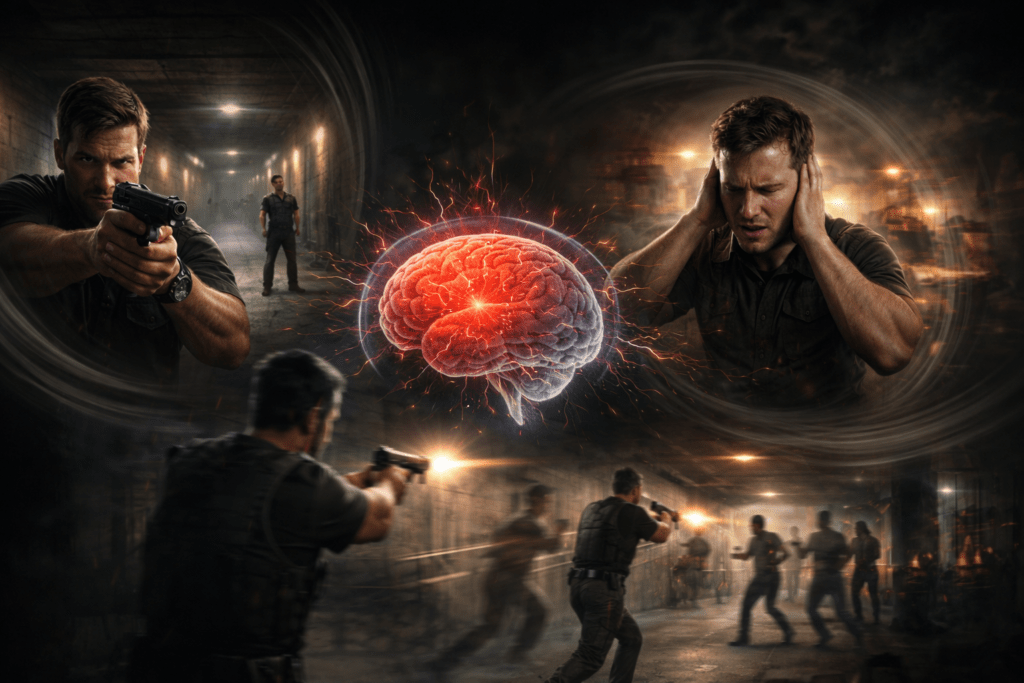
1) Tunnel Vision: You See the Threat… and Miss Everything Else
You lock onto hands, waistband, weapon, face—good. But you lose peripheral awareness, movement cues, secondary threats, bystanders, and escape routes.
Flat ranges don’t punish this because nothing changes in your environment. Real encounters do.
2) Auditory Exclusion: You Don’t Hear What You Think You’ll Hear
People assume they’ll hear commands, warnings, shots, and their own voice. Under stress, hearing can distort or narrow.
That can mean missed cues, missed communication, and missed surrender indicators.
Static lanes don’t train communication under chaos because communication is rarely required.
3) Decision-Making Paralysis: “I Don’t Know What To Do”
Flat range training often creates a single solution: shoot.
But real encounters may require verbal control, movement to cover, protecting a third party, disengagement, or waiting for legal justification.
If you’ve never trained that decision tree under pressure, your brain stalls.
4) Movement Failures: You Freeze in the Open
On most ranges, movement is limited or nonexistent. That’s convenient. It’s also a liability.
- You may need to move off the X immediately.
- You may need to create angles.
- You may need to protect someone while moving.
- You may need to fight for space, not score points.
Static training teaches your feet to stay planted. A threat teaches your feet they should have moved two seconds ago.
5) Cognitive Overload: You Can’t Process Fast Enough
In a defensive encounter, your brain is juggling threat cues, legal justification, bystanders, backstop, distance, angles, communication,
malfunction management, cover, concealment, and family positioning.
Flat range training isolates variables. Real life stacks them all—aggressively.
The Myth: “If I Can Shoot Tight Groups, I’m Ready”
Tight groups are great. They are not the standard for defensive readiness.
A defensive encounter is not a marksmanship test. It’s a human performance test under stress, uncertainty, and consequence.
If your training has never included:
- An opponent who moves and reacts
- Ambiguity and deception
- A need to speak, assess, and decide
- Time pressure that changes the plan
- Consequences for bad choices
Then what you have is range skill—not defensive capability.
Florida Context: The Real World Includes the Law, Not Just the Threat
Florida isn’t theoretical. Florida is crowded public spaces, parking lots, gas stations, nighttime encounters,
tourists, families, and cameras everywhere—plus road-rage dynamics that go from loud to lethal fast.
And Florida self-defense is not “I felt threatened.” Your actions have to be defensible under Florida’s legal framework for justified use of force.
That means your decision matters just as much as your shot placement.
Flat range training doesn’t train articulation under stress, threat discrimination, de-escalation when appropriate, or breaking contact when you can.
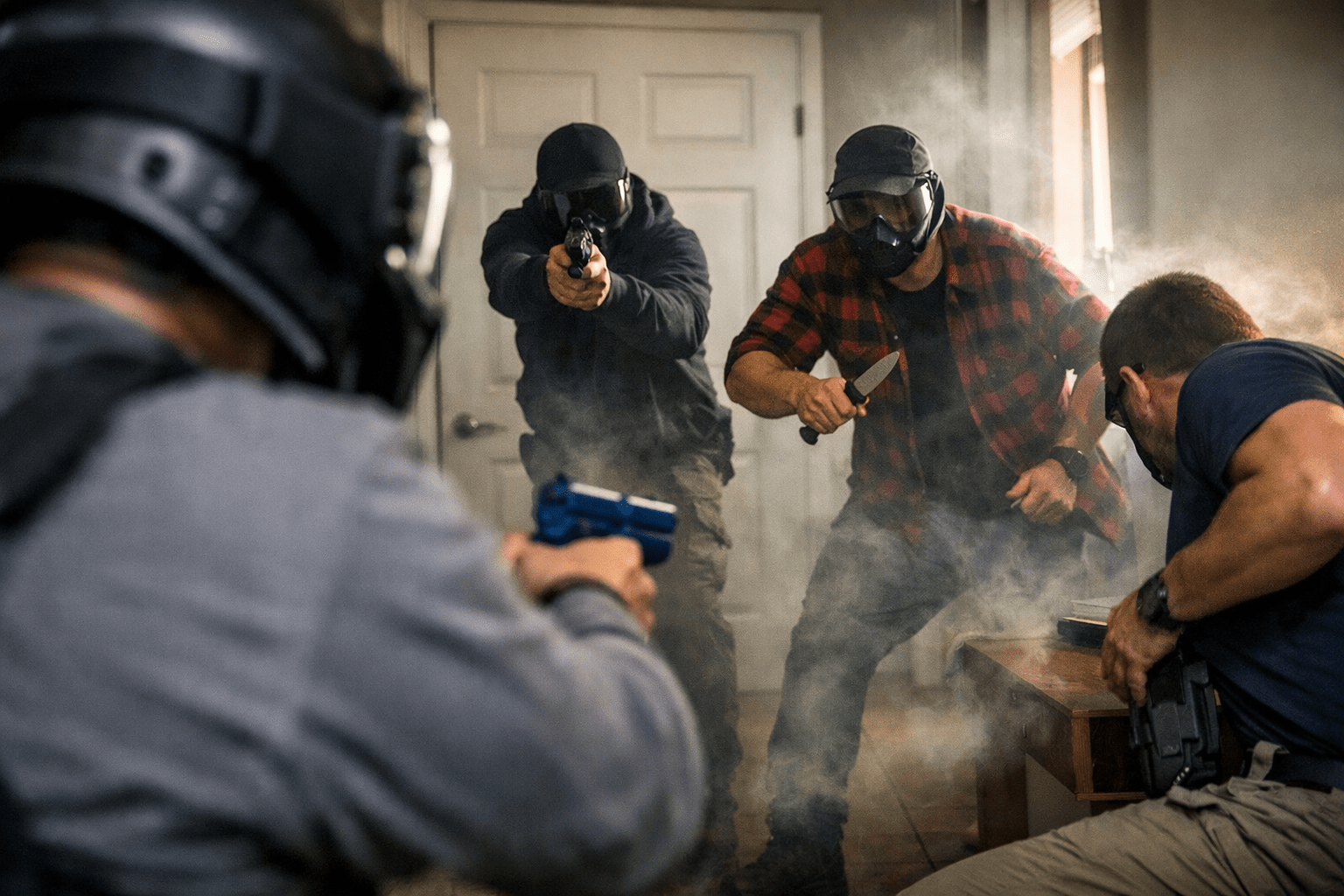
Force-on-force training does—because it forces you to solve problems, not just shoot targets.
Flat Range vs Real World Training: The Three Gaps That Break People
Gap #1: The Threat Is Alive
Paper doesn’t lie. People do. Paper doesn’t flank. People do. Paper doesn’t rush you. People do.
Gap #2: The Environment Is Dirty
Low light. Noise. Confined spaces. Unknown angles. Limited movement. Innocents nearby.
Static lanes don’t replicate that. They avoid it.
Gap #3: The Problem Isn’t Always “Shoot”
Sometimes the right answer is move, leave, verbalize, control, hold, call, cover, or escape.
Static training doesn’t teach options. It teaches a routine.
The Solution: Force-on-Force Training Is the Missing Bridge
If you want real readiness, you need controlled exposure to the realities that crush flat range confidence.
Force-on-force training is where shooters learn:
- Threat recognition under ambiguity
- Decision-making under time pressure
- Movement with purpose
- Communication while stressed
- Managing tunnel vision and attention
- Processing unexpected changes
- Making legal, defensible choices under load
This is not “tactical cosplay.” This is the only environment that can safely simulate an opponent who reacts,
consequences for bad decisions, and unpredictability without real injury.
Flat range training is where you build the engine.
Force-on-force training is where you learn to drive it when someone is trying to kill you.
How Static Shooting Training Problems Show Up in Real Encounters
Here are common “flat range shooters” failure patterns:
- They chase sights instead of solving distance and angle
- They stand still because they never trained movement
- They default to shooting because they never trained alternatives
- They can’t speak because they never trained communication
- They lose the wider scene because they never trained scanning under stress
- They freeze when the script breaks because they only trained scripts
That’s not a character flaw. That’s a training flaw.
What to Do Now: Practical Fixes You Can Start Immediately
1) Stop Worshiping Comfort
If your training always feels controlled, clean, and predictable, it is incomplete.
Start adding stressors that force thinking—without sacrificing safety.
2) Add Decision Cues to Live Fire
Even on a flat range, you can train the brain: mixed target priority, “no-shoot” conditions (as rules allow),
verbalization before shooting, and movement to a position before engaging.
3) Train Scanning as a Skill, Not a Ritual
Scanning isn’t head-wagging theater. It’s trained recovery of awareness: check hands, check flanks, check exits, check people.
4) Build Movement That Solves Problems
Movement must have purpose: create angle, create distance, get to cover, protect family, exit.
5) Get Into Force-on-Force Training in Florida
This is the non-negotiable step. If you carry and your training has never included realistic problem-solving against another human,
you are leaving readiness up to luck.
The Bottom Line
Flat range confidence fails under pressure because it’s built in a world without uncertainty, consequence, decision-making load,
human behavior, dynamic movement, and legal complexity.
That’s the truth. And if that truth makes you uncomfortable, good. Discomfort is the first sign you’re paying attention.
Call to Action: Train for Reality in Florida
If you’re serious about defensive readiness—and you’re tired of false confidence—it’s time to graduate from the lane.
Enroll in force-on-force training through
Florida firearms training programs built for real-world performance.
You’ll learn what holds up under pressure, what collapses, and how to build a defensive skill set that survives chaos.
Stop training for applause. Train for survival.