

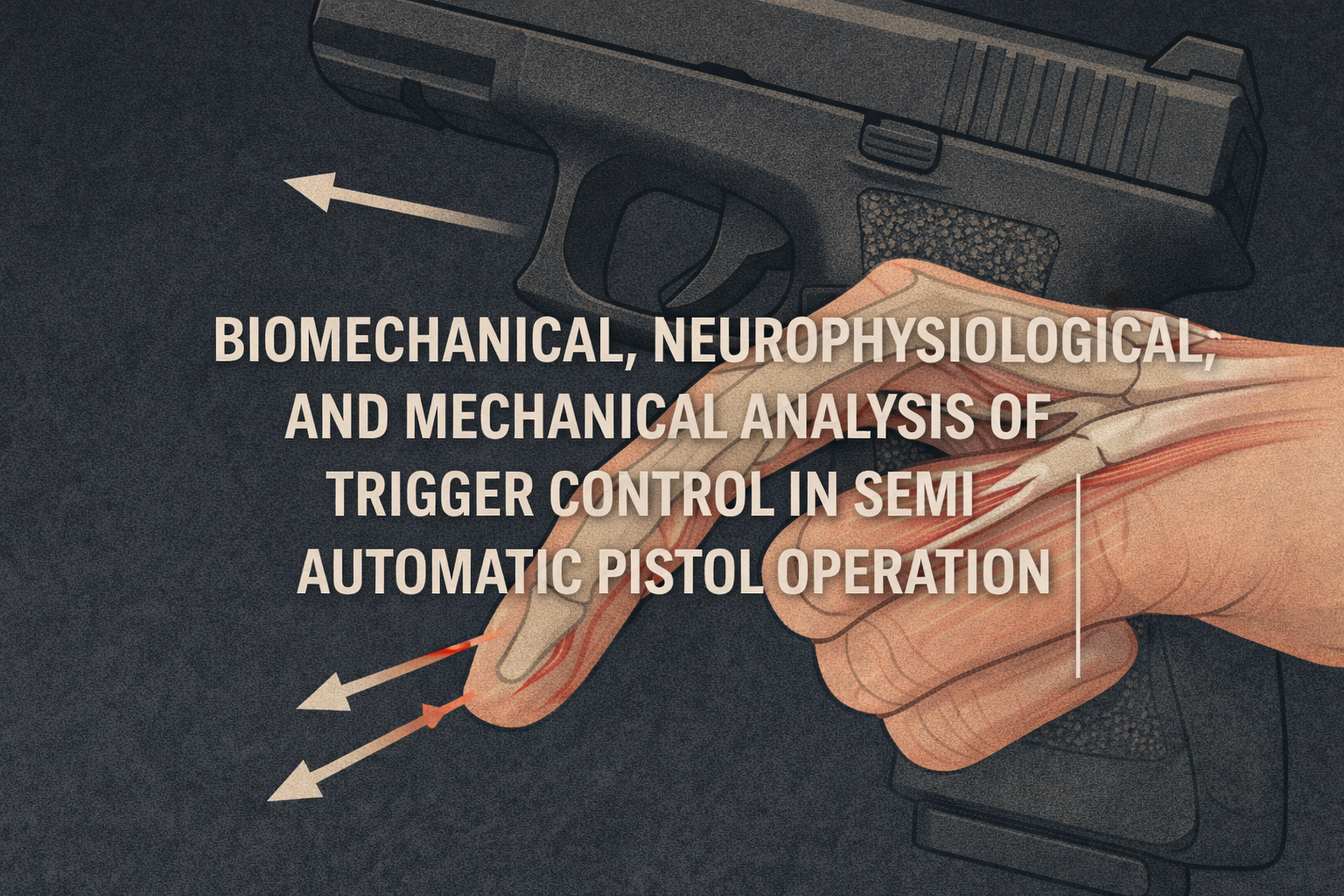
Biomechanical, Neurophysiological, and Mechanical Analysis of Trigger Control in Semi-Automatic Pistol Operation
Abstract
Trigger control remains one of the most frequently taught yet least scientifically substantiated elements of firearms instruction. Traditional pedagogical models continue to emphasize rigid, pad-centric trigger-finger placement rules that fail to account for anatomical variability, joint kinematics, neuromuscular coordination, and the mechanical behavior of modern trigger systems. This manuscript integrates principles from functional anatomy, biomechanics, neurophysiology, motor-learning science, and applied physics to reframe trigger manipulation as a precision neuromuscular task rather than a static positioning rule. Legacy trigger instruction is critically examined and shown to be biomechanically incomplete, physiologically naive, and pedagogically insufficient. A contemporary, evidence-based framework is proposed emphasizing individualized finger–trigger interface mechanics, linear force vector alignment, staged trigger management, and neuromotor isolation.
1. Introduction
Trigger manipulation is the controlled application of force through the index finger (digit II) to activate the sear mechanism while minimizing unintended displacement of the firearm. Biomechanically, this task requires selective digit articulation combined with isometric stabilization across the hand, wrist, and forearm (Enoka, 2008).
Despite this complexity, traditional firearms education has historically reduced trigger control to simplistic heuristics—most notably the directive to use the distal pad of the index finger. This reductionist approach neglects anatomical diversity, neuromuscular constraints, and mechanical system behavior, resulting in instruction that is outdated and scientifically incomplete.
2. Functional Anatomy of the Trigger Finger
The index finger possesses a high degree of neuromuscular independence relative to adjacent digits due to its cortical representation and specialized motor control (Kandel et al., 2021). Trigger actuation involves coordinated activation of the flexor digitorum profundus (FDP), flexor digitorum superficialis (FDS), lumbricals, interossei, and antagonist stabilization via the extensor digitorum (Latash, 2008).
Optimal trigger manipulation occurs through controlled flexion at the metacarpophalangeal (MCP) and proximal interphalangeal (PIP) joints rather than isolated distal phalanx compression. DIP-dominant articulation increases lateral shear forces and promotes sympathetic contraction in adjacent digits, degrading precision and stability (Slobounov et al., 2002).
3. The Fallacy of Pad-Only Trigger Finger Placement
Pad-centric trigger instruction assumes a standardized hand morphology that does not exist. Human variation in metacarpal length, phalangeal ratios, palm depth, trigger reach, joint mobility, and tendon excursion capacity renders universal placement rules biomechanically indefensible (Zatsiorsky & Latash, 2008).
From a mechanical standpoint, distal-pad-only contact increases the moment arm between the trigger face and the finger’s axis of rotation, amplifying lateral torque and inducing transverse muzzle displacement. Empirical evidence indicates that linear force direction, not skin contact location, is the primary determinant of trigger stability (Mon-López et al., 2019).
4. Trigger Manipulation as a Staged Mechanical Process
Semi-automatic pistol triggers function as staged mechanical systems exhibiting discrete phases: take-up, resistance wall(s), break, overtravel, and reset. Effective trigger manipulation aligns with motor-learning principles by treating these phases as a continuous mechanical interaction rather than a binary press (Schmidt & Lee, 2019).
The reset-and-prep methodology—progressive preload, minimal incremental force to sear release, and controlled decompression to reset—minimizes acceleration spikes, reduces grip disruption, and preserves sight alignment during rapid fire.
5. Neuromuscular Isolation and Motor Control
Isolating digit II is a neuromotor challenge constrained by shared cortical pathways and natural motor synergies. Independent finger movement requires active inhibition of synergistic activation in digits III–V and stabilization of proximal joints (Gandevia, 2001).
Dry-fire and hybrid diagnostic drills exploit proprioceptive and visual feedback to refine motor-unit synchronization. Repetition drives cerebellar adaptation, reducing oscillatory force output and improving consistency in trigger press dynamics (Vigouroux & Quaine, 2006).
6. Straight-Line Trigger Kinematics
Biomechanical and mechanical analyses support the principle that straight-line posterior force application is more consequential than precise finger placement. Linear kinematics minimize off-axis torque at the trigger pivot regardless of whether contact occurs at the distal pad, intermediate phalanx, or proximal pad (Enoka, 2008).
Articulation through the PIP joint produces a more collinear force vector than distal-only flexion, particularly in shooters with longer fingers or shorter trigger reach.
7. Constant Velocity and Minimal Effective Force
Trigger press efficiency improves when force is applied at constant velocity, reducing impulse spikes transmitted into the grip system. Abrupt acceleration increases neuromuscular noise and destabilizes the firearm (Tomlinson et al., 2009).
Equally important is the principle of minimal effective force—using only the pressure required to release the sear. Excess force increases antagonist recruitment, accelerates fatigue, and degrades fine motor control, particularly under stress (Gandevia, 2001).
8. Educational Failure of Traditional Trigger Doctrine
The persistence of outdated trigger instruction reflects institutional inertia rather than scientific ambiguity. Instructors replicate inherited doctrine, certification standards lag behind research, and simplified rules are favored for ease of instruction. However, pedagogical simplicity does not equate to biomechanical correctness.
Instruction that ignores anatomy, physics, and motor control is not merely outdated—it is educationally deficient.
9. Requirements for Modern Trigger-Control Instruction
A scientifically defensible curriculum must:
- Reject universal finger-placement mandates
- Treat trigger control as a joint-articulation and force-vector problem
- Emphasize linear posterior force application
- Integrate trigger mechanics and staging awareness
- Account for anatomical variability and physical limitations
- Employ motor-learning-based diagnostics
- Validate technique through observable sight behavior
10. Conclusion
Trigger control is a precision neuromuscular task constrained by anatomy and mechanical interaction, not a simplistic finger-placement exercise. Pad-centric doctrine represents a legacy artifact from an era lacking access to biomechanics, neuroscience, and mechanical analysis.
Trigger control is anatomy.
Trigger control is physics.
Trigger control is motor control.
The evolution toward individualized, science-based trigger instruction is not innovation—it is necessary correction.
References
Enoka, R. M. (2008). Neuromechanics of human movement (4th ed.). Human Kinetics.
Gandevia, S. C. (2001). Spinal and supraspinal factors in human muscle fatigue. Physiological Reviews, 81(4), 1725–1789. https://doi.org/10.1152/physrev.2001.81.4.1725
Kandel, E. R., Koester, J. D., Mack, S. H., & Siegelbaum, S. A. (2021). Principles of neural science (6th ed.). McGraw-Hill.
Latash, M. L. (2008). Neurophysiological basis of movement (2nd ed.). Human Kinetics.
Mon-López, D., Gómez, M. Á., & Lorenzo, A. (2019). The relationship between pistol Olympic shooting performance and peak finger flexor forces. PLOS ONE, 14(9), e0220790. https://doi.org/10.1371/journal.pone.0220790
Schmidt, R. A., & Lee, T. D. (2019). Motor learning and performance (6th ed.). Human Kinetics.
Slobounov, S., Chiang, H., Johnston, J., & Ray, W. (2002). Modulated cortical control of individual fingers. Neuroscience Letters, 319(3), 153–156. https://doi.org/10.1016/S0304-3940(02)00044-7
Tomlinson, S. E., Lewis, R., & Carré, M. J. (2009). Review of the frictional properties of the finger–object interface. Tribology International, 42(6), 888–898. https://doi.org/10.1016/j.triboint.2008.11.001
Vigouroux, L., & Quaine, F. (2006). Fingertip force and electromyography in a precision task. Journal of Electromyography and Kinesiology, 16(5), 461–468. https://doi.org/10.1016/j.jelekin.2005.08.002
Zatsiorsky, V. M., & Latash, M. L. (2008). Multifinger prehension: An overview. Journal of Motor Behavior, 40(5), 446–476. https://doi.org/10.3200/JMBR.40.5.446-476


