Biomechanical and Musculoskeletal Analysis of AR-15 / M4 Carbine Employment in Defensive Environments
Abstract
Effective defensive employment of the AR-15/M4 carbine platform is governed not solely by mechanical accuracy but by
the shooter’s musculoskeletal alignment, neuromotor control, and interaction with recoil forces under stress.
Traditional rifle instruction has often emphasized external positional cues—such as indexing the stock into the
outer shoulder pocket or adopting bladed stances—without sufficient consideration of spinal alignment, axial load
transfer, and centerline force management. This paper examines carbine shooting through functional anatomy,
biomechanics, and applied physics, emphasizing centerline rifle alignment, neutral spinal posture, multi-point
contact stability, and compact upper-limb positioning as determinants of accuracy, precision, recoil mitigation,
and weapon retention during close-range defensive encounters.
1. Introduction
Carbine accuracy and precision in defensive contexts emerge from the dynamic interaction between the firearm’s
recoil system and the shooter’s neuromusculoskeletal structure. Under stress, the nervous system preferentially
defaults to gross motor patterns, making biomechanically efficient alignment essential for repeatable performance.
This analysis reframes defensive carbine use as a whole-body motor task emphasizing skeletal stacking, axial load
transmission, and centerline alignment rather than isolated muscular effort or legacy positional heuristics.
2. Skeletal Alignment and the Central Axis Principle
2.1 Spinal Alignment and Postural Integrity
The vertebral column functions as a load-bearing structure designed to transmit forces longitudinally through
stacked vertebral segments. Lateral flexion of the cervical or thoracic spine during carbine employment introduces
asymmetric load vectors, increasing rotational torque and degrading recoil control and optic stability.
Maintaining near-neutral cervical alignment preserves vestibulo-ocular coordination, enhances visual tracking, and
reduces asymmetric muscular recruitment in the neck and shoulder girdle. The rifle should be aligned to the
shooter’s spine—not the spine contorted to meet the rifle.
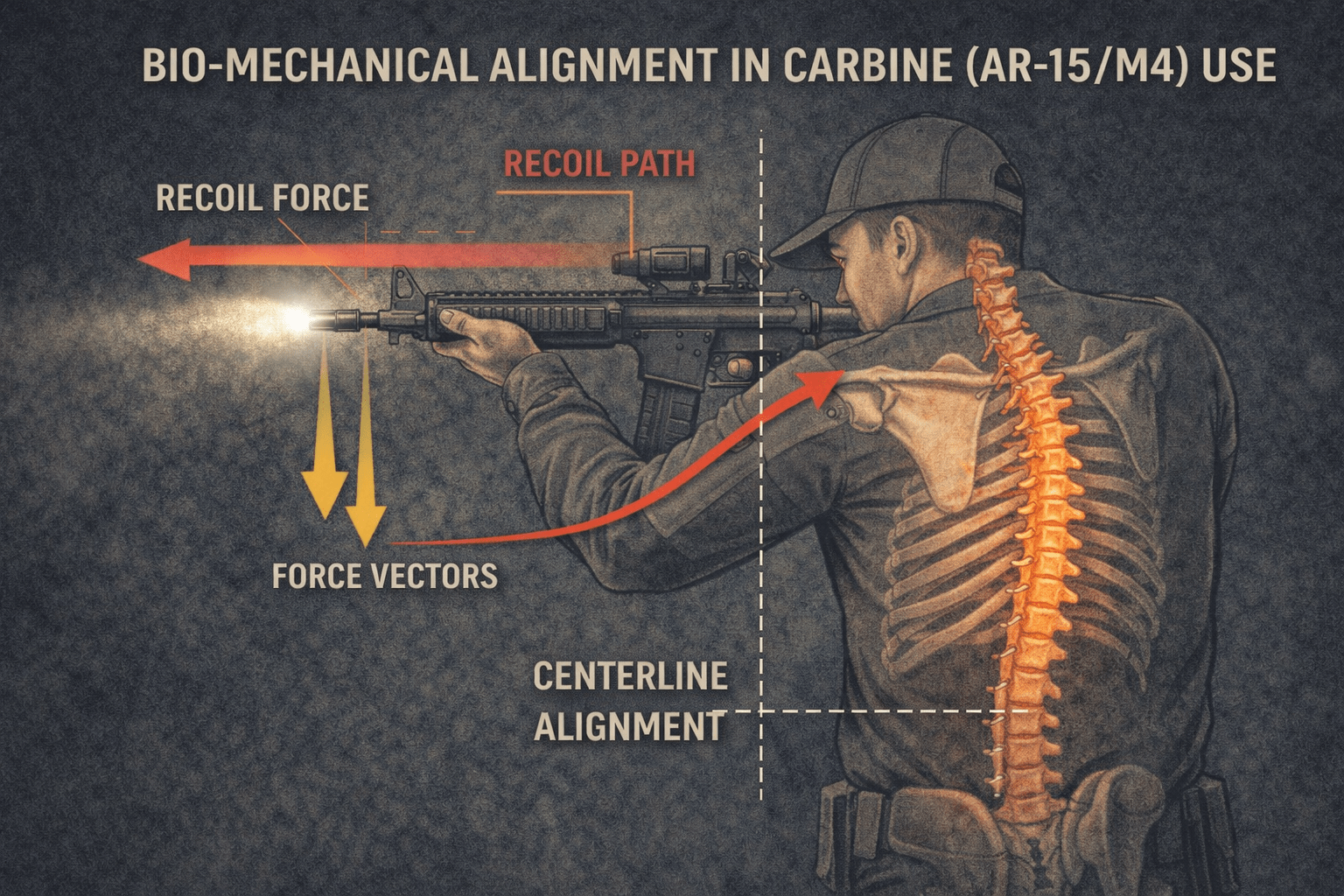
2.2 Centerline Rifle Alignment
Modern defensive carbine doctrine benefits from positioning the rifle closer to the body’s sagittal plane rather
than indexing exclusively into the outer shoulder pocket. Centerline alignment reduces rotational moments about the
spine, improves bilateral muscular symmetry, and aligns recoil impulse closer to the body’s center of mass. This
configuration supports axial load transmission and accelerates recovery between shots.
3. Recoil Mechanics and Load Transfer
3.1 Internal Recoil Dynamics
Upon firing, the AR-15/M4 platform generates a rearward impulse composed of projectile acceleration, gas-system
operation, bolt carrier group motion, and buffer-spring compression. In simplified form:
Frecoil = Δp / Δt
Where momentum change (Δp) is distributed over time (Δt) by the operating system, and the shooter’s body becomes
the final stage of energy transmission.
3.2 Skeletal vs. Muscular Absorption
When the rifle is aligned along the centerline with proper skeletal stacking, recoil energy is transmitted through
the shoulder girdle, axial skeleton, and lower extremities into the ground. Poor alignment shifts absorption to
smaller stabilizing muscles (deltoids, rotator cuff, cervical musculature), increasing muzzle rise, slowing sight
recovery, and accelerating fatigue.
4. Multi-Point Contact and Stability
4.1 Contact Point Framework
Effective carbine control relies on multiple consistent contact points between firearm and body:
- Firing-hand grip interface
- Support-hand forend interface
- Shoulder/chest contact
- Cheek weld
- Visual alignment through the optic
Each contact point reduces degrees of freedom in the rifle–shooter system, increasing stability and repeatability.
4.2 Proprioceptive Indexing
Consistent placement of the rifle against the body enhances proprioceptive mapping, allowing rapid, repeatable
mounting under stress. This reduces reliance on visual confirmation and improves performance in low-light or
dynamic environments.
5. Upper Limb Positioning and Movement Mitigation
5.1 Elbow Adduction and Compact Posture
Keeping the elbows tucked closer to the torso reduces the lever arm created by the upper limbs, minimizing
rotational inertia and lateral wobble. Arm adduction allows recoil forces to be transmitted through the torso
rather than dissipated through unsupported limb extension, improving recoil control and consistency.
5.2 Grip and Forend Interaction
The support hand primarily provides directional stabilization and counters muzzle rise through rearward and
slightly inward pressure. Excessive lateral tension increases neuromuscular noise and degrades fine control. The
firing hand maintains consistent rearward interface and trigger management, contributing to longitudinal stability.
6. Squaring to the Threat and Movement Efficiency
A squared stance—hips and shoulders oriented toward the threat—optimizes visual field coverage, balance, and
lateral movement initiation. It also improves weapon retention and supports efficient transitions between forward,
lateral, and rearward movement while maintaining muzzle alignment and postural integrity.
7. Close-Range Retention and Structural Advantage
In close-proximity confrontations, a compact, centerline-oriented posture with elbows adducted shortens lever arms
available to an adversary, enhances retention through skeletal alignment, and preserves balance during contact.
Weapon retention becomes a function of structural positioning rather than upper-body strength alone.
8. Accuracy, Precision, and Neuromotor Efficiency
Accuracy (closeness to point of aim) and precision (shot-to-shot consistency) depend on minimizing muzzle
displacement and accelerating sight recovery. Proper musculoskeletal alignment reduces neuromuscular noise,
enabling repeatable firing sequences even under sympathetic activation.
9. Training Implications
A biomechanically valid defensive carbine curriculum must:
- Emphasize neutral spinal alignment and centerline rifle positioning
- Teach recoil as a whole-body load-transfer problem
- Reinforce consistent multi-point contact
- Train compact limb positioning for control and retention
- Validate technique through observable optic and muzzle behavior
Instruction rooted solely in legacy shoulder-pocket indexing without biomechanical context is incomplete.
10. Conclusion
Effective defensive employment of the AR-15/M4 platform is achieved through integration of anatomy, biomechanics,
and physics. Centerline alignment, axial spinal posture, multi-point contact, and compact limb positioning
transform recoil from a disruptive impulse into a manageable load transmitted through the skeletal framework.
In defensive environments—where stress, movement, and proximity dominate—musculoskeletal alignment is not a
stylistic preference. It is a performance requirement.
References
- Enoka, R. M. (2008). Neuromechanics of human movement (4th ed.). Human Kinetics.
- Hatcher, J. S. (1947). Hatcher’s notebook. Stackpole Books.
- Latash, M. L. (2008). Neurophysiological basis of movement (2nd ed.). Human Kinetics.
- McGill, S. M. (2007). Low back disorders: Evidence-based prevention and rehabilitation (2nd ed.). Human Kinetics.
- Schmidt, R. A., & Lee, T. D. (2019). Motor learning and performance (6th ed.). Human Kinetics.
- Zatsiorsky, V. M., & Latash, M. L. (2008). Multifinger prehension: An overview. Journal of Motor Behavior, 40(5), 446–476. https://doi.org/10.3200/JMBR.40.5.446-476