What Is Scenario-Based Firearms Training?
If your “training” is the same five drills, in the same lane, at the same distance, with the same target… you’re not training for defense.
You’re rehearsing comfort.
Scenario based firearms training is what happens when you stop practicing shooting and start practicing decisions—under movement, uncertainty, pressure, and consequences.
That’s where most shooters discover an uncomfortable truth: your flat-range skill is not your real-world performance.
And Florida is not a gentle place to learn that lesson the hard way.
Scenario Based Firearms Training: The Definition
Scenario based firearms training is structured firearms training that places the shooter inside a realistic problem—complete with context, constraints, and consequences—so they must process information,
make decisions, move, communicate, and apply skills appropriately.
It’s not “random chaos.” It’s designed on purpose.
A scenario includes:
- A setting (parking lot, doorway, hallway, store aisle, vehicle, home)
- A problem (unknown contact, escalation, multiple people, family present, low light, close distance)
- Decision points (shoot / don’t shoot, move / hold, verbalize / disengage)
- Consequences (bad choices create bad outcomes—immediately)
- A clear debrief (what happened, why it happened, what to fix)
This is defensive scenario practice. Not drill theater.
Why Traditional Drills Feel Good (And Why That’s the Problem)
Most shooters live on drills:
- Draw and fire 2
- Bill drills
- Failure-to-stop
- 1–5 drill
- Reload and re-engage
- Timed strings on a beep
Drills build mechanics. They matter. But drills also lie.
Here’s what drills quietly teach your brain:
- The target is always the threat
- The threat is always in front of you
- The solution is always shooting
- Nobody screams, runs, lies, or freezes
- Nobody is between you and the target
- Nothing changes after the first shot
That is not “realistic.” That is predictable. And predictability creates the illusion of competence.
Dynamic Defensive Training: Where Performance Changes
Dynamic defensive training is where people discover the performance gap.
Same shooter. Same pistol. Same skills. Different context.
Put them in a scenario and suddenly:
- The draw slows down
- Accuracy falls apart
- They stop moving
- They forget to speak
- They stare at the threat like they’re hypnotized
- They don’t see the second person
- They fire when they shouldn’t
- They hesitate when they must act
This isn’t because they’re weak. It’s because context changes performance.
Static Drills vs Defensive Scenario Practice
Drills answer: “Can you shoot?”
Scenario-based training answers: “Can you solve—under pressure?”
Static drills (flat range):
- One task at a time
- Known target, known distance
- No ambiguity
- No consequences
- Minimal decision-making
- Minimal movement
- Minimal communication
Defensive scenario practice (scenario based firearms training):
- Multiple tasks stacked
- Unknown variables
- Ambiguity on purpose
- Consequences on purpose
- Decision-making required
- Movement is required
- Communication is required
In short: drills make you a better shooter. Scenarios make you a better defender.
The “Context Crash”: Why Shooters Fold When Reality Shows Up
You can be “good on the range” and still be unprepared for a defensive encounter. Because a defensive encounter is not a marksmanship test.
It’s a human performance test.
Scenarios introduce what drills avoid:
1) Threat Discrimination
Who is the threat? Is there a weapon? Is it a decoy? Is it a misunderstanding? Is the “victim” actually the aggressor?
Static drills don’t train this because they already told you who to shoot.
2) Verbal Skills Under Stress
Most people can’t talk under pressure. They go silent—or they yell nonsense.
Scenario based firearms training forces communication: commands, distance, de-escalation when possible, and control without firing.
3) Movement With Purpose
Flat range lanes teach planted feet. Real defense requires movement: off the line, to cover, to protect a family member, or to escape.
Dynamic defensive training makes movement non-optional.
4) Tunnel Vision and Missed Information
In scenarios, shooters lock onto the problem and ignore everything else. They don’t see exits, bystanders, or the second actor.
That’s what stress does. Scenario training exposes it early—so you can correct it.
5) Decision-Making Under Legal Reality (Florida Included)
Florida self-defense isn’t “I felt weird.” Your decisions matter. Your articulation matters. Your restraint matters when restraint is possible.
Scenario training pressures you to make choices that would actually hold up in the real world—especially in a state where cameras and witnesses are everywhere.
Examples: What Scenario-Based Firearms Training Looks Like
Scenario 1: Unknown Contact in a Parking Lot
One person approaches fast. Hands disappear. Distance closes.
You must decide: verbalize, move, disengage, or act. Drills don’t teach distance management with a thinking human. Scenarios do.
Scenario 2: Convenience Store Aisle With Innocents Present
Threat isn’t centered. Innocents move. Backstop changes.
You must decide whether you can shoot at all. Static lanes rarely force a real “don’t shoot” decision with pressure.
Scenario 3: Home Entry / Doorway Problem
Limited angles. Unknown threat location. Family behind you. Light and sound change everything. This is where range confidence collapses.
Scenario 4: Vehicle Encounter
Seated posture. Seatbelt constraints. Limited mobility. Windows, pillars, and angles you never train.
Most shooters never practice this until after they realize they should have.
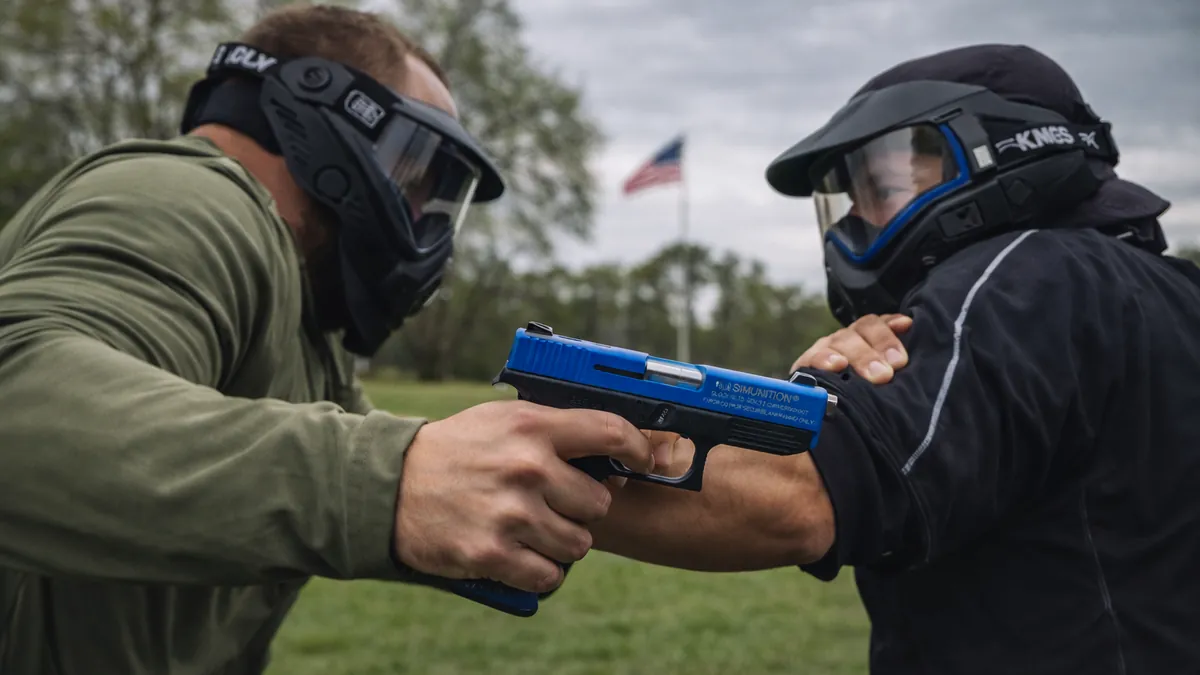
Force-on-Force Training: The Pinnacle of Scenario-Based Preparation
If scenario based firearms training is the category, force-on-force training is the highest form of it.
Because the opponent is alive. They move. They react. They deceive. They pressure you. They punish bad decisions immediately.
Force-on-force training delivers what drills cannot:
- A thinking adversary
- Real timing
- Real surprise
- Real consequences (without real injury, when done correctly)
This is where shooters stop pretending. And it’s where real defensive capability gets built.
Who Needs Scenario-Based Training in Florida?
If you carry a firearm for defense in Florida, you need it. Period.
- Concealed carriers who only shoot slow-fire groups
- Armed security who only qualify and call it “training”
- Home defenders who have never moved with a gun
- Gun owners who’ve never practiced decision-making under pressure
Florida has parking lots, gas stations, crowded stores, nightlife, road rage, and unpredictable human behavior.
If your training model doesn’t match the environment, your confidence is fantasy.
The Bottom Line
Scenario based firearms training is not “extra.” It’s the missing link between mechanical skill and defensive performance.
Dynamic defensive training and defensive scenario practice do what static drills can’t:
- Force decisions
- Expose stress failures
- Build movement and communication
- Teach threat discrimination
- Create pressure in a controlled environment
- Produce skills that survive chaos
Call to Action: Train Like Florida Is Real (Because It Is)
If you’re ready to move past flat range comfort and build real defensive capability, enroll in scenario-based training that includes force-on-force.
This is the difference between “I shoot well” and “I can solve the problem under pressure.”
Get into force-on-force training in Florida and find out what actually holds up when the script breaks.
Stop collecting drills. Start building performance.