Florida Is Not Immune: What the Public Record Says About Terror Threats, High-Consequence Cities, and Why Readiness Matters Now
Florida does not need panic. It needs adults, planning, lawful training, and the discipline to stop confusing comfort with security.
Let’s get one thing straight: this article is not an accusation against an entire religion or community. It is a public-safety warning about violent jihadist organizations, inspired actors, material-support networks, and the hard reality that Florida has already appeared in the federal counterterrorism record.
Too many people in Florida still think terrorism is somebody else’s problem. Somebody else’s city. Somebody else’s crowd. Somebody else’s church. Somebody else’s airport. Somebody else’s school. That mindset is exactly how communities stay soft, slow, distracted, and vulnerable.
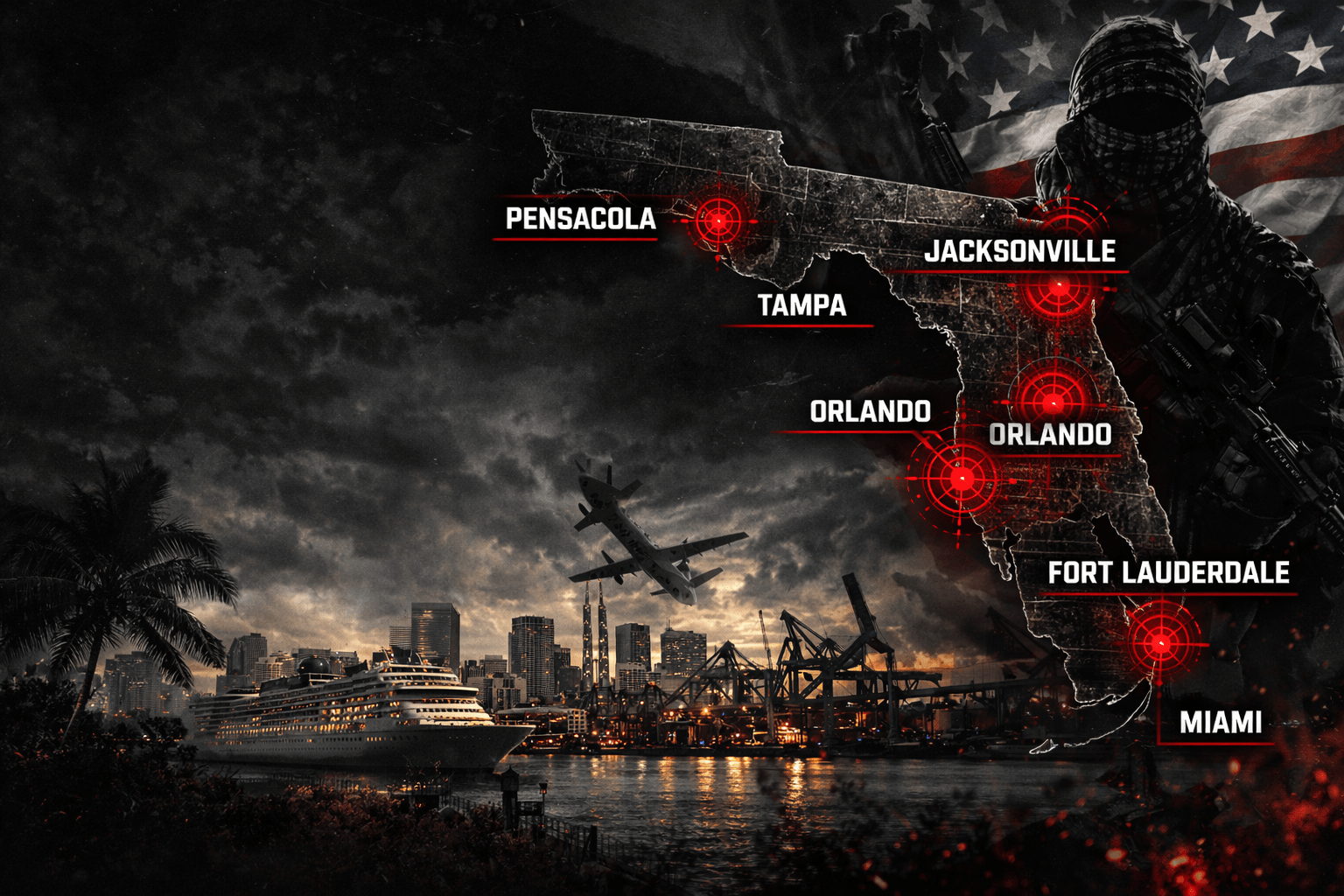
The public record does not support lazy internet fantasy maps that assign one terrorist brand to one Florida city as if the threat is clean, obvious, and neatly labeled. The real picture is more serious than that. Florida has seen documented cases tied to ISIS, AQAP, and al-Qaeda-linked plotting, plus material-support cases, online radicalization, disrupted attack planning, and one major foreign terrorist attack on U.S. soil at Pensacola. The lesson is not that every city has a neat label. The lesson is that Florida is a high-visibility, high-density, high-consequence state where readiness matters.
What the public record actually shows
Start with the history. In 2006, federal authorities charged seven Florida men in the Liberty City case with conspiring to support al-Qaeda and attack targets in the United States. In South Florida, the Qazi brothers case included admissions tied to AQAP and al-Qaeda communications, attack planning, and Florida-based preparation. In Orlando, the Pulse attacker pledged allegiance to Abu Bakr al-Baghdadi and the Islamic State during his 911 call. In Pensacola, the FBI said the naval air station attack was carried out by an AQAP associate and described it as the culmination of years of planning. In Tampa, Muhammed Momtaz Al-Azhari was sentenced after prosecutors said he planned an ISIS-inspired attack and scouted locations in the Tampa Bay area. Florida also saw the St. Augustine Langhorne case involving attempted support to ISIS, the former Gainesville resident Mohamed Suliman case involving attempted support to ISIS, and the Kissimmee/Orlando Benkabbou case tied to lies to the FBI in an ISIS investigation.
That is not paranoia. That is case history.
And now layer that history onto Florida’s current reality: crowded tourism corridors, massive event traffic, cruise terminals, fuel movement, seaports, airports, dense hospitality environments, military installations, and constant civilian congregation. That is not a “target list.” That is a consequence map. It shows where disruption, panic, casualties, and cascading effects could be worst if violence breaks out.
Translation: you do not need a Hollywood-style “sleeper cell” movie plot to have a Florida problem. One committed actor, one weak venue, one untrained team, one delayed response, and one crowded environment are enough to create mass casualties and national headlines.
Florida cities and regions with the highest consequence profile
From a preparedness standpoint, not a fantasy “confirmed target” standpoint, several Florida regions carry a heavier consequence burden than others because of crowd density, symbolic value, logistics, and infrastructure.
1. Orlando and Central Florida
Orlando remains one of the clearest examples of why readiness cannot be optional. The region welcomed more than 75.3 million visitors in 2024. Orlando International handled more than 57.2 million passengers. The Orange County Convention Center hosted 172 events with total attendance of 1,744,329 in 2024. Add the Pulse history and the more recent Kissimmee/ISIS-related federal case, and Central Florida stands out as a dense civilian environment where crowd concentration alone raises consequence.
Why it matters: tourism districts, entertainment venues, hotels, malls, convention spaces, and transit nodes create a soft-target environment where confusion spreads fast.
2. Tampa Bay
Tampa Bay is not just another metro area. It combines a large civilian population with military relevance, port significance, aviation traffic, and energy movement. Tampa International reported 24,756,631 passengers in 2024. Port Tampa Bay says more than 43% of Florida’s petroleum flows through the port. It also reported a record 1.66 million cruise passengers in 2025. Add U.S. Central Command at MacDill Air Force Base and the Al-Azhari federal case involving scouting in the Tampa Bay area, and this region demands serious preparedness.
Why it matters: military symbolism, cargo, fuel, cruise traffic, and public venues combine into a high-value disruption environment.
3. South Florida: Fort Lauderdale / Miami Corridor
South Florida remains a dense, internationally connected environment with heavy passenger flow and critical logistics. Fort Lauderdale-Hollywood International served more than 32.2 million passengers in 2025. Port Everglades reported more than 4.1 million total passengers in FY2024, while petroleum remained a major revenue and throughput category. The Qazi brothers case also reinforces that South Florida has appeared before in the terrorism case record.
Why it matters: international connectivity, cruise density, airport traffic, petroleum movement, and large public venues create serious consequence if security fails.
4. Northeast Florida and the Panhandle
Northeast Florida and the Panhandle sit in a different but equally important category. Pensacola is already part of the record because of the AQAP-linked naval air station attack. Jacksonville adds major logistics scale through JAXPORT, which reported nearly 1.4 million TEUs, more than 10 million tons of cargo, and over 506,000 vehicle units in FY2025. The St. Augustine Langhorne case and the former Gainesville resident Suliman case show that North Florida cannot be dismissed as outside the threat picture.
Why it matters: military presence, port operations, cargo flow, and regional dispersion complicate both prevention and response.
What residents need to stop getting wrong
The first mistake is denial. The second is theatrics. The third is thinking that owning a firearm equals readiness. It does not.
A gun without judgment is not preparedness. A permit without stress exposure is not preparedness. A one-day certificate without legal understanding is not preparedness. And a social-media-fed sense of confidence is definitely not preparedness.
Real preparedness means understanding how violence unfolds in crowds, how fast situational awareness collapses under stress, how communication breaks down, how family members get separated, how exits get blocked, how medical care gets delayed, and how lawful force decisions become brutally compressed by time and chaos.
This is where most people are dangerously undertrained. They practice marksmanship in sterile conditions, then imagine they are ready for a parking-lot ambush, a church security emergency, a mall attack, a gas-station robbery, or a public-space active killer event. That is fantasy.
What the federal guidance says the public should do
DHS’s If You See Something, Say Something® campaign is explicit: suspicious activity can include behavior that may indicate pre-operational planning associated with terrorism or terrorism-related crime, and the public should report suspicious behavior to law enforcement. Ready.gov also advises the public to know exits, be ready to run if possible, hide if escape is not possible, and fight only as a last resort when in immediate danger. Preparedness also includes alert systems, communications plans, and emergency medical capability.
- Report suspicious behavior early. Do not wait for certainty. Pre-operational indicators matter.
- Know your exits in crowded places. Restaurants, houses of worship, event halls, schools, theaters, and malls are not immune.
- Build family emergency communication plans. Chaos separates people fast.
- Train medically, not just tactically. Massive bleeding control and trauma response matter when EMS is delayed.
- Pressure-test your assumptions. A plan that has never been rehearsed is not a plan.
Businesses can also review our discussions of corporate security planning and common limitations of Wi-Fi security cameras.
What this means for churches, businesses, schools, and security teams
If your organization has no active-threat plan, no communication protocol, no rally points, no trauma kits, no role assignments, and no realistic rehearsal cycle, you are not secure. You are lucky. Those are not the same thing.
Houses of worship, private schools, retail centers, event venues, apartment complexes, and corporate campuses should all be asking the same hard questions:
- Who calls 911 and who relays updates?
- Who directs evacuation and who handles lockdown?
- Who has medical gear and who knows how to use it?
- What happens if the main entry becomes the kill zone?
- What happens if the threat is outside and moving inward?
- What happens if armed staff or citizens are on scene and identification becomes a problem?
If you cannot answer those questions clearly, your security is built on hope.
Related organizational perspectives include structured church security training in Florida and first-responder awareness after attacks on firefighters.
Why force-on-force and decision-making training matter
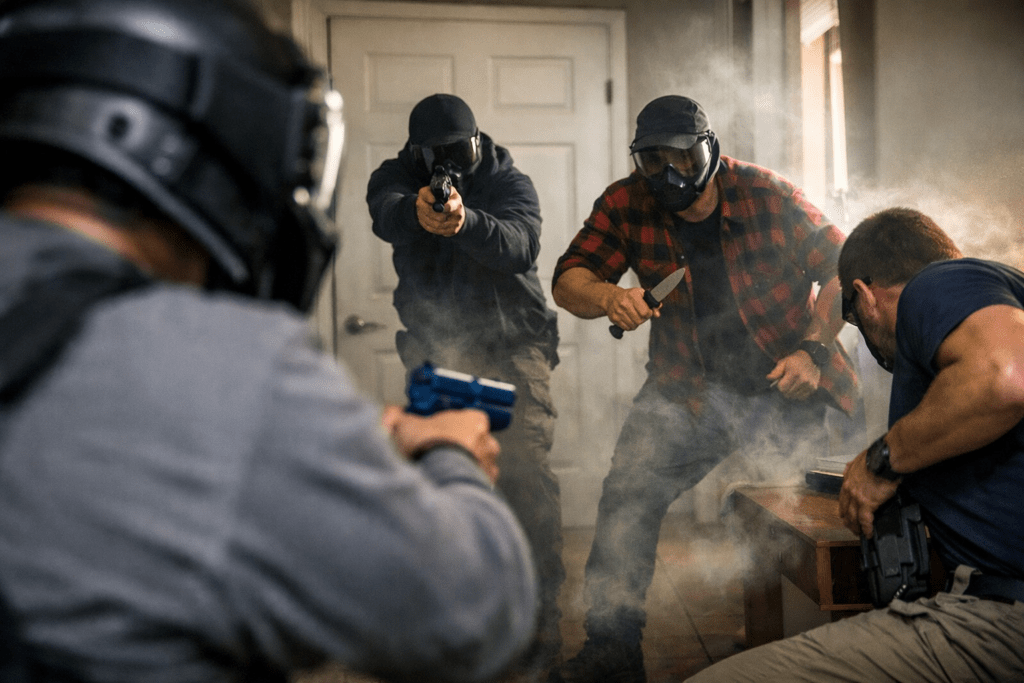
Static range work has value. It does not solve the whole problem. Real defensive performance requires stress exposure, decision-making, movement, communication, angle management, threat recognition, lawful force boundaries, and post-incident awareness. That is why scenario-based firearms training and force-on-force training matter. They expose what square-range confidence hides.
And if you carry or protect others, legal knowledge is not optional. Read why civilian firearms training must include use-of-force law, because surviving the event is only part of the equation. Aftermath, articulation, witness handling, law enforcement contact, and civil exposure all matter.
For institutions and agencies, poor training is not just a tactical problem. It is a liability problem. That is why training gaps carry deadly and legal consequences, and why raising standards across the board matters for armed professionals and civilians alike. Valortec has also addressed the broader oversight issue in Florida’s firearms training oversight gap and the dangerous minimum-standard mentality behind Florida’s Class G training problem.
The hard truth
Florida does not need more denial, more fake confidence, or more paper-trained protectors. It needs prepared citizens, disciplined security teams, competent instructors, and institutions willing to train for ugly reality instead of polished fantasy.
The public record is already loud enough. Orlando. Tampa Bay. South Florida. Pensacola. Jacksonville. St. Augustine. Gainesville. Kissimmee. These are not all the same story. But together they say one thing clearly: Florida is not outside the threat picture.
The only real question is whether residents, leaders, churches, businesses, and armed citizens are willing to act like adults before chaos forces the lesson on them.
Train before your assumptions collapse
Preparedness is not a slogan. It is a performance standard. Valortec trains citizens, security teams, and organizations in lawful force decisions, scenario-based performance, active-threat awareness, and reality-based defensive readiness.
Explore Force-on-Force / SDF Pistol,
review faith-based security readiness,
or visit Valortec to see upcoming training options.
For a separate examination of extremist threat reporting and responsible public preparedness, read ISIS Threat to the United States in 2026: What Americans Need to Know.
For a law-enforcement-specific discussion of preparedness, see our analysis of readiness for potential sleeper-cell threats.
Frequently Asked Questions
Is this article saying Florida cities are officially confirmed targets?
No. This article does not claim any city is an officially confirmed target list item. It identifies Florida regions where public case history, crowd density, infrastructure, and symbolic value raise the consequence of a violent attack if one occurs.
Is this about blaming Muslims or immigrant communities?
No. This article addresses violent extremist organizations, supporters, and inspired actors documented in public federal case records. Public safety requires precision, not lazy collective blame.
Why is firearms training part of this conversation?
Because carrying a firearm without judgment, legal knowledge, medical capability, and stress-tested decision-making can worsen a crisis. Readiness is broader than marksmanship and must be trained accordingly.
Sources
- DOJ: Seven Florida Men Charged with Conspiring to Support al Qaeda, Attack Targets in the United States
- DOJ: Qazi Brothers Sentenced on Terrorism Violations and Assault on Two Deputy U.S. Marshals
- DOJ/FBI: Joint Statement Regarding Transcript Related to the Orlando Terror Attack
- FBI: Remarks Regarding Naval Air Station Pensacola Shooting Investigation
- DOJ: Tampa Man Sentenced for Attempting to Provide Material Support to ISIS
- DOJ: St. Augustine Case / Material Support to ISIS
- DOJ: Former Gainesville Resident Arrested for Attempting to Provide Material Support to ISIS
- DOJ: Kissimmee/Orlando ISIS-Related False Statements Case
- Visit Orlando: 2024 Visitor, Convention Center, and MCO Data
- Tampa International Airport 2025 Fact Sheet
- Port Tampa Bay: About the Port
- Port Tampa Bay: 2025 Cruise Passenger Record
- U.S. Central Command: Component Commands / MacDill AFB Tampa
- FLL Statistics
- Port Everglades FY2024 Financial Statements
- JAXPORT: 2026 State of the Port / FY2025 Cargo Statistics
- DHS: NTAS Bulletin, June 22, 2025
- DHS: If You See Something, Say Something®
- DHS: Recognize Suspicious Activity
- Ready.gov: Be Prepared for an Active Shooter