Holster Retention Levels for Duty Carry
Most people talk about holster retention like it is some universal law carved in stone. It is not. NIJ has stated there has not been a single independent universal standard for holster weapon-retention capability, and NIST described Level I, Level II, and Level III as a manufacturer-developed ranking system rather than a single industry-wide rulebook. That is the first reality professionals need to understand: the label matters, but the actual mechanical design matters more. (National Institute of Justice)
Stop confusing labels with function
Retention is simple in principle. A holster either secures the handgun with passive retention, active retention, or both. Passive retention is friction, molding, and tension against the firearm. Active retention adds a mechanical security device that must be deliberately defeated before the pistol can be drawn. Safariland’s current duty-retention system measures retention by the number of distinct hand movements required to clear those security devices, while other manufacturers still use the broader commercial convention of Level I, II, and III based on passive fit plus added locking devices. (Inside Safariland)
That is why professionals should stop buying holsters based on internet talk and start looking at the actual mechanics. Does the holster rely only on friction? Does it use a rotating hood? Does it lock on the ejection port or internal geometry? Does it require a thumb release, a strap, a hood, or multiple motions? Those answers matter far more than marketing language. (Inside Safariland)
Level I retention
In the common commercial sense, Level I usually means passive retention only. The pistol stays in place because of friction, molded fit, and sometimes adjustable screws. That is fine for concealed carry, range work, competition, or other low-risk environments where someone is not likely to grab your gun in public. It is not the right answer for most exposed duty use. (Alien Gear Holsters)
Level I is fast, but speed without security is not a professional solution when the handgun is exposed on a duty belt. If your work involves public contact, crowd movement, hands-on encounters, ground fighting, inmate handling, patrol work, or physical security, passive retention alone is too little insurance. (Alien Gear Holsters)
Level II retention
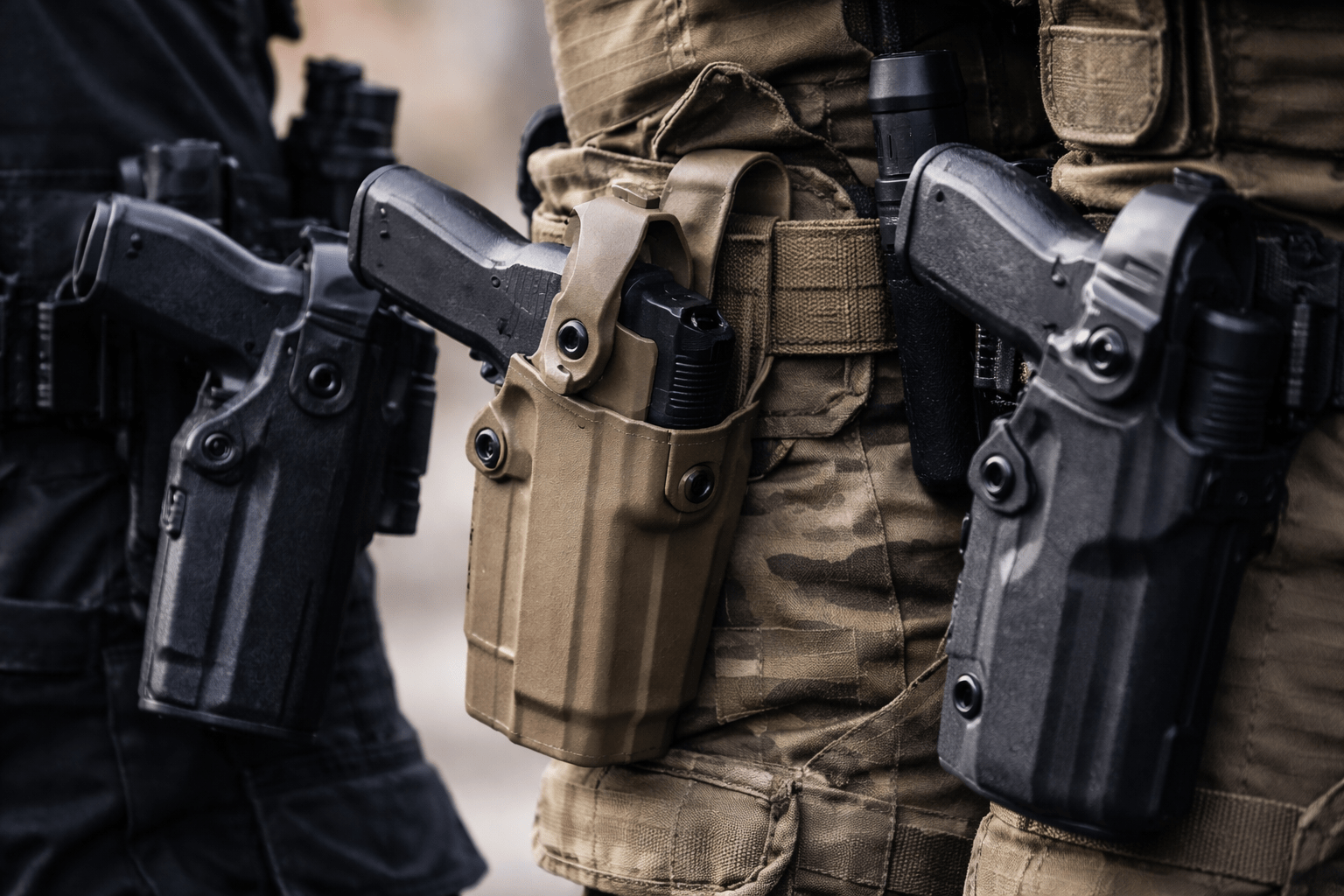
Level II is where duty use starts becoming serious. In the common commercial model, Level II means passive retention plus one active security device. In Safariland’s duty-rated system, Level II requires two distinct hand motions to clear the holster. A common example is the SLS rotating hood, which must be pushed down and rotated forward before the pistol can be drawn. (Alien Gear Holsters)
This is why Level II is so common in professional open carry. It gives the user real protection against a basic gun-grab without burying the draw under unnecessary complexity. Safariland describes its Level II SLS holsters as providing strong protection against attempted takeaways, and duty-holster makers continue to market Level II systems directly to law enforcement, armed security, and military users because that balance is exactly what many field roles demand. (Safariland)
For many security roles, especially uniformed work in public-facing environments, Level II is often the practical minimum. It gives the officer or guard an exposed sidearm with real retention, while keeping the drawstroke simple enough to perform under stress, in vehicles, around obstacles, and during constant movement. (Alien Gear Holsters)
Level III retention
Level III is the sweet spot for a large portion of law enforcement, armed security, and military duty carry. In the common commercial shorthand, it usually means passive retention plus two active retention devices. In Safariland’s duty-rated framework, it is typically achieved by combining systems such as ALS and SLS so the user must defeat multiple security elements before drawing. (Alien Gear Holsters)
The reason Level III dominates patrol and general-duty use is simple: it gives far better protection during physical confrontation while still allowing a trained user to build an efficient draw around the thumb and master grip. Safariland explicitly states that Level III retention is popular for patrol and general duty use, and Blackhawk likewise emphasizes thumb-activated retention built around the master grip principle for duty deployment under stress. (Safariland)
Level III is also firmly established in military duty use. Safariland states that its MHHC Military Kit, selected by the U.S. Army for the SIG Sauer M17 sidearm, includes a Level III retention holster. That alone tells you everything you need to know about where professional institutions land when they need speed, security, and battlefield practicality in the same system. (Safariland)
Level IV retention
Level IV is the highest commonly named retention level in mainstream duty-holster marketing, but it is not where most mobile duty users want to live. Safariland states that Level IV adds another security element and is not typically used for patrol and general duty, but is more commonly used by corrections. That makes sense. The more layers you add, the more secure the pistol becomes, but the more draw complexity you introduce. (Inside Safariland)
Level IV has a place. It is just not every place. In close-control environments such as corrections, prisoner handling, and settings where takeaway risk is constant and immediate, extra retention may be worth the added complexity. For many patrol, field, and mobile protective roles, however, Level IV is more holster than the mission realistically needs. (Inside Safariland)
Why Level II and Level III dominate professional use
Level II and Level III dominate because they solve the actual problem. The real problem is not drawing fast on a square range. The real problem is keeping an exposed sidearm secure during movement, contact, stress, collisions, grappling, hands-on control, vehicle work, and sudden violence, while still being able to access that pistol immediately when the fight turns lethal. Current duty-holster makers repeatedly frame Level II and Level III as the professional standard for law enforcement, security, and military users for exactly that reason. (Alien Gear Holsters)
Level I is usually too light for exposed duty use. Level IV is usually more retention than most patrol and general-duty users need. Level II and Level III sit in the middle where real work happens. One gives a fast, manageable active lock. The other adds another layer for higher-risk environments without turning the draw into a clumsy mechanical event. That is why these two levels continue to dominate the professional market. (Alien Gear Holsters)
There is another reason: ergonomics under stress. The best modern duty holsters are designed so the retention defeat happens naturally as the user builds the firing grip, usually through thumb-driven actions rather than awkward fine-motor gymnastics. Blackhawk highlights thumb-activated retention tied to the master grip, and some FLETC firearms programs currently list auto-lock and trigger-finger-release style holsters as unauthorized gear. That should tell every serious user something: retention is not just about how hard the gun is to steal. It is also about how cleanly and safely the gun comes out when you need it now. (Blackhawk)
The Valortec bottom line
If the handgun is exposed in public, Level I is usually not enough. If the mission is standard patrol, armed security, executive protection, tactical movement, or military sidearm carry, Level II and Level III are where serious users should be looking first. They are common because they work. They provide meaningful resistance to unauthorized access without sabotaging speed, consistency, or weapon presentation under pressure. (Alien Gear Holsters)
Stop buying holsters based on hype, brand worship, or social-media noise. Buy based on mission, exposure, confrontation risk, draw efficiency, and proven mechanical retention. A duty holster is not fashion. It is life-support equipment. (National Institute of Justice)
References
National Institute of Justice, NIJ Duty Holster Retention Standard Fact Sheet. (National Institute of Justice)
National Institute of Standards and Technology, Office of Law Enforcement Standards holster-retention publication. (NIST Publications)
Safariland, Understanding Holster Retention Levels and related duty-retention product pages. (Inside Safariland)
Safariland, MHHC Military Kit for the U.S. Army M17 sidearm. (Safariland)
Blackhawk, T-Series Level 3 Duty Holster. (Blackhawk)
Federal Law Enforcement Training Centers, firearms program equipment guidance. (Federal Law Enforcement Training Centers)
Alien Gear, duty-holster and retention-level technical pages. (Alien Gear Holsters)