

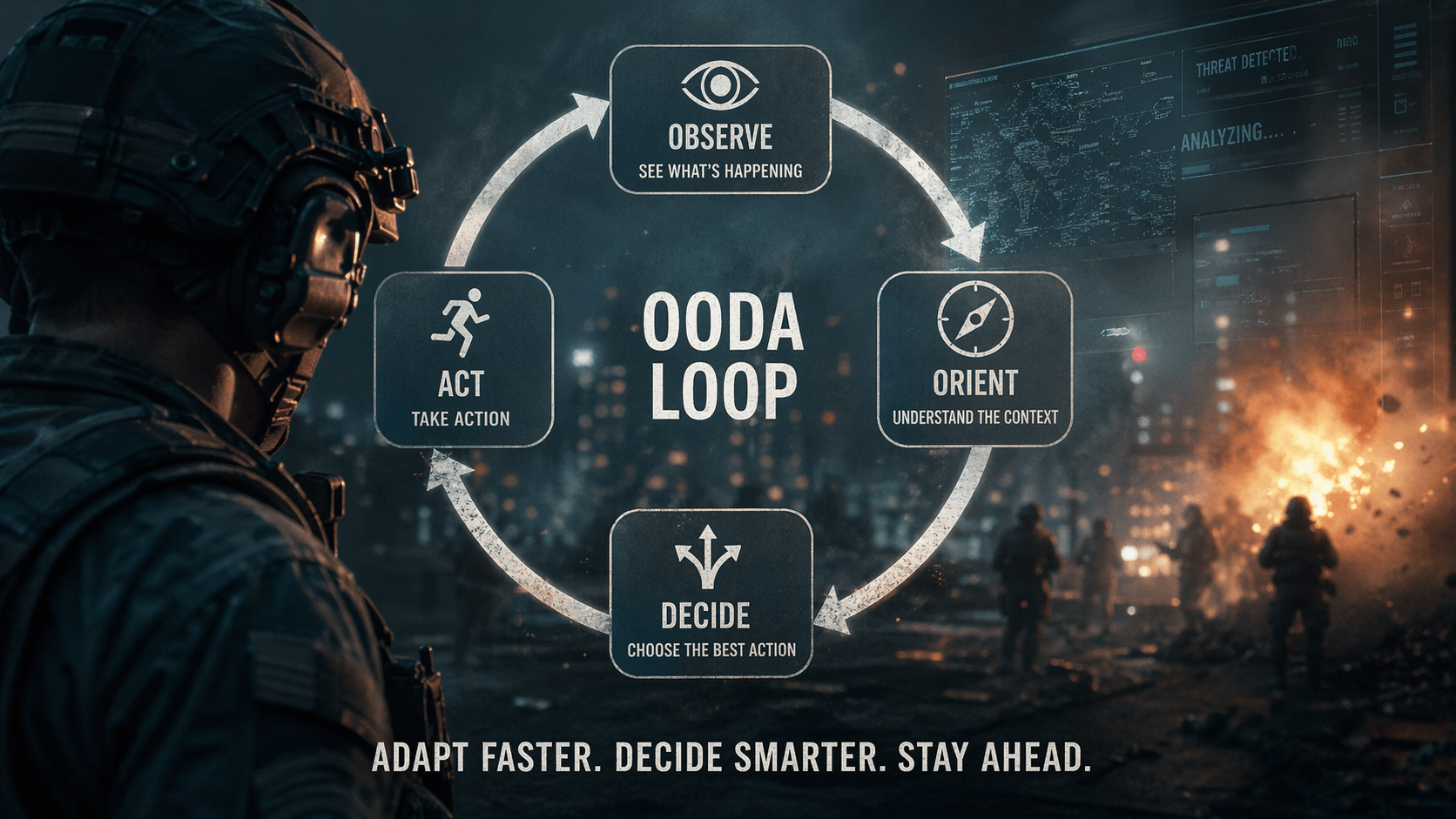
The OODA Loop Explained: How Adaptive Decision-Making Works Under Stress, Uncertainty, and Pressure
The OODA Loop is one of the most widely discussed decision-making models in military strategy, law enforcement, emergency response, executive protection, crisis leadership, and high-risk performance. It is also one of the most misunderstood. In many popular discussions, it is reduced to a simple formula: observe, orient, decide, act. That version is incomplete.
In reality, the OODA Loop is a far more sophisticated framework for understanding how human beings process information, interpret meaning, make decisions, and act in environments shaped by uncertainty, time pressure, friction, stress, and constant change. It is not merely about speed. It is about adaptive performance. More specifically, it is about how individuals and organizations adjust to reality faster and more accurately than the problem in front of them evolves.
When studied seriously, the OODA Loop becomes more than a tactical concept. It becomes a scientific and operational model of how people function under pressure. It helps explain why some individuals make better decisions in chaos, why others freeze or misread the situation, and why the ability to update quickly is often more important than the ability to react quickly.
What Is the OODA Loop?
OODA stands for observe, orient, decide, act. The concept is most closely associated with Colonel John Boyd, whose work on conflict, adaptation, maneuver, and decision cycles has influenced multiple professional disciplines. The OODA Loop describes a repeating cycle in which a person observes what is happening, orients to its meaning, makes a decision, takes action, and then begins the cycle again as the environment changes.
That simple description is useful at the introductory level, but it can also be misleading if taken too literally. The OODA Loop is not a rigid checklist. It is not a one-way chain of mental steps. It is a dynamic process of interaction between the decision-maker and a changing environment. Each stage affects the others. Every action changes the situation. Every change in the situation produces new information. Every new piece of information forces a new interpretation.
That is why the OODA Loop remains so relevant in high-stakes environments. It captures the reality that decision-making under pressure is never static, never perfectly informed, and never finished after one move.
Why the OODA Loop Matters
The OODA Loop matters because high-pressure environments punish delay, confusion, overconfidence, and false assumptions. In real-world settings, people rarely have perfect information before they must act. They must make judgments while reality is still unfolding.
That challenge appears everywhere. A law enforcement officer must interpret rapidly changing behavior in seconds. A medic must identify the most likely cause of deterioration before the patient crashes. A protective agent must identify risk in a crowd before the threat fully develops. A business leader in crisis must distinguish signal from noise before the organization loses initiative. In all of these cases, the core problem is the same: how to perceive, interpret, decide, and adapt before the situation outruns the decision-maker’s understanding.
The OODA Loop provides a framework for that problem. It explains why success is not merely about aggression or speed, but about updating reality correctly under pressure.
The Origins of the OODA Loop
John Boyd and Adaptive Conflict
John Boyd did not create the OODA Loop as a simplified self-help tool. He developed it as part of a larger theory about conflict, adaptation, and survival in changing environments. His earlier work established a powerful idea: human beings rely on mental models to make sense of the world, but those models are always at risk of becoming outdated. If reality changes and the person fails to update, performance degrades.
This insight is foundational. The problem is not only what happens outside the individual. The problem is also what happens inside the individual when old assumptions no longer fit current conditions. The OODA Loop addresses that problem by treating decision-making as a continuous cycle of perception, interpretation, hypothesis, action, and revision.
More Than a Four-Box Diagram
The simplified circular diagram most people know is only a surface-level representation. In more complete treatments of Boyd’s work, the loop is shown as nonlinear and influenced by feedback, feed-forward pathways, environmental interaction, and what Boyd described as implicit guidance and control. That means the OODA Loop is better understood as a living adaptive system than as a simple linear process.
This distinction matters because poor training often turns the OODA Loop into a shallow slogan about moving first. Serious application requires something much more demanding: the ability to interpret change correctly and update fast enough to maintain initiative.
The Four Components of the OODA Loop
Observe: Seeing What Matters
Observation is more than simply looking at what is in front of you. In high-pressure situations, observation is the discipline of identifying relevant cues while ignoring noise. The environment often presents too much information, much of it incomplete, some of it misleading, and some of it irrelevant to the immediate problem.
Strong observation means noticing what matters first. It requires attention, situational awareness, and cue discrimination. The observer must detect movement, behavior, spatial relationships, timing, changes in pattern, and any indicators that materially affect the developing situation. Poor observation does not always come from blindness. Often it comes from overload, distraction, fixation, or misplaced focus.
Orient: Turning Information Into Meaning
Orientation is the most important stage of the OODA Loop. It is where raw observation becomes interpretation. This is the part of the process in which the person decides what the observed information likely means.
Orientation is shaped by prior experience, training, expectations, cultural background, emotional state, habits, and assumptions. Two people can see the same event and reach different conclusions because they orient through different internal frameworks. That is why orientation is the true center of gravity in the OODA Loop. It shapes how the problem is understood, which options are seen as possible, and what action appears justified.
If orientation is wrong, everything downstream is compromised. A person can observe correctly and still decide badly if they interpret the situation through a flawed mental model. This is one of the most important reasons the OODA Loop is so often misunderstood. People focus on the visible parts of action and speed, while ignoring the invisible part that determines whether action fits reality at all.
Decide: Selecting the Best Next Action
Decision in the OODA Loop is not the same as certainty. In real-world application, a decision is a working hypothesis. It is the best next course of action based on what is known at that moment. In dynamic settings, waiting for complete certainty often means surrendering initiative.
This does not mean the decision should be rushed or careless. It means the decision must be practical, timely, and grounded in reality as currently understood. The goal is not to produce the perfect solution in theory. The goal is to choose a viable next action that can be tested against the environment.
Experienced professionals often appear faster at this stage because they are not building every response from scratch. They recognize patterns, compare them to prior experience, and move toward workable options more efficiently. But that only works if the pattern match is accurate. When the interpretation is wrong, fast decision-making can become fast failure.
Act: Testing the Decision in the Real World
Action is the point at which the chosen course is imposed on reality. It is not the end of the process. It is the test of the current hypothesis. Once action is taken, the environment responds, and that response becomes the next set of observations.
This is why the OODA Loop must always be understood as continuous. Action changes the problem. A strong action in one moment may create new risks in the next. A decision that was appropriate ten seconds ago may become wrong after one movement, one new actor, one changed angle, one unexpected behavior, or one new piece of information.
In serious contexts, action should never be reduced to force alone. Action may mean movement, repositioning, verbal commands, communication, cover, disengagement, intervention, rerouting, seeking help, or escalating resources. The right action is the one that best fits the problem as it exists right now.
Why Orientation Is the Most Important Part of the OODA Loop
Most weak explanations of the OODA Loop focus on being faster than the other side. Stronger explanations focus on being more adaptive than the other side. The difference comes down to orientation.
Orientation is where information becomes meaning. It is where the mind sorts what is relevant, what is assumed, what is misunderstood, and what still needs to be verified. It is where bias enters, where experience helps, where experience misleads, and where judgment is either sharpened or corrupted.
If orientation is sound, even imperfect observation can still lead to a workable decision. If orientation is flawed, even rapid action becomes dangerous. That is why raw speed should never be mistaken for competence. A person who acts quickly on a false interpretation is not operating effectively inside the problem. They are simply accelerating error.
The Science Behind the OODA Loop
Stress and Cognitive Performance
Scientific research on stress and executive function helps explain why the OODA Loop becomes fragile under pressure. Acute stress can impair working memory, reduce cognitive flexibility, narrow attention, and interfere with executive control. These effects matter because the OODA Loop depends heavily on the ability to detect relevant information, compare competing interpretations, inhibit premature reactions, and revise the mental model as new data appears.
When those functions begin to degrade, the loop becomes unstable. Observation narrows. Orientation hardens too early. Decision-making becomes more impulsive or more rigid. Action may become premature, excessive, delayed, or misdirected. In practical terms, the person is no longer cycling through adaptive judgment. They are collapsing into a fixed response.
Mental Models and Pattern Recognition
The human brain relies heavily on mental models and pattern recognition to function in fast environments. This is useful because it allows experienced performers to identify likely solutions without slow, exhaustive comparison of every possible option. It is one reason experts often appear calm and decisive in situations that overwhelm novices.
But this same mechanism creates vulnerability. Pattern recognition only works if the pattern is matched correctly. If the person misclassifies the situation early, everything that follows may be built on a false premise. That is why humility, reassessment, and re-orientation are critical. Experience is valuable, but only if it remains flexible enough to update when reality contradicts expectation.
Decision-Making Under Uncertainty
The OODA Loop fits real human decision-making because people rarely operate with complete information. Most high-pressure decisions are made under uncertainty, incomplete data, and time compression. In these conditions, the decision-maker often chooses the best available next action rather than waiting for certainty. This aligns closely with recognition-primed decision-making and other naturalistic models of performance under pressure.
That is one reason the OODA Loop has endured across professions. It reflects the way real decisions are made in the field, not the way people wish decisions could be made in perfect conditions.
How the OODA Loop Fails
False Orientation
The most common failure is not slow action. It is false orientation. This happens when the decision-maker interprets the situation incorrectly and then acts with confidence on that bad interpretation. Once the internal model is wrong, speed becomes a liability rather than an advantage.
Information Overload
Too much information can be as damaging as too little. When the observer is flooded with data but lacks a method for prioritizing what matters, the loop slows down or breaks apart. Observation becomes cluttered, orientation becomes confused, and decision-making becomes unstable.
Premature Closure
Premature closure occurs when a person commits too early to one interpretation and stops looking for new information that might challenge it. This traps the loop. The person is no longer adapting. They are protecting a narrative.
Stress Collapse
Under severe pressure, the OODA Loop can collapse into a much cruder process: notice one cue, assign one meaning, execute one response. That is not disciplined adaptation. It is cognitive narrowing under stress. Without training, reassessment, and mental discipline, the loop can become more reactive and less intelligent as pressure rises.
Real-World Examples of the OODA Loop
Law Enforcement and Protective Operations
In a close-contact protective or law enforcement environment, observation may include movement patterns, hand behavior, distance changes, crowd flow, spatial constraints, and anomalies in behavior. Orientation determines whether those cues indicate normal conduct, confusion, aggression, panic, or emerging threat. Decision selects the best next action, which may involve movement, verbal challenge, repositioning, disengagement, or intervention. Action then changes the environment and produces new data.
Emergency Medical Response
In medicine, observation includes vital signs, bleeding, airway status, skin changes, responsiveness, and mechanism of injury. Orientation frames what those indicators likely mean. Decision selects the next treatment priority. Action tests that judgment in the patient’s response. The loop continues as the patient improves, deteriorates, or presents new symptoms.
Security and Cyber Response
In cybersecurity or physical security operations, observation may include anomaly detection, unusual access patterns, inconsistent user behavior, system changes, or sensor alerts. Orientation determines whether the pattern is benign, accidental, malicious, or escalating. Decision selects containment, monitoring, escalation, or intervention. Action changes the operational environment and reveals new information. The loop continues.
How to Train the OODA Loop More Effectively
Train Observation and Cue Selection
Students should learn how to identify relevant signals and avoid fixation on irrelevant details. Training should strengthen the ability to separate fact from noise and recognize what changes matter most.
Teach Orientation as a Skill
Orientation must be taught directly, not assumed. Students should be trained to ask what they are assuming, what else the evidence could mean, what prior experience is influencing them, and what new information would cause them to change course.
Use Decision Games and Scenario-Based Training
Tactical decision games, case studies, scenario labs, and structured debriefs are especially effective because they force students to explain how they observed, oriented, decided, and acted. The real learning often happens in the after-action review, where students can see exactly where interpretation helped or failed.
Build Progressive Stress Exposure
Stress training should be structured, progressive, and tied to cognitive skill development. Throwing students into chaos without teaching them how stress affects performance does not build a strong OODA Loop. It often builds noise, confusion, or false confidence. Stronger training builds understanding first, then adds pressure in a controlled way.
Why the OODA Loop Still Matters Today
The OODA Loop still matters because the environments that demand rapid adaptation have not disappeared. If anything, they have become more complex. More data, more uncertainty, more speed, and more pressure do not make the OODA Loop obsolete. They make it more relevant.
Whether the context is tactical, medical, protective, corporate, or technological, the same challenge remains: how to interpret reality accurately enough and fast enough to act effectively before the situation gets away from you. That is the enduring value of the OODA Loop.
Final Thoughts
The OODA Loop is not just a model of action. It is a model of disciplined adaptation. It explains how human beings perceive, interpret, decide, test, and revise under pressure. Most importantly, it reminds us that the decisive factor is not movement alone. It is orientation.
The individual or organization that can update reality faster and more accurately than the problem evolves gains initiative, preserves options, and improves the quality of action. That is why the OODA Loop remains one of the most important frameworks for understanding decision-making in high-stakes environments.
References
Primary Sources and Doctrine
- Boyd, John R. Destruction and Creation.
- Boyd, John R. A Discourse on Winning and Losing.
- Boyd, John R. Organic Design for Command and Control.
- U.S. Marine Corps. MCDP 6: Command and Control.
Decision-Making and Cognitive Science
- Klein, Gary. Research on recognition-primed decision-making and naturalistic decision-making.
- Marine Corps Training and Education Command materials on decision-making and tactical decision games.
Stress and Executive Function
- Arnsten, Amy F.T. Research on stress and prefrontal cortex function.
- Shields, Grant S., Sazma, Mark A., and Yonelinas, Andrew P. Research on acute stress and executive function.
- RAND Corporation research on stress inoculation training and performance under pressure.


