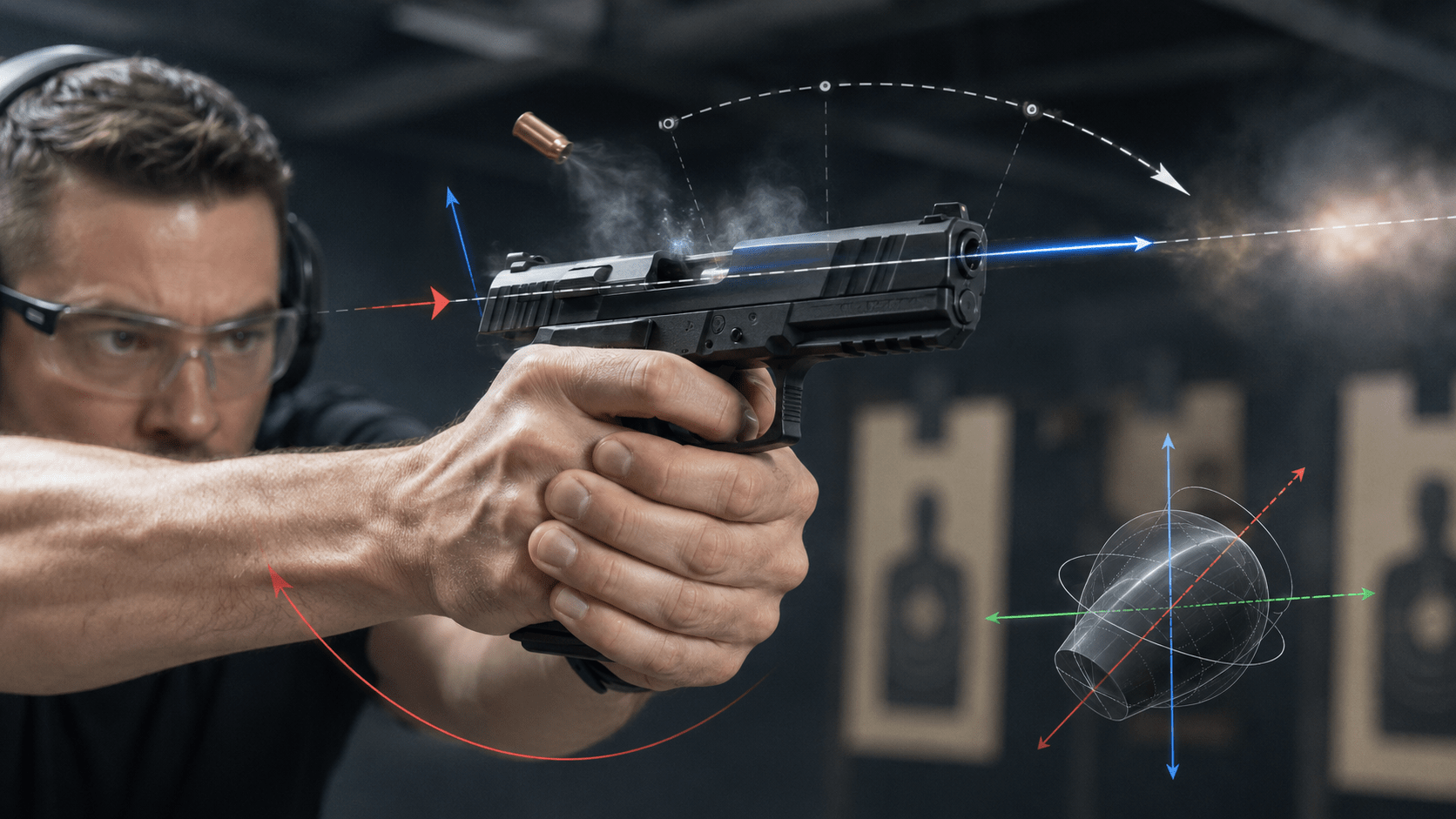
The Dzhanibekov Effect and Modern Handgun Recoil Management
A Scientific Look at Muzzle Rise, Rotational Instability, and Human–Weapon Control
Abstract
The Dzhanibekov effect, also known as the intermediate-axis theorem or tennis-racket theorem, describes the instability of a freely rotating rigid body when rotation occurs around its intermediate principal axis of inertia. Although a modern handgun under recoil is not a torque-free object floating in space, the Dzhanibekov effect provides a powerful scientific analogy for understanding recoil management, muzzle rise, rotational instability, and human–weapon control.
This article examines the relationship between rigid-body dynamics and the shooter–handgun system. The central argument is simple: recoil control should not be reduced to grip strength alone. Instead, modern handgun control must be understood as the coordinated management of impulse, torque, moment arm, joint stiffness, damping, skeletal alignment, friction, visual feedback, and repeatable return-to-target behavior.
Muzzle rise occurs when rearward recoil impulse is converted into rotational movement because the bore axis sits above the shooter’s primary support structure. Poor grip architecture, wrist collapse, uneven hand pressure, weak upper-body integration, and insufficient contact friction create unstable rotational pathways. These pathways allow recoil energy to escape through pitch, yaw, and roll.
The Dzhanibekov effect does not literally explain handgun recoil. However, it helps illustrate a critical training truth: small rotational disturbances can become exaggerated when the system is poorly stabilized.
For firearms instruction, the implication is clear. Effective recoil management is not simply “holding the gun tighter.” It is the creation of a stable human–weapon structure that reduces undesirable rotational freedom and promotes a consistent, predictable recoil cycle.
1. Introduction: Recoil Is Not Just a Feeling
Modern handgun training often explains recoil control with simple field commands:
“Grip harder.”
“Lock the wrists.”
“Lean forward.”
“Drive the gun back down.”
These phrases may contain partial truth. However, they are incomplete. They do not fully explain why one shooter experiences a clean, predictable recoil track while another experiences excessive muzzle rise, lateral deviation, grip disruption, dot loss, or inconsistent sight recovery.
A handgun firing a cartridge is a short-duration mechanical event. The projectile and propellant gases move forward. The firearm receives an equal and opposite rearward impulse. However, the shooter does not experience that impulse as pure rearward motion.
Because the bore axis sits above the hand and wrist support structure, the rearward force produces a rotational moment. That moment produces muzzle rise.
This distinction matters.
Recoil is primarily linear.
Muzzle rise is rotational.
That is where rigid-body dynamics becomes useful. The Dzhanibekov effect, demonstrated through the intermediate-axis theorem, shows how rotation can become unstable when energy acts through an unfavorable axis.
A handgun does not perform a literal Dzhanibekov flip. It is not floating in space. It is connected to the shooter’s hands, wrists, arms, shoulders, torso, stance, and visual system. Still, the analogy matters because the shooter–weapon system can also become unstable across multiple rotational axes.
When recoil energy is allowed to escape through weak joints, poor hand geometry, loose wrists, uneven support-hand pressure, or disconnected shoulders, muzzle rise becomes less predictable. The sights or dot return inconsistently. Follow-up shots slow down. Accuracy becomes more dependent on conscious correction.
Therefore, the Dzhanibekov effect should not be treated as a literal model of handgun recoil. It should be treated as a conceptual bridge between rotational instability and human–weapon control.
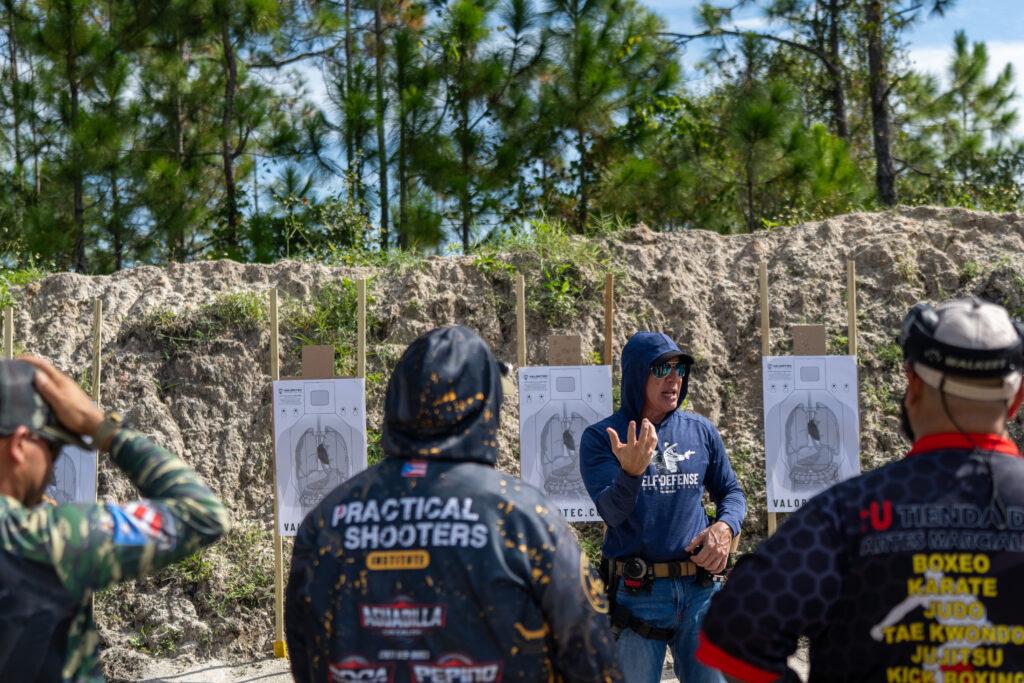
This is exactly why Valortec’s approach to science-based marksmanship focuses on the shooter as a complete performance system, not merely as a person pulling a trigger.
2. The Dzhanibekov Effect in Plain Language
The Dzhanibekov effect became widely known after observations of objects tumbling in microgravity. A wingnut or similarly asymmetric object can rotate smoothly for a period, suddenly flip 180 degrees, continue rotating, and then flip again.
It looks strange because the object appears to reverse itself without obvious external interference.
The physics, however, is not mystical.
A rigid body has three principal axes of inertia. These axes represent the natural rotational directions of the object. If the moments of inertia around those axes are all different, rotation around the smallest and largest axes can be stable, while rotation around the intermediate axis is unstable.
This is described mathematically through Euler’s equations for rigid-body dynamics.
In simplified form:

Where:
(I_1, I_2, I_3) are the principal moments of inertia.
(\omega_1, \omega_2, \omega_3) are angular velocity components.
(\dot{\omega}) represents angular acceleration.
The key lesson is not the equation alone. The key lesson is the behavior.
Rotation around certain axes is naturally more stable. Rotation around another axis is highly sensitive to disturbance.
For handgun training, that becomes a powerful analogy:
When recoil torque is allowed to act through an unstable human–weapon structure, small errors can become large deviations.
3. Handgun Recoil: From Linear Impulse to Rotational Motion
When a handgun fires, the projectile and propellant gases move forward. Momentum conservation produces a rearward impulse on the firearm.
In simplified terms:

Where:
(p) is momentum.
(m) is mass.
(v) is velocity.
Technical recoil calculations are commonly discussed through SAAMI recoil formulae, which provide a useful industry reference for understanding recoil velocity and free recoil energy.
However, free recoil alone does not fully explain what the shooter experiences.
The firearm does not simply move backward in the hands. Because the bore line sits above the hand’s resistance structure, rearward recoil force creates torque.
Torque is produced when force is applied at a distance from the pivot or resistance point:


Where:
(\tau) is rotational torque.
(F_r) is recoil force.
(h) is the vertical distance between the bore axis and the shooter’s effective resistance point.
This vertical distance is commonly discussed as bore-axis height relative to the grip. The larger the distance between the bore line and the shooter’s support structure, the greater the rotational leverage available to the firearm.
This is why a high grip, organized wrist structure, and efficient support-hand contact are central to reducing muzzle rise.
The handgun does not rise because recoil “goes up.”
Recoil moves rearward.
The muzzle rises because rearward force is applied above the hand’s resisting structure, creating a rotational moment.
4. Why the Dzhanibekov Effect Matters as an Analogy
The Dzhanibekov effect shows what happens when a rotating body is poorly stabilized around an unstable axis. In handgun shooting, the shooter–weapon system also has multiple possible rotational axes.
Those axes are:
Pitch — muzzle rise and downward return.
Yaw — left-right deviation during recoil.
Roll — twisting or canting of the pistol in the hands.
A well-built grip and body structure reduce unwanted movement across all three axes. A poor structure allows recoil to express itself through whichever axis offers the least resistance.
The shooter may perceive this as:
The muzzle flipping sharply upward.
The red dot disappearing out of the optic window.
The front sight lifting inconsistently.
The gun twisting in the hands.
Shots drifting laterally during strings of fire.
The support hand separating or losing pressure.
The firing wrist bending under recoil.
The gun returning to a slightly different index after each shot.
These are not random training failures.
They are mechanical outcomes.
That is why Valortec’s work on biomechanics of pistol grip is so important. Recoil management is not a personality trait. It is not magic. It is not simply “being strong.”
It is structure.
It is axis control.
It is mechanical discipline applied through the human body.
5. The Shooter–Handgun System as a Coupled Mechanical Structure
A handgun should not be analyzed as an isolated object once it is in the shooter’s hands. The moment the shooter grips the pistol, the system changes.
The handgun becomes part of a coupled mechanical structure:
Handgun + hands + wrists + elbows + shoulders + torso + stance + visual system.
This system has mass, stiffness, damping, leverage points, friction surfaces, and neuromuscular control.
In engineering terms, the shooter adds mechanical impedance to the firearm system.
Mechanical impedance includes:
Inertia — resistance to acceleration due to mass.
Stiffness — resistance to displacement.
Damping — reduction of oscillation or vibration over time.
A simplified recoil model can be expressed as:

Where:
(I) is effective rotational inertia.
(c) is damping.
(k) is stiffness.
(\theta) is angular displacement.
(\tau(t)) is recoil torque over time.
This explains a major reality of shooting:
The same handgun and ammunition can behave differently in different shooters because the human component changes the system.
A shooter with better structure increases effective inertia, stiffness, and damping. The gun still recoils, but it has fewer unstable pathways. A shooter with poor structure reduces system control. The pistol then rotates more freely.
This is why serious pistol recoil management must be taught through biomechanics, not slogans.
6. Wrist Stiffness and Grip Force
The wrist is one of the most important control points in handgun recoil management because it sits directly behind the pistol.
If the wrist becomes the primary hinge, the handgun rotates sharply.
If the wrist is structurally stabilized, recoil is distributed into the larger arm and upper-body system.
Research on wrist joint viscoelastic properties supports the importance of stiffness, damping, and mechanical impedance when the wrist is exposed to perturbation. For firearms instructors, this matters because recoil is a rapid perturbation event applied through the shooter’s hand and wrist structure.
However, the answer is not simply maximum grip strength.
Grip demand can influence wrist stiffness, but stiffness is not identical to crushing the pistol. Human motor control can also use cocontraction, which means coordinated activation of opposing muscle groups. Research on human grip stiffness and cocontraction shows that stiffness and force can be partially separated.
That distinction is critical.
A shooter who merely crushes the grip may create unnecessary tension, tremor, trigger disruption, fatigue, and loss of dexterity. Conversely, a shooter who applies organized pressure through the correct hand surfaces can increase functional stability without destroying trigger control.
In other words:
Grip pressure matters.
Grip architecture matters more.
Effective grip is not maximum force.
It is directed force.
7. Bore Axis, Moment Arm, and Muzzle Rise
The bore axis is the line running through the barrel. In most modern semiautomatic pistols, this line sits above the web of the firing hand.
That vertical offset creates a moment arm.
A moment arm is the perpendicular distance between the line of force and the point of resistance. In handguns, the practical moment arm is the distance between the bore axis and the shooter’s effective support structure.
A lower effective bore-to-grip relationship reduces torque. However, firearm design is only part of the equation. The shooter can also reduce the effective moment arm through technique.
That requires:
A high tang grip.
No unnecessary space between the hand and backstrap.
Strong support-hand contact.
A wrist that does not act as a loose hinge.
Arms that route recoil into the body.
Symmetrical support pressure to reduce yaw and roll.
The gun’s geometry matters.
The shooter’s geometry matters just as much.
A low bore-axis pistol in a weak grip can still flip. A higher bore-axis pistol in a strong mechanical structure can return predictably. Equipment matters, but structure determines whether the equipment’s advantages are realized.
8. Pitch, Yaw, and Roll: The Three-Axis Problem
Many shooters and instructors discuss recoil almost exclusively as vertical movement.
That is incomplete.
Handgun recoil is a three-axis problem.
Pitch: Muzzle Rise
Pitch is the upward and downward movement of the muzzle. It is the most visible form of recoil because the sighting system moves away from the target.
Muzzle rise is mainly driven by the torque created between the bore axis and the shooter’s resisting structure.
Yaw: Horizontal Deviation
Yaw occurs when the pistol shifts left or right during recoil. It may be caused by uneven hand pressure, trigger manipulation, poor wrist alignment, or asymmetrical support-hand contact.
Yaw is especially important because it may not look dramatic, yet it can move shots off the intended line.
Roll: Rotational Twist
Roll occurs when the pistol twists in the hands. It may result from poor palm contact, weak support-hand pressure, grip-panel friction issues, or unequal torque between the firing and support hands.
These three axes interact.
A pistol may not simply rise.
It may rise and twist.
It may rise and drift.
It may rise diagonally.
That is where the Dzhanibekov analogy becomes useful. A poorly stabilized object does not necessarily rotate in one clean plane. It moves according to the available instability in the system.
A poorly stabilized pistol does the same.
9. Friction and Contact Surfaces
Grip strength alone cannot control recoil if the shooter lacks effective friction and surface contact.
The hands must transmit force into the firearm. That transmission depends on:
Skin-to-grip friction.
Grip texture.
Hand placement.
Palm pressure.
Support-hand coverage.
Moisture, sweat, rain, or contaminants.
Grip angle and frame geometry.
Glove use, when applicable.
When friction is insufficient, the gun shifts inside the hands. Once it shifts, recoil control becomes reactive. The shooter must re-grip after every shot or every string.
That is inefficient.
From a mechanical standpoint, grip contact creates a frictional interface that resists displacement:

Where:
(F_f) is frictional force.
(\mu) is the coefficient of friction.
(N) is normal force, or pressure into the surface.
This explains why support-hand pressure matters.
The support hand does not merely “help hold the gun.” It increases contact area, increases pressure, improves frictional coupling, and reduces rotational freedom.
That is not brute force.
That is mechanical efficiency.
10. Red Dots, Lights, and Modern Handgun Configuration
Modern defensive handguns are increasingly equipped with pistol-mounted optics, weapon-mounted lights, compensators, threaded barrels, extended magazines, and modified recoil systems.
These accessories change the firearm’s mass distribution and inertia profile.
A pistol-mounted optic adds mass to the slide or mounting system. A weapon-mounted light adds mass forward and below the bore. A compensator redirects gas and can reduce muzzle rise. A heavier slide, lighter frame, or different recoil spring can alter timing and perceived impulse.
These changes do not eliminate recoil.
They change how recoil is expressed.
From a rigid-body perspective, any change in mass distribution changes moments of inertia. That may affect how the pistol tracks during recoil and returns to target.
Some configurations may reduce pitch but change return timing. Others may improve stability but create different movement patterns.
This is why modern firearms instruction must go beyond slogans.
A red dot shooter, for example, must be taught to observe the dot’s recoil path. The dot becomes a diagnostic tool. If the dot rises straight and returns consistently, the system is organized. If the dot leaves unpredictably, arcs diagonally, or returns to a different point, the shooter has an axis-management problem.
That is why optics training must be connected to recoil analysis, not treated as a separate skill.
11. Recoil Management Is Axis Management
The most important training implication is this:
Recoil management should be taught as axis management.
The shooter’s goal is not to eliminate recoil. That is impossible.
The goal is to make recoil predictable.
A predictable recoil cycle has five characteristics:
The gun lifts consistently.
The sights or dot remain trackable.
The pistol does not twist or shift in the hands.
The muzzle returns naturally toward the original index.
The shooter does not need excessive conscious correction between shots.
This is achieved by reducing unstable rotational freedom.
The shooter must create a structure where the gun has fewer options. The pistol should not be allowed to rotate freely through the wrist, roll inside the hands, or yaw because of uneven pressure.
The body must receive recoil as a connected structure rather than as disconnected joints.
This is why the phrase “control recoil” can be misleading.
The shooter is not stopping recoil.
The shooter is shaping recoil.
12. Training Implications for Science-Based Marksmanship
A science-based handgun curriculum should teach recoil management through measurable principles, not tradition-based language.
The following concepts should be integrated into professional instruction.
High Grip and Reduced Moment Arm
A high grip reduces the effective distance between the bore axis and the shooter’s resistance point. This reduces rotational leverage and improves return.
Support-Hand Dominance in Stabilization
The support hand should increase friction, surface contact, and lateral stability. It should reduce yaw and roll, not merely add squeezing force.
Wrist Integrity
The wrist must not become the primary hinge. The shooter should create enough stiffness to prevent collapse while avoiding excessive tension that disrupts trigger control.
Shoulder and Torso Integration
The arms should connect recoil into the upper body. If the shoulders are disconnected, recoil terminates at weak joints. If the torso and shoulder structure are engaged, the system gains mass and damping.
Visual Tracking
Iron sights and red dot optics provide feedback about recoil behavior. The sighting system tells the instructor whether recoil is moving vertically, diagonally, laterally, or unpredictably.
Repeatability Over Brute Force
The best recoil management is repeatable under stress. It should not depend on perfect conscious effort. It should be built into the shooter’s structure.
This is where structured defensive pistol training in Florida becomes important. Shooters need more than isolated range drills. They need coaching that connects mechanics, feedback, accountability, and repeatable performance.
13. Why “Grip Harder” Is an Incomplete Instruction
“Grip harder” is one of the most common phrases in handgun training.
It is also one of the least precise.
Harder where?
Harder with which hand?
Harder in which direction?
Harder at what cost to trigger control?
Harder with what effect on wrist stiffness, sight movement, and return?
Maximum grip force can increase fatigue. It can also create tremor, sympathetic hand movement, trigger disruption, and reduced dexterity.
The correct question is not whether the shooter is gripping hard.
The correct question is whether the shooter is gripping efficiently.
Efficient grip accomplishes the following:
Reduces muzzle rise.
Reduces lateral movement.
Prevents pistol shift.
Preserves trigger control.
Maintains sight tracking.
Allows repeatable recovery.
Holds up under time pressure and stress.
That is the difference between strength and structure.
Strength may help.
Structure explains why.
14. Limitations of the Dzhanibekov Analogy
The Dzhanibekov effect must be used carefully.
A handgun under recoil is not a torque-free rigid body. The classical Dzhanibekov effect occurs in a free or near-free rotational environment. A handgun is externally constrained by the shooter. It is also affected by internal mechanical cycling, ammunition impulse, grip friction, muscular response, and environmental conditions.
Therefore, the Dzhanibekov effect should not be presented as a literal explanation of muzzle rise.
It should be presented as an analogy for rotational instability.
The scientifically responsible statement is this:
The Dzhanibekov effect demonstrates how asymmetric bodies can become unstable when rotational energy acts through an unfavorable axis. Handgun recoil management involves preventing recoil torque from escaping through unstable axes in the shooter–weapon system.
That statement is accurate.
It is defensible.
It is also useful for serious firearms instruction.
15. The Recoil Axis Control Framework
A practical science-based model for handgun recoil management can be organized into five layers.
Layer 1: Force Line
Identify the direction of recoil impulse along the bore axis.
Layer 2: Moment Arm
Reduce the vertical offset between bore axis and support structure through grip placement and firearm fit.
Layer 3: Rotational Axes
Control pitch, yaw, and roll through grip symmetry, wrist integrity, and support-hand structure.
Layer 4: Mechanical Impedance
Increase functional stiffness and damping through organized muscular engagement, not excessive tension.
Layer 5: Visual Return
Use the front sight or red dot to verify whether the pistol returns consistently.
This model allows the instructor to diagnose recoil scientifically.
Instead of saying, “You are not gripping hard enough,” the instructor can identify the actual failure.
The wrist is acting as a hinge.
The support hand is not controlling roll.
The grip is too low, increasing the moment arm.
The shoulders are disconnected.
The dot path shows diagonal recoil.
The gun is shifting because of poor frictional contact.
The shooter is using strength without structure.
That level of diagnosis produces better coaching and safer, more accountable shooters.
16. Why This Matters for Instructors
A firearms instructor is not merely a person who runs a drill.
A serious instructor must diagnose performance.
That requires observation, explanation, correction, and measurement.
If the instructor cannot explain why the gun is moving, the shooter is left with generic commands. That creates frustration. It also creates inconsistency.
A science-based instructor should be able to identify whether the shooter’s problem is caused by grip geometry, wrist collapse, poor support-hand pressure, weak shoulder integration, visual tracking failure, fatigue, recoil anticipation, or poor trigger isolation.
This is especially important for law enforcement, military, security, and serious civilian training.
Performance under pressure cannot be built on slogans.
It must be built on repeatable principles.
That is the professional standard behind Valortec’s Firearms Academy Tampa and its broader science-based marksmanship approach.
17. Conclusion
The Dzhanibekov effect does not directly describe handgun recoil.
However, it provides a powerful scientific analogy for understanding why uncontrolled rotational axes matter.
A modern handgun under recoil is a human–weapon system. The recoil impulse begins as linear momentum. Because the bore axis is above the shooter’s support structure, that impulse creates torque. Torque produces muzzle rise.
If the shooter’s grip, wrists, arms, shoulders, and torso fail to stabilize the system, recoil escapes through pitch, yaw, and roll.
This is the real lesson:
Recoil management is not the elimination of recoil.
It is the disciplined organization of the shooter–handgun system so recoil becomes predictable, trackable, and repeatable.
The future of handgun instruction must move beyond tradition and slogan-based coaching. Effective modern firearms training requires a science-based understanding of rigid-body dynamics, torque, moment arm, biomechanics, grip stiffness, damping, friction, and visual feedback.
For Valortec, this is not academic theory for its own sake.
It is the foundation of responsible, defensible, high-performance firearms training.
The shooter who understands recoil as a physics and biomechanics problem is better equipped to train safely, diagnose failure honestly, and perform consistently under pressure.
Train With Valortec
Valortec provides professional firearms training for responsible gun owners, armed citizens, security professionals, law enforcement, military personnel, and instructors throughout Florida.
Our training is built around safety, accountability, legal responsibility, biomechanics, human performance, and repeatable skill development.
If you want to move beyond range myths and learn how serious pistol performance is actually built, train with Valortec.
Explore Valortec firearms training: Defensive Pistol Training in Tampa, Lakeland, and Orlando
Educational References
Harvard Natural Sciences Lecture Demonstrations — Tennis Racquet Flip / Intermediate-Axis Theorem
MIT OpenCourseWare — Euler’s Equations, 3D Rigid Body Dynamics
SAAMI — Gun Recoil Formulae
Falzarano et al. — Evaluating Viscoelastic Properties of the Wrist Joint During External Perturbations
Höppner et al. — Human Grip Stiffness Can Be Decoupled from Force by Cocontraction and Predicted from Electromyography
This article is for educational and training-development purposes only. It is not a substitute for professional instruction, legal guidance, or agency policy.