This Is Not a Firearms Qualification. It Is Paperwork With Gunfire.
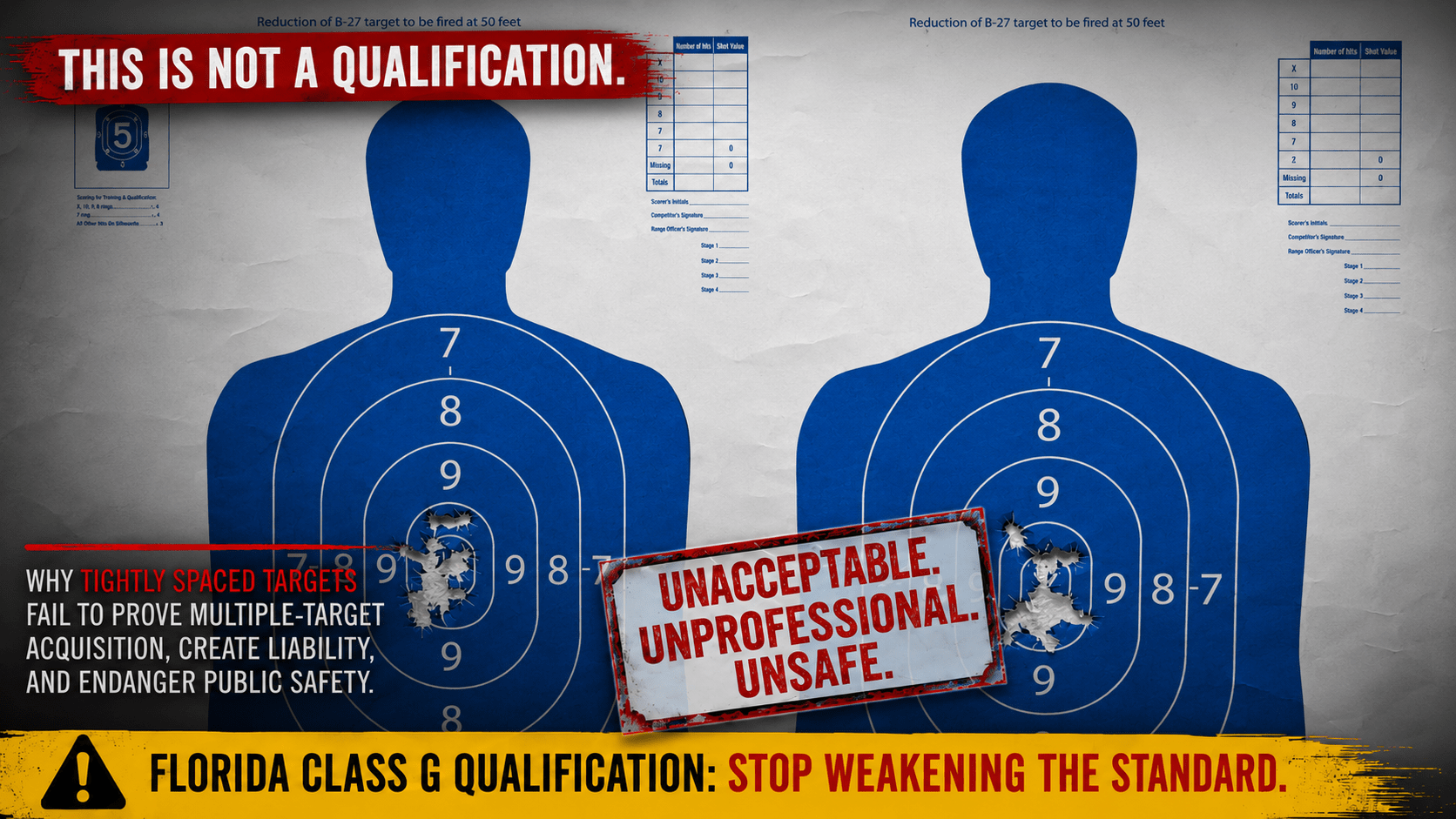
The target shown in this photograph should not be used to qualify armed security personnel in Florida.
The problem is not necessarily the reduced size of each individual silhouette. Even assuming the silhouettes satisfy the applicable dimensional requirements, placing two targets together with only a narrow space between them destroys one of the central performance objectives of the state handgun qualification: multiple-target engagement.
Florida’s current Firearms Training Manual requires the handgun qualification to be fired on two B-34 targets or two reduced B-29 targets. Multiple Stages specifically directs the shooter to engage the right and left targets in alternating order. The stated objective is to develop the quick draw, weapon alignment, close-quarters engagement, and multiple-target engagement.
When the two silhouettes are practically touching, that objective becomes a joke.
Two Silhouettes In One Piece of Paper Do Not Automatically Create Two Meaningful Targets
A student can technically fire at the “right target” and then the “left target,” but that does not mean the student has demonstrated competent target acquisition.
With targets arranged this closely, the shooter performs little more than a minor lateral correction. There is minimal visual relocation, minimal angular displacement, minimal deceleration of the firearm, and almost no requirement to stabilize the sights on a genuinely separate threat area.
That is not meaningful target transition. It is moving the muzzle a few inches across a sheet of paper.
Human-performance research has consistently demonstrated that target-directed movement becomes more demanding as the distance between targets increases and as the available target area decreases. Moving targets closer together lowers the difficulty of the task. That is not an opinion, a shooting-school preference, or tactical folklore. It is established motor-control science. (PubMed)
A qualification designed to test transitions must create enough separation to require an actual transition. Otherwise, it is like testing someone’s ability to drive through traffic by asking them to move a car from one parking space to the next.
Technically, the vehicle moved. Congratulations. Nobody proved they could drive.
The State’s Objective Is Being Defeated
The Florida course does not merely require that bullets appear on two different pieces of paper. It requires alternating engagement between right-side and left-side targets under time constraints. The instructor’s guide expressly identifies multiple-target engagement as an objective.
The absence of a numerical target-spacing requirement should not be interpreted as permission to place the silhouettes wherever they fit conveniently on a target carrier.
A professional instructor is expected to understand the purpose of the exercise—not merely exploit omissions in the wording.
When a Class “K” instructor places the targets so close together that the student never has to perform a meaningful visual and mechanical transition, the instructor may be preserving the superficial appearance of the course while eliminating the skill the course was designed to evaluate.
That is not professional judgment.
That is gaming the qualification.
A Qualification Is an Assessment, Not a Participation Exercise
The state qualification is supposed to determine whether a person possesses the minimum proficiency necessary to carry a firearm while performing regulated armed duties. Florida’s instructor guide states that students must demonstrate safe weapon handling, handgun drawing and holstering, loading, basic shooting principles, weapon-handling proficiency, malfunction intervention, and a qualifying score.
A score alone does not establish proficiency when the testing conditions have been deliberately weakened.
A student may place rounds in the scoring area while still being unable to:
- Identify and visually confirm a separate target.
- Move the firearm without sweeping unintended areas.
- Stop the muzzle precisely on a second target.
- Prevent overtravel during a transition.
- Maintain trigger discipline while moving between targets.
- Distinguish one person from another in a crowded environment.
- Control the firearm when the required movement exceeds a few degrees.
The tightly grouped silhouettes shown in the photograph conceal those deficiencies rather than expose them.
The result is a qualification that rewards basic trigger manipulation while pretending to evaluate armed performance.
The Public Does Not Stand Shoulder-to-Shoulder Like Cardboard
Armed security officers work around employees, customers, residents, patients, visitors, motorists, and bystanders. Real human beings do not reliably arrange themselves on the same sheet of paper with neat scoring rings around their torsos.
In a real incident, the officer may have to redirect attention and muzzle orientation across a much larger visual field. The person must identify the correct subject, control the firearm during the transition, stop the sights on the intended target, and avoid innocent people who may be moving through the same environment.
None of that is meaningfully evaluated when the “second target” is only a slight nudge away from the first.
This does not mean a state qualification must become an advanced tactical course. It means the qualification should honestly evaluate the limited skills it claims to evaluate.
When the state calls something a multiple-target exercise, there should be enough separation to require multiple-target performance.
That should not be controversial.
The Instructor’s Signature Carries Liability
Florida law does not treat a Class “K” instructor as someone who merely supervises ammunition consumption. Class “G” training must be taught and administered by a licensed Class “K” firearms instructor, and the instructor must report the student’s successful completion to the Division of Licensing. (Online Sunshine)
That signature is a professional certification.
It represents that the instructor administered the required course and that the student demonstrated the required level of proficiency. It is not an autograph given in exchange for tuition.
Florida Statute §493.6118 identifies fraud, deceit, negligence, incompetence, misconduct, and violations of Chapter 493 as potential grounds for disciplinary action. Available penalties include reprimand, administrative fines, probation, suspension, and revocation. (Online Sunshine)
This does not mean that target spacing alone automatically proves a statutory violation. It means that knowingly weakening an assessment, misrepresenting the proficiency demonstrated, or certifying someone who did not meaningfully complete the required objectives can create serious administrative exposure.
The photograph will not disappear after the certificate is issued.
Neither will the instructor’s records.
Negligent Certification and Negligent Training
Suppose a student repeatedly demonstrates poor muzzle control, unsafe transitions, weak visual processing, or an inability to distinguish between targets. Instead of remediating those failures, the instructor places two targets almost together, allows the student to produce a passing numerical score, and signs the certificate.
Later, that licensee fires negligently during an armed assignment.
A plaintiff’s attorney will not limit the investigation to the moment the trigger was pressed. The investigation may move backward through the licensee’s employment history, training records, qualification targets, instructor notes, course photographs, equipment, range procedures, and certification documents.
The question will be straightforward:
What did the instructor know, what should the instructor have known, and why was this person certified?
Florida recognizes employer vicarious liability for negligent acts committed by employees within the scope of employment. Depending on the relationships and facts involved, a school, training company, security agency, or other employer may be drawn into litigation arising from an instructor’s negligent conduct. (Justia Law)
Direct claims involving negligent training, supervision, retention, or authorization may also arise when an organization knows—or reasonably should know—that its personnel are not competent to perform armed duties.
Negligent Entrustment Must Be Used Correctly
Negligent entrustment should not be thrown around as a dramatic slogan.
A firearms instructor does not automatically “entrust” a firearm merely by signing a qualification certificate. However, negligent entrustment may become relevant when an employer, agency, school, or other party supplies or authorizes the use of a firearm despite knowing that the person is unfit, unsafe, or inadequately trained.
Florida courts have recognized firearm-related negligent-entrustment and common-law negligence principles when a party provides a firearm under circumstances in which harm is reasonably foreseeable. (Justia Law)
The potential chain of exposure can therefore include:
Instructor: for negligent instruction, evaluation, documentation, or certification.
Training school: for institutional practices, supervision, and employee conduct.
Security agency: for deploying or arming an officer whose deficiencies were known or should have been discovered.
Employer or firearm owner: for furnishing or authorizing a weapon despite evidence of incompetence.
Whether any particular claim succeeds depends on duty, breach, causation, foreseeability, employment relationships, and the specific facts. But an artificially easy qualification target can become powerful evidence that the system prioritized certificates over competence.
“They Passed the State Course” Will Not End the Lawsuit
That defense sounds comforting until opposing counsel places this photograph on a courtroom display.
The questions write themselves:
Why were the targets placed so close together?
What skill was supposedly being evaluated?
How did the setup test meaningful target transitions?
Was the arrangement chosen because students were struggling?
How many students failed?
What remediation was provided?
Did the instructor document unsafe behavior?
Would the student have passed if the targets had been separated adequately?
Was the instructor teaching proficiency—or manufacturing passing scores?
At that point, the qualification target is no longer scrap paper.
It is Exhibit A.
Stop Using These Targets for Qualification
Florida Class “K” instructors should immediately stop using combined target sheets that place two qualification silhouettes so close together that the multiple-target component becomes functionally meaningless.
FDACS should establish an objective minimum separation requirement, whether expressed through center-to-center distance, edge-to-edge distance, target-width separation, or minimum angular displacement at each firing distance.
Until that occurs, professional instructors should apply judgment consistent with the stated purpose of the course. The targets must be separated enough to require a deliberate visual transition, controlled firearm movement, accurate stopping of the muzzle, and positive engagement of two distinct target areas.
The standard should not be:
“Can I technically call these two targets?”
The standard should be:
“Does this arrangement honestly test the skill the state requires?”
If the answer is no, stop using it.
A Class “G” license authorizes a person to carry a firearm while performing regulated duties. That responsibility deserves more than convenient target placement, generous scoring, and a certificate printed before the brass has cooled.
Florida does not need more armed license holders who have learned how to pass an easy test.
Florida needs armed professionals who have demonstrated that they can safely control a firearm.
Anything less is not training.
It is administrative negligence disguised as qualification.