A Scientific Analysis of Muzzle Movement, Point of Impact, and Forward Hand Placement
Abstract
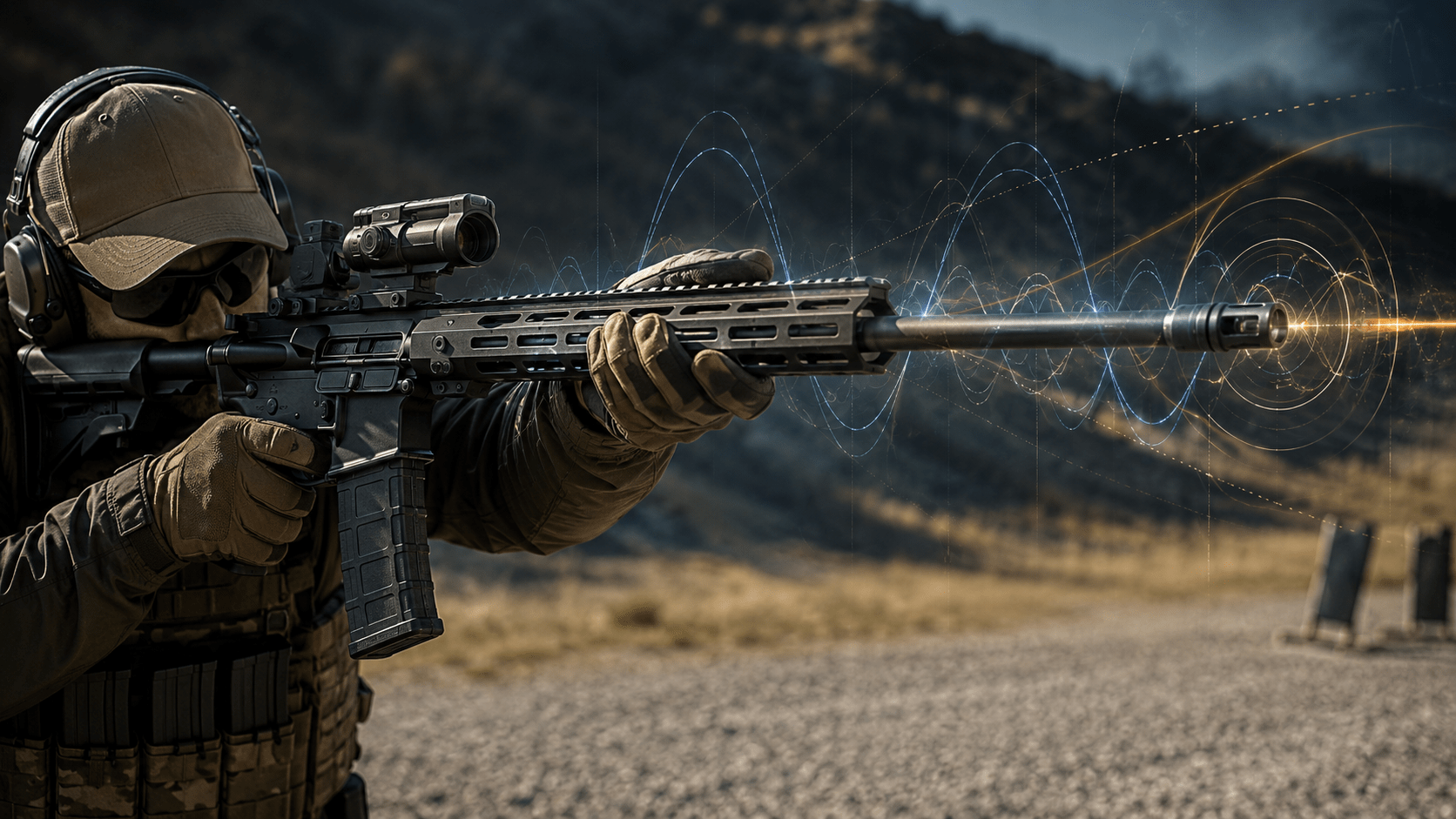
An AR-15 or M4-style carbine does not remain motionless when fired. The barrel vibrates. The muzzle moves. The projectile exits during that movement. That fact matters.
The muzzle is the last physical contact point between the rifle and the bullet. Whatever the muzzle is doing at the instant the bullet leaves the bore becomes part of the projectile’s initial flight path. If the muzzle angle changes, the point of impact changes. It does not matter what the shooter believes, what the instructor repeats, or what the internet says between energy-drink commercials. The bullet obeys physics.
This article examines barrel vibration, natural frequency, resonance, energy transfer, and muzzle displacement in a 16-inch AR-15/M4-style carbine. It also analyzes the role of the support hand. The farther forward the support hand is placed on the handguard, the greater the shooter’s mechanical leverage over the rifle’s front end. That forward position improves muzzle control, repeatability, recoil management, and point of aim/point of impact consistency.
However, this must be stated clearly: the shooter controls the rifle through the handguard, not by loading the barrel itself. Direct barrel pressure can disturb harmonics and shift point of impact. Forward control is science. Pressing on the barrel is negligence wearing tactical gloves.
1. The Barrel Is Not Static
A rifle barrel is not just a metal tube. It is a dynamic structure.
When the cartridge fires, the barrel is exposed to a violent pressure event. Gas expands. The bullet engraves into the rifling. The projectile accelerates down the bore. The rifle begins to recoil. The gas system activates. The shooter’s body absorbs and redirects force.
During all of this, the barrel vibrates.
That vibration is commonly called barrel whip, barrel harmonics, muzzle oscillation, or resonant vibration. Different terms. Same reality. The barrel moves.
This movement may be vertical, horizontal, rotational, or angular. It may be small, but small does not mean irrelevant. A tiny change at the muzzle becomes a measurable difference downrange.
The rifle does not need to move a lot to miss. It only needs to move differently from shot to shot.
That is the problem.
2. The Muzzle Decides Where the Bullet Starts
The muzzle is the final mechanical boundary between the rifle and the projectile.
Before the bullet exits, the barrel controls it. After the bullet exits, the rifle is done. From that moment forward, gravity, drag, wind, spin stability, yaw, and external ballistics take over.
That means the bullet’s initial direction is determined by the condition of the muzzle at the moment of exit.
Not before.
Not after.
At exit.
If the muzzle is angled slightly upward, downward, left, or right at that instant, the bullet leaves on that path. The target will show the result. The bullet does not care about excuses, credentials, or range folklore. It records the muzzle condition with brutal honesty.
This is why barrel harmonics matter. The issue is not whether the barrel vibrates. It does. The issue is whether it vibrates consistently.
Accuracy is not the absence of vibration.
Accuracy is repeatable vibration.
3. Natural Frequency and Resonance
Every barrel has natural frequencies. These are the frequencies at which the barrel tends to vibrate when disturbed.
A barrel behaves, in simplified terms, like a cantilever beam: fixed near the receiver, free at the muzzle. When the shot breaks, the barrel receives a sudden impulse. That impulse excites vibration.
Natural frequency is influenced by:
- Barrel length.
- Barrel profile.
- Barrel stiffness.
- Barrel mass.
- Steel properties.
- Gas system configuration.
- Muzzle device.
- Suppressor use.
- Barrel temperature.
- External pressure.
- Ammunition impulse.
A 16-inch AR-15 barrel has enough length for meaningful muzzle movement. It is short enough to be practical, but long enough to behave dynamically under firing stress.
Resonance occurs when the energy input aligns with the barrel’s natural vibration behavior. When that happens, movement can increase. Change the ammunition, muzzle device, suppressor, sling pressure, barricade load, or hand pressure, and the vibration pattern can change.
When the vibration pattern changes, point of impact can change.
This is not magic. This is mechanics.
4. Energy Transfer During Firing
When a round is fired, chemical energy from the propellant becomes mechanical energy.
That energy does several things:
- Drives the bullet forward.
- Spins the bullet through rifling.
- Produces heat.
- Produces sound.
- Pushes the rifle rearward.
- Activates the gas system.
- Moves the bolt carrier group.
- Deforms and vibrates the barrel.
- Moves the shooter.
The bullet is not the only thing receiving energy. The entire rifle system receives energy. The barrel absorbs part of that energy and responds by vibrating.
On an AR-15/M4-style carbine, the gas system adds another mechanical disturbance. Gas is tapped from the barrel before the bullet exits. That gas impulse begins the operating cycle and contributes to the rifle’s overall movement signature.
So the carbine is not just a barrel launching a bullet.
It is a coupled mechanical system.
Barrel, receiver, gas system, handguard, muzzle device, ammunition, optic, sling, shooter, and support surface all interact. Ignore that, and you are not teaching marksmanship. You are supervising noise.
5. Why the Front of the Barrel Matters
The front of the barrel matters because the muzzle is the last point of control.
The bullet exits from the muzzle, not from the chamber, not from the optic, and not from the shooter’s feelings about his zero.
The farther away the muzzle is from the chamber, the more its final position matters. Any angular deviation at the muzzle becomes a growing displacement downrange.
This is why muzzle consistency is critical. A shooter may hold the same sight picture, press the trigger cleanly, and still produce inconsistent impacts if the rifle system changes from shot to shot.
Common causes include:
- Inconsistent support-hand pressure.
- Inconsistent shoulder pressure.
- Barrel contact with barricades.
- Sling tension pulling against the barrel.
- Non-free-float handguard pressure.
- Suppressor-induced point-of-impact shift.
- Heat-induced barrel behavior.
- Muzzle device changes.
- Ammunition variation.
- Poor body structure.
- Uncontrolled recoil path.
The bullet exits during a mechanical event. If the rifle system is inconsistent, the muzzle condition at exit will be inconsistent.
Then the group opens.
Then the excuses start.
6. Support-Hand Placement Is a Leverage Problem
The support hand is not decoration. It is not there to look aggressive in photographs. It is a control mechanism.
The farther forward the support hand is placed on the handguard, the more leverage the shooter has over the front of the rifle.
This is basic torque.
Torque equals force multiplied by distance from the pivot point. The farther forward the support hand is, the more effectively the shooter can control muzzle movement with the same amount of force.
A rearward support hand near the magazine well gives poor leverage over the muzzle. The rifle becomes a long lever sticking out in front of the shooter with minimal front-end control. That may feel comfortable. Comfort is not the same as performance.
A forward support hand gives the shooter greater authority over:
- Muzzle rise.
- Lateral drift.
- Target transitions.
- Recoil recovery.
- Rifle indexing.
- Point of aim stability.
- Shot-to-shot repeatability.
This does not mean the arm must be locked out like a mannequin or that every shooter needs the same exact position. Shoulder mobility, injury history, armor, rifle length, handguard length, barricade use, heat, and mission context matter.
But the principle does not change:
The farther forward the support hand can be placed safely and sustainably, the more control the shooter has over the muzzle end of the rifle.
That is not style.
That is physics.
7. Control the Handguard, Not the Barrel
This is where the conversation needs discipline.
Forward support-hand placement is valuable when the shooter is applying pressure to the handguard or rail system. It is not permission to load the barrel.
Direct pressure on the barrel can alter barrel harmonics and shift point of impact. That is why free-float handguards exist. A free-float system allows the shooter to apply pressure to the handguard while reducing direct influence on the barrel’s vibration pattern.
The goal is not to stop the barrel from vibrating. That is impossible.
The goal is to allow the barrel to vibrate the same way every time while the shooter controls the rifle around it.
A free-float handguard helps separate shooter input from barrel behavior. A non-free-float handguard does not isolate those forces as well. That means support-hand pressure, sling tension, or barricade loading can transfer more directly into the barrel system.
That matters.
The rule is simple:
Do not load the barrel. Load the structure designed to be loaded.
A shooter who presses the barrel into a barricade and then complains about point-of-impact shift has not discovered a mystery. He has discovered consequences.
8. Forward Hand Placement and Resonant Control
The shooter cannot eliminate resonant vibration. Anyone claiming otherwise is selling religion with a rail attachment.
What the shooter can do is improve control of the rifle system.
A forward support hand helps in four major ways.
8.1 It Increases Mechanical Authority
The forward hand gives the shooter greater leverage over muzzle orientation. That means less wasted muscular effort and better control of the rifle’s front end.
8.2 It Improves Damping
The shooter’s body naturally moves. Breathing, heartbeat, tension, fatigue, and recoil all create motion. A forward support hand helps dampen unwanted movement before, during, and after the shot.
8.3 It Improves Return to Point of Aim
The muzzle will move under recoil. The question is whether it returns predictably. A forward hand improves the shooter’s ability to drive the rifle back to the same visual and mechanical index.
8.4 It Improves Repeatability
Repeatability is the entire game. The rifle must return to the same condition from shot to shot. The support hand is one of the most important variables in that process.
Inconsistent hand placement equals inconsistent pressure.
Inconsistent pressure equals inconsistent muzzle behavior.
Inconsistent muzzle behavior equals inconsistent impact.
That chain is not complicated. People just keep trying to ignore it.
9. Point of Aim and Point of Impact Are Mechanical Results
Point of aim and point of impact are not held together by hope.
They are created by repeatable mechanics.
A shooter must maintain consistency in:
- Support-hand placement.
- Support-hand pressure.
- Shoulder pressure.
- Cheek weld.
- Trigger input.
- Natural point of aim.
- Body alignment.
- Sling tension.
- Barricade pressure.
- Rifle zero.
- Ammunition.
- Barrel temperature.
If the shooter zeros the rifle one way and shoots it another way, point of impact may change. If the shooter uses a relaxed grip during zero and an aggressive forward grip during drills, the rifle may behave differently. If the shooter loads a barricade one way and shoots unsupported another way, the impact may shift.
The rifle is not betraying the shooter.
The shooter changed the system.
10. Instructor Responsibility
Instructors need to stop teaching support-hand placement as personal preference.
Personal preference is what someone puts on a sandwich. Rifle control is physics.
The correct questions are:
- Does the hand position improve control of the muzzle?
- Does it reduce unnecessary movement?
- Does it support repeatable recoil recovery?
- Does it preserve point of aim and point of impact?
- Does it work under fatigue?
- Does it work from standing, kneeling, prone, and barricades?
- Does it avoid barrel loading?
- Can the shooter repeat it under pressure?
If the answer is no, the technique is weak. It may look good on camera, but the target will expose it.
Professional instruction requires more than repeating inherited range doctrine. It requires explaining why a technique works, where it fails, and how the shooter can verify it.
The support hand should be taught as a mechanical control interface, not a fashion statement.
11. Practical Training Standards
The shooter should establish a consistent forward support-hand index on the handguard.
That index should be repeatable through:
- Rail position.
- Hand stop.
- Textured grip panel.
- Tape switch placement.
- Thumb position.
- Elbow angle.
- Shoulder structure.
- Body alignment.
The hand should be as far forward as the shooter can safely and consistently control. Not dangerously forward. Not theatrically forward. Functionally forward.
The position must allow the shooter to:
- Maintain muzzle control.
- Avoid the muzzle and blast zone.
- Avoid excessive joint strain.
- Manage heat.
- Transition targets efficiently.
- Recover the sights quickly.
- Maintain pressure consistently.
- Work from multiple positions.
The shooter should then test point of impact under realistic conditions:
- Bench zero.
- Standing.
- Kneeling.
- Prone.
- Barricade supported.
- Sling loaded.
- Rapid fire.
- Slow fire.
- Cold barrel.
- Hot barrel.
- Suppressed and unsuppressed, if applicable.
The rifle must be tested the way it will be used. Anything else is administrative comfort disguised as training.
12. Conclusion
The AR-15/M4-style carbine is a dynamic weapon system. When fired, the barrel vibrates. The muzzle moves. The projectile exits during that movement.
The muzzle is the last physical contact point with the bullet. Therefore, the muzzle’s condition at projectile exit directly influences point of impact.
Natural frequency, resonance, and energy transfer explain why the barrel moves. Barrel profile, length, gas system, ammunition, muzzle device, suppressor use, heat, and external pressure all influence that movement.
The support hand matters because the shooter is part of the system. A forward support hand on the handguard gives the shooter greater leverage over the front of the rifle. It improves control, damping, recoil recovery, target transitions, and repeatability.
But direct barrel pressure is not control. It is interference.
The correct principle is clear:
Control the rifle through the handguard. Let the barrel vibrate consistently. Keep the support hand forward enough to control the muzzle. Repeat the same pressure every time.
The barrel will vibrate.
The muzzle will move.
The bullet will leave from wherever the muzzle is pointing at that instant.
The professional shooter does not argue with that.
He builds his technique around it.