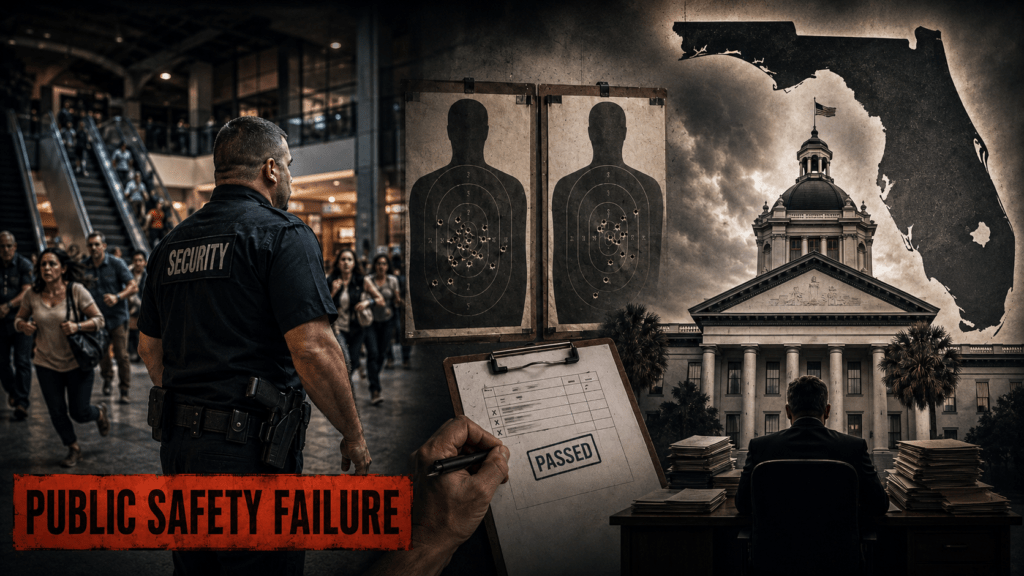
Nearly 20 Rounds, One Uncomfortable Truth: The Meriden Bodycam Exposes America’s Firearms-Training Failure
A badge does not control recoil. A certificate does not make an unaccounted round disappear.
When an armed professional fires nearly an entire combat load at close distance before an attacker finally stops, the firearms-training establishment does not get to hide behind one convenient word: stress.
The Meriden, Connecticut, police shooting should force an uncomfortable national conversation—not merely about whether deadly force was legally justified, but whether American law enforcement, military personnel, security professionals, and armed citizens are receiving the firearms training they actually need to perform when lives are being destroyed in front of them.
An Active Murder in Progress
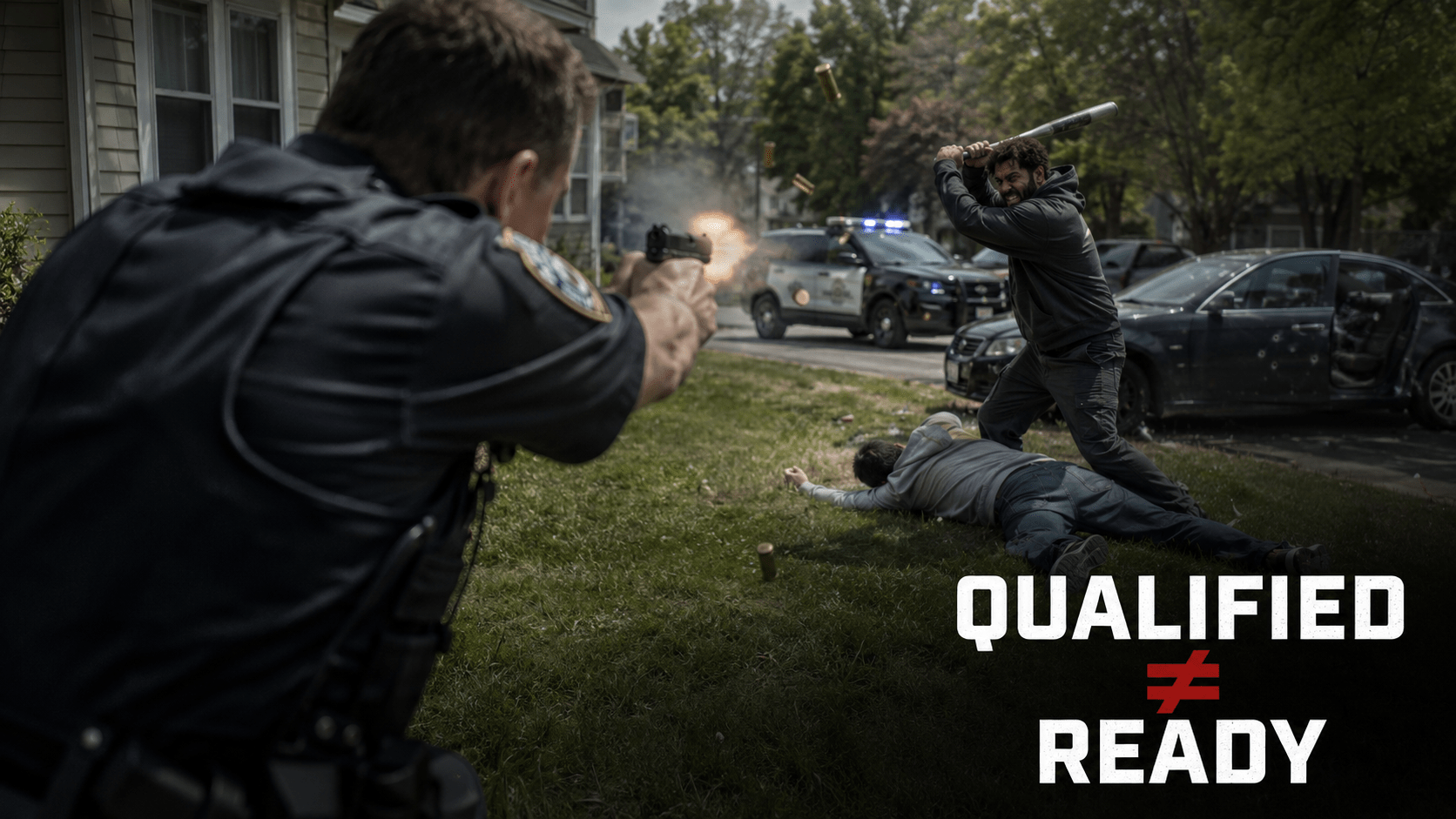
On July 19, 2026, Meriden Police Officer Anthony Offiaeli responded to an active domestic-violence incident on Sagamore Road. According to the Connecticut Office of Inspector General’s preliminary report, Offiaeli was the first officer to arrive and encountered 38-year-old Robert Lee Jenkins III repeatedly striking a motionless man in the head with a baseball bat.
Offiaeli ordered Jenkins to drop the bat four times. Jenkins refused and continued the attack. The officer then fired numerous rounds, several of which struck Jenkins, who eventually dropped the bat and fell. The assault victim was pronounced dead at the scene. Jenkins later died at Hartford Hospital.
The medical examiner determined that Jenkins died from multiple gunshot wounds to the torso. The man he attacked died from blunt-force injuries to the head.
Let us establish something before the social-media experts begin screaming from both sides.
Officer Offiaeli arrived alone at a human being’s worst possible moment. He did not create the violence. He did not have the luxury of observing from a command post, conducting a briefing, warming up on the range, or waiting for a tactical team. He ran toward an active killing and attempted to stop it.
That courage should be acknowledged.
But courage and firearms proficiency are not the same thing.
Legal Justification and Shooting Performance Are Separate Questions
The apparent need to intervene with deadly force should not prevent us from examining the officer’s shooting performance.
Those are two separate issues.
A shooting can be legally justified while still exposing serious deficiencies in firearms proficiency, training frequency, recoil control, visual processing, shot accountability, or agency standards. The law determines whether deadly force was permissible. It does not automatically declare every round fired tactically acceptable.
The official investigation is continuing, and the preliminary report does not provide a final round count, impact sequence, trajectory analysis, or complete accounting of where every projectile traveled.
Public reporting based on the body-camera footage estimated that the officer fired at least 18 rounds. Officer.com described nearly 20 rounds fired in several rapid sequences as Jenkins continued the attack. Local reporting also stated that many rounds appeared to miss, although that visual assessment is not a substitute for the final forensic investigation. (Officer)
Therefore, no responsible instructor should announce with certainty that the first 16 rounds were misses. Body-camera video is not a trajectory reconstruction, and the medical examiner confirmed multiple torso wounds.
But hiding behind that uncertainty would be equally dishonest.
The visible duration of the volley, the number of rounds fired, the continuing assault and the apparent difficulty producing an effective stop create legitimate questions about performance. Those questions matter because every projectile that does not remain inside the intended threat continues traveling into somebody else’s world.
The law may authorize the shot. It does not excuse the miss.
The Suspect Was Not Shooting Back—But the Officer Was Still Under Extreme Pressure
Some viewers will describe this as an “easy” officer-involved shooting because Jenkins was not firing a gun, moving rapidly between cover positions or exchanging fire with the officer.
That description is careless.
There is nothing psychologically easy about arriving alone and witnessing one human being crush another person’s skull with a baseball bat. The visual violence, urgency, screaming, uncertainty and knowledge that every fraction of a second may determine whether someone survives create enormous pressure.
But that is precisely the point.
Stress is not an unexpected complication in defensive firearms use. Stress is the environment for which the training is supposedly preparing you.
Research involving police officers has repeatedly demonstrated that anxiety can reduce shooting accuracy, alter visual behavior and change how officers move and execute shots. In one experimental study, officers displayed reduced accuracy under a threatening condition in which an opponent fired back with training ammunition. (Vrije Universiteit Amsterdam)
Another study involving 27 police officers found that officers who practiced under anxiety improved their ability to maintain shooting accuracy under pressure, while those who trained without comparable pressure continued to experience performance degradation. (PubMed)
Research comparing static shooting with simulation and shoot-house exercises has also found significant differences in hit percentages and heart rates. Performance declined as exercises became more representative of actual confrontations, leading the researchers to recommend more high-stress, combat-relevant training. (Sage Journals)
In plain language: people generally perform according to the demands they have been trained to manage—not according to the confidence created by shooting paper under comfortable conditions.
Qualification Culture Is Not Combat Preparation
This incident exposes one of the firearms industry’s most protected lies:
Passing a qualification means you are prepared to fight with a firearm.
It does not.
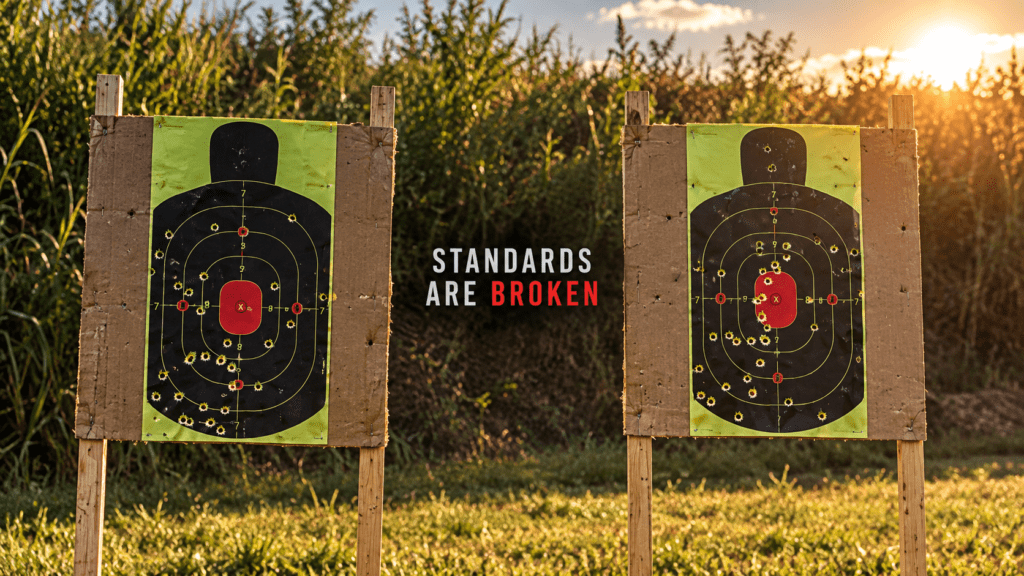
Most institutional qualifications are predictable administrative exercises. The shooter knows the distance, target, course of fire, number of rounds and commands before the exercise begins. The target does not move. It does not scream. It does not attack another person. It does not force the shooter to process a rapidly changing scene while considering foreground, background, innocent people, movement and the legal consequences of every trigger press.
Frequently, the shooter is allowed to warm up before being tested. Generous scoring areas turn marginal impacts into passing scores. Poor performers are recycled until they barely meet the minimum. The paperwork is completed, the box is checked and everyone pretends readiness has been established.
It has not.
A qualification records what someone did during a controlled qualification. It does not prove that the person can recognize a lethal threat, establish a functional grip, manage recoil, maintain visual discipline, process feedback, control cadence and account for every round while experiencing extreme urgency.
A qualification card is a receipt. It is not a guarantee.
The paper target never swings a bat.
A Hit Is Not Automatically a Stop
The preliminary medical findings create another lesson that firearms instructors routinely fail to explain properly.
Jenkins sustained multiple torso gunshot wounds and continued his actions for some period before falling. That does not automatically prove every earlier round missed. It demonstrates that handgun bullets do not possess magical, instantaneous stopping power simply because they strike the torso.
There is a dangerous difference between hitting a target and producing a timely physiological interruption.
Traditional qualification targets often reward rounds anywhere within a broad scoring zone. Real human anatomy does not operate according to cardboard scoring rings. A technically counted “hit” may fail to create the immediate result required to save a life.
This does not mean officers or citizens should recklessly fire faster or chase low-probability anatomical targets. It means training must teach shooters to observe results, process visual information and make controlled follow-up decisions rather than firing an emotionally driven string until the firearm is nearly empty.
Speed without control is noise.
Accuracy without adequate speed may arrive too late.
The professional standard is the ability to balance both according to the problem happening in front of you.
Every Round Is a Public-Safety Decision
The Meriden incident occurred on a residential lawn. In another environment, there could have been children behind windows, pedestrians on sidewalks, motorists passing through the background or family members moving toward the violence.
That is why merely counting how many rounds eventually struck the attacker is insufficient.
Where did every other round go?
That question should be asked after every law-enforcement shooting, military engagement, security incident and civilian defensive gun use. It should also be asked during training—before a real human being is standing behind the target area.
The shooter owns the projectile from the moment it leaves the barrel until it stops.
Not the department.
Not the ammunition manufacturer.
Not the instructor who signed the qualification card.
The shooter.
Every round leaves the muzzle carrying the shooter’s name, career, freedom and future with it.
Science-Based Firearms Training Is Not Optional
Real defensive firearms training must go beyond firing more ammunition.
Round count is not curriculum.
Science-based firearms instruction examines how the human body interfaces with the weapon. It addresses skeletal alignment, muscular efficiency, grip pressure, recoil management, trigger control, visual processing, perception, decision-making and motor-skill retention.
It measures performance rather than praising effort.
It identifies exactly why rounds leave the intended area. It determines whether the failure came from visual disruption, uncontrolled recoil, inconsistent grip, poor trigger manipulation, cognitive overload or an inability to process feedback at speed.
It tests students cold—not only after they have been permitted to rehearse until the target looks respectable.
It uses realistic decision-making, time pressure, elevated heart rate, scenario training and properly controlled force-on-force exercises to expose weaknesses before those weaknesses appear in public with live ammunition.
Most importantly, it requires remediation.
A student who cannot consistently account for rounds under reasonable pressure should not be congratulated, handed a certificate and returned to duty unchanged. The instructor’s responsibility is not to protect feelings or agency statistics. It is to develop capability.
Anything less is performance theater.
This Problem Extends Beyond Law Enforcement
Civilians should not watch the Meriden footage and conclude that criticism applies only to police.
A concealed-carry permit does not confer competence. Owning an expensive pistol, optic, holster or tactical wardrobe does not create defensive capability. Neither does watching videos, attending a two-hour introductory course or firing fifty rounds once every few months.
The armed citizen may have fewer resources than the responding officer. There may be no radio, no body armor, no immediate backup and no established command structure. A civilian may also be surrounded by family members, crowds or confined spaces where an unaccounted round creates catastrophic consequences.
Military personnel are not exempt either. Rank, occupational specialty and previous qualification history cannot replace current, measurable performance. The mechanics of controlling a pistol or rifle do not change because the shooter wears a uniform.
A badge does not defeat biomechanics.
A uniform does not override vision science.
A certificate does not repeal human stress responses.
Stress does not create skill. It audits whatever skill was already there.
The Industry Does Not Need More Certificates
America has no shortage of firearms instructors.
It has a shortage of instructors willing to measure performance honestly.
Too many programs are designed to process students, protect pass rates and issue documentation. Too many instructors repeat range folklore inherited from someone who repeated it from somebody else. Too many agencies confuse annual compliance with operational readiness.
Then body-camera footage appears, and everyone acts surprised when real performance bears little resemblance to the qualification range.
The Meriden shooting should not become entertainment. Nor should it become an excuse to personally attack an officer who ran toward an active murder.
It should become a case study.
Officer Offiaeli acted while another man was being beaten to death. That intervention required courage. The observable firearms performance also deserves professional examination. Both statements can be true at the same time.
Respect for law enforcement does not require intellectual dishonesty.
Supporting officers means demanding that they receive enough ammunition, range time, competent instruction, performance analysis and pressure-based training to survive the realities society sends them into.
Anything less is not support.
It is institutional abandonment.
The Valortec Standard
The core purpose of the Valortec curriculum is not to manufacture certificates or create artificial confidence. It is to develop measurable firearms capability grounded in the science of marksmanship.
That means building efficient mechanics, improving visual and neuromuscular performance, evaluating shooters cold, identifying deficiencies through data and progressively testing skills under realistic pressure.
For law enforcement, military personnel, security professionals and responsible armed citizens, the objective is the same:
Recognize the threat. Make the correct decision. Deliver accountable performance. Stop when the threat stops.
Emergencies do not award points for effort. Innocent people do not receive a second life because the shooter met a minimum qualification standard six months earlier.
The Meriden body-camera footage is a warning.
The question is whether the firearms-training establishment will study it—or make excuses until the next volley of unaccounted rounds forces the same conversation again.
Stop collecting certificates. Start developing capability.