Laser Boresighters and the Physics They Don’t Tell You About
Social media has turned the laser boresighter into another shortcut product wrapped in tactical marketing.
The advertisement usually sounds like this:
Insert the laser into the barrel. Put the red dot on the laser. Your handgun is zeroed.
That statement is not scientifically accurate.
A laser boresighter can help with initial alignment. It can help get the optic close enough to land shots on paper. It can save ammunition during the first stage of sight setup.
But it does not create a true ballistic zero.
Why?
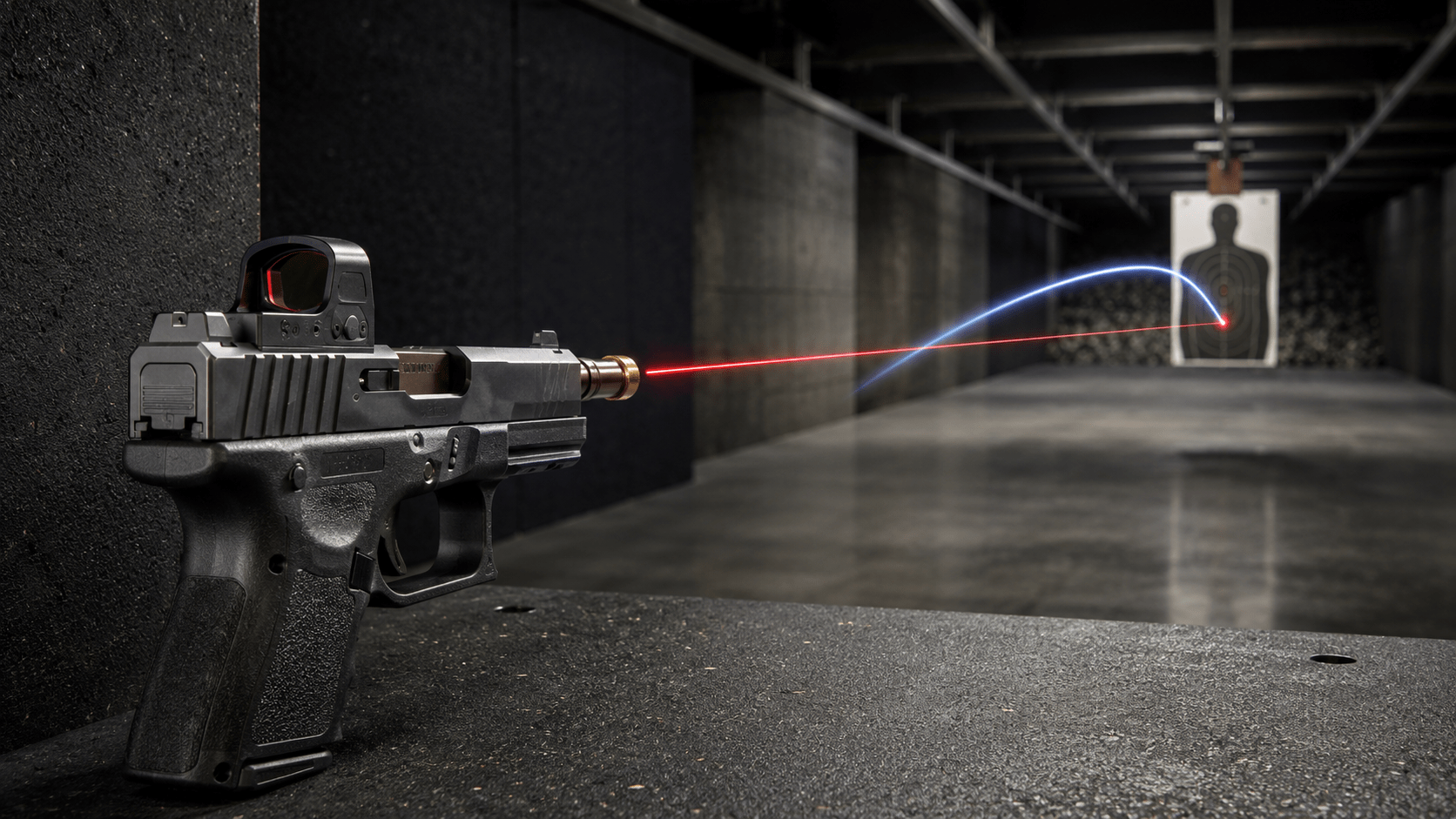
Because a laser beam travels in a straight optical line. A bullet does not.
A bullet is a physical projectile traveling through space under gravity, drag, velocity loss, bore angle, optic offset, and shooter-induced variables. NASA’s basic ballistic-flight explanation notes that projectile motion is a first approximation of objects such as bullets, while real flight becomes more complex when drag is included. (NASA)
The internet wants the answer to be simple.
Physics refuses.
A Scientific Breakdown of Why a Laser Pointer Cannot Replace Real Pistol Red Dot Zeroing
The Three Lines Nobody on Social Media Wants to Explain
When a pistol has a slide-mounted red dot, there are three different paths involved.
1. The Bore Axis
This is the centerline of the barrel.
A laser boresighter sits inside the chamber or muzzle and projects light along that bore axis. The laser is essentially showing you where the barrel is pointing in a straight line.
That matters — but only partially.
2. The Optic Line of Sight
This is the visual line created by the shooter’s eye, the red dot, and the target.
On a pistol-mounted optic, this line sits above the bore. Federal’s published handgun trajectory tables use a sight height of 0.9 inches above bore line for some 9mm 115-grain loads, which is a realistic reference point for this discussion. (Federal Premium)
That vertical distance between the bore and the optic is called height over bore.
3. The Bullet Trajectory
This is the actual flight path of the projectile.
It is not a laser beam. It is not perfectly flat. It is not straight. It begins below the optic, moves forward, is influenced by gravity immediately, and follows a curved ballistic path.
The National Institute of Standards and Technology lists standard gravity as 9.80665 m/s², or approximately 32.174 ft/s². That force is acting on the bullet the moment it leaves the barrel. (NIST)
That is the problem.
A laser shows a straight line.
The dot shows a straight visual reference.
The bullet travels in a curve.
Those are not the same thing.
Why Height Over Bore Matters on a Pistol Red Dot
A red dot mounted on top of a pistol slide sits above the bore.
That means the bullet does not start at the red dot. It starts below it.
If the optic centerline is approximately 0.9 inches above the bore, then the bullet begins roughly 0.9 inches below the line of sight before gravity, drag, and barrel angle are even considered.
To make point of aim and point of impact meet at a chosen distance, the barrel must be angled slightly upward relative to the optic’s visual line. That allows the bullet trajectory to intersect the optic line at the selected zero distance.
That selected distance is the true zero.
Not the laser.
The zero is not established when the dot touches the laser.
The zero is established when the fired bullet lands where the dot is aimed.
The Laser Boresighter Problem
A laser boresighter projects a straight optical beam from the bore.
That beam does not simulate:
- bullet drop
- velocity loss
- aerodynamic drag
- projectile stabilization
- barrel harmonics
- ammunition variation
- optic mounting tolerance
- shooter grip influence
- recoil behavior
- real point of impact
That is why serious optic manufacturers and professional zeroing procedures still rely on live-fire confirmation. Leupold’s red dot sight-in guidance, for example, uses initial alignment only as a starting point and then moves to live-fire groups, adjustment, and final confirmation. (leupold.com)
Leupold also states clearly in its riflescope bore-sighting guidance that bore sighting is rarely, if ever, perfect and is only intended to get the shooter on target before firing and adjusting. (leupold.com)
That same principle applies to handguns.
A boresighter is not a zeroing solution.
It is a starting reference.
The Scientific Model: 9mm 115-Grain Ballistics Inside 25 Yards
Let’s use a realistic handgun example:
- Caliber: 9mm Luger
- Bullet weight: 115 grains
- Bullet style: FMJ
- Test barrel reference: 4 inches
- Muzzle velocity reference: 1125–1180 fps
- Sight height reference: 0.9 inches above bore
- Maximum analysis distance: 25 yards
Federal lists one 115-grain 9mm FMJ load at 1125 fps from a 4-inch test barrel, and another American Eagle 115-grain FMJ load at 1180 fps from a 4-inch test barrel. (Federal Premium)
Federal’s American Eagle 115-grain FMJ data also shows trajectory information based on a 25-yard zero with sights 0.9 inches above bore line. At 25 yards, the point of impact is listed at zero; at 50 yards, it is already approximately 0.9 inches low. (Federal Premium)
That tells us something important:
Even with a fast 115-grain 9mm load, the bullet does not remain flat forever. The projectile is already dropping relative to the line of sight beyond the zero distance.
Inside 25 yards, the bullet is still dealing with the geometry of starting below the optic and rising toward the sight line.
Approximate 25-Yard Zero Behavior With 9mm 115-Grain FMJ
Using a simplified physics model with:
- 1180 fps muzzle velocity
- 0.9-inch sight height over bore
- 25-yard zero
- standard gravity
- no drag correction
we get an approximate understanding of how the bullet approaches the optic line.
| Distance | Approximate Impact Relative to Dot |
|---|---|
| 1 yard | about 0.83 inch low |
| 3 yards | about 0.71 inch low |
| 5 yards | about 0.60 inch low |
| 7 yards | about 0.49 inch low |
| 10 yards | about 0.35 inch low |
| 15 yards | about 0.17 inch low |
| 20 yards | about 0.06 inch low |
| 25 yards | zero |
These are simplified educational estimates, not a replacement for live-fire confirmation. Real ammunition is affected by drag, barrel length, actual velocity, optic height, ammunition lot variation, firearm fit, and shooter consistency. NASA’s discussion of flight equations with drag reinforces that real projectile flight is more complex than the clean “gravity-only” model. (NASA)
But the pattern is the point:
At close distance, the bullet is low because it has not yet reached the optic line.
At the zero distance, point of aim and point of impact meet.
Past that distance, gravity continues working.
Gravity does not stop because a laser dot looked good on Instagram.
What Happens If You “Zero” Only to the Laser?
This is where the social media shortcut collapses.
If a shooter inserts a boresighter and adjusts the red dot to match the laser at a short distance, they are not matching the optic to the bullet trajectory.
They are matching the optic to a straight line projected from the barrel.
That straight line does not include bullet drop.
For example, if a shooter adjusts the red dot to match the laser at 5 yards, the optic line and bore line may intersect at 5 yards. But the bullet will not stay on that laser line. It begins dropping immediately.
Depending on the distance used, this can create a false zero that looks acceptable up close but becomes wrong as distance changes.
A laser alignment at 5 yards can make the pistol appear “close enough” at 5 yards while shifting point of impact significantly at 15, 20, or 25 yards.
That is not precision.
That is a mathematical accident.
Why One Distance Can Look Correct While Another Is Wrong
Point of aim and point of impact can only be perfectly matched at a specific distance unless the shooter understands the offset and trajectory.
That is not a defect in the pistol.
That is geometry.
A 25-yard zero does not mean the bullet hits exactly dead-on at every distance from 1 to 25 yards. It means the bullet trajectory intersects the optic line at 25 yards.
At closer distances, the projectile may still be slightly low because it started below the optic.
At longer distances, the bullet begins dropping again relative to the optic line.
This is why a shooter may say:
“My dot is dead-on at 7 yards, but I’m off at 25.”
Or:
“My laser zero looked perfect, but my live rounds are not landing where expected.”
The answer is usually not mysterious.
The shooter did not establish a ballistic zero.
They established a visual coincidence.
There is a difference.
A Laser Boresighter Is Not Useless — It Is Just Overmarketed
The correct criticism is not that laser boresighters are useless.
They are not useless.
They can help with:
- rough optic alignment
- confirming that the dot is not wildly off
- getting rounds onto paper faster
- reducing wasted ammunition during initial setup
- checking whether an optic has shifted dramatically
That is legitimate.
The problem is when sellers imply that a laser boresighter can replace live-fire zeroing.
It cannot.
A laser boresighter is an alignment tool.
Live fire establishes the zero.
Anything else is marketing.
The Red Dot Is Not the Problem
The pistol-mounted optic is not the problem.
The red dot is an excellent aiming system when properly mounted, properly zeroed, and properly trained.
The failure comes from misunderstanding how the system works.
A red dot does not magically eliminate:
- bore offset
- trajectory
- close-range mechanical deviation
- grip inconsistency
- trigger disturbance
- poor presentation
- lack of live-fire confirmation
The dot only tells you where the optic is aimed.
It does not prove where the bullet will land until the bullet is actually fired and measured.
The “Straight Line” Trap
The laser is straight.
The dot appears straight.
The shooter assumes the bullet must follow the same path.
That assumption is the trap.
The actual projectile path is governed by Newtonian mechanics. Gravity accelerates the bullet downward. Drag slows it. The barrel angle determines how the trajectory intersects the optic line.
Hornady’s ballistic resources emphasize that ballistic calculators exist because trajectory solutions are needed to improve practical accuracy. (Hornady Manufacturing, Inc)
If bullets simply followed laser beams, ballistic calculators would be unnecessary.
They are necessary because projectile flight is not a laser line.
The 25-Yard Defensive Pistol Reality
For a pistol-mounted red dot, many serious shooters and instructors use a 15- to 25-yard zero depending on the application.
A 25-yard zero is common because it provides a useful balance across typical handgun distances. It keeps close-range offset manageable while giving the shooter a meaningful confirmation distance.
But the chosen zero must be confirmed with live ammunition.
Aimpoint’s zeroing guidance, for example, uses a target at 25 meters, a supported firearm, a fired shot, point-of-impact inspection, adjustment, and repeat confirmation. (aimpoint.com)
That is the professional method:
Aim.
Fire.
Measure.
Adjust.
Confirm.
Not:
Insert laser.
Believe advertisement.
Declare victory.
Why This Matters for Real Defensive Accuracy
A pistol red dot is not jewelry.
It is not there to make the firearm look modern.
It is a precision aiming reference. If the shooter does not understand offset, trajectory, and zero distance, that optic can become a false confidence generator.
In training, qualification, or defensive application, false confidence is dangerous.
A shooter who believes the firearm is zeroed because a laser dot matched the optic may discover the truth only when rounds land somewhere else.
That is unacceptable.
Responsible firearms training requires verification.
SAAMI’s mission includes creating and publishing standards for safety, reliability, interchangeability, and responsible firearm use. (SAAMI) That same mindset should apply to optic zeroing: technical claims must be verified, not blindly accepted because a product video looked convincing.
Practical Scientific Conclusion
A laser boresighter can show you where the barrel is pointing.
It cannot show you where the bullet will impact.
A laser travels in a straight line.
A bullet travels in a curved trajectory.
A red dot sits above the bore.
Gravity begins immediately.
The true zero exists only where point of aim and point of impact are confirmed by live fire.
The laser is a reference.
The target is the evidence.
The bullet hole is the truth.
Final Valortec Position
The laser boresighter is not the enemy.
The lie is the enemy.
The lie is telling shooters that a laser pointer inserted into a barrel can replace the scientific process of confirming point of aim and point of impact with live ammunition.
That is not training.
That is marketing dressed up as marksmanship.
At Valortec, we teach the Science of Marksmanship because accuracy is not magic. It is geometry, biomechanics, visual processing, recoil management, ballistic verification, and disciplined confirmation.
The internet sells shortcuts.
Physics does not honor shortcuts.
And when accountability matters, the only zero that counts is the one proven on target.
References
Federal Premium, 9mm Luger 115-grain Champion Training ballistic data. (Federal Premium)
Federal Premium, American Eagle 9mm Luger 115-grain FMJ ballistic data, including 1180 fps muzzle velocity and trajectory table with 0.9-inch sight height over bore. (Federal Premium)
NASA Glenn Research Center, flight equations with drag and ballistic flight explanation. (NASA)
NIST CODATA value for standard acceleration of gravity. (NIST)
SAAMI, standards-setting mission for safety, reliability, and responsible firearms use. (SAAMI)
Hornady Ballistics Resources and ballistic calculator reference. (Hornady Manufacturing, Inc)
Leupold, red dot sight-in and live-fire confirmation guidance. (leupold.com)
Leupold, bore-sighting explanation stating bore-sighting is intended only to get on target before live-fire adjustment. (leupold.com)
Aimpoint, red dot zeroing process using fired rounds, point-of-impact inspection, adjustment, and confirmation. (aimpoint.com)