What 9mm Bullet Weight Actually Means
The number identifies projectile mass. It does not independently tell you the powder charge, pressure, velocity, recoil, accuracy, or performance.
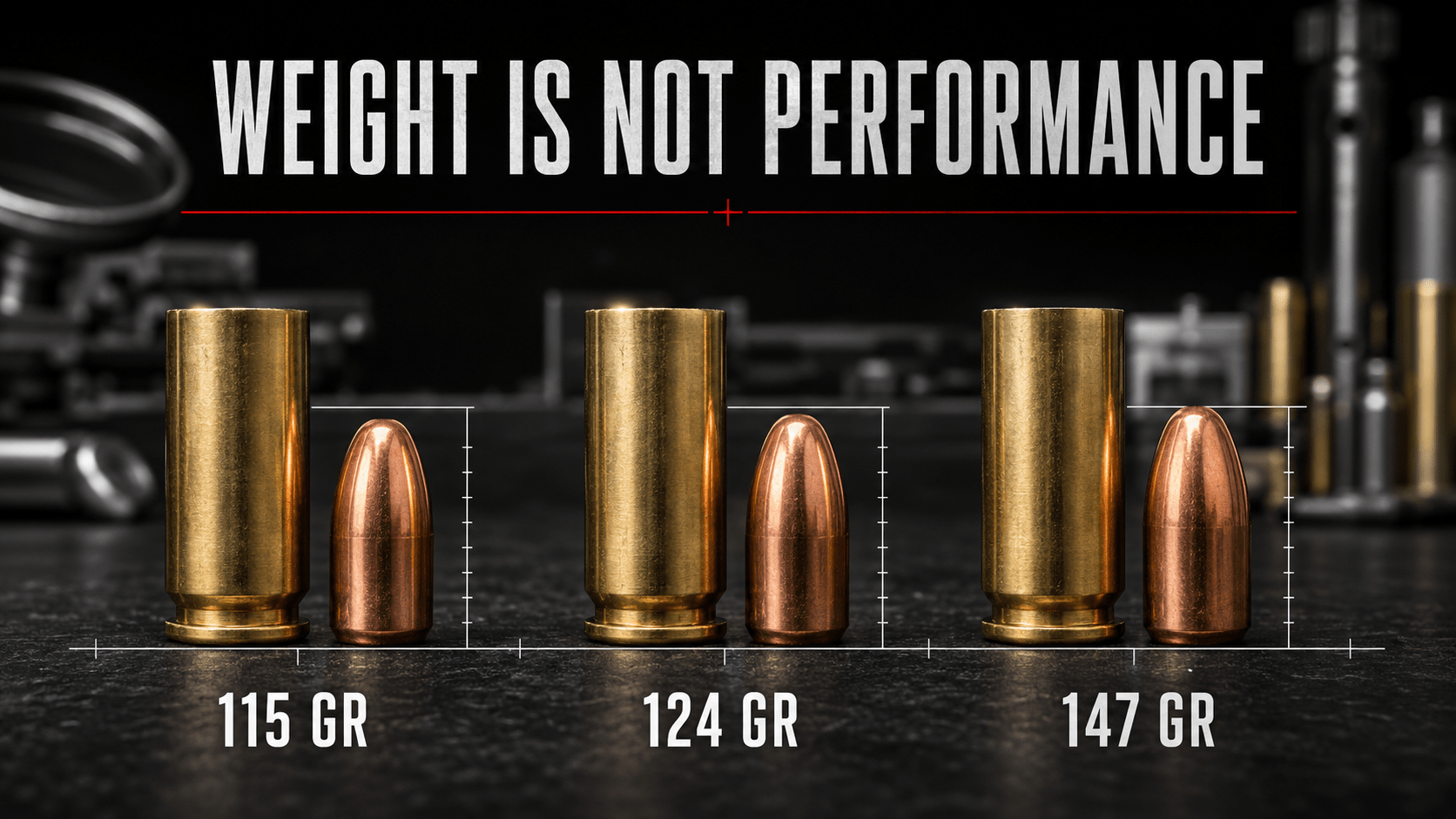
115. 124. 147.
You see those numbers on boxes of 9mm ammunition everywhere. Shooters repeat them constantly. Some defend one weight as if the other two insulted their family.
But what do those numbers actually mean?
The answer is simple: they identify the weight of the projectile. They do not tell you how much powder is inside the cartridge. They do not automatically tell you its chamber pressure, velocity, recoil, accuracy, or terminal performance. And they certainly do not tell you which load is “best.”
For a new shooter, understanding that distinction is ammunition literacy. For an experienced shooter, ignoring it is an avoidable failure.
What Is a Grain?
A grain—abbreviated gr—is a unit of mass used to describe bullet and propellant weight. It is extremely small. The National Institute of Standards and Technology lists 7,000 grains in one avoirdupois pound. One grain equals approximately 0.0648 gram. (NIST Handbook 44, Appendix C)
Here is what the three common 9mm projectile weights equal in more familiar units:
| 9mm projectile | Approximate grams | Approximate ounces |
|---|---|---|
| 115 gr | 7.45 g | 0.263 oz |
| 124 gr | 8.04 g | 0.283 oz |
| 147 gr | 9.53 g | 0.336 oz |
The difference between a 115-grain and a 147-grain projectile is only 32 grains—about 2.07 grams. That sounds minor. Inside a handgun cartridge, however, it is enough to influence projectile dimensions, velocity, momentum, recoil impulse, trajectory, point of impact, and the way a particular load interacts with a particular pistol.
Influence is not the same as prediction. Bullet weight is one variable, not the entire ballistic equation.
Bullet Weight Is Not Cartridge Weight
New shooters often use the words bullet, cartridge, and round as if they mean the same thing. They do not.
A complete centerfire pistol cartridge contains four primary components:
- Projectile: The bullet that leaves the barrel.
- Case: The container, normally made of brass, steel, or another suitable material.
- Propellant: The powder that burns and generates expanding gas.
- Primer: The ignition component struck by the firing pin.
SAAMI defines a cartridge as a single round consisting of a case, primer, propellant, and one or more projectiles. Federal’s pistol-ammunition guide illustrates the same four-part anatomy. (SAAMI Glossary; Federal Ammunition: Anatomy of a Pistol Cartridge)
When a box of factory 9mm ammunition says 115 GR, that designation refers to the bullet—not the combined weight of the complete cartridge.
Does “More Grains” Mean More Powder?
No.
This is where many new shooters become confused because propellant charges are also measured by weight and commonly expressed in grains. The same unit can measure two different components, just as pounds can measure both a person and a suitcase.
The 115-, 124-, or 147-grain number printed prominently on a 9mm ammunition box identifies projectile weight. It does not disclose the propellant charge.
Powders also differ in composition, density, geometry, and burn characteristics. Two cartridges can use bullets of the same weight while using different propellants, charge weights, pressure curves, and velocities. Conversely, cartridges with different projectile weights may both fall within the same standard-pressure specification.
Do not attempt to identify a propellant or determine a safe charge by looking at factory ammunition. Handloading requires current, component-specific data from reputable reloading manuals and propellant or component manufacturers. SAAMI expressly states that its commercial standards do not provide propellant-selection or charge-weight guidance. (SAAMI Standards)
What Changes Physically Between 115-, 124-, and 147-Grain 9mm Bullets?
They are all intended for the same cartridge family—9mm Luger, also called 9×19mm—but the projectiles contain different amounts of mass.
SAAMI’s 9mm Luger drawing specifies a bullet diameter of up to .3555 inch, with its stated tolerance, and a maximum loaded-cartridge overall length of 1.169 inches. It also notes that the illustrated bullet profile is only an example. (SAAMI Z299.3-2022, 9mm Luger drawing)
If caliber remains the same, additional projectile mass has to come from somewhere. When materials and construction are comparable, a heavier bullet is often longer. But manufacturers can also change the core, jacket, cavity, nose profile, bearing surface, or material density. That is why two 124-grain bullets can look different, and why a 115-grain solid-copper projectile may not share the dimensions of a conventional 115-grain lead-core bullet.
The practical lesson is simple: grain weight describes mass, not shape or construction.
115 vs. 124 vs. 147 Grain: A Real Factory-Ammunition Comparison
The cleanest way to understand the general trend is to compare three loads from the same manufacturer and product family. Federal lists the following American Eagle 9mm full-metal-jacket loads, each tested from a four-inch barrel:
| Bullet weight | Advertised muzzle velocity | Advertised muzzle energy | General tendency |
|---|---|---|---|
| 115 gr FMJ | 1,180 fps | 356 ft-lb | Lighter and faster |
| 124 gr FMJ | 1,150 fps | 364 ft-lb | Middle weight and velocity |
| 147 gr FMJ | 1,000 fps | 326 ft-lb | Heavier and slower |
Sources: Federal American Eagle 115-grain FMJ, 124-grain FMJ, and 147-grain FMJ.
This comparison demonstrates a common pattern: as projectile weight increases within a comparable product line, advertised velocity often decreases. It does not establish a universal rule for every load on the market.
It also destroys another lazy assumption: the heaviest bullet in this comparison does not produce the highest listed muzzle energy. The 124-grain load does. A number on the box is not a substitute for reading the entire specification.
Catalog velocity is not guaranteed velocity from your firearm. SAAMI warns that production-firearm tolerances, barrel length, ammunition condition, and other variables can produce results different from standardized test-barrel values. (SAAMI Z299.3-2022, Velocity Data Interpretation)
How Bullet Weight Relates to Velocity
Velocity is speed, normally stated in feet per second. Projectile weight and velocity are related, but one does not independently determine the other.
Within the pressure and dimensional limits of a handgun cartridge, lighter bullets are commonly driven faster and heavier bullets are commonly driven slower. That is the trend visible in the Federal comparison and in SAAMI’s 9mm velocity tables, which list multiple bullet weights and nominal velocities rather than one universal speed for the cartridge.
But “115 grain” does not mean “fast,” and “147 grain” does not mean “slow” without a specific load, barrel length, and test result. Manufacturers can produce standard-pressure and higher-pressure loads, use different propellants, and design ammunition for compact pistols, duty guns, competition, reduced recoil, or suppressed use.
To know velocity, read the manufacturer’s data—and remember that your pistol may produce a different number.
How Bullet Weight Relates to Muzzle Energy
Kinetic energy is calculated from both mass and velocity:
Kinetic energy = ½ × mass × velocity²
Velocity is squared. That matters. A lighter projectile moving substantially faster can equal or exceed the muzzle energy of a heavier projectile moving slower.
Muzzle energy can be useful for comparing specific loads, but it is not a complete measure of ammunition performance. Energy on a chart does not tell you how much energy will be transferred, how a bullet will deform, whether it will expand, how deeply it will penetrate a particular medium, or whether it will function reliably in your firearm.
Energy is a calculated property. It is not a diagnosis and it is not a magic score.
How Bullet Weight Relates to Recoil
Heavier bullets do not automatically produce more felt recoil.
Recoil begins with conservation of momentum, but the complete recoil event includes more than projectile mass. Projectile velocity, propellant gases, firearm weight, slide and recoil-spring behavior, compensators, grip geometry, ammunition pressure curve, and the shooter’s physical interface with the gun all matter.
SAAMI distinguishes measurable recoil from felt recoil and notes that the projectile, propellant gases, firearm construction, firearm weight, and the way the gun is held all contribute to the result. (SAAMI: Recoil and Free Recoil Energy)
In practice, shooters sometimes describe lighter, faster 9mm loads as having a quicker or sharper impulse and heavier, slower loads as having a longer push. That description can be useful, but it is subjective—not a law. Change the load or the pistol and the sensation can change.
The only honest answer is to compare specific factory loads in the specific firearm while maintaining the same safe, repeatable grip and stance.
Bullet Weight Does Not Tell You Chamber Pressure
A 147-grain label is not a pressure warning. A 115-grain label is not a promise of mild ammunition.
Pressure is governed by the complete cartridge design: propellant, charge, bullet, seating geometry, case, primer, and other manufacturing variables. Bullet weight by itself does not identify pressure.
For 9mm Luger, SAAMI lists a Maximum Average Pressure of 35,000 psi for standard ammunition and 38,500 psi for 9mm Luger +P. SAAMI also states that +P ammunition is loaded to higher pressure to obtain higher velocity and should be used only in firearms specifically designed and manufacturer-approved for it. (SAAMI Z299.3-2022)
That means these labels answer different questions:
- 115, 124, or 147 gr: How much does the projectile weigh?
- Standard pressure or +P: Which pressure category does the cartridge occupy?
- FMJ, JHP, solid copper, frangible, or another design: How is the projectile constructed?
- Advertised fps: What velocity did the manufacturer report under its stated test conditions?
Do not collapse four separate specifications into one number.
Are 147-Grain 9mm Loads Always Subsonic?
No—but many conventional 147-grain 9mm loads are designed to remain below the speed of sound when fired from typical handgun barrels.
NASA places the speed of sound at roughly 1,100 fps under standard-day, sea-level conditions, while the National Weather Service notes that the actual value changes with air temperature. (NASA: Speed of Sound; National Weather Service calculator)
Federal advertises its 147-grain American Eagle load at 1,000 fps from a four-inch test barrel, which is subsonic under those reference conditions. Its 115-grain example is listed at 1,180 fps and its 124-grain example at 1,150 fps.
Still, bullet weight alone does not guarantee subsonic velocity. Barrel length, ammunition temperature, atmospheric conditions, and the specific load matter. “Subsonic” also does not mean silent or automatically hearing-safe. A firearm still generates muzzle blast, mechanical noise, and other sound. Continue to use appropriate hearing protection.
Does Bullet Weight Determine Accuracy?
No projectile weight is automatically the most accurate in every pistol.
Accuracy is the product of an entire system: firearm, barrel, chamber, lockup, sights, ammunition construction, velocity consistency, projectile geometry, and shooter performance. One pistol may group a particular 124-grain load extremely well and perform poorly with another 124-grain load from a different manufacturer.
Different loads can also strike at different points of impact. Changes in velocity, recoil dynamics, barrel time, projectile design, and sight regulation can move the group even when the shooter does everything correctly.
Do not argue with the target. Test the ammunition from a stable position, shoot meaningful groups, and record the results.
Does Bullet Weight Determine Penetration or Expansion?
Not by itself.
When caliber and construction are equal, a heavier projectile has greater sectional density, which can affect how it retains velocity and moves through a medium. But defensive ammunition rarely gives us perfectly equal construction. Cavity design, jacket thickness, bonding, material, impact velocity, expansion threshold, and barrier interaction can dominate the result.
A 147-grain full-metal-jacket bullet and a 147-grain jacketed hollow point share a weight. They are not designed to behave the same way. Federal, for example, lists both 124- and 147-grain HST defensive loads, but each is a complete engineered cartridge with its own velocity and ballistic specifications—not merely a different number stamped on the box. (Federal 124-grain HST; Federal 147-grain HST)
For defensive ammunition, evaluate the specific product, not a grain-weight category. Consider reliability in the firearm, accuracy, point of impact, controllability, projectile design, barrel length, and credible performance testing.
There is no serious ballistic analysis that ends with, “It is heavier, therefore it is better.”
The Practical Differences Among Common 9mm Weights
115-grain 9mm
115-grain ammunition is widely available in training and defensive configurations. In comparable standard-pressure loads, it is commonly faster than 124- or 147-grain ammunition. Depending on the firearm and load, shooters may perceive a quicker recoil impulse. It is often economical and practical for high-volume training.
That does not make every 115-grain load cheap, weak, harsh, inaccurate, or inferior. Those conclusions require product-specific evidence.
124-grain 9mm
124-grain ammunition occupies the middle of the three common weights. It is available in extensive training, competition, duty, and defensive offerings. Many shooters select it because it provides a useful balance of mass and velocity, but “balanced” is a preference—not a scientific verdict.
Do not assume that every 124-grain load duplicates every other 124-grain load. Standard-pressure and +P offerings can share the same projectile weight while producing different velocities and recoil characteristics.
147-grain 9mm
147-grain ammunition is commonly loaded at lower velocity than lighter 9mm projectiles and is frequently chosen when a subsonic load is desired. Some shooters prefer its recoil character or point of impact in a particular firearm. It is available in both training and defensive designs.
It is not automatically quieter, softer, more accurate, deeper-penetrating, or more effective. Those are separate questions that require specific data.
Which 9mm Grain Weight Is Best for Training?
The best training ammunition is not determined by one number. It should:
- Be the exact cartridge approved for the firearm.
- Function reliably in that firearm.
- Produce acceptable accuracy at the distances being trained.
- Offer consistent, controllable recoil.
- Be available at a cost that supports meaningful practice.
- When appropriate, provide a recoil impulse and point of impact reasonably similar to the defensive or duty load.
For many shooters, 115-grain FMJ is a practical training choice because it is common and affordable. Others use 124- or 147-grain ammunition to better match their carry load, competition requirement, sights, or suppressed system.
The correct answer comes from purpose and verification—not internet loyalty.
Which 9mm Grain Weight Is Best for Defensive Use?
Again, there is no universal winner.
Choose a reputable factory load engineered for defensive use and approved for your firearm. Then verify:
- Reliable feeding, firing, extraction, and ejection.
- Practical accuracy and point of impact.
- Controllability during realistic strings of fire.
- Performance from a barrel length comparable to your firearm.
- Credible penetration and expansion data for that exact load.
- Compatibility with the firearm manufacturer’s pressure guidance.
Projectile construction and load engineering matter more than repeating “115,” “124,” or “147” as if one number settles the argument.
Five Common 9mm Grain-Weight Myths
Myth 1: More grains means more powder
False. The prominent grain number on the box identifies projectile weight. Propellant charge is separate.
Myth 2: A heavier bullet is automatically more powerful
False. Energy depends on mass and velocity, while useful performance also depends on construction and what the bullet actually does.
Myth 3: A heavier bullet always produces more recoil
False. Projectile mass matters, but so do velocity, propellant gases, pressure curve, firearm design, firearm weight, and shooter interface.
Myth 4: All 147-grain 9mm is subsonic
False. Many loads are, but the specific cartridge, barrel, temperature, and atmospheric conditions determine actual velocity relative to the local speed of sound.
Myth 5: One grain weight is always more accurate
False. Accuracy belongs to a particular firearm-ammunition-shooter system. Test it.
How to Read a Box of 9mm Ammunition
Before buying or loading ammunition, look beyond the largest number on the package:
- Exact cartridge designation: Confirm 9mm Luger or 9×19mm as specified by the firearm manufacturer. Other cartridges containing “9mm” in their names are not automatically interchangeable.
- Projectile weight: 115, 124, 147 grains, or another listed weight.
- Projectile construction: FMJ, JHP, frangible, solid, plated, or another design.
- Pressure marking: Standard pressure or +P. Follow the firearm manufacturer’s instructions.
- Advertised velocity: Check the stated test-barrel length and understand that your firearm may differ.
- Intended use: Training, competition, defensive use, suppressed use, or another application.
- Manufacturer and product code: Weight alone is not enough to identify or compare a load.
The Bottom Line
115, 124, and 147 grains tell you how much the projectile weighs. Nothing more.
That weight can influence velocity, momentum, recoil impulse, trajectory, point of impact, and physical design. It does not independently determine any of them. It does not disclose the powder charge. It does not identify chamber pressure. It does not guarantee accuracy, expansion, penetration, reliability, or suitability for your purpose.
Know the number—but do not stop at the number.
Responsible shooters read the complete label, understand the variables, verify compatibility with the firearm, and test the actual load they intend to use.
Because ammunition is not selected by superstition. It is selected by purpose, evidence, and performance.
Train Often. Train Smart. Train Proudly.
Understanding ammunition is only the beginning. Live-fire training shows you how different loads affect recoil control, point of impact, reliability, and repeatable performance in your own firearm. Explore Valortec firearms training courses in Florida, or continue with our guide to 9mm hollow-point ammunition.
Frequently Asked Questions
What does 115 grain mean on a box of 9mm ammunition?
It means the projectile weighs 115 grains, or approximately 7.45 grams. It does not mean the cartridge contains 115 grains of powder.
Is 124-grain 9mm more powerful than 115-grain 9mm?
Not automatically. Muzzle energy depends on both projectile mass and velocity. Pressure, bullet construction, barrel length, and the specific factory load must also be considered.
Does 147-grain 9mm have less recoil?
It may feel different, but bullet weight alone cannot answer the question. Velocity, propellant gases, pressure curve, pistol design, firearm weight, and the shooter’s grip all affect recoil and felt recoil.
Is 147-grain 9mm always subsonic?
No. Many 147-grain factory loads are subsonic from common handgun barrel lengths, but the actual result depends on the specific ammunition, barrel, ammunition temperature, and atmospheric conditions.
Can a 9mm pistol fire 115-, 124-, and 147-grain ammunition?
Many modern pistols chambered for 9mm Luger can function with all three common weights, but weight is not the only compatibility issue. Consult the firearm’s manual for the exact cartridge and pressure specifications, use reputable factory ammunition, and confirm reliable operation. Do not assume that every cartridge containing “9mm” in its name is interchangeable.
Technical References
- National Institute of Standards and Technology, Handbook 44—General Tables of Units of Measurement
- Sporting Arms and Ammunition Manufacturers’ Institute, SAAMI Z299.3-2022
- SAAMI Standards and handloading notice
- SAAMI Glossary
- SAAMI FAQ: recoil and terminal energy
- Federal Ammunition: Anatomy of a Pistol Cartridge
- Federal American Eagle 9mm 115-grain FMJ specifications
- Federal American Eagle 9mm 124-grain FMJ specifications
- Federal American Eagle 9mm 147-grain FMJ specifications
- NASA Glenn Research Center: Speed of Sound
Educational note: This article explains factory-ammunition terminology and ballistic concepts. It does not provide handloading data. Always follow the firearm manufacturer’s instructions and use the exact cartridge and pressure designation approved for the firearm.