THE SCIENCE OF WHAT BULLETS ACTUALLY DO TO BONE
Why wound path, energy transfer, tissue type, fracture pattern, and bone biology matter more than internet caliber arguments
The human body does not care what is stamped on an ammunition box.
It does not read caliber debates. It does not recognize brand loyalty. It is not impressed by “stopping power” slogans repeated by people who have never studied trauma, treated a gunshot wound, or looked beyond ballistic gelatin.
The body responds to three things: physics, anatomy, and biology.
That is the real conversation.
An orthopedic surgeon does not rebuild a femur by arguing about 9mm versus .223. The surgeon evaluates the fracture pattern, blood supply, soft-tissue damage, contamination, bone loss, vascular injury, nerve injury, and whether the remaining tissue is still alive. Caliber may help describe the event. It does not diagnose the wound.
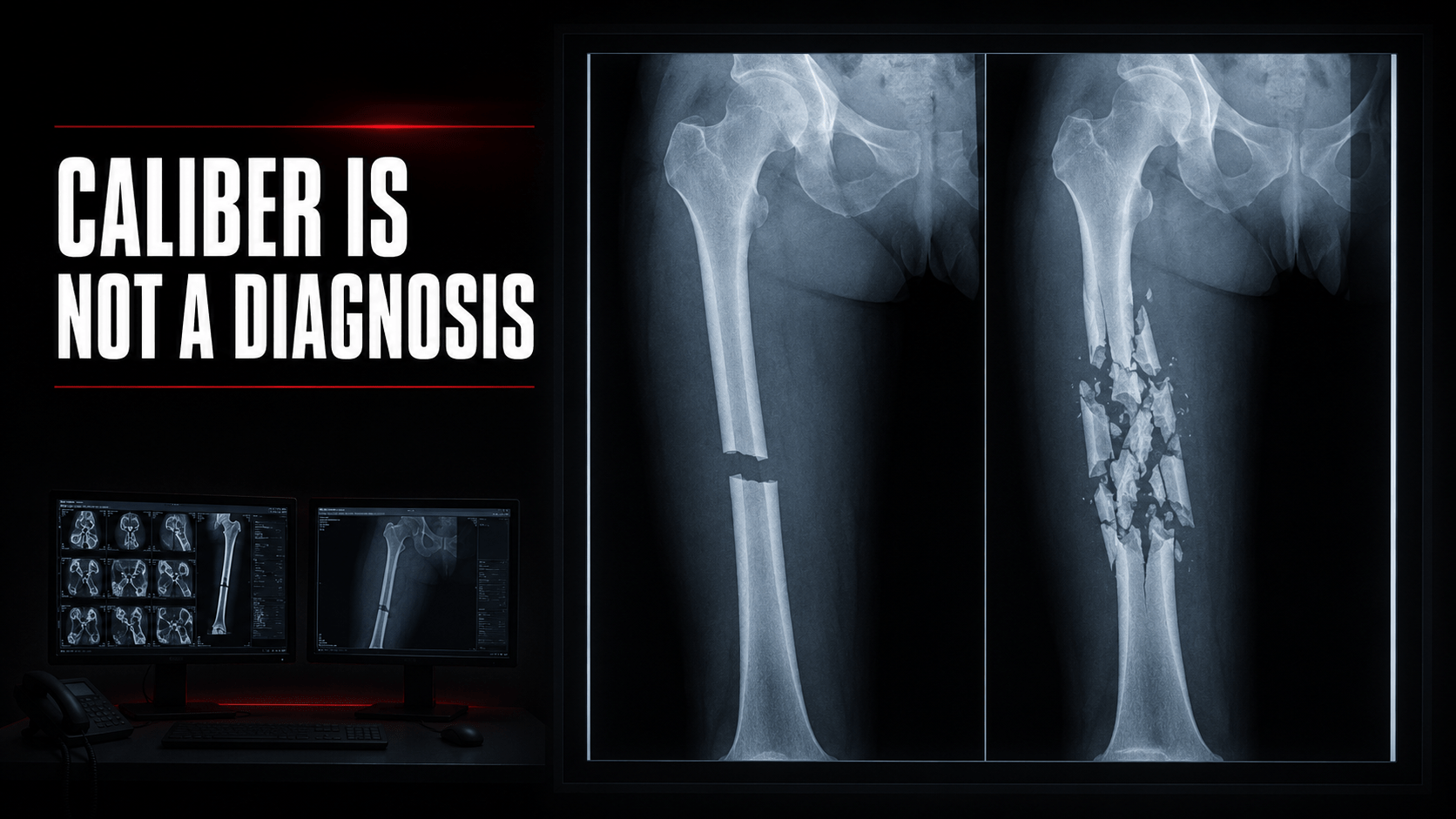
This distinction was made powerfully in a presentation by orthopedic surgeon and medical educator Dr. Chris Raynor: two projectiles can strike the same type of bone and leave radically different surgical problems. One fracture may be comparatively simple to stabilize. Another may produce extensive comminution, devitalized tissue, bone loss, multiple operations, infection risk, and a recovery measured in years.
That is not anti-caliber. It is anti-nonsense.
1. “Shot Placement Is Everything” Is Incomplete
Shot placement matters. Of course it matters. Anatomy is not optional.
But “placement” is usually discussed as if the human body were a flat paper target. It is not. A gunshot creates a three-dimensional path through skin, fat, fascia, muscle, vessels, nerves, organs, and sometimes bone. Two entry wounds only centimeters apart can cross completely different structures and produce completely different outcomes.
The better term is wound path.
A wound path tells us what the projectile encountered, how it behaved after impact, how much energy it transferred, and which tissues were forced beyond their ability to recover. That is far more informative than caliber alone.
The serious variables include:
- Projectile mass and impact velocity
- Projectile shape and construction
- Impact angle
- Deformation, yaw, tumbling, or fragmentation
- Penetration depth
- Energy deposited along the wound path
- Tissue density and elasticity
- Bone contact
- Vascular and nerve involvement
- The viability of the surrounding soft-tissue envelope
Caliber is one variable inside that system. It is not the system.
2. The Two Main Wounding Mechanisms
Gunshot wound ballistics is often buried under jargon. The basic concept is not difficult.
Permanent cavity
The permanent cavity is the tissue physically crushed, cut, torn, or displaced beyond recovery along the projectile’s path. It is the lasting wound channel.
In many conventional handgun wounds, this direct track is the dominant injury mechanism. The projectile damages the structures it actually intersects. If that track crosses a major vessel, the result may be catastrophic. If it remains within less vulnerable soft tissue, the injury may be survivable and more localized.
The caliber label does not decide which structure was crossed.
Temporary cavity
The temporary cavity is the brief radial displacement of tissue surrounding the projectile path. Tissue is accelerated outward, stretched, compressed, and then moves back toward its original position.
This is where internet ballistics usually loses discipline.
A dramatic temporary cavity in slow-motion video is not automatically a matching volume of destroyed human tissue. Temporary displacement becomes permanent damage only when the affected tissue is stretched beyond its mechanical tolerance.
Elastic tissue may deform and recover. Less elastic, highly organized, dense, or confined tissue may tear, fracture, or rupture. The effect depends on the tissue, the projectile’s behavior, and the rate and location of energy transfer.
There is no honest universal velocity threshold that converts every temporary cavity into the same injury. Velocity matters, but velocity alone is not the mechanism.
3. Velocity Matters—But Energy Transfer Matters More
Kinetic energy is commonly expressed as:
[
E_k = \frac{1}{2}mv^2
]
Mass matters. Velocity matters even more because it is squared in the equation. That is basic physics.
But the projectile’s energy before impact is not identical to the energy deposited in tissue. A projectile can enter with substantial energy and exit carrying part of that energy away. Another may deform, yaw, fragment, or decelerate rapidly and deposit more energy over a shorter path.
In simple language: carrying energy and transferring energy are not the same thing.
The local force between the projectile and tissue—the resistance that slows the projectile along its path—helps determine the wound. Projectile profile, stability, construction, deformation, fragmentation, impact angle, and the material encountered all change that interaction.
This is why broad labels such as “high velocity” and “low velocity” can be useful for initial description but misleading when treated as a diagnosis. Two projectiles with different velocities can produce overlapping soft-tissue effects under some conditions. Two projectiles from the same nominal caliber can also produce very different wounds.
The ammunition box gives you a category. The wound path gives you the case.
4. Tissue Decides What Energy Becomes
The same physical load does not produce the same result in every material. Drop a tool onto a rubber mat and then onto a pane of glass. Same tool. Same gravity. Different response.
Human tissue behaves the same way.
Skeletal muscle, skin, lung, liver, brain, blood vessels, and cortical bone do not share the same density, architecture, tensile strength, or ability to stretch. A projectile passing through muscle may create a temporary cavity that partially collapses without leaving equivalent destruction throughout its full visual diameter. A similar energy-transfer event in brain, liver, spleen, or bone may produce substantially different damage.
This is why the statement “these two rounds do the same thing” is scientifically incomplete.
The correct response is simple:
Through what tissue?
Without that answer, the statement is marketing dressed as analysis.
5. Bone Changes the Entire Problem
Soft-tissue-only comparisons do not tell the whole story because bone is not just another soft medium.
When a projectile strikes bone, several things may occur:
- The projectile may deform, yaw, or fragment.
- The bone may crack into two major segments or shatter into many fragments.
- Energy may be transferred into surrounding muscle and connective tissue.
- Bone and projectile fragments may travel away from the primary path as secondary missiles.
- The blood supply and living tissue around the fracture may be stripped, crushed, or devitalized.
A relatively simple transverse fracture and a severely comminuted fracture are not variations of the same administrative problem. They are different biological and reconstructive realities.
A transverse fracture may leave two main segments that can be aligned and stabilized. A comminuted ballistic fracture may leave multiple fragments, missing bone, contaminated tissue, dead tissue, and a damaged soft-tissue envelope. Fixation is only one part of the problem. The surgeon must also preserve or restore the biology required for healing.
This is the point the caliber argument routinely misses: once bone fragments, the wound is no longer defined only by the original projectile.
The skeleton can create additional damaging fragments. The fracture can enlarge the zone of injury. Bone contact can alter the projectile’s behavior. A wound that looked simple in gelatin may become a complex orthopedic reconstruction in a living human being.
6. The Periosteum: Thin Tissue, Serious Consequences
The periosteum is a thin, vascular connective-tissue layer covering most external bone surfaces. Its inner cellular layer contains progenitor cells that contribute to new bone formation during fracture healing. Its vascular network also participates in supplying cortical bone and the healing callus.
It is not the bone’s only blood supply, and it should not be reduced to one fixed thickness across every age and anatomical location. But its clinical importance is not negotiable.
When the periosteum and surrounding soft tissue remain viable, the fracture retains critical biological resources for healing. When high-energy injury strips or devitalizes that tissue, fragments may lose blood supply. Dead or contaminated bone may require debridement. The resulting defect may demand staged reconstruction, bone grafting, specialized fixation, soft-tissue coverage, or other advanced procedures.
The hardware can hold a structure in place. It cannot make dead tissue alive.
That is why severe ballistic fractures may progress toward delayed union, nonunion, infection, bone loss, repeated surgery, and long-term disability. The X-ray shows the geometry. The tissue viability determines whether that geometry can become living bone again.
Survival is not the same as recovery.
7. Ballistic Gelatin Is Useful—and Incomplete
Ballistic gelatin is not fraudulent. It is a standardized tissue simulant used to compare projectile penetration, deformation, fragmentation, and cavity behavior under controlled conditions. It is valuable precisely because it removes many variables.
That is also its limitation.
Gelatin has no living blood supply. It has no periosteum, cortical bone, nerves, vessels, fascia, immune response, infection risk, or capacity to heal. It cannot reproduce the full mechanical and biological complexity of a human extremity, chest, abdomen, or skull.
Gelatin can answer questions such as:
- How deeply did this projectile penetrate under this test protocol?
- Did it expand, yaw, or fragment?
- Where did rapid deceleration and cavity formation occur?
- How did one loading compare with another in the same medium?
It cannot answer:
- Will this patient survive?
- Will the fracture unite?
- How much living bone remains?
- Will infection develop?
- Will the limb function normally two years later?
Gelatin shows projectile behavior in a repeatable medium. It does not predict an individual patient’s complete outcome.
Treating a gel block as a human body is not science. It is a category error.
8. The Hospital-Data Trap
One of the most provocative findings discussed in Dr. Raynor’s presentation comes from hospital registries. A 2024 propensity-score-matched study of intracranial gunshot wounds recorded in the National Trauma Data Bank reported lower in-hospital mortality among the matched long-gun group than the handgun group: 35% versus 43%.
Read the qualifier again: in-hospital mortality among patients recorded in a trauma database.
That does not prove that long guns are less lethal. It means that, within the selected group of patients who survived long enough to reach participating hospitals and met the study criteria, that statistical relationship appeared after matching measured variables.
People who die before transport or hospital admission are not represented in the same way. Intent, firing distance, wound trajectory, contact wounds, prehospital time, anatomical disruption, and treatment selection can also differ between groups. Propensity matching can reduce measured imbalance. It cannot convert retrospective registry data into a controlled human experiment.
This is a classic survivorship and selection problem.
The number is real. The lazy interpretation is not.
No ethical study will ever randomize human beings to identical anatomical gunshot wounds from different cartridges. The evidence will remain a combination of physics, validated simulants, animal and cadaveric research, imaging, operative findings, forensic examination, and observational trauma data—each with strengths and limitations.
Anyone claiming a precise universal multiplier for how much “worse” one caliber is than another is selling certainty the evidence does not provide.
9. What Responsible Firearms Owners and Instructors Should Learn
This is not an ammunition recommendation. It is a responsibility lesson.
First, stop teaching caliber mythology as if it were medical science. Cartridge selection can matter, but it does not replace competence, reliable equipment, lawful judgment, disciplined handling, and repeatable performance.
Second, stop using gelatin as a complete model of the human body. Use it for the questions it can answer. Do not force it to answer questions it cannot.
Third, understand that every projectile creates consequences beyond a hole in paper. A miss, an unintended discharge, or a poorly justified shot is not an abstract training error. It can mean hemorrhage, nerve damage, shattered bone, infection, repeated reconstruction, permanent disability, legal exposure, and a life changed in milliseconds.
Fourth, firearms instruction must remain grounded in accountability. Training is not entertainment. It is not costume-driven performance. It is the disciplined development of safe gun handling, judgment, marksmanship, decision-making, and lawful restraint.
You own every round.
Not only when it leaves the muzzle. You own its path, its consequence, and the decision that launched it.
The Bottom Line
Caliber matters. It is simply not enough.
Real gunshot wound ballistics depends on projectile behavior, impact conditions, energy transfer, wound path, tissue elasticity, anatomy, bone contact, vascular injury, contamination, and the biological capacity to heal.
The permanent cavity matters. The temporary cavity can matter. Bone can change everything. The periosteum and soft-tissue envelope can separate a repairable fracture from a prolonged reconstruction. Hospital statistics can illuminate patterns, but they can also mislead anyone who ignores who never entered the dataset.
The internet wants a winner in the caliber war.
Science refuses to give it one.
The human body is not a gel block. A caliber is not a diagnosis. And surviving the wound is not the same as getting your life back.
Train often. Train smart. Train proudly.
Scientific References
- Petrone P, Dagnesses-Fonseca JO, Marín-Garcia J, McNelis J, Marini CP. Principles of wound ballistics and their clinical implications in firearm injuries. European Journal of Trauma and Emergency Surgery. 2025;51:101. https://doi.org/10.1007/s00068-025-02777-y
- Baum GR, Baum JT, Hayward D, MacKay BJ. Gunshot wounds: Ballistics, pathology, and treatment recommendations, with a focus on retained bullets. Orthopedic Research and Reviews. 2022;14:293–317. https://doi.org/10.2147/ORR.S378278
- Bartlett CS, Helfet DL, Hausman MR, Strauss E. Ballistics and gunshot wounds: Effects on musculoskeletal tissues. Journal of the American Academy of Orthopaedic Surgeons. 2000;8(1):21–36. https://doi.org/10.5435/00124635-200001000-00003
- Santucci RA, Chang YJ. Ballistics for physicians: Myths about wound ballistics and gunshot injuries. The Journal of Urology. 2004;171(4):1408–1414. https://doi.org/10.1097/01.JU.0000103691.68995.04
- Carr DJ, Stevenson T, Mahoney PF. The use of gelatine in wound ballistics research. International Journal of Legal Medicine. 2018;132(6):1659–1664. https://doi.org/10.1007/s00414-018-1831-7
- Penn-Barwell JG, Brown KV, Fries CA. High velocity gunshot injuries to the extremities: Management on and off the battlefield. Current Reviews in Musculoskeletal Medicine. 2015;8(3):312–317. https://doi.org/10.1007/s12178-015-9289-4
- Wang T, Zhang X, Bikle DD. Osteogenic differentiation of periosteal cells during fracture healing. Journal of Cellular Physiology. 2017;232(5):913–921. https://doi.org/10.1002/jcp.25641
- Karger B. Penetrating gunshots to the head and lack of immediate incapacitation. I. Wound ballistics and mechanisms of incapacitation. International Journal of Legal Medicine. 1995;108:53–61. https://doi.org/10.1007/BF01369905
- Jiang SH, Marotta D, Molina Neves T, Bhaskara M, Mehta AI. Comparison of in-hospital mortality and neurosurgical intervention between intracranial gunshot wounds arising from long guns and handguns: A propensity score matched study. Neurosurgery. 2024;95(4):825–833. https://doi.org/10.1227/neu.0000000000002937
- Deng H, Yue JK, Winkler EA, et al. Adult firearm-related traumatic brain injury in United States trauma centers. Journal of Neurotrauma. 2019;36(2):322–337. https://doi.org/10.1089/neu.2017.5591
Educational disclaimer
This article is for education only. It is not medical advice, a substitute for emergency care, or tactical guidance. Any suspected gunshot wound is a medical emergency: contact emergency services and follow care instructions from qualified professionals.