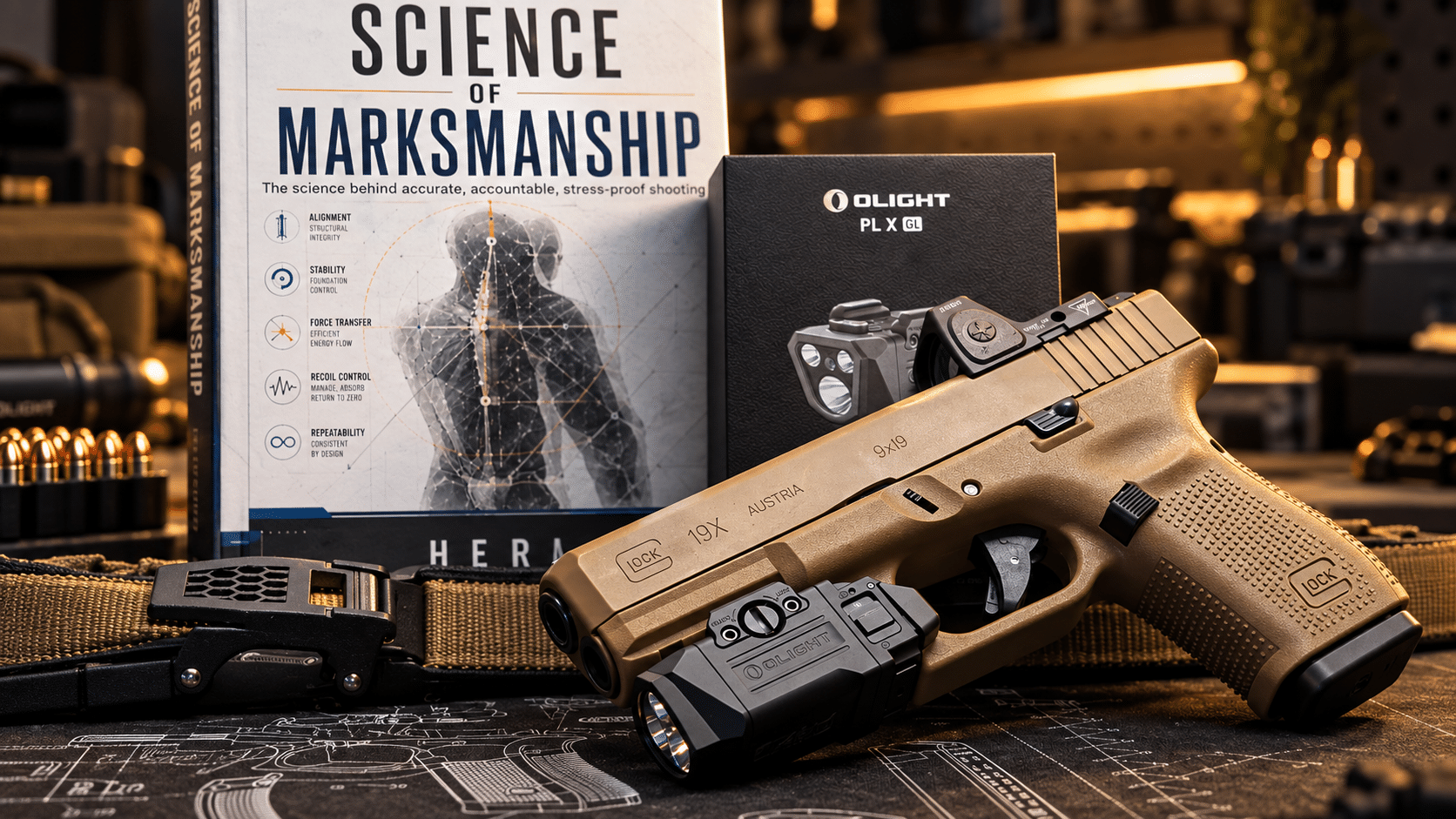
A Better PL-X—or a Compromise With a Green Laser?
Adding a laser does not automatically make a weapon light better. Sometimes it just gives marketing another bullet point.
That was my first concern when Olight released the PL X GL.
I reviewed the original PL-X and liked it for a very simple reason: it made sense. It was compact, powerful, easy to operate, USB-C rechargeable, and gave the shooter both flood illumination and a concentrated spotlight without turning the pistol into an electronics project.
Now Olight has added a green aiming laser.
The question is not whether the PL X GL has more features.
It does.
The question is whether those features actually improve the platform.
My answer?
Mostly yes—but not without a tradeoff.
WHAT CHANGED?
The new PL X GL combines three capabilities inside essentially the same compact platform:
- 1,200-lumen flood beam
- 900-lumen, 16,900-candela spotlight with a rated 260-meter throw
- Adjustable Class 3R green laser
The laser can operate independently or together with either white-light beam. The light also retains USB-C charging, ambidextrous activation and compatibility with Glock-style and 1913 rails.
That is a lot of capability packed into a weapon light weighing roughly three ounces.
But more capability does not automatically mean better equipment.
THE GREEN LASER: USEFUL TOOL OR TACTICAL JEWELRY?
Let’s kill one myth immediately.
A laser will not fix bad shooting.
If your grip is unstable, your trigger press is garbage and you cannot manage the pistol under stress, the green dot simply gives you a brighter visual demonstration of your mistakes.
But that does not make the laser useless.
A visible green laser can provide an additional aiming reference when normal sight alignment becomes difficult, when shooting from unconventional positions, or under certain low-light conditions.
That has legitimate value.
Green is also highly visible to the human visual system under many lighting conditions, which can make the aiming reference fast to locate.
But understand the hierarchy.
The laser helps you aim.
The white light helps you determine whether you should be aiming a gun at something in the first place.
Those are not the same job.
Threat identification comes first.
Always.
That is why a weapon-mounted light should never become an excuse to ignore proper low-light training.
THE REAL STRENGTH IS STILL FLOOD + SPOT
The most intelligent part of the PL-X platform was never the lumen number.
It was beam versatility.
The PL X GL retains that advantage.
Flood illumination gives you environmental information—rooms, hallways, vehicle interiors and peripheral areas.
The spotlight concentrates intensity farther downrange.
One gives you context.
The other gives you reach.
And that matters because lumens alone tell only part of the story.
Everybody loves advertising 1,000-plus lumens.
Wonderful.
What does the beam actually do?
That is the question serious users should ask.
HERE IS THE COMPROMISE OLIGHT SHOULD NOT GET A FREE PASS ON
The original PL-X we reviewed was rated at a 300-meter throw.
The new PL X GL spotlight is rated at approximately 260 meters and 16,900 candela. The original PL-X was published at roughly 22,500 candela and 300 meters.
So no—the GL is not simply:
“PL-X + laser = automatically better.”
You gain the laser.
You surrender some spotlight intensity and theoretical reach.
That is the trade.
And frankly, I respect the product more when we acknowledge it rather than pretending engineering has suddenly discovered free space.
The laser aperture occupies real estate inside a very compact optical system.
Something had to give.
Is the reduction significant for most defensive handgun users?
Probably not.
A 260-meter published throw is already dramatically farther than the overwhelming majority of realistic defensive pistol applications.
But specifications matter, and consumers deserve to know what changed.
Never confuse “newer” with “better.”
Determine what capability matters to you.
THE CONTROLS DID NOT BECOME STUPID
This is where Olight could have destroyed the product.
Add another emitter.
Add more switches.
Add twelve operating modes.
Then make the owner memorize a video-game cheat code just to turn the damn thing on.
Fortunately, they did not.
The PL X GL separates the controls logically.
One selector determines light, laser, or light + laser.
Another selects flood or spot.
The familiar ambidextrous rear controls operate the system without requiring a major change in grip.
Good.
Defensive equipment should be simple enough to operate when your heart rate is elevated and your attention is somewhere considerably more important than remembering button sequences.
Complicated equipment usually becomes stupid equipment under stress.
USB-C STILL GETS MY VOTE
Olight retained USB-C charging.
Thank you.
I do not need another proprietary charging cable breeding inside my range bag.
USB-C gives you far more practical charging options from vehicles, battery banks, computers and common power adapters.
But rechargeable does not mean maintenance-free.
If this light is mounted on a defensive firearm, checking battery condition should become part of your normal equipment inspection.
You check ammunition.
You check your optic.
You check mounting hardware.
Check the damn light.
Maximum-output modes also step down as the system manages heat and battery demand, so do not read “1,200 lumens” and assume the light produces that output indefinitely. Published operating tables show the higher-output modes stepping down after several minutes.
That is normal thermal management.
It is also something buyers should understand.
FIT, SIZE AND HOLSTERS MATTER MORE THAN INTERNET COMMENTS
The PL X GL remains exceptionally compact at roughly 2.48 × 1.18 × 1.24 inches and approximately 3.1 ounces according to published specifications.
That matters.
Put enough accessories on a handgun and eventually you are carrying a cordless drill.
The PL-X platform works particularly well because the housing does not overwhelm compact defensive pistols.
But verify holster compatibility before buying.
Not afterward.
Your pistol, optic, light and holster are a system.
Treat them like one.
THE VERDICT
The Olight PL X GL is not revolutionary.
Good.
I am tired of everything in the firearms industry supposedly being revolutionary.
What it is, however, is a thoughtful evolution of an already impressive compact weapon light.
You get excellent flood illumination.
You get a concentrated spotlight.
You get straightforward controls.
You get USB-C charging.
And now you get a visible green aiming laser without dramatically increasing the physical footprint of the system.
But you also give up some of the original PL-X’s maximum spotlight intensity and reach.
That matters.
Not because 260 meters is inadequate—it isn’t.
It matters because serious equipment reviews should discuss compromises instead of repeating advertisements.
My conclusion:
If maximum candela and maximum spotlight performance are your priorities, the original PL-X remains extremely compelling.
If you want a compact system combining flood, spot and a useful secondary aiming reference, the PL X GL is the more versatile package.
Just don’t buy it because it has a green laser.
Buy it because you understand what that laser adds—and what you traded to get it.
And please remember:
A laser does not make you trained.
A weapon light does not make you tactically competent.
And expensive equipment does not repair cheap fundamentals.
Equipment supports skill.
It never replaces it.
Train Often. Train Smart. Train Proudly.