USCCA INSTRUCTOR CERTIFICATION: WHAT DOES IT REALLY TAKE TO EARN THE CREDENTIAL?
TWO DAYS. LIMITED RANGE TIME. THEN THE WORD “INSTRUCTOR.”
USCCA instructor certification is marketed as a pathway to teaching concealed carry and home-defense fundamentals. But what does the actual instructor qualification establish?
USCCA calls its instructors “professional-grade.”
It says its certification involves “rigorous multi-day training” and declares that “only the best” earn the USCCA Instructor shirt.
Those are powerful claims.
So we looked at the actual training being advertised.
And the public deserves to see what we found.
THE TWO-DAY INSTRUCTOR PIPELINE
USCCA’s own website describes its Concealed Carry and Home Defense Fundamentals Instructor Certification as a:
“2-Day Classroom Instruction Course With Range Qualification.”
Current certification classes listed directly on USCCA’s platform show examples of:
16 classroom hours. 1 hour of range time.
16 classroom hours. 2 hours of range time.
Another Florida listing advertises:
13 classroom hours. 2 hours of range time.
And after successfully completing the program?
You become a:
USCCA CERTIFIED INSTRUCTOR.
Read that again.
Someone can enter a two-day program without already being a professional firearms instructor and emerge authorized to teach USCCA’s concealed-carry and home-defense curriculum.
That is not speculation.
That is the program being advertised.
NOW LOOK AT THE SHOOTING STANDARD.
This is where the investigation gets uncomfortable.
Some circulated descriptions reference a 70% instructor passing score, but this investigation has not independently verified that figure as a current official USCCA standard. It should not be treated as an established national requirement.
The 70% figure remains unverified.
Separately, an individual instructor’s profile hosted on USCCA’s platform describes:
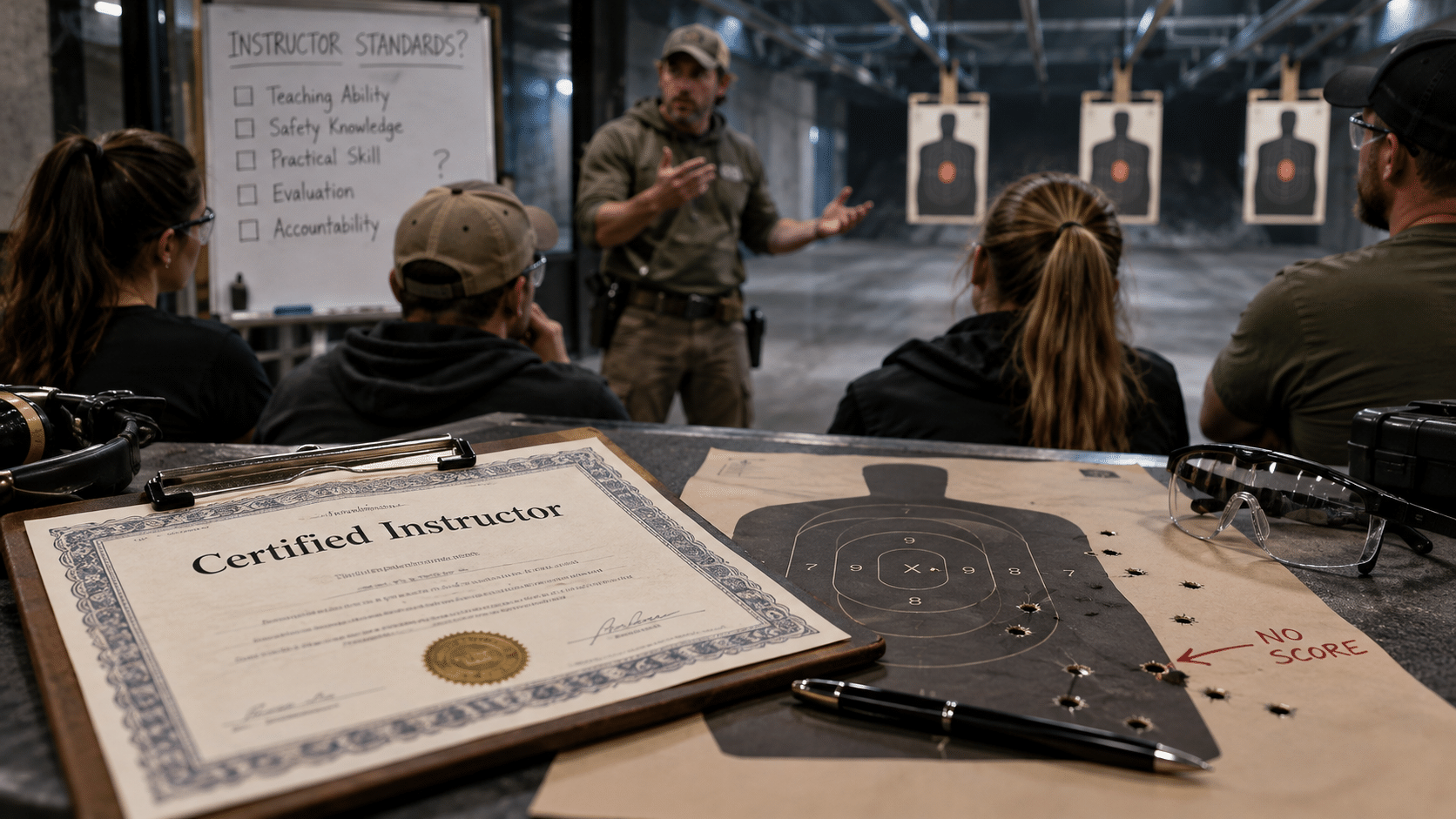
50 rounds. 80% to pass.
An older published USCCA instructor qualification document used by an instructor provider specifies 40 hits out of 50, an 80% passing standard, with one re-shoot permitted.
So what exactly is the current national instructor shooting standard?
70%?
80%?
Something else?
USCCA’s main public “Become an Instructor” page describes a range qualification—but does not publish the passing score on that page.
For an organization marketing “professional-grade” firearms instructors, that is a question worth answering clearly.
IF IT’S 80%, HERE’S THE MATH.
50 rounds.
40 required hits.
10 rounds can fail to meet the scoring requirement.
And the candidate can still meet an 80% accuracy threshold.
Let’s be accurate: that does not prove all ten rounds completely missed the paper.
It means they did not produce qualifying hits.
But we’re not evaluating a beginner.
WE’RE EVALUATING THE INSTRUCTOR.
The person who may soon be standing in front of paying gun owners teaching them how to handle lethal weapons.
If an instructor candidate cannot be held to an exceptionally high shooting standard, who exactly should be?
CERTIFIED IS NOT LICENSED.
This is another distinction consumers rarely hear.
A USCCA instructor certification is a private organizational credential.
It is not inherently a state professional license.
Florida provides a useful comparison.
Anyone providing classroom and range instruction to applicants for Florida’s armed-security Class “G” license must hold a Class “K” Firearms Instructor License.
Florida requires qualifying professional credentials and successful completion of a state firearms-instructor examination.
And Florida’s Class G students themselves undergo 28 hours of required instruction, including legal material, firearms safety and mechanical training, and a firearms qualification involving 144 rounds during initial training.
To be clear: Florida does not require every civilian firearms instructor to hold a Class K license.
But the comparison exposes something the public needs to understand:
CERTIFICATION AND LICENSURE ARE NOT THE SAME THING.
Neither are certification and experience.
Neither are certification and mastery.
THE BIGGER PROBLEM: FALSE CONFIDENCE
This isn’t about hurting somebody’s feelings.
It’s about what happens after the certificate is issued.
An inexperienced instructor can influence dozens, hundreds, potentially thousands of gun owners.
And bad instruction doesn’t merely create poor technique.
It can create false confidence.
A student walks away believing:
“I’ve been trained.”
Then carries a loaded firearm into a vehicle, restaurant, store or home.
If that confidence exceeds the person’s actual ability, judgment or understanding of the law, the consequences can become very real, very quickly.
Injury.
Death.
Criminal prosecution.
Civil litigation.
Destroyed families.
Firearms instruction is not a weekend side hustle.
THE QUESTION USCCA SHOULD ANSWER
USCCA publicly says its instructors are “professional-grade.”
Fine.
Then publish the standard prominently.
Tell consumers:
Exactly how many hours of hands-on firearms training are required?
Exactly what shooting score is required?
Exactly what target is used?
What distances?
Is it timed?
How many attempts are permitted?
What prior instructional experience is mandatory?
What continuing firearms education is mandatory?
How often must instructors demonstrate shooting competency again?
And if current USCCA-hosted pages are advertising different passing scores—
EXPLAIN WHY.
Those aren’t hostile questions.
Those are questions any serious profession should welcome.
HERE’S WHAT THE PUBLIC SHOULD ASK THEIR INSTRUCTOR.
Don’t ask only:
“Are you certified?”
Ask:
Certified by whom?
Against what standard?
How much experience did you have before certification?
Are you professionally licensed where applicable?
What additional instructor credentials do you possess?
How often do you requalify?
Can you explain negligence, civil liability and use-of-force law?
And perhaps the most important question:
WHAT QUALIFIED YOU TO TEACH BEFORE SOMEONE PRINTED THE CERTIFICATE?
Because after examining the public record, one thing is absolutely clear:
A USCCA certificate proves someone successfully completed USCCA’s certification process.
It does not, standing alone, prove decades of experience.
It does not prove professional licensure.
It does not prove advanced firearms mastery.
And it should never prevent consumers from asking harder questions.
TWO DAYS.
LIMITED RANGE TIME.
A SHORT QUALIFICATION.
THEN “CERTIFIED FIREARMS INSTRUCTOR.”
USCCA wants the public to see the title.
We think the public should see the standard behind it.
Because when firearms are involved, credentials should never receive automatic respect simply because the certificate looks impressive.
SHOW US THE STANDARD.
SHOW US THE PERFORMANCE.
THEN LET THE PUBLIC DECIDE WHAT “PROFESSIONAL-GRADE” REALLY MEANS.
Florida law: certification, licensing, and acceptable training are different questions
Florida law makes an important distinction. A USCCA instructor credential is a private program certification; it is not, by itself, a Florida Class K firearms-instructor license. Under FDACS Class K requirements, instructors providing classroom and range instruction to Class G applicants must hold a Class K license. The Class G program has its own prescribed training requirements.
For civilian concealed weapon licensing, Florida Statutes section 790.06(2)(h) provides multiple ways of demonstrating firearm competency, including certain courses taught by appropriately certified instructors. The statute does not name USCCA as a certifying organization. That absence alone does not establish that every course taught by a USCCA-certified instructor is unacceptable; eligibility depends on the applicable statutory pathway, the instructor’s other qualifications, the instruction delivered, and the documentation. See FDACS’s acceptable training documentation guide.
What this investigation verifies—and what remains unverified
USCCA’s public instructor certification overview describes a two-day classroom course with a range qualification. A specific Florida course listing advertises 16 classroom hours and two range hours; individual course advertisements should not be treated as proof of the national minimum. The 70% and 80% passing figures discussed above require confirmation from the current official qualification rubric. As of this review, Valortec has not established a universally applicable current USCCA national passing score from that public overview. The 80% calculation in this article is therefore an illustration, not proof that every candidate nationally may miss ten scoring hits.
For questions about corrections, sources, or the distinction between our analysis and documented requirements, see Valortec’s Editorial & AI Use Policy. For the author’s background, see Herfel Torres’s instructor profile.
Primary Sources and Further Reading
- USCCA: Become a Firearms Instructor — published course overview
- USCCA-hosted Florida instructor course listing — advertised classroom and range hours
- Florida FDACS: Class K Firearms Instructor License Requirements
- Florida FDACS: Class G Statewide Firearm License Requirements
- Valortec: USCCA Instructor Certification Qualification Standards
- Valortec: USCCA Instructor Credentials and Florida Law
- USCCA-hosted instructor profile — individual description of a 50-round, 80% qualification
- Armed2Defend qualification guide (November 2025 PDF) — instructor-provider publication, not an official current national USCCA policy statement
- Florida Senate: section 790.06, concealed weapon licensing and evidence of firearm competency