

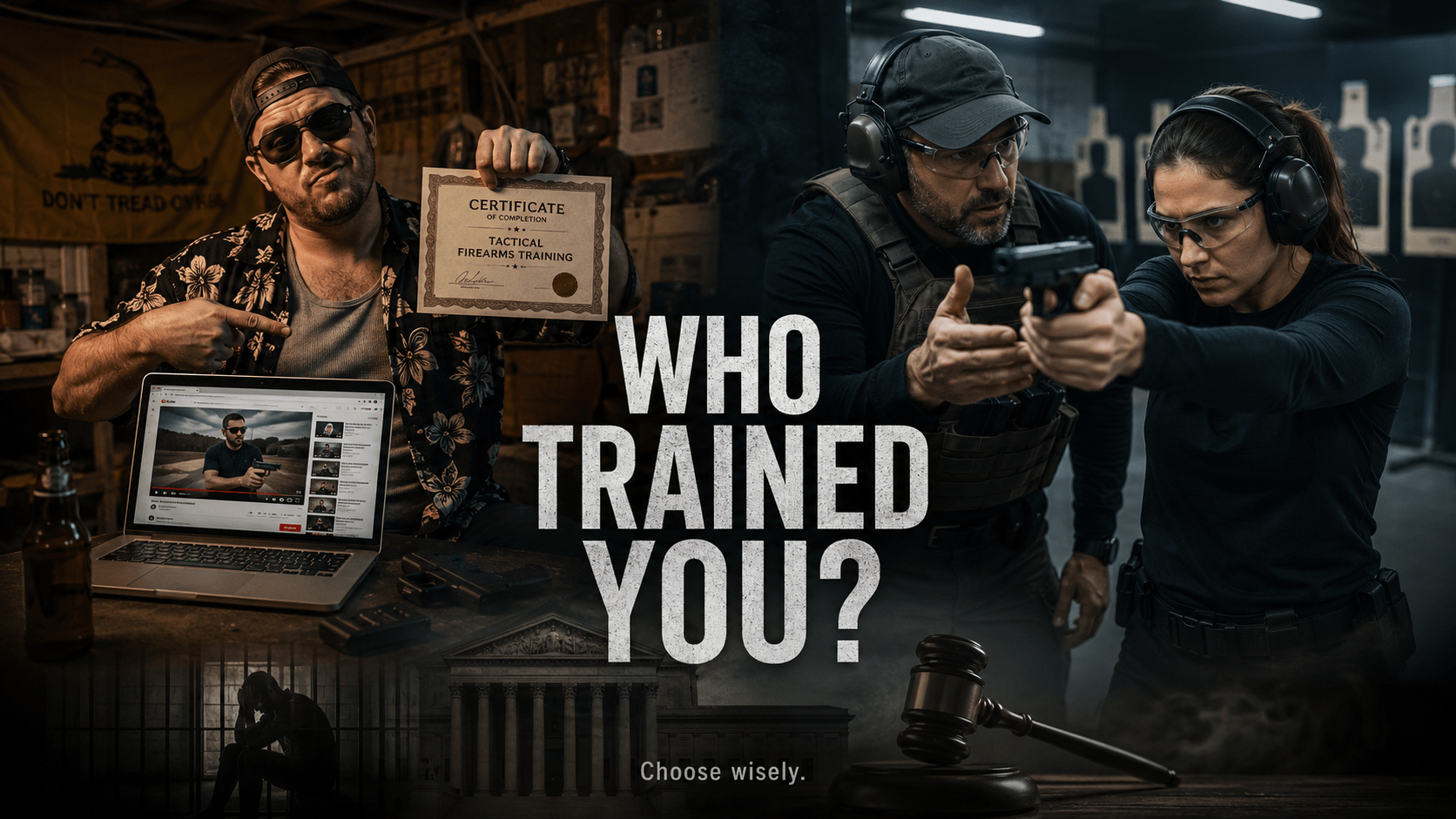
Who Trained You? The Firearms Instructor You Choose Can Cost You Your Freedom
Would you let a YouTube-trained surgeon operate on your heart?
Then why would you let a weekend-certified firearms instructor teach you decisions that could put you in prison?
That question should make every responsible gun owner uncomfortable. It should also make every so-called firearms instructor with a two-day certificate taped to the wall take a hard look in the mirror.
Because firearms training is not entertainment. It is not a hobby with a holster. It is not a weekend business opportunity for people who watched a few videos, attended a short course, bought a polo shirt, and suddenly started calling themselves “instructors.”
Firearms training is a high-liability profession.
When a student leaves a class believing they are prepared to carry a firearm in public, they are not just carrying a weapon. They are carrying decisions. They are carrying legal exposure. They are carrying the possibility that one misunderstood lesson, one poorly explained concept, one reckless drill, or one fantasy-based use-of-force statement could destroy their life.
The wrong instructor can do more than waste your money.
The wrong instructor can give you false confidence.
And false confidence with a firearm can get someone injured, get someone killed, or send a decent citizen to jail for a very long time.
The YouTube Surgeon Problem
Imagine this.
A loved one needs brain surgery. The procedure is delicate. One mistake can cause permanent damage or death. The surgeon walks into the room and says, “Don’t worry. I watched a lot of videos, took a weekend class, and got this certificate from a company that sells medical insurance.”
Would you stay in that hospital?
Of course not.
You would demand a real surgeon. You would want education, licensing, residency, experience, supervision, case history, accountability, and proof that this person has spent years learning how to operate under pressure.
Now apply that same logic to firearms training.
A firearm is a tool that exists inside a legal system. Every defensive decision must survive more than the range. It must survive law enforcement questioning, prosecutor review, civil liability, expert analysis, and potentially a courtroom.
So why would anyone trust their legal future to a part-time instructor whose authority came from a weekend certificate sold through a marketing machine?
That is not professional instruction.
That is a liability factory.
A Certificate Is Not Competence
There is a difference between a certificate and competence.
A certificate can prove attendance. It can prove that someone paid a fee. It can prove that someone completed a class.
It does not automatically prove that the person understands use of force. It does not prove they can teach civilians. It does not prove they understand the difference between military engagement, law enforcement policy, armed security duties, and civilian self-defense law.
It does not prove they understand liability.
It does not prove they can explain why deadly force may be justified in one situation and criminal in another.
It does not prove they know how to keep students safe.
And it definitely does not prove they are ready to teach others how to make life-altering decisions under stress.
A firearms instructor who cannot explain the law has no business selling defensive firearms training.
A firearms instructor who cannot explain liability has no business teaching civilians.
A firearms instructor who teaches confidence without accountability is not empowering students. He is endangering them.
Firearms Training Is Not Just Shooting
This is where the industry has misled the public.
Too many people think firearms training is about shooting tight groups on paper. Too many instructors promote fast draws, tactical-looking drills, and range theatrics while completely ignoring the legal aftermath of force.
But defensive firearms training is not just shooting.
It is judgment.
It is restraint.
It is decision-making.
It is target identification.
It is knowing when not to touch the gun.
It is understanding that the moment a firearm appears, everything changes.
The student must understand that the gun does not solve the legal problem. In many cases, the gun creates the legal problem.
If the instructor never teaches that, the student is being trained for fantasy, not reality.
The real world has police reports.
The real world has prosecutors.
The real world has grieving families.
The real world has civil attorneys.
The real world has expert witnesses.
The real world has judges and juries who do not care how many social media followers your instructor had.
They will care about what you did, why you did it, what you believed, whether that belief was reasonable, and what kind of training shaped your decision.
That is where bad training comes back to haunt you.
False Confidence Is Dangerous
The most dangerous student is not always the beginner.
The most dangerous student is often the one who took a poor class and now believes they are prepared.
That person has just enough exposure to feel confident, but not enough education to understand what they do not know.
They may know how to draw from a holster, but not when drawing becomes legally indefensible.
They may know how to shoot fast, but not how to articulate imminent threat.
They may know how to hit a target, but not how to recognize when the threat has ended.
They may know slogans, but not statutes.
They may know drills, but not consequences.
That is not training.
That is legal Russian roulette.
And the instructor who created that false confidence may not be standing next to the student when the handcuffs come out. But that instructor’s words, methods, lesson plans, safety failures, and qualifications can become part of the legal autopsy.
What did you teach?
Why did you teach it?
Were you qualified to teach it?
Did you know the law?
Did you warn the student about limitations?
Did you create a reckless mindset?
Did you encourage unnecessary confrontation?
Did you present deadly force as the answer to problems that legally required avoidance, de-escalation, or restraint?
Those questions matter.
The Courtroom Does Not Care About Your Marketing
Here is the brutal truth.
The courtroom does not care about your tactical logo.
The courtroom does not care about your social media videos.
The courtroom does not care about your “operator” vocabulary.
The courtroom does not care that you paid for a two-day instructor course and received a certificate with a shiny seal.
A courtroom cares about facts, training, conduct, foreseeability, negligence, credibility, and causation.
For the student, bad training can become evidence of poor judgment.
For the instructor, bad training can become evidence of negligence.
If you are teaching civilians, you are not just teaching mechanics. You are shaping decisions that may involve death, serious bodily injury, criminal prosecution, and civil litigation.
That brings responsibility.
That brings liability.
That brings exposure.
And for the paper instructor who believes a weekend certificate is a shield, reality may arrive in the form of subpoenas, depositions, lawsuits, expert reports, and criminal allegations.
That certificate you hold up like a Medal of Honor may become Exhibit A.
The Instructor’s Liability Problem
Firearms instructors need to understand something clearly.
You are not immune because you call yourself an instructor.
You are not protected because a marketing company gave you a certificate.
You are not safe because your waiver says students are responsible for themselves.
You are not untouchable because you teach part-time in a private yard, rented bay, club range, or informal environment.
If you provide instruction, you may be judged by the standard of what a reasonable, competent firearms instructor should know and do under similar circumstances.
That includes safety procedures.
That includes curriculum design.
That includes student screening.
That includes range supervision.
That includes legal accuracy.
That includes the foreseeable consequences of what you teach.
If you tell students nonsense, and they act on that nonsense, you may have a problem.
If you teach aggressive gun-handling without legal restraint, you may have a problem.
If you run unsafe drills beyond your knowledge, you may have a problem.
If you present civilian self-defense like military engagement or law enforcement intervention, you may have a problem.
If you cannot explain use of force, negligent entrustment, vicarious liability, and the legal limits of deadly force, you should stop teaching defensive firearms classes until you can.
Because ignorance is not a defense strategy.
It is usually the beginning of the lawsuit.
Military or Law Enforcement Experience Is Not Enough
This also needs to be said.
Military experience does not automatically make someone qualified to teach civilians.
Law enforcement experience does not automatically make someone qualified to teach civilians.
Competitive shooting experience does not automatically make someone qualified to teach civilians.
Those backgrounds can be valuable. They can provide discipline, weapons familiarity, stress exposure, and operational insight.
But civilian self-defense exists in a different legal environment.
Civilians do not have military rules of engagement.
Civilians do not have law enforcement authority.
Civilians do not have arrest powers.
Civilians do not have agency policy protection.
Civilians do not get qualified immunity because they watched a tactical video.
A civilian who carries a firearm must understand civilian law, civilian liability, civilian limitations, and civilian consequences.
An instructor who cannot separate those worlds is dangerous.
The problem is not experience.
The problem is misapplied experience.
The problem is when someone teaches civilians to think like they are on a mission instead of teaching them how to survive legally as private citizens.
That is how people end up making catastrophic decisions.
The Student’s Responsibility
The public also has responsibility.
You have the freedom to choose where you train. But that freedom does not remove the consequences of choosing poorly.
Before you give someone money, ask hard questions.
Is this instructor licensed or recognized by the appropriate authority for the type of training being offered?
Can the instructor explain use of force in your state?
Can the instructor explain the difference between force and deadly force?
Can the instructor explain when a threat ends?
Can the instructor explain what happens after a defensive shooting?
Can the instructor explain civil liability?
Can the instructor explain what their course does not qualify you to do?
Can the instructor teach safety, judgment, restraint, and articulation — or only shooting?
Can the instructor demonstrate what they teach?
Can the instructor explain why they teach it?
Can the instructor show real experience beyond a certificate?
If the answer is no, walk away.
Cheap training can become very expensive.
Convenient training can become legally disastrous.
Entertaining training can become life-altering.
A firearm is not a toy, and a firearms class is not a social event. It is education that may influence the most consequential decision of your life.
Choose accordingly.
The Instructor’s Warning
To the so-called instructors: this is your warning.
If your entire professional identity depends on a short certificate from a company better known for marketing, memberships, insurance products, and instructor recruitment than serious professional standards, you need to rethink what you are doing.
If your business model depends on turning students into instructors as fast as possible, you are not building a profession.
You are building a pyramid of liability.
If you cannot explain the law, stop teaching defensive law.
If you cannot explain liability, stop pretending you understand consequences.
If you cannot demonstrate what you teach, stop selling performance.
If you cannot keep students safe, stop renting range time.
If you do not know what negligent entrustment means, learn it before someone else’s attorney teaches it to you in a deposition.
If you do not understand vicarious liability, stop acting like your paper certificate makes you bulletproof.
Because when something goes wrong, the marketing company may not be the one sitting in the chair answering questions.
You will be.
Demand Better
Responsible gun ownership requires more than owning a firearm.
It requires education.
It requires humility.
It requires judgment.
It requires knowing that every round you fire has a legal, moral, and human consequence.
The Second Amendment deserves better than diploma mills.
Students deserve better than paper instructors.
The public deserves better than false confidence sold as training.
And the firearms training profession deserves better than people who confuse certification with mastery.
If you are a student, do your research.
If you are an instructor, raise your standard.
If you are in the industry, stop protecting incompetence because it is profitable.
Bad firearms training is not harmless.
It creates liability.
It creates danger.
It creates false confidence.
And in the wrong moment, it can create a defendant.
So ask the question before you take the class.
Ask it before you trust the instructor.
Ask it before you carry a firearm in public believing you are prepared.
Who trained you?
Because one day, a prosecutor, plaintiff’s attorney, investigator, judge, or jury may ask the same thing.
And by then, the answer may determine your freedom.
Train With Accountability
At Valortec, firearms training is treated as a serious, high-liability discipline.
We do not teach fantasy. We do not sell false confidence. We do not pretend that a firearm solves every problem.
We teach responsible gun owners, security professionals, and serious students how to train with discipline, legal awareness, judgment, and measurable performance.
If you are going to carry a firearm, train like your freedom depends on it.
Because it does.
Visit Valortec.com and choose training built on responsibility, science, law, and accountability.


