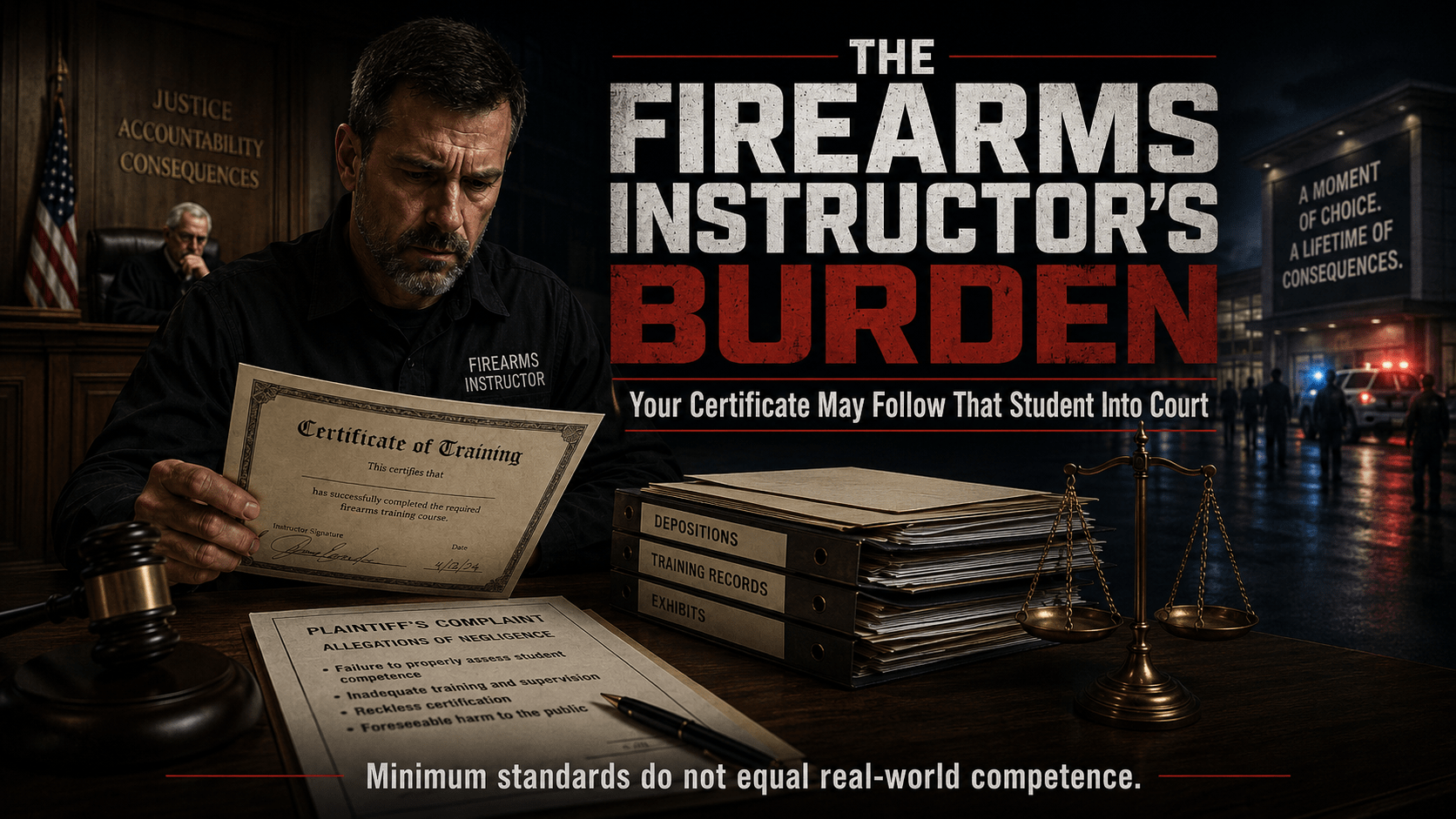
Minimum firearms training standards are not enough when public safety is on the line.
Every firearms instructor should ask one brutal question before signing another certificate:
Would I trust this student with a loaded firearm around my own family?
Not on a controlled range.
Not under perfect lighting.
Not standing still, shooting paper, while everyone knows when the drill begins and ends.
I mean in the real world.
A crowded mall.
A church service.
A gas station robbery.
A parking lot confrontation.
A violent attack where people are screaming, moving, falling, running, and making decisions under fear, confusion, and adrenaline.
That is where your student may one day stand.
And when that day comes, your certificate may follow them.
So may your name.
So may your training standards.
So may your curriculum.
So may every claim you ever made about preparing people to carry, defend, protect, or respond with a firearm in public.
This is the uncomfortable truth too many firearms instructors avoid:
A certificate is not just paper. It can become evidence.
The Dangerous Illusion of “Qualified”
A student comes through your firearms class.
They meet the minimum passing requirement. Maybe that requirement comes from a state agency. Maybe it comes from an association. Maybe it comes from a basic concealed carry class, an NRA course, a USCCA course, or another entry-level firearms certification program.
They pass.
You sign.
They leave.
And in their mind, something changes.
They are now “trained.”
They are now “qualified.”
They now believe they can carry a firearm in public and use it effectively if violence appears in front of them.
But here is the problem:
Minimum passing requirements do not equal real-world competence.
Minimum is not judgment.
Minimum is not stress control.
Minimum is not decision-making.
Minimum is not legal understanding.
Minimum is not target identification.
Minimum is not bystander awareness.
Minimum is not the ability to process chaos while holding a deadly weapon.
Minimum is only the lowest line someone was allowed to cross.
That may satisfy a form.
It may satisfy a basic class requirement.
It may satisfy a certificate program.
But it does not satisfy reality.
And reality does not care about your certificate template.
The Moment Everything Changes
Now put someone you love into the situation.
There is an active shooter at a mall.
An armed attack inside a church.
A robbery unfolding inside a business.
Your former student is there.
So is your wife.
Your husband.
Your child.
Your parent.
Your friend.
Someone whose life matters more than your reputation, your business, your class photo, your online image, or your instructor ego.
Your student decides to act.
They draw their firearm.
They believe they are ready because you passed them.
They believe they can control the situation because you gave them a certificate.
They believe they can make a deadly-force decision because someone told them they were trained.
Then the real world hits.
They miss.
They panic.
They misread the threat.
They lose muzzle discipline.
They fail to understand angles.
They do not see what is behind the target.
They cannot process movement.
They cannot manage adrenaline.
They do not understand when they are legally justified to shoot.
They do not understand when not to shoot.
They fire under pressure.
And the person they injure or kill is someone you love.
Now answer honestly:
How do you feel knowing you were the firearms instructor who signed off on that student?
How do you feel knowing your training may have created the confidence that placed that person into motion?
How do you feel knowing your certificate may now be sitting inside an evidence file?
That is not drama.
That is responsibility.
Your Firearms Training May Be Examined in Court
Too many instructors act as if their responsibility ends when the class ends.
That is false.
Once a student uses a firearm in public, everything can be examined.
Their actions.
Their statements.
Their mindset.
Their training history.
Their certificates.
Their instructors.
Their curriculum.
Their qualification standards.
Their warnings.
Their understanding of use-of-force law.
Their ability to articulate why they acted.
And yes, the instructor who gave them confidence.
If there is a criminal investigation, civil lawsuit, wrongful injury claim, or wrongful death claim, the question may become very simple:
Who told this person they were trained?
That is when your certificate becomes more than a certificate.
That is when your signature becomes part of the record.
That is when your lesson plan may be reviewed.
That is when your training standards may be challenged.
That is when your website, advertisements, social media posts, class descriptions, and instructor claims may be placed under a microscope.
That is when an attorney may ask:
What exactly did you teach?
What did you fail to teach?
What did the student actually demonstrate?
Did you test judgment?
Did you test decision-making?
Did you test safe firearm handling under stress?
Did you explain the limits of the course?
Did you teach use-of-force law?
Did you document unsafe behavior?
Did you document deficiencies?
Did you pass the student because they were competent?
Or did you pass the student because they paid?
That is the courtroom question many firearms instructors are not ready to answer.
The Firearms Industry Has a Standards Problem
The firearms training industry does not need more certificate mills.
It does not need more instructors hiding behind minimum standards.
It does not need more fragile egos wearing range shirts and pretending that a basic course equals real-world preparation.
It does not need more people selling false confidence to students who do not yet understand what they do not know.
This is not about popularity.
This is not about class photos.
This is not about collecting students.
This is not about selling paper.
This is not about pretending every student is ready because failing them may hurt your reviews.
This is about public safety.
When you certify, approve, or validate a student’s firearm ability, you are influencing how that person sees themselves with a deadly weapon in public.
That influence matters.
A student who falsely believes they are ready may step into a situation they had no business entering.
That false confidence can injure innocent people.
It can kill innocent people.
It can destroy families.
It can turn a lawful gun owner into a defendant.
And it can come back to the instructor who helped create that confidence.
Firearms Instructor Responsibility Does Not End at the Range
If you teach firearms, your job is not simply to run a line and sign certificates.
Your job is to protect the student from ignorance.
Your job is to protect the public from false confidence.
Your job is to explain the limits of training.
Your job is to demand safe gun handling.
Your job is to teach accountability.
Your job is to make it painfully clear that carrying a firearm in public is not a fantasy, not a costume, and not a license to play hero.
A responsible firearms instructor must understand that every class has consequences.
What you teach matters.
What you ignore matters.
What you document matters.
What you fail to document matters.
What you advertise matters.
What you promise matters.
What you sign matters.
If a student leaves your classroom believing they are more capable than they truly are, that is not a small problem.
That is a public safety problem.
Minimum Standards Do Not Equal Real-World Competence
Minimum firearms training standards may have a place.
They may establish a baseline.
They may satisfy an administrative requirement.
They may allow a student to complete an entry-level course.
But no serious instructor should confuse minimum compliance with responsible competence.
A student may pass a basic firearms qualification and still be dangerously unprepared to carry a gun in public.
They may not understand how stress changes vision, hearing, movement, breathing, memory, and decision-making.
They may not understand how fast a public confrontation becomes legally complex.
They may not understand target identification.
They may not understand background risk.
They may not understand bystander danger.
They may not understand angles of fire in crowded spaces.
They may not understand when deadly force is legally justified.
They may not understand how quickly they can become the threat in the eyes of responding law enforcement.
And if you did not teach that, test that, document that, or clearly explain those limitations, then your job was not complete.
It was convenient.
And convenience has no place in serious firearms instruction.
False Confidence Is a Public Safety Risk
False confidence is dangerous because it feels like competence.
It sounds like competence.
It looks like competence to the untrained student.
But under pressure, false confidence collapses.
The student who looked acceptable on the range may fail in the parking lot.
The student who passed a slow-fire drill may panic during movement.
The student who shot a clean target may not recognize a lawful threat.
The student who smiled with a certificate may not understand what happens when a missed round strikes an innocent person.
That is why serious firearms training must go beyond basic marksmanship.
It must address judgment.
It must address legal accountability.
It must address stress.
It must address human performance.
It must address the reality that every bullet has a destination and every decision has consequences.
If you certify students without making that clear, you are not preparing them.
You are enabling them.
The Legal Exposure Instructors Ignore
No responsible person should pretend that every instructor is automatically liable for every bad decision made by a student.
Students are responsible for their own conduct.
But instructors should also stop pretending that their training can never be questioned.
It can.
Your course can be questioned.
Your curriculum can be questioned.
Your standards can be questioned.
Your warnings can be questioned.
Your advertising claims can be questioned.
Your decision to pass a student can be questioned.
Your documentation can be questioned.
Your lack of documentation can be questioned.
That should make serious instructors more professional.
It should make careless instructors nervous.
And it should make certificate mills very uncomfortable.
Because after a tragedy, investigators and attorneys do not care about your ego.
They care about facts.
They care about records.
They care about what was taught.
They care about what was promised.
They care about what was signed.
And they care about whether a reasonable instructor should have known that a student was not ready.
Responsible Firearms Instructors Must Raise the Standard
A responsible firearms instructor must do more than meet the lowest requirement.
A responsible instructor must know the law.
Teach the law.
Respect the limits of the course.
Document the training.
Document safety issues.
Document deficiencies.
Enforce standards.
Demand competence.
Correct unsafe behavior.
Fail students when necessary.
Tell students the truth, even when the truth is uncomfortable.
That may cost you a registration.
Good.
That may cost you a good review.
Good.
That may offend someone who believes paying for a class means they are entitled to pass.
Good.
This industry does not need more easy certificates.
It needs more serious instructors.
If a student is unsafe, fail them.
If a student lacks judgment, address it.
If a student cannot control the firearm, do not pretend they can.
If a student does not understand the legal weight of carrying a gun in public, make that clear.
If your course is introductory, say it is introductory.
Do not sell basic training as defensive competence.
Do not sell minimum proficiency as public readiness.
Do not sell confidence the student has not earned.
A Certificate Should Never Become a Permission Slip for Bad Judgment
A firearms certificate should mean something.
It should represent training completed honestly.
It should represent standards applied consistently.
It should represent instruction delivered responsibly.
It should never become a permission slip for false confidence.
It should never make a student believe they are ready for a problem they have never been trained to solve.
It should never allow an instructor to hide behind paperwork while ignoring public safety.
If you are teaching people to carry firearms, you are operating in a high-liability, high-consequence environment.
That means your standards must be higher.
Your documentation must be stronger.
Your language must be clearer.
Your warnings must be direct.
Your ego must be removed from the process.
This is not about humiliating students.
This is about protecting them.
This is not about attacking instructors.
This is about demanding professionalism.
This is not about fear.
This is about responsibility.
The Question Every Instructor Must Answer
Before you sign the next firearms certificate, ask yourself:
If that student’s bullet struck someone I love, would I be proud to defend the training I gave them?
If the answer is no, then the standard is not professional.
It is convenient.
And convenience is dangerous.
Firearms instructors must step down from the imaginary pedestal and accept the moral, legal, and public safety weight of the profession.
The classroom is not the finish line.
The certificate is not the shield.
The minimum standard is not the mission.
The real world is the test.
And one day, your student may take that test in public with a firearm in their hand and your signature in their training history.
So raise the standard now.
Document the training now.
Teach the law now.
Fail unsafe students now.
Tell the truth now.
Because after the shooting, after the investigation, after the injury, after the funeral, after the lawsuit, and after the courtroom questions begin, it will be too late to pretend minimum standards were enough.
Final Warning to Firearms Instructors
If you do not understand the legal, ethical, and professional weight of firearms instruction, seek qualified legal counsel.
If you do not understand use-of-force law, get educated.
If you do not understand negligent training, negligent supervision, negligent entrustment, civil exposure, documentation, and instructor accountability, stop pretending and start learning.
Because reality will eventually audit this industry.
And when it does, some instructors may discover that the certificate they signed was not protection.
It was a trail.
And their name was on it.