

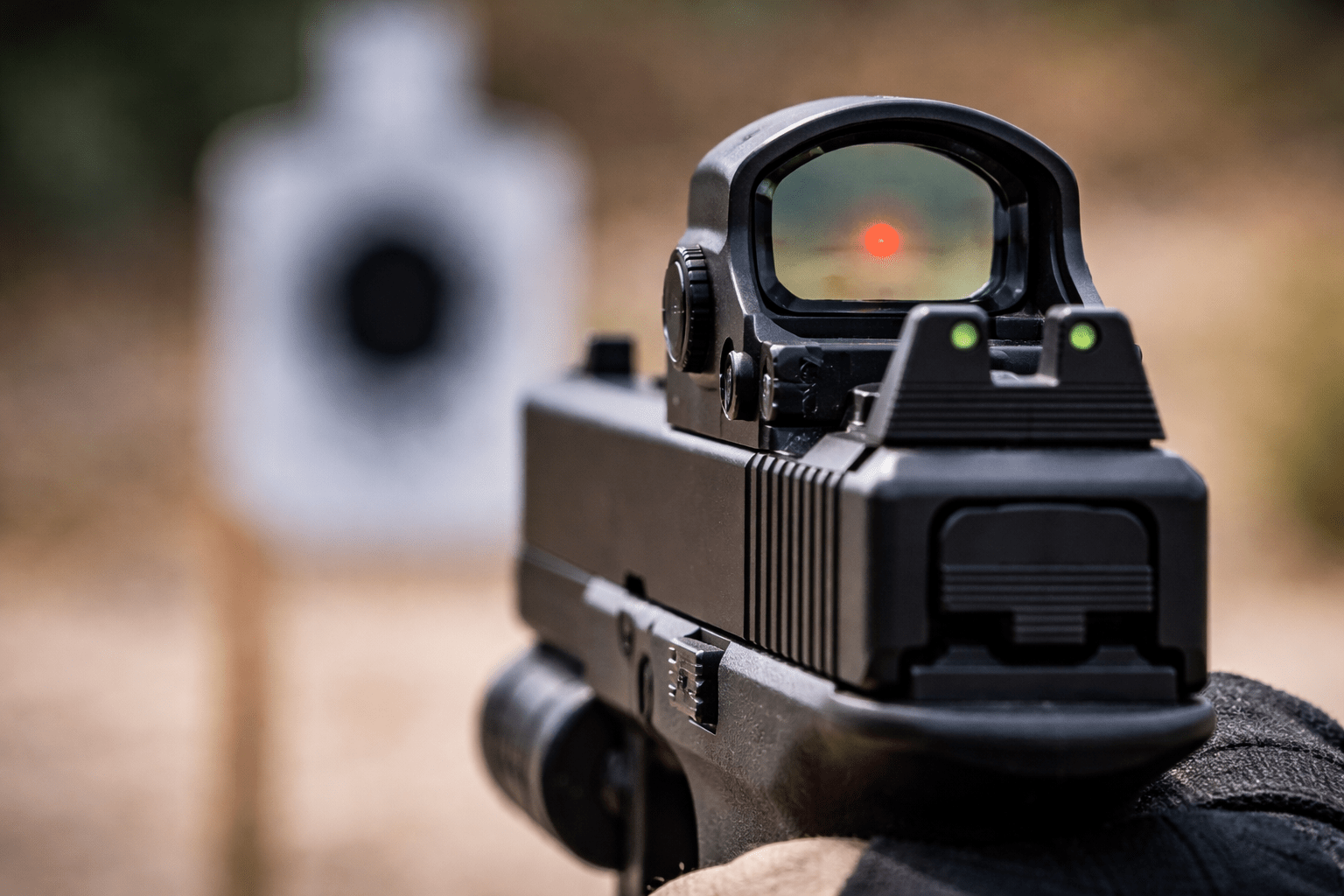
Co-Witness Iron Sights on a Red-Dot Handgun: Why “Dot + Irons” Can Make You Slower—and Miss
Co-witness is a backup capability—not a primary aiming method. When shooters try to “marry” irons to the dot inside the optic window,
they often create visual clutter, dot-hunting, and predictable POA/POI errors under speed and stress.
If your irons dominate the window, you’re paying for an optic while training like you don’t trust it.
Configure for visibility. Train for target focus. Confirm zeros like a professional.
Abstract
Co-witness iron sights are widely discussed in pistol-mounted red-dot setups, often as if they must be continuously used together.
This is a misconception. On a handgun, the active attempt to align irons and dot at the same time increases visual competition,
encourages iron-confirmation habits, and slows acquisition—especially under stress. This review explains the concept,
the vision mechanisms behind dot performance, and how mixed references can shift point of aim versus point of impact (POA/POI).
It concludes with configuration and training guidance for defensive and duty use.
What Co-Witness Actually Means on a Handgun
- Co-witness means backup visibility: irons remain usable through the optic window if the dot fails or is obstructed.
- Co-witness does not mean constant alignment: you are not required to “confirm irons” on every shot.
- Pistols are not rifles: small windows and close sightlines make obstruction and distraction more likely.
Tall pistol irons can materially reduce usable window space and interfere with dot pickup.
Manufacturer guidance and co-witness discussions acknowledge this obstruction problem.
The Vision Problem: “Dot + Irons” Competes for Your Attention
1) Target focus is the dot’s advantage
The dot is designed to be superimposed on the target while you keep your attention where it belongs: the threat, the target,
and the environment. When you chase an iron picture inside the window, you often break that advantage and slow down.
2) Occluded-optic principles prove the method
With both eyes open, the brain can fuse the target image from one eye with the dot image from the other—even if the optic is
partially blocked. That shows dot use is driven by binocular vision and attention, not iron alignment in the glass.
3) Tall irons add clutter and increase dot-hunting
Suppressor-height sights create bold shapes inside a small window. Under stress, the eye can get pulled into “iron-mode,”
causing dot loss, slower re-acquisition, and inconsistent aiming references. The more the irons occupy the window,
the more likely this becomes.
POA vs POI: How Mixed References Create Predictable Misses
Hybrid sight pictures create hybrid errors
When shooters try to satisfy both dot and irons, they often invent a hybrid rule:
“dot on the front sight,” “dot centered above the rear notch,” or “equal height inside the window.”
Those rules change shot to shot as speed rises—so POA becomes unstable, and POI follows.
“Looks aligned” is not “is aligned”
The red dot has a defined zero at a selected distance with a selected load. The irons have their own regulation.
Co-witness appearance can be a diagnostic reference, but it is not a substitute for confirming both zeros independently.
Close-range offset gets worse when you mix systems
Sight height over bore creates predictable offset at close distances. If the shooter is also chasing an iron picture inside the window,
they often add an inconsistent correction. The result is classic: vertical stringing, low hits, or unexplained bias that is blamed on the optic.
Choose one primary aiming reference per shot. Either you’re shooting the dot, or you’re shooting the irons—do not blend them at speed.
What Works: Configuration and Training Rules (Duty / Defensive)
Configuration (Hardware)
- Backup irons should be visible, not dominant.
- Preserve usable window area so the dot stays easy to pick up.
- Document both zeros using your carry/duty ammunition.
- Accept tradeoffs if you must run tall sights (suppressed use).
Training (Software)
- Presentation consistency so the dot appears without searching.
- Target-focused reps with both eyes open; irons stay in the background.
- Dot-down drills to prove capability without dot dependence.
- Occluded window work to reinforce binocular fusion under stress.
Bottom Line
Co-witness is a backup plan. If your setup forces you to constantly “confirm irons” in the optic window, you have built a system that
competes with itself. Configure to keep the window clean, train a repeatable presentation, and confirm zeros with discipline.
Train It the Right Way in Florida
If you’re running a pistol red dot for concealed carry or duty work in Orlando, Tampa, Daytona, or across Central Florida,
your setup must be validated under realistic standards—not just slow fire on a square range.
References
- Aimpoint. (n.d.). Shooting with an occluded optic.
- Cowan, A. (n.d.). Miniaturized red dot systems for duty handgun use (White paper).
- KR Training. (n.d.). Red dot study – key points.
- Vortex Optics. (n.d.). Everything you ever wanted to know about co-witnessing (Part Two).


