Armed, Overconfident, and Dangerous: The Firearms Training Crisis at America’s Gun Ranges
An experienced law enforcement firearms instructor exposes the dangerous illusion of proficiency, the rise of social media pseudo-experts, and an industry where a certificate can be mistaken for competence.

The Most Dangerous Person at the Gun Range May Be the One Who Thinks He’s an Expert
Somewhere in America, a person is carrying a loaded firearm in public, absolutely convinced they can defend themselves and everyone around them.
Unfortunately, the last paper target they shot tells a very different story.
And that should concern every American, whether you own a firearm or not.
I have spent decades working with firearms, training law enforcement personnel, military professionals, security officers, and ordinary civilians from virtually every walk of life.
My work takes me to public and private shooting ranges across the country. I encounter people of different ages, professions, backgrounds, and levels of experience. Some are outstanding shooters. Others are beginners genuinely interested in learning.
But in recent years, particularly with the explosive influence of social media, I have witnessed a trend that I consider an increasingly serious public safety concern.
It is not simply that some armed Americans cannot shoot accurately.
It is that many appear completely unaware of how poorly they shoot—and are extraordinarily confident in abilities they have never demonstrated.
That combination should frighten us far more than it does.
This firearms training crisis is not merely about missed shots. It is about the gap between confidence, demonstrated competence, and the quality of instruction people receive.
And the firearms training industry deserves a significant portion of the blame.
A Gun, a Certificate, and the Illusion of Superiority
The story frequently begins with an ordinary person purchasing a firearm.
There is nothing inherently wrong with that. I firmly support the Second Amendment and the right of law-abiding Americans to protect themselves.
A firearm can be an effective equalizer when a person faces a genuine threat to life.
But Hollywood, social media, and the commercial firearms industry have also sold an appealing fantasy: purchase the right gun, buy the right accessories, watch enough tactical videos, and suddenly you become a formidable defender.
Some gun owners take the next step.
They attend a basic concealed carry or firearms safety course, perhaps lasting only a few hours. They receive introductory instruction, handle a firearm under supervision, fire several rounds, and leave with a certificate.
Some eventually obtain a concealed weapons license.
And somewhere between receiving that piece of paper and purchasing their first tactical holster, something remarkable happens.
They begin confusing permission with preparation.
A few become convinced they possess the abilities of highly trained law enforcement or military professionals.
Others start imagining themselves intervening in violent confrontations, stopping armed criminals, or performing heroic rescues in crowded public spaces.
There is just one problem.
They have never demonstrated the proficiency necessary to justify that confidence.
A certificate establishes that certain course requirements were satisfied. A license establishes legal authorization under applicable law.
Neither automatically proves that an individual can perform effectively under the unpredictable conditions of a violent emergency.
Yet that distinction is routinely ignored.
The Paper Target Doesn’t Lie
Let me describe something I have witnessed repeatedly.
A person walks into a modern indoor shooting range.
The environment is comfortable. The temperature is controlled. The lighting is predictable. Everyone wears eye and hearing protection.
There are no screaming people.
No injured bystanders.
No immediate danger.
No complicated decisions involving innocent lives.
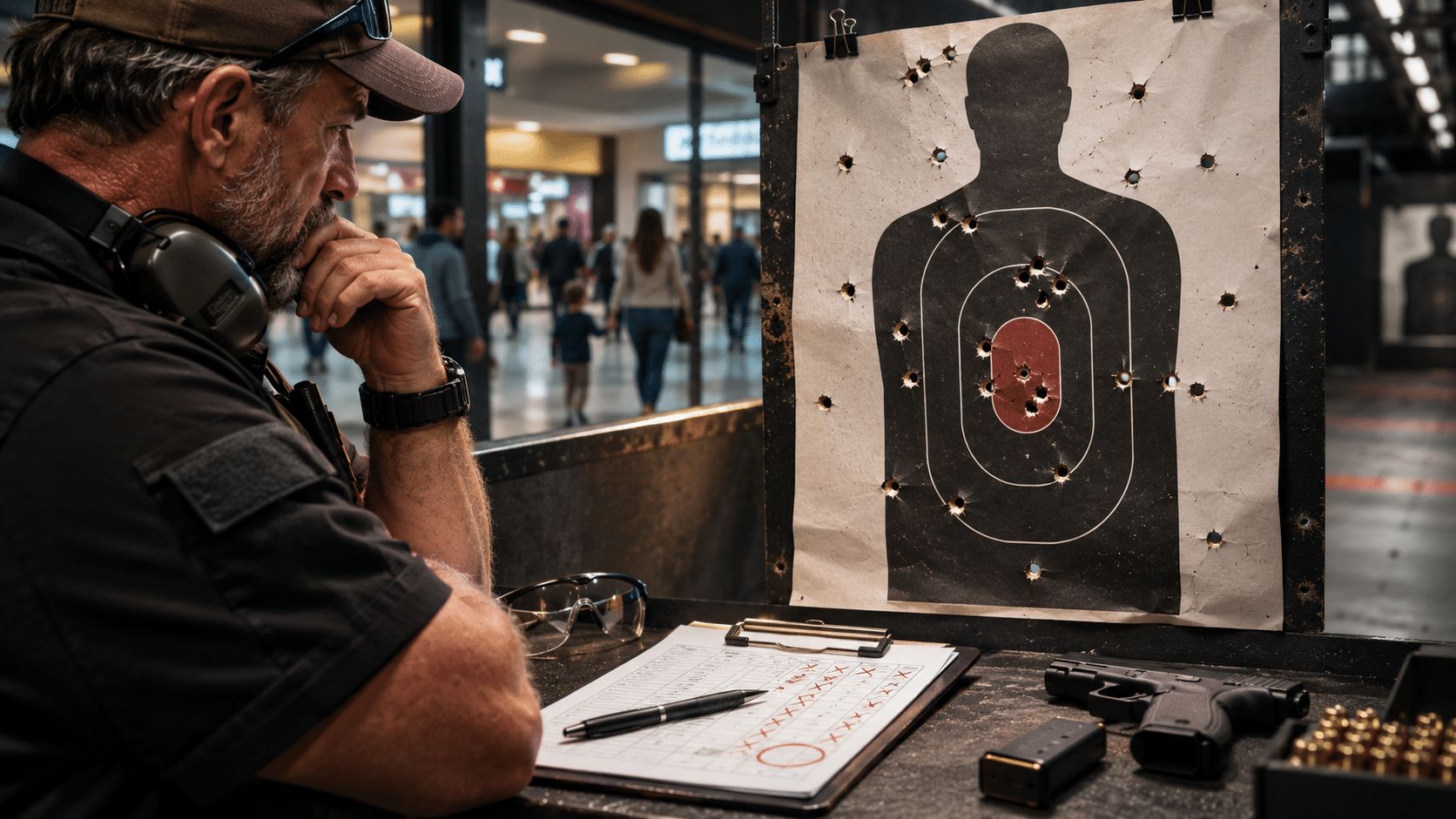
The shooter places a standard silhouette target, perhaps approximately 11 by 18 inches, at five, seven, or ten yards.
They draw or raise their pistol, revolver, or rifle and begin shooting.
And then the target comes back.
Sometimes the results are astonishing.
The impacts are scattered across the silhouette. Some rounds strike the edges. Others land completely outside the intended scoring area. Occasionally, shots miss the paper entirely.
I have seen targets that look less like the result of controlled marksmanship and more like the aftermath of a shotgun firing birdshot.
Yet the shooter smiles.
“Look at that! I hit the target!”
Another congratulates a friend.
Someone takes a photograph and uploads it to Facebook, Instagram, or another social media platform.
The comments arrive.
“Great shooting!”
“Looking tactical!”
“Ready for anything!”
And the illusion grows.
Meanwhile, experienced instructors looking at those same targets may see something entirely different.
We see inconsistent performance.
We see a lack of fundamental control.
We see people mistaking occasional hits for repeatable proficiency.
And we wonder what might happen if that individual attempts to use a firearm in a crowded shopping center, restaurant, parking lot, or other public setting.
Because a missed shot does not simply disappear.
Every projectile that leaves a firearm has a destination. Every round fired carries responsibility. And innocent human beings may occupy the space beyond an intended target.
This is the part of the conversation that deserves national attention.
If You Cannot Control the Firearm at Seven Yards, What Happens at Twenty?
I frequently raise a simple question with students and other professional firearms instructors:
If you cannot consistently demonstrate control and accuracy at five or seven yards, why would you assume your performance will improve at ten, fifteen, twenty, or twenty-five yards?
Consider a basic test of fundamental marksmanship.
At seven yards, in a calm and controlled environment, can you consistently place your shots inside a three-inch circle?
That is not a universal legal qualification standard. It is a useful precision benchmark that I personally employ when discussing fundamental control.
If you cannot produce consistent results under favorable conditions, it should be a warning that further instruction and practice are necessary.
Now consider what happens when those favorable conditions disappear.
Real emergencies introduce uncertainty, fear, physical limitations, unpredictable movement, obstructed views, and difficult decisions.
And above all, consequences.
A paper target provides useful feedback about mechanical accuracy. It cannot, by itself, measure someone’s legal judgment, decision-making ability, target discrimination, or preparedness for a violent encounter.
But when a person cannot demonstrate basic control under ideal conditions, the assumption that they will suddenly become exceptionally proficient during an emergency is difficult to defend.
That is not a personal insult.
It is an invitation to confront reality.
The problem is not being a beginner. The problem is believing you are an expert when your performance says otherwise.
A responsible beginner who recognizes their limitations is far less concerning to me than an overconfident gun owner who refuses to acknowledge them.
The Social Media Operator: When Entertainment Becomes Firearms Education
The situation becomes more disturbing when we examine where many Americans obtain their firearms knowledge.
Social media has transformed the firearms training industry.
An individual can develop a substantial audience by producing visually spectacular content involving aggressive movements, elaborate equipment, dramatic camera angles, and carefully edited demonstrations.
Some content creators are legitimate professionals whose work contributes to firearms education.
Others appear far more proficient at producing videos than at teaching complex skills. The illusion of explanatory depth in firearms training helps explain why confidently repeating a technique is not the same as understanding it.
And the platforms rarely distinguish between the two.
A video receives thousands of views.
The creator gains followers.
The followers assume the creator is an authority.
Soon, people begin repeating techniques they watched online, often without understanding the circumstances for which those techniques were developed—or whether the techniques have been validated at all.
I see this phenomenon when students arrive at our classes.
I hear it in conversations at shooting ranges.
“But this instructor on YouTube said…”
“I saw this former operator do it differently…”
“This guy has hundreds of thousands of followers…”
My response is simple:
What evidence supports the technique?
Can the instructor explain why it works?
Can they identify when it fails?
Can they teach it safely to someone with different physical abilities and experience?
Can they diagnose why a student is missing?
Most importantly, can their students demonstrate measurable improvement?
Popularity is not proficiency. A dramatic demonstration is not a validated teaching methodology. And a million followers do not create professional competence.
The algorithm rewards attention.
A responsible firearms instructor must deliver education, evaluate performance, and accept accountability.
Those are profoundly different objectives.
Florida Requires 1,200 Hours to Become a Cosmetologist. What Does It Take to Become a Firearms Instructor?
Now we arrive at what I consider one of the most uncomfortable questions in this entire discussion.
How seriously does America regulate the people who claim to be qualified to teach others to use potentially deadly weapons?
Consider Florida.
According to the Florida Department of Business and Professional Regulation’s official cosmetology licensing guidance and the Florida Board of Massage Therapy’s examination applicant requirements:
To become a licensed cosmetologist: An applicant generally must complete at least 1,200 hours of approved education and pass the required state examination.
To become a registered nail specialist: An applicant must complete at least 180 hours of approved training and obtain state registration. A separate state cosmetology examination is not required for this specialty. Continuing education generally applies at renewal, with exemptions for certain long-standing licensees.
To become a licensed massage therapist: An applicant generally must complete at least 500 clock hours at a board-approved massage school, pass an approved examination, and satisfy background-screening and other licensing requirements.
These requirements exist for legitimate consumer protection reasons. Poorly performed personal services can cause significant injuries, and professional regulation serves an important purpose.
But the comparison raises an unavoidable question.
Why should someone responsible for teaching the safe and effective use of a deadly weapon be subjected to less scrutiny than people entering many other regulated occupations?
The answer requires understanding an important distinction.
Florida does regulate certain categories of firearms instruction.
For example, an individual teaching applicants for the state’s Class G armed-security license must hold a Class K Firearms Instructor License. That credential has specific eligibility, qualification, examination, and renewal requirements.
Class G applicants generally complete 28 hours of prescribed instruction, including classroom and practical range training. Licensees also have annual requalification requirements.
That is a regulated framework.
But it is not the same framework governing every private firearms instructor offering civilian courses.
Florida Statutes § 790.06 recognizes several different forms of firearms training and experience for concealed weapons licensing, including qualifying courses conducted by instructors holding specified certifications.
The state requires observed live fire for certain course-certification pathways, but that does not mean every concealed carry student must demonstrate advanced marksmanship, make sound decisions in realistic scenarios, or pass one comprehensive statewide practical performance standard.
And under Florida’s permitless concealed carry provisions, eligible individuals may carry without obtaining a concealed weapons license or completing a mandatory firearms training course.
These are meaningful differences—not minor technicalities.
They also raise questions about the relationship between private instructor certifications, actual teaching competence, and public accountability.
The Weekend Certificate Industry Deserves Investigation
There are excellent civilian firearms instructors throughout America.
Some have extensive law enforcement experience. Others come from military backgrounds, competitive shooting, formal education, or years of disciplined professional development.
I respect competent instructors regardless of where their careers began.
My criticism is not directed at a particular background or organization merely because it is private.
It is directed at the assumption that completing a short instructor-development program automatically makes someone capable of teaching others to handle firearms responsibly.
Private organizations can issue instructor certificates according to their own program requirements. Valortec examines the distinction between a certificate and teaching competence in its analysis of firearms instructor certification standards and public safety.
But what do those requirements actually measure?
Do candidates have to demonstrate consistent technical proficiency?
Can they explain common student errors and their causes?
Can they safely supervise an entire firing line?
Can they recognize dangerous behavior before an accident occurs?
Do they understand the legal boundaries of defensive force?
Can they evaluate students objectively—even when failing a student might mean losing a paying customer?
How often must instructors demonstrate continued competence?
And who audits the quality of their instruction after the certificate is issued?
These are questions consumers, lawmakers, insurance providers, journalists, and regulators should be asking.
Because a certificate should represent verified competence—not simply course attendance, payment, or the ability to repeat an approved presentation.
Teaching someone how to shoot is not the same as being qualified to evaluate whether that person should be considered proficient.
An instructor who cannot identify dangerous deficiencies may send a student into the world with something more dangerous than poor technique.
False confidence.
And false confidence can influence decisions involving innocent lives.
This Is Not an Attack on the Second Amendment
I want to make this distinction unmistakably clear.
This is not an anti-gun argument.
It is not an attack on lawful firearm ownership.
And it is not a claim that ordinary Americans should be denied the right to defend themselves.
Quite the opposite.
I believe responsible firearm ownership deserves to be protected by serious, professional, accountable education.
The Second Amendment protects a constitutional right.
But possessing that right does not automatically grant someone competence, judgment, or the ability to perform effectively during an emergency.
The same principle applies to law enforcement officers, military personnel, and armed security professionals.
A uniform is not evidence of exceptional shooting ability.
A badge does not eliminate human error.
And passing a minimum qualification is not the same as maintaining genuine operational readiness.
These are principles I explore in The Science of Marksmanship, which examines firearms performance through biomechanics, motor learning, visual processing, and the human response to stress.
But readers do not need a scientific textbook to understand the central issue.
They only need to understand one distinction:
Being legally authorized to carry a firearm and being genuinely prepared to use one responsibly are not the same thing.
A Public Safety Problem That Government Can No Longer Ignore
If policymakers are genuinely concerned about public safety, firearms instructor standards deserve closer examination.
I believe Florida should begin a serious regulatory and legislative review of the qualifications required for individuals who commercially provide firearms instruction and certify students for recognized purposes.
That review should examine instructor education, demonstrated marksmanship, legal knowledge, instructional ability, safety procedures, continuing education, documentation, and objective performance evaluation.
It should distinguish introductory instruction from advanced or professional training, and it should establish clear expectations for anyone claiming to certify another person’s proficiency.
The state should also examine how existing requirements are enforced, whether training programs produce measurable results, and whether the public can meaningfully verify an instructor’s credentials.
And perhaps most importantly, regulators should examine whether the current system creates financial incentives to pass students who have not demonstrated satisfactory performance.
An instructor must have the authority, professional obligation, and integrity to tell a student: “You have not met the standard.”
A meaningful evaluation has to permit failure.
Otherwise, it is not a standard.
It is a ceremony.
These questions should be considered alongside constitutional protections, access to training, reasonable costs, and the rights of responsible citizens. Better oversight must be evidence-based and carefully designed, rather than regulation for regulation’s sake.
But refusing to examine an apparent weakness simply because the subject involves firearms is not responsible public policy.
An Invitation to American Journalists: Visit a Public Shooting Range
I have a suggestion for journalists interested in investigating this issue.
Visit public and private shooting ranges.
Speak with qualified range safety officers and instructors.
Ask about the most common deficiencies they observe.
Examine discarded targets when the facility permits it.
Ask how often they encounter shooters who cannot consistently keep their rounds within an intended scoring area.
Investigate private firearms instructor certification programs.
Compare the requirements imposed by different organizations.
Review state licensing laws, qualification courses, oversight procedures, instructor disciplinary records, and consumer complaints where those records are publicly available.
Ask the institutions issuing certificates how they establish and verify instructional competence.
Then ask an even more important question:
What happens to students who fail?
Is failure documented?
Is remedial instruction required?
Or does everyone eventually leave with a certificate?
My range observations are firsthand professional experience, not a national statistical study. They warrant systematic investigation rather than being mistaken for comprehensive national evidence.
But there is more than enough here to justify asking difficult questions.
And those questions concern the public—not just firearm owners.
The Person Standing Beside You Deserves Better
The next time you visit a shopping mall, a restaurant, a supermarket, or another crowded public space, consider something.
Among the people around you may be a law-abiding citizen carrying a concealed firearm.
That person might be highly trained, disciplined, responsible, and thoroughly aware of their limitations.
Or that person might have received minimal instruction, failed to develop consistent marksmanship, and mistaken a basic training certificate for evidence of advanced readiness.
You probably cannot tell the difference by looking at them.
That is what concerns me.
Not lawful gun ownership.
Not the responsible citizen who trains seriously.
But the individual who carries enormous confidence unsupported by demonstrated ability—and the instructor or training organization that may have helped create that illusion.
I do not expect every gun owner to become a professional marksman.
I do expect armed citizens to recognize their limitations, respect the consequences of their actions, and seek instruction appropriate to their responsibilities.
And I expect anyone who calls themselves a professional firearms instructor to take responsibility for what their students actually learn.
Because this issue is not ultimately about impressive firearms, expensive optics, colorful certificates, social media followers, or tactical reputations.
It is about the innocent person standing beyond the target.
The shopper walking behind a violent attacker.
The parent holding a child’s hand.
The family eating dinner.
The stranger whose life could depend on another person’s judgment and control.
A missed shot on a paper target is a training failure. A missed shot in a crowded public place can become an irreversible tragedy.
That is why standards matter.
That is why competent instruction matters.
And that is why accountability must matter more than profits, popularity, or personal pride.
If this article makes you uncomfortable, good. It should provoke serious questions.
But if your first instinct is to defend weak standards rather than examine their consequences, perhaps you should ask yourself what, exactly, you are protecting.
America does not need more armed people who believe they are prepared.
America needs more armed citizens who can demonstrate they are responsible, competent, and accountable.
Because the innocent people around them deserve nothing less.
About the Author
Herfel “Boots” Torres is a law enforcement firearms instructor, master instructor, and author of The Science of Marksmanship: From Tradition to Truth. He serves as Chief Operating Officer and Master Instructor at Valortec Training Academy, a Florida-based firearms and security training organization providing instruction to responsible civilians, security professionals, law enforcement, and military personnel.
His work emphasizes measurable performance, evidence-informed training, professional accountability, and responsible firearm ownership.
Train Often. Train Smart. Train Proudly.