This Is Not Instructor Development. It Is Credential Inflation — and Government Agencies Need to Investigate It
There comes a point when staying polite becomes intellectually dishonest.
This is that point.
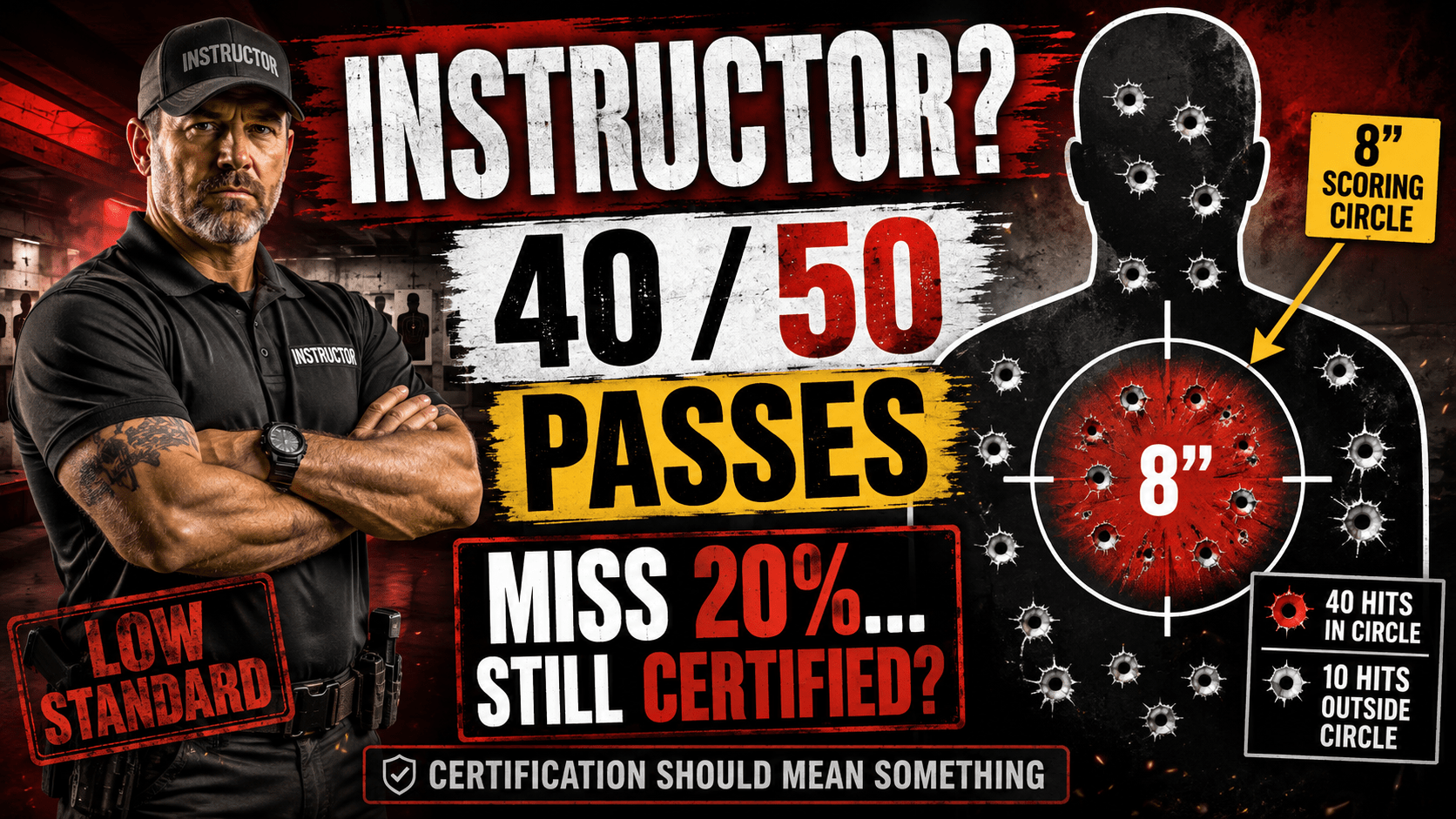
A firearms-instructor candidate can fire 50 rounds at an eight-inch scoring circle, place only 40 of them inside that required scoring area, and still satisfy the published shooting standard for instructor certification.
That is 20% of the qualification outside the required scoring circle.
And somehow, at the end of this process, the word INSTRUCTOR gets attached to the candidate’s name.
That should infuriate every serious professional in the firearms-training industry.
It should concern every responsible gun owner.
And it should get the attention of every government agency that accepts, recognizes, references, or relies upon private firearms-instructor certifications as evidence of professional competence.
Because this is no longer merely an argument about shooting standards.
This is a public-safety issue.
The published qualification requires 50 rounds: 15 at four yards, 15 at seven yards, 10 at ten yards, and 10 at fifteen yards. The required scoring area is an eight-inch circle. Forty hits out of fifty passes.
Thirty of those fifty rounds—60% of the qualification—are fired from only four and seven yards.
And ten rounds can fail to enter the required scoring circle while the candidate still satisfies the shooting requirement.
For someone seeking the title firearms instructor.
Wake up and smell the coffee.
Scope and source note: This analysis addresses the specific 50-round, 40-hit instructor shooting qualification described in the program materials reviewed for this article. Course requirements and published standards can change; readers should verify the current requirements directly with the issuing organization. Passing a particular shooting exercise does not, by itself, establish an instructor’s entire range-safety, teaching, or legal competency.
Stop Lowering the Meaning of “Instructor”
An instructor is supposed to be more than someone who can barely clear a minimum standard.
An instructor is supposed to represent demonstrated competence.
Not assumed competence.
Not marketed competence.
Not logo-approved competence.
Demonstrated competence.
A legitimate firearms instructor should be able to perform at a level that immediately distinguishes him or her from the average student.
The instructor should demonstrate superior gun handling.
Superior safety.
Superior technical understanding.
Superior range control.
Superior judgment.
Superior instructional ability.
And yes—
superior shooting performance.
Nobody serious claims marksmanship alone makes somebody a good instructor.
But pretending marksmanship is somehow secondary when certifying a firearms instructor is equally absurd.
You cannot credibly stand in front of students teaching pistol performance while your certification standard allows one out of every five rounds to fail to enter an eight-inch scoring area.
That is not excellence.
That is a minimum.
And minimums are supposed to keep people out.
Not usher everybody through.
Their Own Material Calls This “Instructor Level”
The most remarkable part is that the published material itself tells candidates this is an “instructor-level class, not a beginner’s course.”
Fine.
Then judge it like an instructor-level standard.
Not like a beginner qualification.
Not like a concealed-carry familiarization course.
Not like somebody’s first trip to the range.
Judge it against what the word instructor is supposed to mean.
Forty out of fifty.
Eight-inch scoring circle.
Thirty rounds from four and seven yards.
Twenty percent can fail to score.
And that contributes to an instructor credential.
If this is what we now call instructor-level shooting proficiency, the firearms-training industry has a serious standards problem.
The Holster Is Not Even Part of the Certification Event
Then we get to another astonishing detail.
The course materials specifically state that drawing from a holster is not taught and that candidates will not use a holster in the class.
Yet this certification is connected to concealed-carry and home-defense instruction.
Think about that contradiction.
A person can leave the certification process carrying a nationally recognizable firearms-instructor credential without holster competency being demonstrated during that certification event.
Does that mean every graduate lacks holster competence?
Of course not.
Some graduates may be outstanding shooters.
Some may have military, law-enforcement, competitive, security, or extensive private-training backgrounds.
But that is not the point.
A certification should certify what the certifying organization actually verified.
If holster proficiency was not tested, the certificate does not establish holster proficiency.
If advanced gun handling was not tested, the certificate does not establish advanced gun handling.
If exceptional marksmanship was not required, the certificate does not establish exceptional marksmanship.
A logo cannot certify skills that were never examined.
And Then We Hand Them a Shirt and Call Them Instructors?
According to the program materials, successful candidates gain access to instructor resources and can begin offering official courses or incorporating the materials into their own branded instruction. The materials also describe an instructor toolkit and the ability to post classes after credentials become active.
That raises an unavoidable question.
Is this primarily an instructor-development system—or a distribution system?
There is nothing wrong with a company building a network.
There is nothing wrong with selling training.
There is nothing wrong with memberships, instructional materials, services, insurance-related products, merchandise, or commercial growth.
Valortec is a business too.
Commerce is not the issue.
Standards are.
The problem begins when the barrier to becoming an “instructor” becomes low enough that the credential can function as an entry point into a larger commercial ecosystem.
Because the economic incentive is obvious.
More certified instructors.
More classes.
More students.
More customers.
More memberships.
More product exposure.
More revenue opportunities.
That does not prove that commercial growth is the purpose of the certification.
But when an instructor qualification is this modest, professionals are absolutely entitled to ask whether the credential is developing educators or expanding a sales network.
And nobody should be offended by that question.
They should answer it.
Firearms Instructors Are Not Sales Representatives With Certificates
A professional instructor has a duty to the student.
A salesperson has a duty to move a product.
Those functions may coexist inside a business.
They must never be confused.
The moment the industry allows instructor credentials to become primarily a marketing mechanism, we have a serious problem.
Because firearms instructors are not selling harmless consumer products.
They are shaping behavior involving lethal weapons.
Their students may carry those firearms around families.
Inside homes.
Inside vehicles.
At businesses.
At churches.
In parking lots.
In public.
Under stress.
During confrontation.
Possibly during the worst seconds of their lives.
Bad instruction does not remain inside the classroom.
It leaves with the student.
That is why weak instructor standards are not merely embarrassing.
They can become dangerous.
Government Agencies: Start Investigating These Credentials
This is where government regulators need to stop taking private certification logos at face value.
Any government agency that accepts private firearms-instructor credentials as part of licensing, contracting, security training, public-safety instruction, or another regulated function should immediately begin examining the standards behind those certificates.
Not the advertising.
Not the reputation.
Not the size of the membership base.
Not the logo.
The actual standard.
Agencies should require certifying organizations to disclose:
What does the shooting qualification require?
What percentage can be missed?
At what distances?
What target size?
What time limits?
Is drawing from a holster evaluated?
Are reloads evaluated?
Are malfunctions evaluated?
Is range management tested?
Are emergency procedures tested?
Is instructional competence independently evaluated?
Are candidates required to demonstrate prerequisite experience?
How many candidates fail?
What remediation occurs?
How frequently must instructors requalify?
What continuing education is required?
Those are not unreasonable questions.
They are the questions regulators should have been asking all along.
Stop Recognizing Weak Credentials Until They Are Audited
Government agencies should go further.
Where private certifications are accepted as evidence of competency for regulated activities, agencies should conduct formal reviews of the underlying qualification standards.
And where those standards cannot demonstrate meaningful professional competency—
stop recognizing the credential.
At least until the deficiencies are corrected.
That is precisely what oversight is supposed to accomplish.
If a credential allows an instructor candidate to demonstrate what would be considered ordinary recreational shooting performance and then present himself or herself to the public as a professional instructor, regulators should determine whether that credential deserves official recognition.
This is especially important when the certification may ultimately be relied upon in security licensing, public institutions, government contracts, protective services, or other environments involving public safety.
Government should not wait for somebody to get injured before asking what “certified instructor” actually meant.
State Regulators Need to Stop Rubber-Stamping Private Certifications
Every state agency responsible for firearms-related occupational licensing should examine this issue.
If a private credential forms any part of the pathway toward regulated instruction, the agency has a responsibility to determine what the credential actually proves.
A certificate should never receive government credibility simply because the issuing organization is nationally recognized.
Government recognition transforms a private marketing claim into something much more powerful.
The public begins assuming:
The state accepts this, therefore this person must be professionally qualified.
That assumption can be dangerous if nobody ever examined the underlying performance standard.
Government agencies should establish objective minimum standards for any private firearms-instructor certification they recognize.
Not company-specific standards.
Professional standards.
And those standards should be high enough to actually separate instructors from students.
If Your Entire Defense Is “But They Passed,” You Have Proved the Problem
Somebody will inevitably respond:
“But the instructor passed the qualification.”
Exactly.
That is the criticism.
The problem is not that somebody failed.
The problem is that the qualification defines this level of performance as sufficient.
Standards create outcomes.
If you lower the standard, more people pass.
That does not make the candidates more competent.
It makes the certificate easier to obtain.
This is elementary.
If a qualification permits performance that experienced instructors would consider mediocre, then the argument should not be:
“Well, technically they passed.”
The argument should be:
Why the hell is that passing?
Serious Instructors Should Be Angry About This
Professional firearms instructors spend years developing their craft.
Thousands of hours on ranges.
Continuing education.
Instructor schools.
Biomechanics.
Ballistics.
Safety.
Teaching methodology.
Use-of-force law.
Visual processing.
Stress physiology.
Scenario development.
Range operations.
Student diagnostics.
After-action analysis.
Equipment failures.
Professional liability.
They study because the responsibility is serious.
Then somebody else can complete a short certification pathway, satisfy a modest live-fire standard, place “Certified Firearms Instructor” on social media, and to the average consumer both people appear equivalent.
They are not.
And the industry should stop pretending that every instructor certificate represents the same level of professional development.
It does not.
If This Is the Certificate You Use to Prove You Are an Expert, You Should Reconsider That Strategy
This is going to irritate some people.
Good.
If your primary claim to professional firearms authority is that you possess a certificate earned through a standard this modest, perhaps displaying that credential as proof of exceptional expertise should make you uncomfortable.
Not because obtaining education is embarrassing.
Education is good.
Certification can be useful.
But a responsible professional understands the difference between:
“I completed this certification.”
and
“This certification proves I am an expert.”
Those are two completely different statements.
If you possess the credential and you are genuinely skilled, excellent.
Prove it.
Show your training history.
Show your continuing education.
Show your shooting.
Show your teaching ability.
Show your range-management competence.
Show your professional development.
Show what exists beyond the certificate.
Because forty out of fifty inside an eight-inch circle does not establish mastery.
It establishes that you passed that qualification.
Nothing more.
The People Using a Minimal Credential as Their Entire Professional Identity Should Be Embarrassed
There is no shame in beginning somewhere.
There is shame in pretending the beginning is the finish line.
If somebody earns an entry-level instructor credential and then continues studying, training, shooting, teaching under supervision, attending advanced schools, developing professionally, and constantly raising personal standards, that person deserves credit.
But if somebody earns a certificate and immediately starts promoting themselves as some sort of firearms authority—
while hiding behind the credibility of the organization’s logo—
that should embarrass the profession.
The certificate is supposed to mark the beginning of instructor development.
Not the coronation.
Putting CERTIFIED INSTRUCTOR across your social-media biography does not magically create competency that the certification never required you to demonstrate.
Professionals build reputations.
Amateurs collect titles.
Stop Denigrating the Profession
This is where the damage becomes broader than individual instructors.
Weak certifications devalue legitimate instructors.
They flatten the profession.
They make the public believe that firearms instruction is something anybody can master over a weekend.
They reduce years of expertise to a certificate.
And they turn the title firearms instructor into a commodity.
That is denigrating to every professional who treats this work seriously.
The profession should be raising barriers.
Not eliminating them.
We should want fewer incompetent instructors.
Not more certificates.
We should want instructor candidates arriving nervous because they know the standard is demanding.
We should want failures.
We should want remediation.
We should want people being told:
You are not ready yet.
That is how professional standards work.
Failure Is Supposed to Protect the Public
This obsession with making certification attainable for everyone is fundamentally backwards.
Not everybody deserves to become an instructor.
That is not elitism.
That is quality control.
You would never want an aviation instructor program designed primarily around maximizing graduation rates.
You would never want a medical certification program concerned primarily with how many certificates it can issue.
You would never want a commercial-driving examiner saying:
“Well, he only made dangerous mistakes twenty percent of the time.”
Yet in firearms instruction, apparently we are supposed to applaud accessibility regardless of what the credential ultimately communicates.
No.
Failure has a purpose.
Failure protects the people who encounter the graduate later.
The Public Should Never Become the Remedial Training Program
Certification should identify deficiencies before somebody begins teaching.
Not afterward.
The public should not become the environment where a new instructor discovers that he cannot manage a firing line.
Students should not discover that their instructor cannot diagnose shooting problems.
A range owner should not discover that an instructor cannot safely control multiple shooters.
And an emergency should certainly not be the first moment when deficiencies become obvious.
The certification process is supposed to prevent exactly that outcome.
If the process does not meaningfully separate competent candidates from unprepared candidates, the process has failed.
Then Someone Gets Hurt—and Everyone Suddenly Discovers “Liability”
This debate will become much less theoretical the day an inadequately trained instructor is involved in a serious incident.
Then nobody will care about marketing.
Nobody will care about branded apparel.
Nobody will care about how friendly the certification weekend was.
Lawyers will start asking questions.
What did the instructor know?
What was he taught?
What was tested?
What was not tested?
Who certified him?
What did certification require?
How many rounds could he miss?
Was holster proficiency evaluated?
What representations were made to students?
What relationship existed between the instructor and certifying organization?
Depending on the facts and jurisdiction, litigation can involve allegations concerning negligent selection, supervision, retention, representations of competency, agency relationships, or vicarious liability.
A certificate does not make those questions disappear.
It may actually create them.
Because certification represents organizational judgment.
The organization is saying:
We evaluated this person and placed our credential behind him.
That carries responsibility.
Imagine Explaining This Qualification to a Jury
Imagine the testimony.
“Your organization certified this defendant as a firearms instructor?”
“Yes.”
“What level of shooting proficiency was required?”
“Forty hits out of fifty.”
“What was the size of the scoring area?”
“Eight inches.”
“How many rounds could fall outside that scoring area while still passing?”
“Ten.”
“So twenty percent?”
“Yes.”
“And thirty of the fifty rounds were fired from four and seven yards?”
“Yes.”
“Was holster proficiency required during the certification course?”
“No.”
Now imagine the jury looking at the injured plaintiff.
That is why professional standards matter before an incident occurs.
Government Agencies Should Open Formal Investigations Before There Is a Tragedy
This is our direct call to regulators:
Investigate.
Review private instructor-certification programs being relied upon in regulated environments.
Audit their shooting standards.
Audit instructor prerequisites.
Audit practical testing.
Audit failure rates.
Audit remediation.
Audit continuing education.
Audit whether marketed competency actually corresponds to tested competency.
And where a certification falls below a reasonable professional threshold—
stop accepting it.
Government agencies should not provide institutional credibility to private credentials until they know exactly what those credentials represent.
That is not an attack against private firearms training.
It is protection of legitimate firearms training.
Because reputable instructors benefit when meaningless credentials lose their ability to masquerade as professional qualifications.
The Industry Should Fix This Before Government Does
The solution is not complicated.
Raise the standard.
Require legitimate prerequisites.
Require documented shooting proficiency before instructor school.
Require meaningful live-fire performance.
Require holster competency where applicable.
Require safe weapon manipulation.
Require malfunction clearing.
Require range-management competence.
Require actual teaching evaluations.
Require continuing education.
Require periodic requalification.
And stop being afraid to fail candidates.
A credible instructor credential should be something a shooter is proud to earn because it was difficult.
Not something marketed primarily around how easily someone can join the instructor ecosystem.
“But We Have Thousands of Certified Instructors”
That is not necessarily something to brag about.
Volume is not quality.
A certification organization announcing that it has created thousands of instructors tells us precisely nothing about whether those instructors are good.
McDonald’s has served billions.
That does not make it fine dining.
The metric that should matter is not:
How many instructors did we certify?
The metric should be:
How much does the certificate actually guarantee about the holder’s demonstrated competence?
If the answer is “not very much,” then the industry should stop worshipping the certificate.
A Credential Is Not Competence
This needs to be printed above the door of every firearms instructor school in America:
A certificate is evidence that somebody satisfied a particular certification process.
That is all.
Its value is directly proportional to the difficulty and relevance of the standards behind it.
A weak standard produces a weak signal.
A demanding standard produces a meaningful credential.
Put a famous logo on a weak standard and it remains a weak standard.
Brand recognition cannot change mathematics.
Forty is still forty.
Fifty is still fifty.
Twenty percent is still twenty percent.
If You Carry This Credential, Demand Better From the Organization
There are undoubtedly competent instructors holding this certification.
Those instructors should be among the loudest voices demanding stronger standards.
Because weak standards hurt them too.
Every marginal candidate who receives the same credential reduces its meaning.
Every instructor who demonstrates mediocre performance while wearing the same certification logo damages everyone associated with it.
Excellent instructors should not defend weak standards out of brand loyalty.
They should demand that the credential become difficult enough to reflect their own professionalism.
If you are genuinely good—
why would you want the certification standard to remain easy?
A related resource for professionals evaluating instructional credentials is our guide to choosing a firearms instructor mentor in Florida.
Stop Protecting Organizations. Protect the Profession.
The firearms industry is sometimes its own worst enemy.
We defend organizations because we like their brand.
We defend instructors because they’re part of our tribe.
We defend certifications because we paid for them.
We become emotionally invested in logos.
Stop.
Professional standards are bigger than brands.
If Valortec published a qualification this weak tomorrow, professionals should criticize Valortec too.
No organization gets immunity.
Not ours.
Not theirs.
Not anyone’s.
Standards either withstand scrutiny or they do not.
Florida Licensing: A Private Certificate Is Not a Class K License
There is an important distinction between a private organization’s instructor certificate and a state-issued occupational license. The Florida Department of Agriculture and Consumer Services (FDACS) explains its Class K firearms instructor requirements, including the qualifying experience or credentials and examination. A person providing classroom and range instruction to applicants for Florida Class G licensure must hold the appropriate Class K license. Do not assume a private instructor certification by itself qualifies an individual to provide regulated Class G instruction.
That distinction does not mean that everyone holding a private instructor certificate is unqualified. It means that certification, occupational licensing, and demonstrated instructional proficiency answer different questions. Verify each separately, and consult the state’s current licensing guidance rather than relying on a logo.
Five Questions Every Student Should Ask a Firearms Instructor
- Who issued the credential? Identify the exact course, certifying body, and current standing.
- What did the assessment test? Distinguish shooting performance from teaching, safety supervision, and judgment.
- Is a state license required for this course? For Florida regulated security firearms instruction, check FDACS Class K requirements.
- What experience supports the instruction? Ask about relevant experience, continuing education, and practical teaching evaluations.
- How is student safety managed? Ask about range procedures, class size, supervision, and emergency planning.
Editorial accountability: This commentary reflects the professional training perspective of Herfel “Boots” Torres and Valortec Training Academy. Our editorial policy explains our approach to authorship, accuracy, and corrections. The numerical qualification discussed above applies to the specific materials reviewed; it should not be presented as a measurement of every certificate holder’s overall capability.
For a closer examination of the published qualification and what this credential does—and does not—establish, read our USCCA instructor certification standards analysis.
Forty Out of Fifty
Let us finish where this started.
Forty out of fifty.
An eight-inch scoring circle.
Thirty rounds fired from four and seven yards.
Twenty percent can fall outside the required scoring area and the candidate can still satisfy the shooting standard.
No holster proficiency required during the certification event.
And afterward:
CERTIFIED FIREARMS INSTRUCTOR.
No.
That title should mean more.
Much more.
Government agencies that rely upon private instructor credentials should investigate these certification standards immediately.
Regulators should stop recognizing any credential that cannot demonstrate meaningful professional competence.
Firearms professionals should stop treating every certificate as equivalent.
And instructors using minimal certifications as their primary evidence of expertise should reconsider what they are advertising.
Because the public does not need more people wearing instructor shirts.
The public needs people capable of carrying the responsibility that comes with the title.
Stop manufacturing credentials.
Stop normalizing mediocrity.
Stop confusing accessibility with professional competency.
And stop asking the public to trust certificates that do not require enough from the people receiving them.
This profession deserves better.
Responsible gun owners deserve better.
Students deserve better.
And government agencies responsible for public safety should demand better.
Forty out of fifty should start a conversation.
It should not end one with:
“Congratulations. You’re an instructor.”
Certification should demonstrate competence.