Law Enforcement Firearms Training Has a Competency Problem
Police firearms qualification is not the same as operational competence. Research on stress, motor learning, shooting performance, and training transfer exposes a dangerous gap between passing a qualification course and performing when lives are actually at stake.
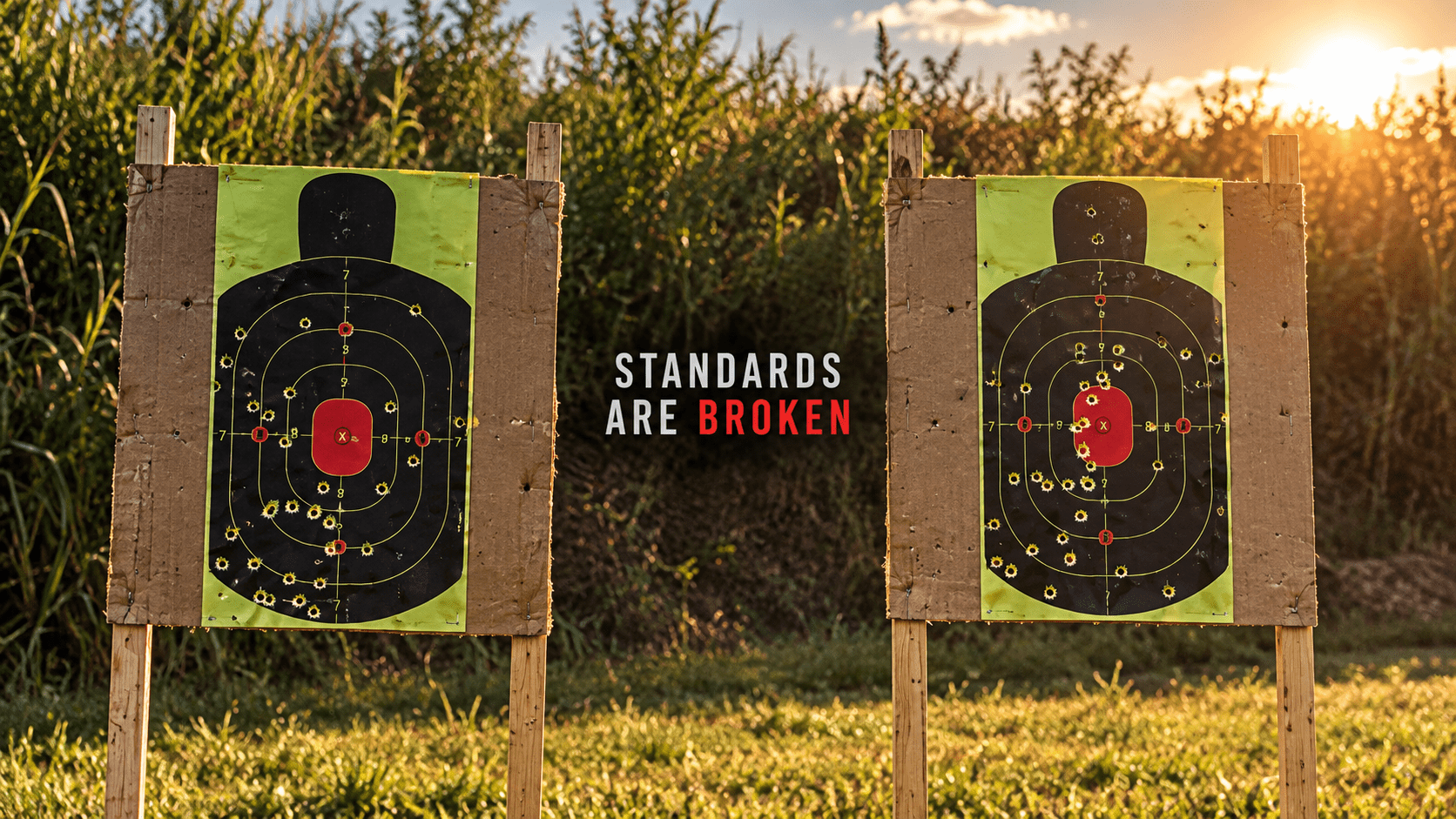
Look carefully at the photograph.
Two targets.
Approximately twelve by eighteen inches.
Ten yards away.
According to the circumstances in which the photograph was taken, these were practice targets fired by two law enforcement officers preparing for an upcoming firearms qualification.
There was no suspect shooting back.
No darkness.
No injured partner.
No screaming.
No radio traffic.
No moving vehicle.
No innocent citizen suddenly crossing the line of fire.
No fight.
No chaos.
Just a controlled shooting range.
And that is precisely why the shot dispersion should concern every law enforcement firearms instructor, rangemaster, training commander, chief, sheriff, risk manager, and agency administrator who takes professional firearms performance seriously.
This is not an argument that every law enforcement officer must shoot one ragged hole.
It is a much more fundamental question:
If an armed professional struggles to demonstrate consistent handgun control at ten yards under controlled conditions, what should we expect when the environment becomes uncontrolled?
That question exposes one of the most persistent problems in law enforcement firearms training:
We continue treating qualification as if it proves competence.
Our Asset or Liability challenge to law enforcement training makes the wider point: a badge, qualification score, or certificate cannot replace demonstrated competence.
It does not.
Police Firearms Qualification and Firearms Training Are Not the Same Thing
The terminology matters.
An officer attends a mandatory firearms block, and we say the officer has been “trained.”
The officer completes the prescribed course of fire, and we say the officer has demonstrated “proficiency.”
A score is recorded.
A form is signed.
The administrative requirement has been satisfied.
That is compliance.
Compliance and competence are not necessarily the same thing.
Recent research examining how police training transfers into operational performance describes precisely this problem. J. Pete Blair and Rob Gray argue that police training can become centered on instructional hours, checklists, isolated tests, and administrative requirements without establishing whether the skill demonstrated during training will reliably transfer into the field.
Their distinction is critical.
Qualification asks whether an officer met a prescribed standard during a particular test.
Training should increase what that officer is capable of doing later, under changing conditions.
Those are very different objectives.
An agency can theoretically maintain an excellent firearms qualification rate and still have a serious law enforcement firearms training problem.
Passing the examination proves that the officer passed the examination.
We should be extremely cautious about claiming that it proves anything more.
The Photograph Is an Illustration. The Research Is the Evidence.
Two targets cannot establish how every police officer in America performs.
They do not need to.
The photograph illustrates a larger problem that researchers have already examined through substantially larger datasets.
Blair and Gray’s review of previous officer-involved shooting research calculated weighted estimates of approximately 46% incident-level accuracy and roughly 25% per-round accuracy across the studies they examined.
The important issue is not simply that officers miss.
The important issue is the difference between what can be demonstrated during controlled firearms qualification and what survives when the environment becomes operationally complex.
That is a training-transfer problem.
An officer may demonstrate a motor skill under predictable conditions without being equally capable of reproducing that skill after the conditions change.
Real shootings may introduce movement, uncertainty, poor lighting, rapidly changing visual information, competing cognitive demands, threat identification, decision-making, communication, physiological stress, legal judgment, environmental complexity, and innocent people.
The answer is not to eliminate firearms qualification.
The answer is to stop pretending qualification represents the entirety of firearms competence.
What Happens to Police Firearms Performance Under Stress?
Research involving active law enforcement officers makes the distinction even more important.
One study involving 122 active-duty police officers examined performance during a realistic lethal-force scenario. Researchers reported substantial performance problems, including lethal-force decision errors, while physiological measurements demonstrated significant stress responses.
Other research has repeatedly shown that anxiety can affect police firearms performance.
But there is another part of the evidence that deserves considerably more attention:
Performance under pressure can be trained.
Experimental research involving police officers found that officers who trained under anxiety-producing conditions became better able to preserve shooting performance when pressure increased compared with officers whose practice did not incorporate the same stress exposure.
Benefits were still detectable months later.
That matters.
It challenges one of the most convenient excuses in firearms training:
“Everybody shoots badly under stress.”
Performance can deteriorate under stress.
That does not mean poor performance should simply be accepted.
The professional objective of training should be to reduce the magnitude of that deterioration.
If This Is the Best-Day Performance, What Happens on the Worst Day?
Return to the photograph.
Ten yards.
Stationary target.
Known firearm.
Known task.
Known environment.
Eye protection.
Hearing protection.
No threat.
No adversary moving.
No innocent person entering the background.
No legal ambiguity developing in real time.
No physiological survival response caused by someone attempting to seriously injure or kill the officer.
Now introduce reality.
The subject moves.
The officer moves.
Lighting changes.
People scream.
Information arrives over the radio.
Another officer enters the scene.
Someone crosses the officer’s peripheral vision.
The officer must identify what is happening, determine whether deadly force is legally justified, process visual information, control the firearm, account for the background, communicate, and make decisions under severe time constraints.
Performance does not magically improve because the environment became harder.
That is why significant deficiencies appearing under controlled conditions should never be casually dismissed with:
“He passed.”
“That’s all the state requires.”
“He’ll be fine on the street.”
“We don’t have enough training time.”
The street is not where mediocre range performance magically becomes professional firearms competence.
The operational environment exposes whatever the training system failed to build.
Florida Law Enforcement Firearms Qualification: What the Standard Actually Requires
This discussion is especially relevant in Florida.
The current Florida Department of Law Enforcement Law Enforcement Officer Firearms Qualification Standard, CJSTC-86A, establishes an objective statewide qualification requirement.
Under the current standard, an officer must place at least 33 of 38 rounds inside or touching the required scoring area using the type of weapon the officer carries. The approved course includes firing from close range through 15 yards, lateral movement, primary-hand and support-hand shooting, drawing from the holster, and a mandatory reload. (Florida Department of Law Enforcement)
FDLE also makes the consequence of failing clear: a certified law enforcement officer who does not demonstrate the required proficiency cannot perform sworn duties until remedial training occurs and the officer subsequently meets the qualification standard. (Florida Department of Law Enforcement)
That is an important standard.
It is also important to understand what that standard represents.
Florida’s firearms qualification establishes a minimum threshold. It does not establish the maximum level of firearms capability an agency should develop.
That distinction is not criticism of FDLE.
A statewide regulatory standard must create an objective baseline that can be administered consistently.
The responsibility for developing capability beyond that baseline belongs to agencies, training units, instructors, supervisors, and officers themselves.
Qualification should answer:
Can this officer demonstrate the required baseline proficiency?
Professional firearms training should ask a much larger question:
Can the officer retain, adapt, and apply that capability when conditions become less predictable?
Those questions should never be confused.
The current FDLE qualification standard can be reviewed through the state’s official firearms qualification documentation. Florida Law Enforcement Officer Firearms Qualification Standard — CJSTC-86A
Minimum Firearms Standards Should Be the Floor, Not the Training Objective
Every profession needs minimum standards.
Problems begin when minimum standards become maximum expectations.
When the primary objective of police firearms training becomes getting officers through qualification, the training system naturally begins optimizing itself around the test.
Officers rehearse the qualification.
Instructors teach the qualification.
Everyone knows the distances.
Everyone knows the target.
Everyone knows the sequence.
Everyone knows what happens next.
Eventually, the organization becomes extremely efficient at producing people capable of passing its qualification course.
But an officer’s job is not to defeat a qualification course.
The officer’s job is to solve unpredictable problems.
Those are completely different performance requirements.
There are agencies and state systems that recognize this distinction by separating firearms skills development from firearms qualification.
That is the correct conceptual model:
Qualification verifies a minimum capability.
Training creates, expands, and preserves capability.
Reverse those two functions and the system eventually begins teaching officers to pass tests instead of preparing them to solve problems.
Every Missed Round Goes Somewhere
Law enforcement officers are entrusted with extraordinary authority.
Carrying a firearm is part of that authority.
Accountability is another.
A projectile does not know that the person who fired it wears a badge.
It does not recognize agency policy.
It does not know what qualification score appeared in an officer’s training record.
Once that projectile leaves the firearm, physics takes over.
That is why an unnecessary miss is more than a numerical error on a qualification score.
It is an uncontrolled projectile traveling somewhere.
Into a wall.
Into a vehicle.
Into another residence.
Toward another officer.
Or potentially toward the citizen the officer was trying to protect.
Professional law enforcement firearms training therefore cannot revolve exclusively around putting enough rounds somewhere inside a scoring area to satisfy an administrative requirement.
There is a principle we repeatedly teach at Valortec:
You own every round.
That principle should be foundational to professional firearms culture.
Valortec has explored the legal and practical consequences of misses in greater depth in its analysis of firearm accountability and third-party harm. Read: You Own Every Round — Misses, Over-Penetration and Liability
If armed citizens are expected to accept responsibility for every projectile they fire, armed government professionals should certainly embrace at least the same philosophy of accountability.
The Law Enforcement Firearms Instructor Is Part of the Solution—or Part of the Problem
It is easy to blame the shooter.
Sometimes individual officers deserve criticism for failing to maintain an essential professional skill.
But when similar deficiencies repeatedly appear throughout an organization, leadership should look upstream.
Who trained the officer?
Who diagnosed the problem?
Who conducted remediation?
Who determined what constituted acceptable performance?
Who designed the training program?
Who evaluated retention?
Who certified the instructor?
And perhaps most importantly:
Who evaluates the evaluator?
A firearms instructor who cannot identify why a shooter is consistently producing a specific performance error is not truly correcting that error.
The instructor may simply be supervising ammunition expenditure.
“More support hand.”
“Slow down.”
“Watch the sights.”
“Don’t jerk the trigger.”
“Try again.”
Those statements may occasionally contain useful coaching cues.
They are not, by themselves, a diagnostic methodology.
Professional law enforcement firearms instructors should understand the interaction among biomechanics, visual processing, motor behavior, recoil management, perception, cognition, feedback, and stress.
An instructor should be capable of answering two questions:
Why did the error occur?
And:
What intervention is most likely to correct it?
That is instruction.
Valortec addresses this same distinction between technique-based instruction and human-performance training in its work on science-based marksmanship for law enforcement and military instructors. Science-Based Marksmanship for Law Enforcement and Military Instructors
Police Firearms Training Must Be Designed for Learning Transfer
Firearms instruction has inherited generations of traditions.
Some are valuable.
Others continue primarily because the instructor who taught the current instructor learned them from somebody else twenty years ago.
Modern learning science provides better tools.
Research on police training has identified insufficient practice, poor scheduling of training, and weak transfer between training environments and operational conditions as major concerns.
This matters because shooting is not simply a conscious checklist.
Grip.
Sights.
Trigger.
Fire.
Real firearms performance requires the nervous system to coordinate visual information, movement, balance, pressure, timing, perception, and motor output rapidly enough that conscious micromanagement becomes increasingly impractical.
Good training should therefore develop technical consistency while simultaneously improving perception, decision-making, adaptability, retention, and performance under changing conditions.
Shooting the same qualification course repeatedly may make someone considerably better at shooting that qualification course.
That does not necessarily mean the shooter became proportionately better at solving an unpredictable armed encounter.
Training transfer—not temporary range performance—is the objective.
The neurological and human-performance foundation behind this approach is also central to The Science of Marksmanship. Explore The Science of Marksmanship
Qualification Should Reveal Capability, Not Hide Deficiencies
There is another uncomfortable training practice worth discussing.
Qualification immediately following extensive rehearsal may produce misleading information.
If an officer practices the exact qualification course repeatedly, receives continuous coaching, fires warm-up strings, and eventually produces a passing run, what was actually measured?
Perhaps short-term adaptation.
Perhaps familiarity with the course.
Perhaps the instructor’s ability to coach someone through the examination.
But that is not necessarily the same as retained firearms capability.
For that reason, periodic cold-performance evaluation can provide useful diagnostic information.
Before turning the qualification itself into another rehearsal exercise, training leadership should understand what the officer can demonstrate without immediately practicing the exact test.
Failure in that environment should not automatically be considered an administrative catastrophe.
Failure is information.
Failure identifies a deficiency.
Failure creates an opportunity for remediation.
Failure protects the integrity of a legitimate standard.
Artificially eliminating failure does not eliminate the deficiency.
It hides it.
Poor Law Enforcement Firearms Training Can Become a Liability Issue
There is another reason agencies should take documented deficiencies seriously.
Liability.
The United States Supreme Court held in City of Canton v. Harris that inadequate police training can, under limited circumstances, support municipal liability under 42 U.S.C. §1983 when a failure to train amounts to deliberate indifference to constitutional rights.
That does not mean every missed round, failed qualification, or mediocre training session creates legal liability.
It does mean that known training deficiencies should not be casually treated as meaningless simply because an officer eventually produced a passing score.
After a catastrophic event, the questions may extend far beyond:
“Was the officer qualified?”
Investigators, attorneys, administrators, experts, and courts may examine what training was provided, how often it occurred, what deficiencies were previously documented, what remediation took place, whether instructors were competent, whether repeated performance problems were known, and what supervisors did after those problems became visible.
A training file can demonstrate the existence of a professional development system.
It can also document a professional training failure.
Valortec has examined the broader legal implications of instructor standards and certification in its analysis of firearms instructor liability. Firearms Instructor Liability: Your Certificate May Follow a Student Into Court
A Badge Should Represent a Higher Standard
Demanding better firearms training is not anti-police.
It is exactly the opposite.
Professional officers deserve professional instruction.
They deserve instructors capable of making them demonstrably better.
Firearms instructors deserve organizations willing to provide the time, resources, authority, and institutional support required to develop genuine capability.
Communities deserve officers capable of exercising extraordinary authority with judgment, precision, restraint, and accountability.
Agencies deserve training systems designed to reduce organizational risk rather than disguise deficiencies.
When poor performance appears on the training range, the professional response should not be:
“He’ll probably qualify.”
The response should be:
“Why is this happening, and how do we correct it?”
That is what professional instruction is supposed to accomplish.
For additional context on threat assessment and professional roles, read how offender target selection may differ across officers, guards, and civilians.
What Chiefs, Sheriffs and Training Commanders Should Be Asking
Training leadership should periodically look beyond the best shooters in the organization.
Not SWAT.
Not the competitive shooter.
Not the firearms instructor.
Look at the ordinary patrol population.
Examine performance trends.
Evaluate officers without excessive rehearsal.
Identify recurring deficiencies.
Determine whether remediation actually produces retention.
Evaluate whether fundamental firearm control survives as complexity increases.
Then ask one uncomfortable question:
Would I consider this level of performance acceptable if an innocent member of my family were standing behind the threat?
The moment that question is asked, firearms proficiency stops being an administrative exercise.
It becomes what it always should have been:
A public-safety responsibility.
To Law Enforcement Firearms Instructors: Your Signature Means Something
Every qualification document bearing an instructor’s signature associates that instructor’s professional judgment with the officer’s demonstrated performance.
Treat that responsibility accordingly.
Do not manipulate a standard because someone is a friend.
Do not manufacture a passing performance because a supervisor does not want a scheduling problem.
Do not confuse repeatedly coaching someone through an examination with remediation.
Teach the officer.
Diagnose the deficiency.
Correct the deficiency.
Test the correction.
Evaluate retention.
Develop capability.
And when someone cannot meet the required professional standard, have the integrity to say so.
That is not hostility toward the officer.
That is professional responsibility to the officer, the agency, and the public.
Why Valortec Built a Different Law Enforcement Firearms Instructor Standard
The solution to weak firearms performance is not simply another qualification course.
The profession needs better instructors.
That philosophy is behind Valortec’s Law Enforcement Advanced Firearms Instructor Development Program.
The program is a 40-hour, in-person instructor-development course built around the Science of Marksmanship, including biomechanics, visual processing, recoil-management principles, instructor methodology, live-fire assessment, diagnostics, and performance under increasing cognitive demand. Valortec’s published standard treats certification as something that must be earned through demonstrated competency rather than attendance alone. (Valortec Instructor Development Program)
The objective is not to manufacture another certificate holder.
It is to develop a teacher.
An instructor should be capable of looking at targets like those that started this discussion and determining why the rounds are landing where they are.
Then correcting the mechanical problem.
Then testing the correction.
Then evaluating retention.
Then increasing performance demands.
Then adding cognition.
Then adding environmental complexity.
Then determining whether the capability survives.
Because the responsibility of a professional firearms instructor is not to make every student feel successful.
It is to make the student more capable.
That responsibility becomes even greater when the student will carry a firearm under government authority.
Explore the Valortec Law Enforcement Advanced Firearms Instructor Development Program
Police Firearms Qualification Is the Beginning—not the Finish Line
Those two targets should not produce excuses.
They should produce questions.
They should produce diagnosis.
They should produce training.
They should produce improvement.
Law enforcement firearms qualification remains necessary because agencies need objective performance standards.
But a qualification score should never be confused with the totality of operational competence.
The research increasingly points toward the same conclusion:
Skills must transfer.
Training must produce retention.
Pressure must be introduced intelligently.
Practice must increasingly resemble the demands placed on the skill.
Instructors need more than shooting ability; they need the ability to diagnose, teach, evaluate, and remediate.
And agencies must be willing to identify deficiencies before those deficiencies appear during the worst possible moment.
The standard must evolve.
The instructor must evolve.
The training must evolve.
Because during an actual deadly-force encounter, nobody gets to call a timeout and return to the qualification line.
The public receives the level of capability the organization actually developed—not the level of proficiency the paperwork implied.
Raise the instructor. Raise the officer. Raise the standard.
Stop collecting certificates. Start building capability.
Related reading: Our Staccato 2011 law enforcement training critique explores the difference between better equipment and better performance. The same qualification-versus-competence question appears in our analysis of military marksmanship training.
For further discussion of modern training standards, read our law-enforcement training modernization commentary and why static range confidence can fail under pressure.
Frequently Asked Questions About Law Enforcement Firearms Training
What is law enforcement firearms qualification?
Law enforcement firearms qualification is a standardized evaluation used to determine whether an officer can meet a prescribed minimum firearms performance standard. Qualification generally evaluates defined shooting tasks under controlled conditions. It should be viewed as an assessment of minimum proficiency, not as a complete measurement of operational firearms competence.
Is police firearms qualification the same as firearms competence?
No. Qualification demonstrates that an officer met a particular standard during a particular evaluation. Broader firearms competence includes skill retention, weapon control, perception, judgment, decision-making, adaptability, and the ability to perform as conditions become more complex.
What is the current Florida law enforcement firearms qualification standard?
Florida’s current FDLE CJSTC-86A requires an officer to place at least 33 of 38 rounds in or touching the scoring area with the type of weapon the officer carries. The handgun course includes engagements from close range through 15 yards, movement, primary- and support-hand shooting, drawing, and a mandatory reload. (Florida Department of Law Enforcement)
Why can shooting performance decline under stress?
Acute stress can affect attention, perception, decision-making, and motor performance. The degree of degradation varies by individual, context, experience, and training. Research involving police officers also indicates that properly designed exposure to pressure during training can improve the ability to maintain performance when anxiety increases.
What should professional law enforcement firearms training include?
Professional training should go beyond rehearsing a qualification course. It should develop and evaluate foundational marksmanship, firearm manipulation, biomechanics, visual processing, decision-making, retention, adaptability, realistic problem-solving, accountability, and progressively more representative performance conditions.