Florida’s Armed Church Volunteer Law: The Public Safety Conversation Nobody Wants to Have
This is not an anti-gun message. This is an anti-fantasy message.
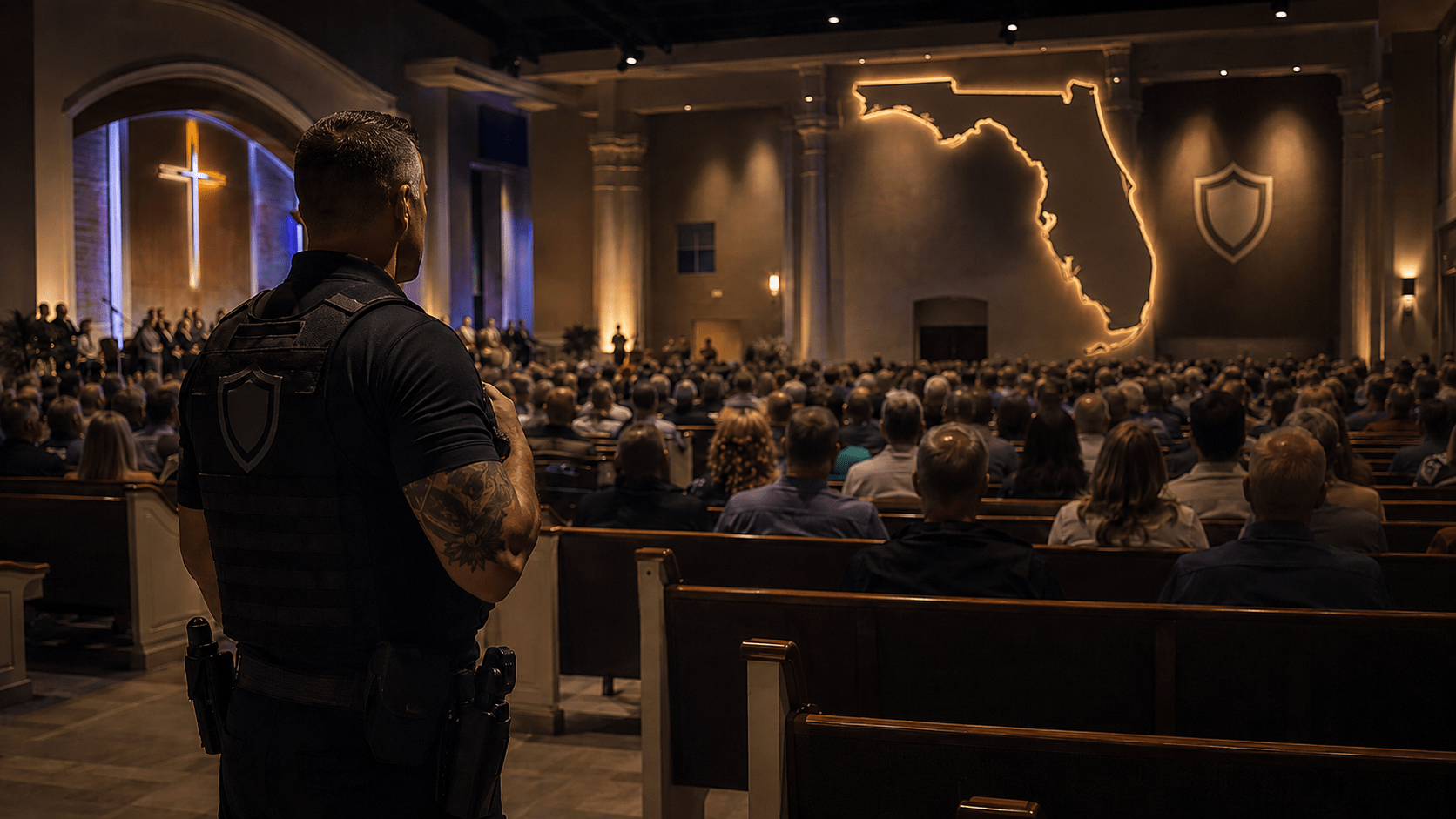
Florida has now cleared the way for unpaid armed volunteers to provide security services at churches, mosques, synagogues, and other houses of worship without being subject to the same Chapter 493 private-security licensing framework that applies to professional security personnel. The final enacted text of Chapter 2026-46 is brutally simple: Chapter 493 “shall not apply” to any unpaid volunteer providing armed security services on the premises of a church, mosque, synagogue, or other place of worship. The law takes effect July 1, 2026. (Laws of Florida)
That sentence should make every pastor, board member, security director, armed volunteer, insurer, attorney, and congregation member stop and think.
Valortec is not against armed citizens. Valortec is not against lawful concealed carry. Valortec is not against houses of worship protecting their people. In a violent world, responsible armed citizens can save lives.
But there is a dangerous difference between being armed and being operationally prepared.
There is a dangerous difference between having a gun and knowing when, why, how, and where not to use it.
There is a dangerous difference between standing at the back of a church with a pistol under your shirt and managing lethal force inside a packed sanctuary filled with children, elderly parishioners, screaming families, fleeing bodies, low light, poor angles, panic, smoke, alarms, confusion, and responding law enforcement.
That difference is where public safety lives or dies.
The Law Changed. Physics Did Not. Liability Did Not. Human Performance Did Not.
The Florida Senate bill page describes CS/SB 52 as creating an exemption from licensure requirements for certain volunteers who provide armed security services for places of worship. The bill passed the Senate 39-0 and the House 111-1 before becoming Chapter 2026-46. (The Florida Senate)
The final enacted language is even broader than earlier versions. Earlier bill language included conditions such as a sheriff-approved armed security plan, Level 2 background screening, and a valid Florida concealed weapon or firearm license. The committee substitute removed those requirements and clarified that volunteers were not subject to the same licensing requirements as paid security services. (The Florida Senate)
That is the part that deserves hard public discussion.
Because the danger is not that a good citizen wants to protect a congregation. The danger is that the law can be misunderstood as a permission slip for untrained confidence.
A law can remove a licensing barrier. It cannot remove recoil. It cannot remove tunnel vision. It cannot remove bystanders. It cannot remove missed rounds. It cannot remove civil litigation. It cannot remove criminal scrutiny. It cannot remove the moral weight of a bullet that leaves the muzzle and does not hit the intended threat.
A Church Is Not a Flat Range
A sanctuary is one of the worst possible environments for a defensive shooting.
It is crowded. It is emotionally charged. It is filled with innocent people sitting shoulder to shoulder. Movement lanes are narrow. Visibility can be poor. Lighting can be inconsistent. Sound is amplified. Children may be present. Elderly people may not move quickly. People may freeze, fall, run, scream, or unintentionally block the armed volunteer’s view of the threat.
Now add gunfire.
Now add adrenaline.
Now add auditory exclusion.
Now add tunnel vision.
Now add the possibility of multiple armed “good guys” who do not recognize each other.
Now add responding law enforcement entering the building with seconds to decide who is the killer and who is the volunteer.
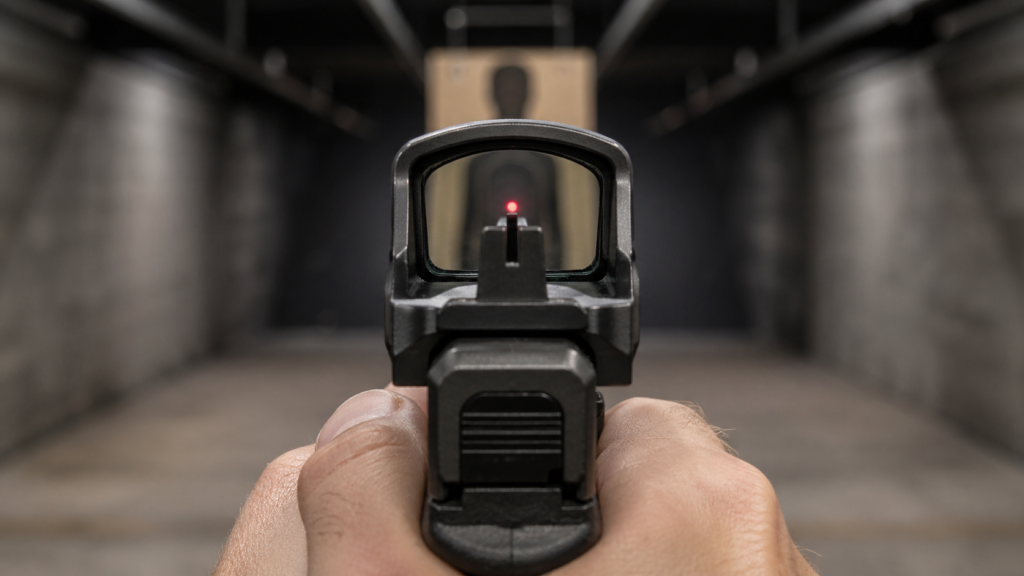
This is not a movie. This is not a YouTube drill. This is not a five-round qualification. This is not standing still at a well-lit range shooting paper at a known distance with no consequence for a miss.
CNA’s 2026 brief on house-of-worship targeted homicides states that these incidents are statistically rare compared to homicide overall, but when they occur, they are often highly lethal, symbolically charged, and disruptive far beyond the immediate event. The same brief notes that houses of worship are intentionally open and community-facing, which complicates both prevention and response. (CNA)
That is the operational problem. Houses of worship are built to welcome people. Active violence exploits that openness.
Even Licensed Armed Security Training Is Minimal
Florida’s own framework for professional armed security shows how serious armed public-facing work is supposed to be. A Class “D” security officer license requires a minimum of 40 hours of professional training. To carry a firearm while performing regulated security duties, a Class “D” licensee must also obtain a Class “G” statewide firearm license. Initial Class “G” applicants must complete at least 28 hours of firearms training, including in-person range training, and Class “G” licensees must complete annual firearms requalification. (The Florida Senate)
That means a professional armed security officer in Florida normally passes through at least 68 hours of baseline licensing-related training before carrying a firearm in a regulated security role.
And here is the uncomfortable truth: even that is minimal.
Florida’s security-officer firearms training structure is not advanced active-shooter interdiction training. It is not a full judgmental shooting program. It is not a house-of-worship force-on-force curriculum. It is not stress inoculation. It is not moving-target work in a crowded sanctuary. It is not team movement, communication, emergency medical integration, low-light decision-making, post-shooting legal articulation, and law enforcement link-up under chaos.
So if the minimum professional armed security pathway is already limited, what exactly are we doing when we tell an unpaid volunteer, “You have a concealed carry class and a good heart—stand in the back and protect 300 people”?
Good intentions do not stop bad rounds.
Police Miss Under Stress. Civilians Are Not Magically Better.
Law enforcement officers train more than the average civilian. They work around force decisions more than the average civilian. They are trained in use-of-force policy, criminal law, report writing, suspect behavior, communication, and command presence. Yet real-world shooting performance remains difficult, inconsistent, and often far below what the public imagines.
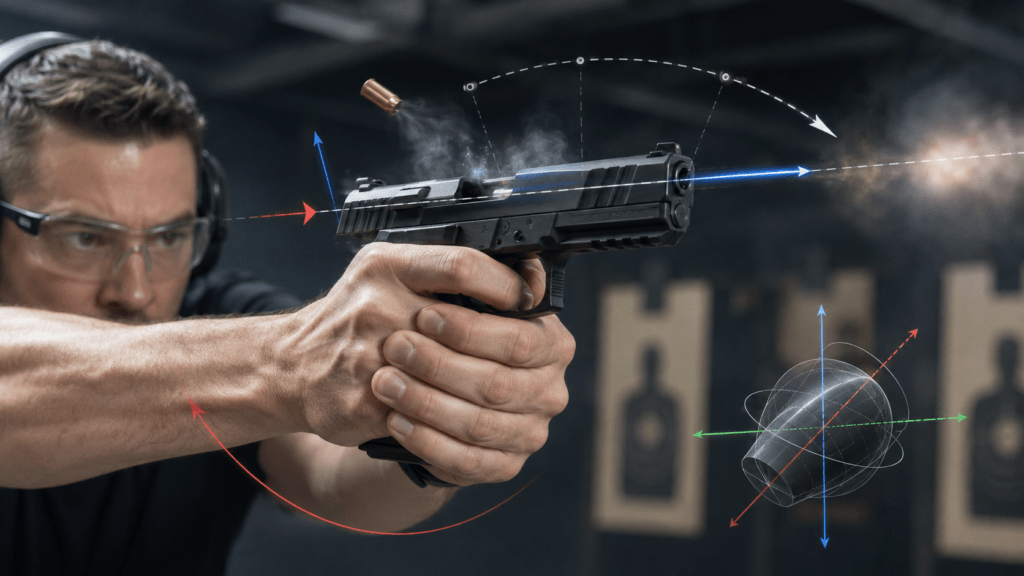
The classic Vila and Morrison study on police combat handgun accuracy warned that police officers often shoot with far less accuracy than citizens, policymakers, and public officials believe. It also emphasized that nervous-system and biomechanical limits place real constraints on handgun performance in complex, fast-changing confrontations. (WSU S3 Storage)
The same study concluded that low combat shooting accuracy increases risks for bystanders, officers, and suspects, and that neurophysiological and biomechanical demands can substantially limit performance in real-world shootings. (WSU S3 Storage)
A National Police Foundation/Major Cities Chiefs Association summary of officer-involved shooting data found that 50% of officer-involved shootings in the dataset occurred within 15 feet of the subject, and 61% occurred within 20 feet. It also reported that 43% of officers injured in the dataset were within 10 feet of the subject, with 26% less than 4 feet away.
That matters because many armed citizens imagine defensive gun use as a clean shot from a stable position. Real incidents are often close, fast, compressed, ambiguous, and violent.
A study of Dallas Police Department officer-involved shootings from 2003 to 2017 found that officers struck the suspect with at least one round in 54% of the 149 shootings studied—roughly a 50/50 split between hit and miss at the incident level. (Police1)
A 2022 narrative review on police marksmanship found that anxiety induced through high-stress scenarios negatively impacts shooting performance, while training under stress may help counteract that effect for a limited period. (Bond University Research Portal)
Read that again.
Stress changes performance.
The body changes. Vision changes. Grip changes. Breathing changes. Decision-making changes. Time perception changes. Fine motor control degrades. The brain prioritizes survival over technical perfection.
If trained officers struggle in real gunfights, why would we pretend that a church volunteer with a basic concealed carry background is automatically prepared to place accurate rounds in a crowded sanctuary under extreme stress?
That is not pro-gun thinking. That is fantasy.
Concealed Carry Is Not Armed Security
A concealed weapons license or permitless carry eligibility does not make a person an armed security professional.
A concealed carry class does not make a person a force-on-force operator.
A basic pistol certificate does not make a person a sanctuary-defense specialist.
Learning three songs on a piano does not make someone a musician. Getting a driver’s license does not make someone a race car driver. Buying a quality firearm does not make someone competent under lethal stress.
This is where the Dunning-Kruger effect becomes dangerous. The original Kruger and Dunning research described how people with limited skill can overestimate their competence because they lack the ability to recognize the depth of what they do not know. (PubMed)
In firearms training, that overconfidence can become lethal.
The student who has never worked through a force-on-force scenario may not understand how fast visual processing collapses under threat.
The volunteer who has only shot paper may not understand how moving bodies destroy clean sight pictures.
The armed citizen who has never done judgmental training may not understand that the most important decision may be not to shoot.
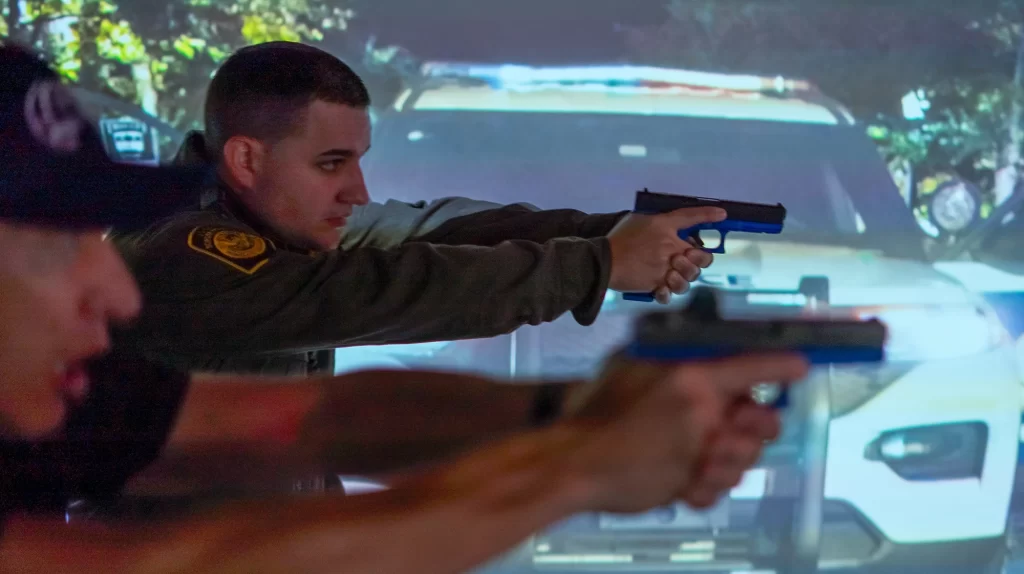
The person who has never trained with role players, low light, screaming, movement, occlusion, and no-shoot targets may genuinely believe they are prepared because they do not yet know what real preparation looks like.
That is not courage. That is untested confidence.
The Legal Standard Does Not Disappear Inside a Church
Florida law justifies deadly force only when a person reasonably believes such force is necessary to prevent imminent death, great bodily harm, or the imminent commission of a forcible felony. The “reasonable belief” standard matters. The word “imminent” matters. The necessity requirement matters. (Online Sunshine)
Florida law also provides immunity from criminal prosecution and civil action only when the use or threatened use of force is justified under the applicable statutes. Immunity is not automatic because someone says, “I was protecting the church.” (Online Sunshine)
The volunteer still has to explain:
Why did you believe deadly force was necessary?
What did you see?
What did you know?
What did you perceive?
What was behind the threat?
Where did every round go?
Were there other people in the line of fire?
Could you identify the threat clearly?
Did the suspect still present an imminent threat when you fired?
Did you hit an innocent person?
Did you fire at sound, movement, panic, or assumption?
That is not a theoretical classroom discussion. That is the language of criminal investigation, civil litigation, deposition, insurance review, media scrutiny, and moral consequence.
The Church Can Become the Defendant
The Firearm Firm warned years ago that organized armed church security teams could create civil implications for the religious institution itself. The article noted that if concealed-weapon license holders are organized and operating with church knowledge, permission, or at the church’s request, the church may open itself to potential civil liability if an innocent person is shot or if excessive force is used. (The Firearm Firm)
That warning did not become less important because the statute changed.
The statute may remove a Chapter 493 licensing barrier for unpaid volunteers. It does not erase negligence claims. It does not erase negligent selection. It does not erase negligent training. It does not erase negligent supervision. It does not erase negligent retention. It does not erase the board minutes, emails, group texts, training records, waiver forms, incident reports, and security-team policies that will be demanded in discovery after a tragedy.
A plaintiff’s attorney will not care that the volunteer was “a good guy.”
The questions will be direct:
Who selected this person?
What qualifications were required?
What training was documented?
Who approved the security plan?
Who supervised the team?
Was there a written use-of-force policy?
Was there a medical plan?
Were volunteers trained to identify each other?
Were volunteers trained to interact with responding law enforcement?
Were there scenario-based drills?
Were there no-shoot decision exercises?
Was there annual qualification?
Were misses, unsafe gun handling, or poor judgment ever documented?
If the answer is “we trusted him because he carries every Sunday,” the church has a problem.
The Real Threat Is Not the Armed Volunteer. The Real Threat Is the Untrained Armed Volunteer.
An armed volunteer can be an asset when properly selected, trained, supervised, and integrated into a serious safety program.
An untrained armed volunteer can become another hazard inside the crisis.
The difference is standards.
A serious house-of-worship security program should include, at minimum:
Formal selection criteria, including background review, temperament evaluation, and documented approval.
Written policies covering role, authority, use of force, de-escalation, medical response, communication, reporting, and coordination with law enforcement.
Legal instruction specific to Florida use-of-force law, civil liability, criminal exposure, and post-incident articulation.
Live-fire qualification that goes beyond static paper shooting.
Scenario-based decision training with no-shoot targets, movement, verbal commands, family-density problems, and ambiguous threat recognition.
Force-on-force training using non-lethal training tools under controlled professional supervision.
Low-light and crowded-environment decision-making.
Medical training, including bleeding control and emergency response coordination.
Radio or communication protocol.
Clear identification protocol for responding law enforcement.
Annual requalification and recurrent scenario training.
Documentation of every training event, qualification, policy update, and safety failure.
A firearm alone is not a security plan.
A church security T-shirt is not a security plan.
A four-hour PowerPoint certificate is not a security plan.
A concealed carry class is not a security plan.
A “we have a few guys who carry” approach is not a security plan.
It is a liability plan waiting for a courtroom.
National Organizations and Certificate Culture Are Not Enough
This is where the firearms training industry needs to be honest.
Not every certificate equals competence.
Not every nationally branded course equals operational readiness.
Not every instructor understands law, stress, movement, biomechanics, low-light decision-making, team communication, and real-world public-safety liability.
Some courses are excellent introductions. But an introductory class must not be marketed, perceived, or treated as preparation for armed intervention inside a crowded house of worship.
A classroom-heavy course may educate. It does not validate performance under chaos.
A membership program may provide resources. It does not prove the armed volunteer can identify a threat through a panicked crowd.
A static qualification may measure marksmanship basics. It does not prove judgment.
Paper targets do not scream.
Paper targets do not move behind children.
Paper targets do not run toward exits.
Paper targets do not hold cell phones.
Paper targets do not look like another armed volunteer.
Paper targets do not create legal ambiguity.
Reality does.
The Public Safety Standard Must Be Higher Than “He Means Well”
Houses of worship have legitimate safety concerns. The threat is real. The FBI reported 24 active shooter incidents in 2024 across five location categories, including houses of worship, and defines an active shooter as one or more individuals actively engaged in killing or attempting to kill people in a populated area. (Federal Bureau of Investigation)
CNA’s 2026 house-of-worship homicide brief identified 399 homicide incidents occurring at or near houses of worship from 2000 to 2025, with 512 killed and 213 injured across all incidents. It also found that active shooter incidents made up a small share of incidents but accounted for a disproportionate share of deaths and injuries.
The same CNA brief noted that active shooter incidents at houses of worship are more likely to occur inside the building during services, when density is highest, and that these interior attacks account for a disproportionate share of fatalities and injuries. (CNA)
That means prevention matters. Greeters matter. Behavioral indicators matter. Access control matters. Lighting matters. Parking-lot awareness matters. Reporting pathways matter. Medical readiness matters. Communication matters.
The firearm may be the last tool. It should never be the only tool.
This Is a Public Safety Message
Valortec’s position is simple:
We support lawful armed citizens.
We support the right of houses of worship to protect their people.
We support responsible volunteers who are willing to train, qualify, document, and accept the legal and moral weight of the role.
But we reject the fantasy that a gun plus good intentions equals readiness.
We reject the dangerous belief that concealed carry equals armed security.
We reject the illusion that a calm day on a flat range prepares someone for a chaotic active-shooter event inside a packed sanctuary.
We reject certificate culture when it gives citizens confidence without competence.
Florida’s law may allow armed volunteers in houses of worship. That does not mean every armed volunteer is ready. It does not mean every church has a defensible program. It does not mean every pastor understands the liability. It does not mean every board has asked the hard questions.
The law opened the door.
Now the adults in the room must decide whether they are building a real safety program—or gambling with the lives of the people they promised to protect.
Because when the first shot is fired inside a crowded sanctuary, nobody will care who had the strongest opinion.
They will care who was trained.
They will care who made the right decision.
They will care where every round went.
And if the wrong person is hit, the words “volunteer security team” will not be a shield.
They will be Exhibit A.
References and Source Base
Florida Chapter 2026-46, Committee Substitute for Senate Bill No. 52, official enacted language and effective date. (Laws of Florida)
Florida Senate CS/SB 52 bill history, vote history, effective date, and chapter number. (The Florida Senate)
Florida House Final Bill Analysis for HB 95 / CS/SB 52, including Class D and Class G licensing requirements and the effect of the new exemption. (The Florida Senate)
Florida Department of Agriculture and Consumer Services / Security Officer Handbook summaries regarding Class G firearms training, classroom/range structure, and annual requirements. (licensing.fdacs.gov)
Florida Statute 776.012, use or threatened use of force in defense of person. (Online Sunshine)
Florida Statute 776.032, immunity from criminal prosecution and civil action for justified use or threatened use of force. (Online Sunshine)
The Firearm Firm, “Volunteer Armed Church Security,” discussing legal and civil liability concerns for organized volunteer armed church security teams. (The Firearm Firm)
FBI 2024 Active Shooter Incidents report release and definition of active shooter. (Federal Bureau of Investigation)
FBI Active Shooter Incidents 20-Year Review, 2000–2019. (Federal Bureau of Investigation)
CNA / Violence Prevention Project, “Trends and Recommendations: House of Worship Targeted Homicides,” 2026. (CNA)
CISA, “Mitigating Attacks on Houses of Worship Security Guide” and houses-of-worship security resources. (CISA)
Vila & Morrison, “Biological Limits to Police Combat Handgun Shooting Accuracy,” American Journal of Police. (WSU S3 Storage)
National Police Foundation / Major Cities Chiefs Association, “Officer Involved Shootings: Incident Executive Summary.”
Donner & Popovich, “Hitting or Missing the Mark,” summarized in Police1 / Force Science coverage of Dallas Police Department shooting accuracy research. (Police1)
Simas et al., “Factors Influencing Marksmanship in Police Officers,” narrative review. (PubMed)
Kruger & Dunning, “Unskilled and unaware of it,” Journal of Personality and Social Psychology. (PubMed)