Firearms Training Standards: Is Barely Passing Enough?
A passing score may earn someone a certificate. It does not automatically earn them the right to be trusted with your life.
And when firearms, protection, and human lives are involved, “barely good enough” is not good enough at all.
Let me ask you a question most training organizations would rather avoid:
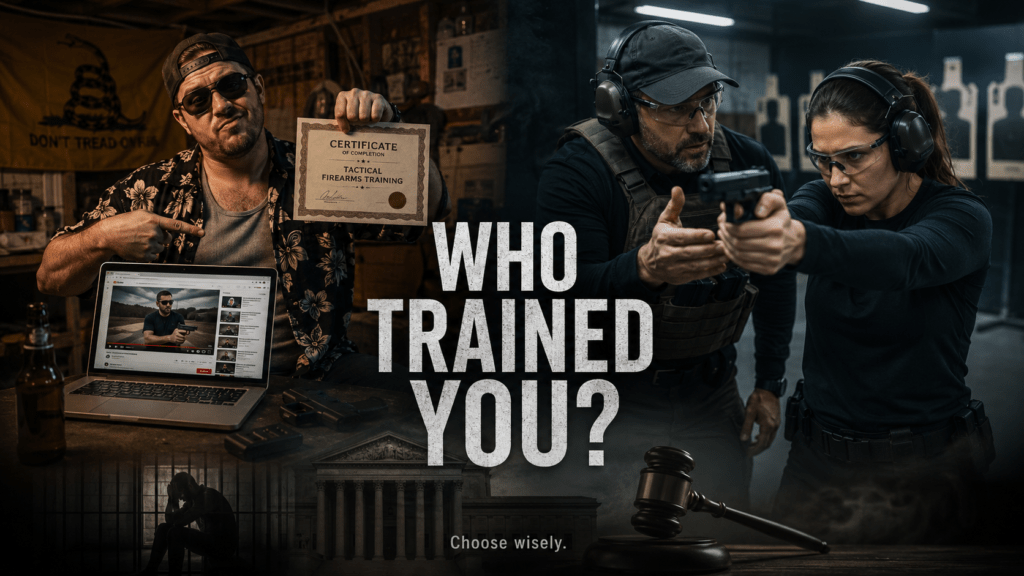
Would you hire a firearms instructor who barely passed the easiest instructor certification available?
Would you trust your spouse, your children, your employees, or your organization to an armed officer or security guard who barely survived the minimum qualification?
Or would you rather train with an instructor who can perform at the highest level, demonstrate every technique on demand, explain the science behind it, identify your errors, and document measurable improvement?
The politically correct answer is that every properly credentialed professional deserves respect.
The honest answer is that credentials are not equal, instructors are not equal, and neither are the armed professionals standing between your family and a violent threat.
That truth may hurt feelings.
Bullets do considerably worse.
A Firearms Certificate Is Not Proof of Mastery
Here is the first uncomfortable fact:
Some instructor certifications prove that a person attended a class and met a minimum requirement. That is all.
They do not necessarily prove that the instructor can shoot at an advanced level.
They do not prove that the instructor understands biomechanics, visual processing, trigger control, recoil management, motor learning, stress physiology, instructional design, or performance diagnostics.
They certainly do not prove that the instructor can take a struggling shooter, identify the actual cause of failure, correct it, and produce repeatable results.
An instructor should not merely repeat information.
An instructor should be able to diagnose performance.
There is a significant difference between someone who can recite the fundamentals and someone who understands why those fundamentals work.
There is also a difference between being able to shoot a qualification once and being able to demonstrate technical proficiency repeatedly, on demand, without excuses.
A certificate may establish that an administrative requirement was completed.
It does not establish excellence.
The Instructor Who Barely Passed Is Now Teaching You to Pass
Read that sentence again.
The instructor who barely passed may now be standing in front of a firing line, presenting himself as an authority and teaching other people how to survive.
That should concern you.
How can an instructor identify subtle deficiencies in grip pressure, skeletal alignment, visual focus, trigger isolation, target processing, or recoil control when the instructor has never mastered those elements personally?
How can that instructor develop a high-performing student when the instructor’s entire professional standard is built around doing just enough to avoid failure?
He cannot teach what he does not understand.
He cannot reliably demonstrate what he cannot perform.
And he cannot demand excellence from students when he has spent his own career negotiating with the minimum.
The firearms industry has tolerated this problem for years because low standards are profitable.
Easy certifications attract more customers.
Easy qualifications create fewer complaints.
Easy standards keep the certificate printer running.
But an easy certificate may become very expensive when the person holding it makes a poor decision, misses the target, mishandles a weapon, teaches an unsafe technique, or provides training that collapses under scrutiny.
Passing Is the Floor—Not the Ceiling
Florida’s official standards demonstrate exactly why the word minimum matters.
The Florida Department of Law Enforcement’s qualification standard requires a law enforcement officer to place at least 33 of 38 rounds within the prescribed scoring area. An officer who fails the standard may not perform sworn duties until remedial training is completed and the officer successfully requalifies. (Florida Administrative Rules)
That requirement establishes a threshold for continued service.
It does not declare that everyone who passes performs at the same level.
An officer who scores 33 is not producing the same result as an officer who scores 38.
Both may receive the word PASS, but the paper does not erase the performance difference.
That distinction matters.
The public frequently assumes that a passing qualification means the officer, guard, or instructor is highly proficient. In reality, a qualification establishes that the individual met the requirements of that specific test, under those specific conditions, on that particular day.
It does not automatically measure decision-making.
It does not fully measure performance under surprise, low light, movement, physical exhaustion, divided attention, environmental complexity, or the physiological effects of a lethal encounter.
Most importantly, it does not guarantee that the person can reproduce the same performance when a human life depends on it.
Passing means the individual crossed the line. Excellence means the line was never the objective.
Would You Hire the Lowest Score to Protect the Highest Value?
Your family is not a minimum-standard responsibility.
Your church is not a minimum-standard responsibility.
Your school, business, executive team, critical infrastructure, and law-enforcement unit are not minimum-standard responsibilities.
So why would anyone knowingly select the lowest-performing person who technically qualifies for the assignment?
Organizations routinely claim that safety is their highest priority. Then they shop for firearms instruction or protective services based primarily on price, convenience, and how quickly the certificates can be issued.
That is not a safety strategy.
That is administrative theater.
When selecting an instructor or armed professional, ask harder questions:
Can the instructor demonstrate the techniques being taught?
What qualification did the instructor complete?
What was the instructor’s score?
Was the qualification fired cold, or was the instructor allowed repeated practice attempts before recording the result?
Does the instructor understand the legal boundaries surrounding defensive force?
Can the instructor explain why a technique works, or does the explanation begin with, “This is how I was taught”?
Can the instructor identify and correct shooting deficiencies?
Does the instructor maintain records, performance metrics, and defensible training documentation?
A polished biography is not a performance test.
A social-media following is not a performance test.
A certificate is not a performance test.
Put the instructor on the line.
The target normally tells the truth long before the résumé does.
Armed Security Carries More Than a Firearm
Florida requires an applicant for a Class “G” statewide firearm license to complete 28 hours of classroom and range instruction. That curriculum includes legal aspects of firearm use, civil and criminal liability, operational safety, mechanical training, and firearms qualification. Class “G” licensees must also complete annual firearms requalification training. (Florida Agriculture Dept.)
Those requirements exist because carrying a firearm professionally is a serious legal responsibility.
But once again, completing the requirement does not mean every license holder has the same level of competence.
One person may barely qualify.
Another may shoot a perfect score.
Another may shoot a perfect score while also demonstrating sound judgment, emotional control, tactical awareness, communication skills, and the ability to make lawful decisions under pressure.
Those are not interchangeable professionals.
Florida law also requires a Class “G” licensee and the employing agency to submit an explanation to the state within five working days when the licensee discharges a firearm in the course of duty. Failure to comply can expose both the licensee and agency to suspension or revocation proceedings. (Online Sunshine)
That should clarify something many people refuse to understand:
The consequences do not end when the shooting stops.
After the incident come the reports.
Then the investigation.
Then the statements.
Then the evidence review.
Then potentially the administrative hearing, civil lawsuit, criminal inquiry, deposition, or courtroom.
At that point, “He had a license” is not the end of the conversation.
Questions may be asked about training, supervision, policies, qualifications, prior performance, decision-making, instructor competence, and whether the organization acted reasonably when selecting and preparing the person it armed.
The badge, license, or certificate does not make those questions disappear.
Sometimes it is what causes the questions to begin.
Perfect Scores and Real Experience Matter—but They Are Not Enough Alone
Now let us address another uncomfortable subject.
Would you rather have an officer or guard who barely passed a qualification—or one who consistently shoots perfect scores and has survived actual violent encounters?
The answer appears obvious.
But experience must be evaluated intelligently.
Simply being present during violence does not automatically make someone a great protector or instructor. People can survive incidents while making serious mistakes. Experience becomes valuable when it is examined, understood, and converted into better judgment.
Real operational experience can teach lessons no square range can fully reproduce:
How quickly normal conditions become chaotic.
How poorly human beings process unexpected violence.
How difficult identification becomes under stress.
How rapidly distance, movement, lighting, bystanders, and communication complicate a decision.
How one careless round can create criminal, civil, moral, and professional consequences.
But experience without disciplined analysis can become nothing more than a dramatic story.
That is why the strongest professional is not simply the person who has “been there.”
It is the person who combines real experience with measurable technical skill, lawful judgment, emotional control, instructional ability, and the humility to continue learning.
Experience without competence is history. Competence without judgment is liability.
You need both.
The Courtroom Does Not Care About Range Excuses
There is a popular fantasy in the firearms community that technical skill and legal judgment are separate subjects.
They are not.
A missed round has a legal destination.
A poorly taught technique may have a legal consequence.
A negligent decision to arm an inadequately prepared employee may become evidence.
A training record may become an exhibit.
An instructor’s lesson plan may be examined.
An agency’s qualification standards may be compared with its actual practices.
Florida law expressly addresses negligent hiring in certain civil actions and identifies steps employers may take when evaluating whether a prospective employee is suitable for the work to be performed. (Online Sunshine)
A background investigation is important.
But a clean background does not establish firearms competence.
The absence of a criminal record does not prove judgment.
A license does not prove excellence.
And a passing score does not eliminate every foreseeable concern surrounding assignment, supervision, training, or continued performance.
The question after a serious incident may not be limited to whether the person possessed the required credential.
The harder question may be:
What did the employer, agency, instructor, or organization know—or what should it reasonably have known—about that person’s actual ability?
That is the question weak programs never want asked.
At Valortec, the Standard Is Not Designed to Protect Feelings
Valortec training is not built around making every participant feel accomplished.
It is built around producing measurable performance.
We use objective evaluations, shooter analytics, technical diagnostics, demanding courses of fire, and repeatable standards. We evaluate the shooter rather than worshiping the certificate.
Our instructor-development process is intentionally difficult because firearms instruction is a high-liability responsibility. Florida itself classifies firearms instruction for criminal-justice officers as a high-liability topic, requiring specific instructor qualifications, training, experience, internship, and evaluation. (Florida Department of Law Enforcement)
We do not believe the instructor should merely pass.
The instructor should perform at a level that leaves no doubt.
That means demonstrating technical proficiency on demand.
That means understanding the science of marksmanship instead of repeating range folklore.
That means explaining complex concepts in language the student can understand.
That means identifying performance problems accurately.
That means documenting results.
That means correcting failure without lowering the standard.
And yes, that means instructors should be capable of producing perfect scores on demanding qualifications.
Not after five warm-up attempts.
Not after moving the target closer.
Not after enlarging the scoring area.
Not after negotiating with the timer.
Cold. Accountable. Documented.
The standard should reveal weakness—not hide it.
Easy Training Is Expensive When It Fails
Cheap instruction becomes expensive when the student develops poor habits.
Convenient instruction becomes inconvenient when the technique fails.
A fast certificate becomes painfully slow when attorneys begin reviewing the training records.
The public has been conditioned to compare firearms classes by price and duration.
That is the wrong comparison.
Compare the instructors.
Compare the standards.
Compare the qualifications.
Compare the documented performance.
Compare the instructor’s ability to explain the legal, technical, and human consequences of carrying a firearm.
Then ask yourself one final question:
When the person you love is standing behind the professional you hired, do you still want the one who barely passed?
At Valortec, we do not train people to barely survive a qualification.
We train them to understand performance, demonstrate competence, make lawful decisions, and accept responsibility for every round they fire.
Because when life, liberty, careers, and families are at stake, the minimum is not a goal.
It is a warning.
This article is educational commentary and does not constitute legal advice.