A Parking Spot Is Not Worth a Body Bag: The Florida Walmart Shooting and the Deadly Reality of Bad Use-of-Force Decisions
A parking space should never become a body bag.
And if your firearm comes out because your ego stayed in the fight, your training failed before the trigger was ever pressed.
The fatal shooting outside a Walmart in North Lauderdale, Florida, is now another brutal reminder that carrying a gun does not make a person prepared. It only makes the consequences permanent.
According to multiple news reports, 62-year-old Bart Diguglielmo was shot after a dispute over a parking space outside the Walmart at 7900 W. McNab Road on June 30, 2026. Broward Sheriff’s Office investigators reported that the woman involved remained at the scene, cooperated with detectives, and claimed self-defense. The case is expected to be reviewed by the Broward County State Attorney’s Office to determine whether criminal charges will be filed.
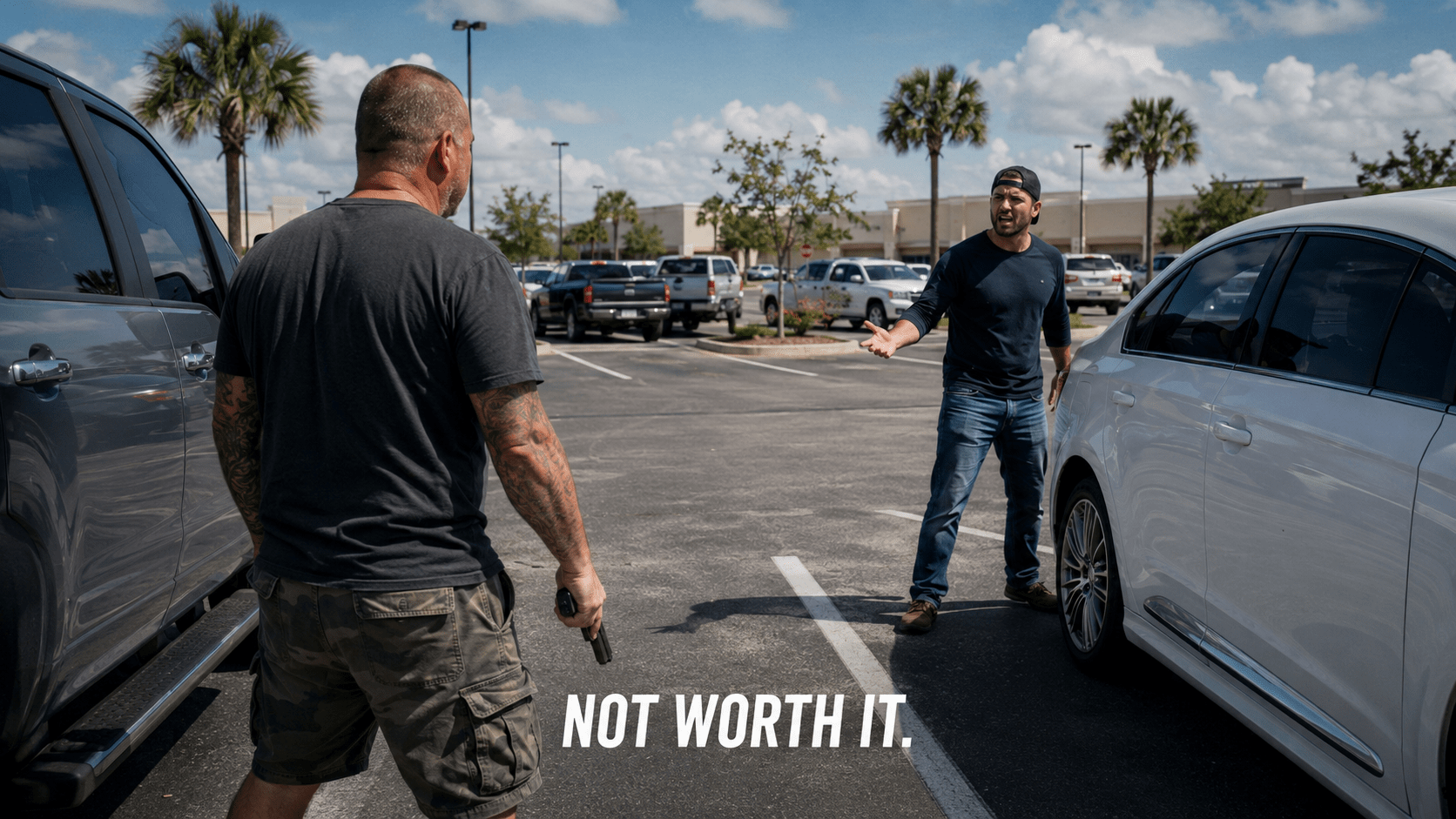
Video described by WSVN shows the woman outside her vehicle with a phone in one hand and a gun in the other. The report states that she pointed the firearm, told Diguglielmo to walk away, and that he appeared to follow her around another vehicle before walking away, returning, and then being shot.
That is not a legal conclusion. That is not a verdict. That is not a trial by internet.
But it is absolutely a teaching moment.
Florida Law Does Not Reward Panic, Pride, or Poor Judgment
Florida law is very clear on the difference between force and deadly force.
Under Florida Statute 776.012, a person may use or threaten non-deadly force when they reasonably believe it is necessary to defend against another person’s imminent unlawful force. But deadly force is treated differently. Deadly force is justified only when the person reasonably believes it is necessary to prevent imminent death, great bodily harm, or the imminent commission of a forcible felony.
That word matters: imminent.
Not uncomfortable.
Not angry.
Not offended.
Not “he would not leave me alone.”
Not “the argument got heated.”
Not “I felt disrespected in a parking lot.”
Imminent means now. Immediate. Unavoidable in the moment. The law does not ask whether you were annoyed, embarrassed, or afraid in a vague emotional sense. It asks whether the use of deadly force was reasonably necessary under the circumstances.
That is the part too many armed citizens never truly study.
“Stand Your Ground” Does Not Mean “Stand in the Argument”
Florida’s no-duty-to-retreat language is constantly misunderstood, misquoted, and abused in public conversation. Florida law says a person who uses or threatens deadly force under the conditions of 776.012 has no duty to retreat and has the right to stand their ground if they are not engaged in criminal activity and are in a place where they have a right to be.
That is not a license to escalate.
That is not permission to turn a parking dispute into an armed confrontation.
That is not legal magic dust sprinkled over a bad decision.
The phrase “stand your ground” does not mean “stand there and keep arguing with a gun in your hand.” It does not mean “win the confrontation.” It does not mean “teach someone a lesson.” It means that, under lawful circumstances, a person does not have a legal duty to retreat before using justified defensive force.
Big difference.
At Valortec, we teach that the gun is not the first answer to a human problem. It is the last-resort answer to an immediate deadly-force problem.
If the problem is pride, the solution is disengagement.
If the problem is a parking space, the solution is leaving.
If the problem is a person closing distance, the solution must still be filtered through law, distance, opportunity, ability, jeopardy, and whether deadly force is truly necessary.
The Aggressor Problem: Who Created the Fire?
Florida Statute 776.041 limits the use-of-force justification for a person who initially provokes the use or threatened use of force, unless very specific exceptions apply. Those exceptions include situations where the force faced becomes so great that the person reasonably believes they are in imminent danger of death or great bodily harm and has exhausted reasonable means of escape, or where the person withdraws in good faith and clearly communicates the desire to stop the conflict, but the other person continues or resumes the threat.
That is where many public confrontations become legally ugly.
The courtroom will not only ask, “Were you afraid?”
It will ask:
Did you escalate?
Did you introduce the firearm too early?
Did you have a chance to disengage?
Did you keep arguing?
Did you create the appearance of a threat?
Did you use the gun as a command tool instead of a defensive tool?
Did your conduct turn a verbal conflict into a deadly-force event?
This is why real training cannot be limited to shooting paper at seven yards. Accuracy matters, but judgment matters before accuracy ever gets invited to the party.
A Gun Is Not a Conversation Piece
Florida also has a specific statute addressing improper exhibition of a firearm. Florida Statute 790.10 states that displaying a firearm in a rude, careless, angry, or threatening manner, when not in necessary self-defense, is a first-degree misdemeanor.
That matters because the moment a firearm appears in a confrontation, the legal temperature explodes.
Your draw can become evidence.
Your muzzle direction can become evidence.
Your words can become evidence.
Your movement can become evidence.
Your failure to leave can become evidence.
Your social media bravado can become evidence.
The gun does not calm down a parking-lot argument. It militarizes it.
Once the firearm is out, you are no longer having a dispute. You are creating a deadly-force record that investigators, prosecutors, attorneys, witnesses, and possibly a jury will dissect frame by frame.
And the camera does not care about your feelings.
Defense of Property Is Not Defense of Ego
This incident reportedly started over a parking space. That point cannot be ignored.
Florida law does recognize the use or threatened use of force in defense of property under 776.031, but deadly force is justified only when the person reasonably believes it is necessary to prevent the imminent commission of a forcible felony.
A parking space is not your life.
A parking space is not great bodily harm.
A parking space is not worth a homicide investigation.
Florida Statute 776.08 defines “forcible felony” to include serious violent crimes such as murder, manslaughter, sexual battery, robbery, burglary, carjacking, aggravated assault, aggravated battery, kidnapping, and other felonies involving the use or threat of physical force or violence.
That is the legal universe deadly force lives in.
Not “he blocked my space.”
Not “she cut me off.”
Not “I got there first.”
Not “people need to learn respect.”
That mentality is not defensive. It is reckless.
The Valortec Perspective: Marksmanship Without Judgment Is Just Liability With Better Grouping
The firearms industry has a bad habit of worshiping shooting skill while ignoring decision-making.
Fast draw.
Tight groups.
Cool gear.
Loud opinions.
Zero legal maturity.
That is how people end up believing they are trained because they can hit a target, while having no idea when they are legally allowed to press the trigger.
At Valortec, we view defensive firearms training through a different lens: science, law, human behavior, and accountability.
A real defensive shooter must understand more than sights and triggers. They must understand distance, perception, stress, verbal commands, disengagement, proportionality, threat recognition, pre-assault indicators, human movement, and the legal meaning of imminent danger.
The question is not simply, “Can you shoot?”
The question is:
Can you recognize when you should not?
Because in the real world, restraint is often the highest form of firearms competence.
The Most Dangerous Armed Citizen Is the One Who Thinks the Gun Solves the Argument
This case should disturb every responsible gun owner in Florida.
Not because we know every final legal fact. We do not.
It should disturb us because we have all seen this pattern before: a normal day, a stupid disagreement, a public place, an armed citizen, a rapidly escalating confrontation, and then one irreversible second.
The gun owner who lacks judgment is not safer because they carry.
They are simply carrying consequences.
Responsible gun ownership is not about living in fear. It is not about acting tough. It is not about turning every rude person into a potential target.
It is about knowing the law, controlling the ego, managing distance, avoiding avoidable conflict, and understanding that every round fired has a legal, moral, financial, and human destination.
A parking spot is replaceable.
A life is not.
Final Word
Florida gives lawful citizens the right to defend themselves. That right matters. It should be protected, respected, and exercised with discipline.
But Florida law does not protect stupidity dressed up as self-defense. It does not protect ego with a holster. It does not protect people who confuse inconvenience with imminent death.
The responsible armed citizen must be better than that.
Train before the crisis. Learn the law before the argument. Build judgment before you carry the tool that can end a life in one second.
Valortec trains lawful gun owners, security professionals, and serious students to understand not only how to shoot, but when the gun should never become part of the conversation.
That difference may be what keeps you alive, free, and legally defensible.